





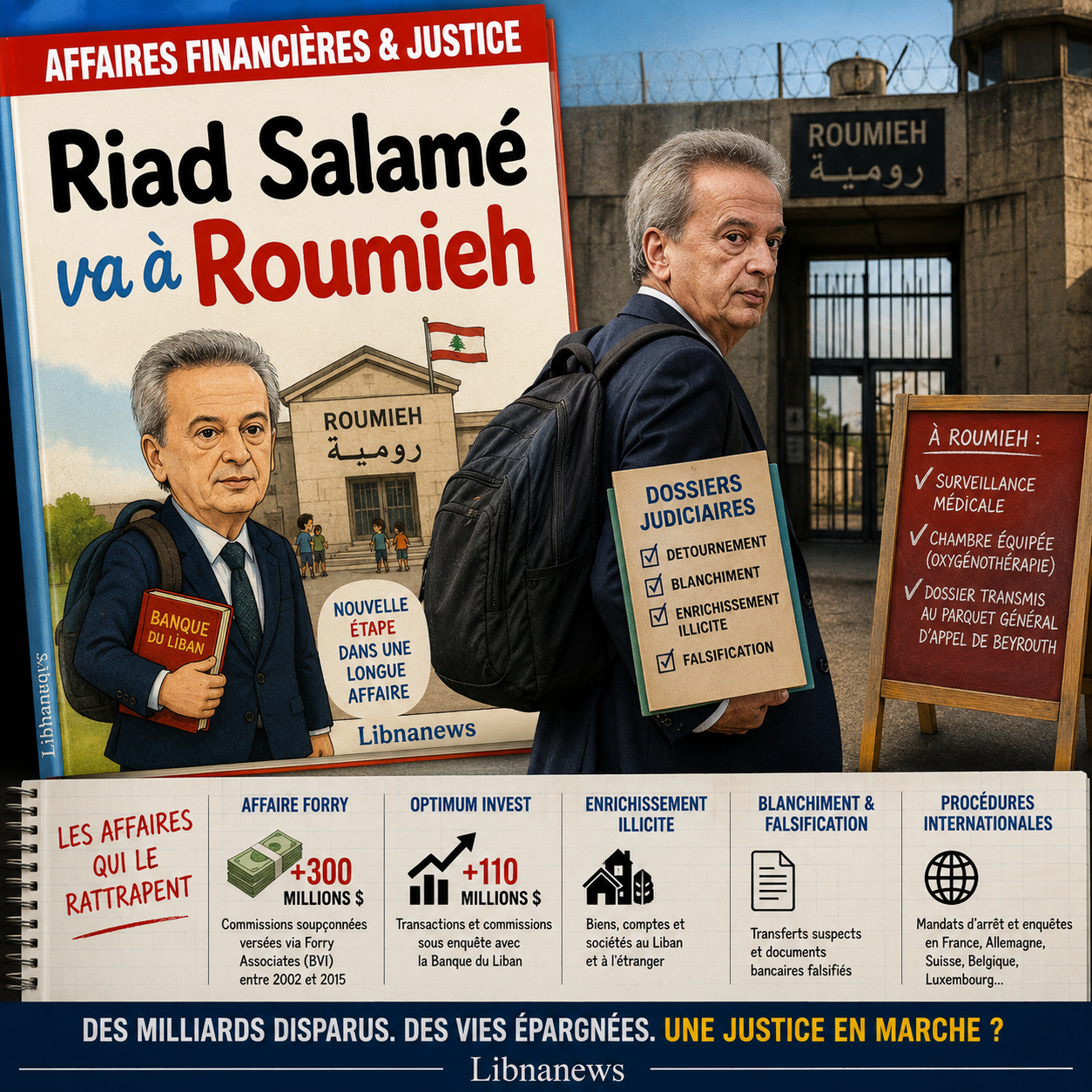
The former Governor of the Bank of Lebanon was placed under medical supervision after his transfer to Rumieh prison. According to MTV, he refuses to take his medication, while his file must be forwarded to the Beirut General Prosecutor’s Office. This new stage is involved in a series of proceedings involving suspicions of diversion, illicit enrichment, laundering and falsification in Lebanon and abroad.
The transfer of Riad Salamé to Rumieh prison opens a new sequence in the judicial path of the former governor of the Bank of Lebanon. According to reports from MTV, he has refused to take his medicine since his arrival in the prison. However, his condition would be stable. The authorities report only changes in blood pressure, without serious complications at this stage.
The Attorney General of the Court of Cassation, Judge Ahmad Rami Al-Hajj, authorized two doctors to examine him whenever necessary. One is under the responsibility of the Internal Security Forces. The other is the former governor’s private doctor. This permanent authorisation must prevent any interruption of medical follow-up and allow rapid intervention in the event of a change in his condition.
A room was also prepared for Riad Salamé in Roumieh. It includes equipment deemed necessary, including an oxygen therapy device. According to the information reported, the authorities have documented this development through audio and video recordings. They are thus seeking to establish that they have taken the necessary measures to ensure his health care during his detention.
At the same time, Judge Ahmad Rami Al-Hajj is to forward the case to the Beirut General Prosecutor’s Office. This step puts the prison situation of the former governor into a much larger judicial system. Riad Salamé is not only subject to medical attention. It remains at the centre of proceedings concerning suspicions of misappropriation, illicit enrichment, laundering and falsification, both in Lebanon and in several European countries.
Riad Salamé in Roumieh under medical supervision
The alleged refusal to take his medication is the main new element since his transfer. The reasons for this decision are not known. MTV does not specify the nature of the treatment, its dosage or the duration of the prescription. There is therefore no reason to see a protest, a distrust of the prison administration or a choice based on a particular medical opinion.
The authorities responded with a strengthened monitoring mechanism. The Internal Security Forces doctor provides institutional follow-up. The private doctor of Riad Salamé brings his knowledge of the medical records of the former governor. The permanent authorization issued by the Attorney General allows both practitioners to visit him without requesting a new decision for each visit.
The framework also aims to protect the prison administration. The detention of such a person carries a high legal and political risk. Any worsening of his condition could lead to accusations of negligence. The room’s audio and video documentation addresses this concern. It is a record of installed equipment and precautions taken before or after arrival.
The oxygen therapy apparatus has been planned as a precaution. The available information does not say that Riad Salamé used it. They only indicate that the room has this equipment. Its condition remains described as stable, despite voltage variations that require regular checks.
Respect for the inmate’s consent remains a sensitive issue. A prisoner may refuse treatment, except in exceptional circumstances provided for by law and assessed by doctors. The authorities must then find this refusal, explain the risks and continue to monitor the general state. No document signed by Riad Salamé has been made public. It is also not known whether his refusal relates to all of his medicines or only part of the treatment.
Thirty years at the heart of the monetary system
Riad Salamé led the Bank of Lebanon from August 1993 to July 2023. For a large part of this period, Lebanese governments, commercial banks and several international institutions presented it as the guarantor of monetary stability. The pound remained stowed to the dollar for more than two decades. The banking sector has attracted diaspora capital and financed an increasing share of public debt.
However, this model was based on the continuous inflow of currencies. The Bank of Lebanon offered banks high returns to attract dollars, while the government accumulated deficits. Starting in 2016, « financial engineering » reinforced this mechanics. They granted significant gains to several institutions in exchange for new foreign exchange inflows to the central bank.
The collapse started in 2019 destroyed the image of stability built around Riad Salamé. Banks have limited depositors’ access to their accounts. The book lost most of its value. The economy has contracted, wages have collapsed and a large part of savings has remained blocked. The issue of the responsibility of the Bank of Lebanon, Governments and commercial banks remains at the centre of public debate.
The proceedings against the former governor, however, do not relate directly to the entire financial collapse. These include specific transactions, commissions, transfers and real estate purchases. This distinction is essential. Political responsibility in the crisis and criminal responsibility in diversion cases meet different criteria.
The Forry file and over $300 million
One of the main components concerns Forry Associates, a company registered in the British Virgin Islands and linked to Raja Salamé, brother of the former governor. European investigators suspect that this structure received over $300 million in commissions between 2002 and 2015. These amounts were derived from transactions by commercial banks on financial instruments of the Bank of Lebanon.
The investigation seeks to determine whether these commissions corresponded to real services or were used to extract funds from the central bank. They also examine the circuits used to transfer money to foreign accounts, companies and real estate investments. Riad and Raja Salame challenged the charges. The former governor argued that the commissions did not come from public funds and that his heritage had a lawful origin.
In Lebanon, Riad Salamé and his brother were subject to several procedures related to illicit enrichment, laundering and alleged misappropriation. Raja Salamé was detained in 2022 before being released on bail. The judges also examined the movements of accounts associated with Marianne Hoayek, former assistant and director of the governor’s executive office at the Bank of Lebanon.
Marianne Hoayek is suspected of having participated in certain transfers or of having benefited from flows from the scheme under review. She challenged the charges against her. Its role is one of the points followed by European and Lebanese investigators, alongside that of several companies, financial intermediaries and close to Riad Salamé.
The procedures do not yet allow the amounts examined to be presented as definitively diverted. These are allegations under investigation and, depending on the courts, indictments, indictments or preparatory decisions. The guilt of the persons concerned can only be established by final judgements.
A new charge in Lebanon in 2026
In January 2026, a Beirut indictment chamber charged Riad Salamé and two lawyers in a separate case. Reports include misappropriation of public funds, forgery and illicit enrichment. The case concerned approximately $44.8 million allegedly drawn from a Bank of Lebanon consultancy account.
This decision extended proceedings following the arrest of the former governor in September 2024. He was then questioned about operations related to Optimum Invest and financial commissions. The suspicions raised in this other investigation exceeded $110 million. Forry, Optimum Invest and the consulting account should not be confused. They refer to separate circuits and periods.
Riad Salamé spent nearly 13 months in detention after his arrest in 2024. He was released in September 2025 after a bail of approximately $14 million and five billion Lebanese pounds. A travel ban had also been imposed. His current transfer to Roumieh, as reported by MTV, follows a first long period of detention and bail.
The announced transmission of the file to the Beirut Public Prosecutor’s Office should specify the framework for this new phase. The information provided does not yet indicate the exact procedure behind the transfer or what decisions the prosecution may take. However, they confirm that the cases against the former governor remain active despite his release in 2025.
Arrest warrants and investigations in Europe
France has opened an investigation into the assets and financial operations of Riad Salamé and his relatives. In May 2023, a French magistrate issued an arrest warrant after her absence at a judicial summons in Paris. An Interpol red notice was then issued. Germany has also issued a warrant for suspicions of money laundering, corruption, forgery and misappropriation.
French, German and Luxembourg magistrates visited Beirut in 2023 to consult bank data and hear several people. Switzerland, Belgium, Luxembourg, Liechtenstein and other European courts also examined flows attributed to Riad Salamé, his brother or associated structures.
In March 2022, Eurojust announced the freezing of goods worth EUR 120 million in several European countries. Assets included property and bank accounts in France, Germany, Luxembourg, Monaco and Belgium. The European agency had not named the suspects in its initial statement, but the investigations were then publicly linked to Riad Salamé and his entourage.
French justice was interested in real estate, heritage societies and transfers that could have been used to recycle funds. It also examined bank documents suspected of being falsified to justify the origin of certain assets. Riad Salamé rejected these charges and claimed that a significant part of his fortune came from his career in the business bank before his appointment to the Bank of Lebanon.
His brother Raja was indicted in France in 2024 for acts including embezzlement of public funds, aggravated abuse of trust, corruption and money laundering. Again, this indictment is not a conviction. It means that judges consider that they have sufficient evidence to continue the investigation.
The relatives of the former governor also targeted
The investigations do not concern only the two Salamé brothers. They cover several persons suspected of having participated in transfers, held companies or acquired property with the funds examined. Marianne Hoayek remains one of the most cited figures because of her position at the Bank of Lebanon and her professional proximity to the governor.
Nady Salamé, son of Riad Salamé, was also associated with certain real estate companies or transactions examined abroad. Anna Kosakova, former companion of the former governor, was mentioned in proceedings involving assets and companies. The US, British and Canadian authorities included them, along with Raja Salamé and Marianne Hoayek, in sanctions measures adopted in August 2023.
The US Treasury then accused Riad Salamé of using his position to enrich himself, with the help of relatives and associates. Sanctions have frozen any assets under US jurisdiction and have prohibited certain transactions. The United Kingdom and Canada have adopted coordinated measures. These sanctions are administrative. They do not replace criminal proceedings or constitute a judicial conviction alone.
The persons cited challenged, as appropriate, the charges or their involvement. A rigorous article must maintain this reservation. Family or professional ties are not sufficient to establish participation in an offence. Judges must demonstrate the role of everyone in the flows, companies and acquisitions examined.
Optimum Invest, separate from Forry
The arrest of September 2024 brought forward another case, linked to Optimum Invest. The Lebanese brokerage company has conducted transactions with the Bank of Lebanon. Investigators were interested in operations and commissions worth more than $110 million, according to judicial sources cited at the time.
This case is not based on the same mechanism as Forry. It covers brokering transactions and the destination of revenue generated by such transactions. Magistrates are looking at whether some of the money has been diverted to private persons or transferred without sufficient control.
The company denied having committed unlawful acts and claimed to have complied with the applicable rules. Riad Salamé also rejected the charges. The investigation must still establish the nature of the operations, the responsibility of the decision-makers and any damage suffered by the Bank of Lebanon.
This plurality of cases explains the complexity of the judicial process. A decision in one case does not end the others. Bail does not mean a waiver of prosecution. Similarly, a transfer of files between prosecutors can answer a question of jurisdiction without prejudging a future conviction.
A former governor who rejects the charges
Riad Salamé has always denied having diverted public funds. He claims that his fortune was already significant before he joined the Bank of Lebanon. He worked for about twenty years at Merrill Lynch and claims to have made investments that explain his heritage.
He also challenged the presentation of Forry’s commissions as public money. According to his defence, these commissions were paid by the participating banks and not taken from the central bank’s resources. European and Lebanese investigators are examining this distinction and the real contractual role of society.
The former governor also believes that he has become a scapegoat for financial collapse. He recalled that fiscal policies were the responsibility of Governments and that commercial banks had accepted the operations proposed by the Bank of Lebanon. On the contrary, his critics blame him for prolonging an unsustainable system, masking losses and distributing returns that delayed the recognition of the crisis.
These economic debates are not confused with criminal charges. They nevertheless form the background of each hearing. For many of the depositors, the name Riad Salamé symbolizes both the disappearance of savings, the opacity of the central bank and the persistent lack of accountability.
Roumieh, new theatre of an old dossier
In Roumieh, the authorities want to prevent the medical issue from distracting attention from the procedure or causing a parallel crisis. The authorisation granted to both doctors, the preparation of a room and the presence of an oxygen therapy apparatus meet this objective. They enable detention to be maintained while ensuring appropriate follow-up.
However, the refusal of medicines should be accurately recorded. Doctors will have to determine if he exposes Riad Salamé to immediate danger. They should also report any changes in blood pressure or general condition. Hospitalisation could be decided if the equipment available in prison is no longer sufficient.
The health situation does not resolve any of the ongoing cases. However, it may affect the timing of interrogations, hearings and confrontations. The defence could ask for accommodation if doctors believe that the state of the former governor does not allow certain procedural acts. The prosecution will then have to reconcile health requirements, the rights of the defence and the continuation of investigations.
The transfer to the Beirut General Prosecutor ‘ s Office thus becomes the next concrete step. It comes as European procedures follow their own timetable, while frozen assets remain at the heart of judicial battles and several relatives of the former governor remain subject to investigations or sanctions.
For depositors, the stake now exceeds the conditions of detention of Riad Salamé. They are waiting to know whether magistrates will be able to reconstitute financial channels, identify beneficiaries and recover some of the assets seized abroad. In Roumieh, doctors monitor his blood pressure. In Beirut and several European capitals, judges continue to follow the money.