






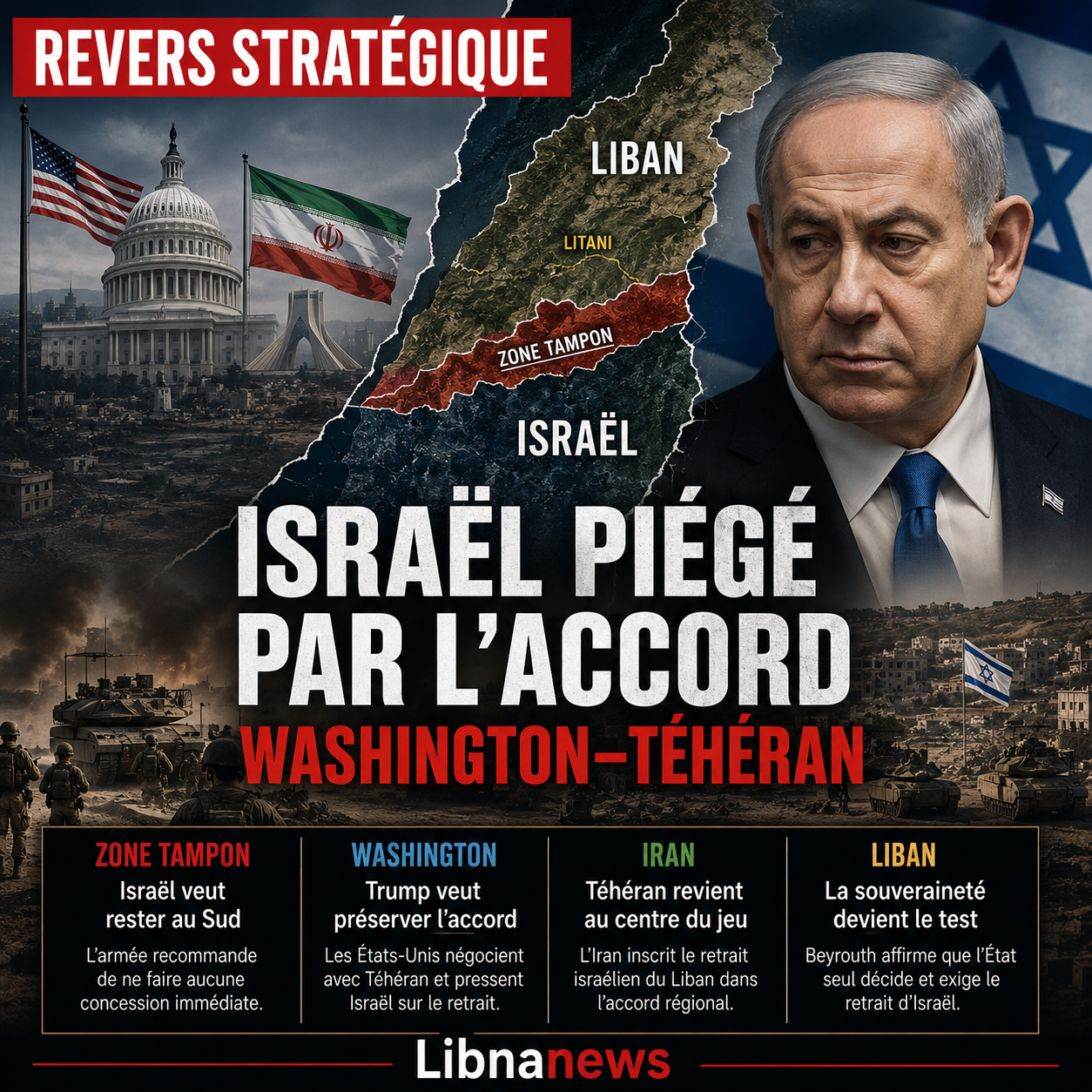
The emerging agreement between Washington and Tehran places Israel in a position that its leaders feared: that of a militarily engaged but diplomatically coerced actor. Israeli officials now describe the American-Iranian compromise as a deeply disappointing development, far removed from the strategic objectives set by the Hebrew state. According to the Israeli press, the army recommends that the political leadership make no immediate concessions to Lebanon. It wants to preserve three priorities: the freedom to strike throughout Lebanon, the maintenance of an active buffer zone in the South and the absolute demilitarization of that region. But the agreement gives Iran a new capacity: to include the Israeli withdrawal from Lebanon in a Washington-sponsored negotiation. For a senior Israeli official quoted by a local media, Iran comes out winning and Israel appears to be the loser of the sequence.
An agreement that reverses the Israeli story
Since the beginning of the regional war, Benjamin Netanyahu sought to impose a simple reading: Israel struck to restore its security, weaken Iran, contain Hezbollah and redraw the balance of power to the north. This reading was based on real military superiority. The Israeli army advanced deeply in Lebanon, struck infrastructure attributed to Hezbollah, set up positions on strategic reliefs and defended the idea of a buffer zone to protect northern Israel.
The agreement between the United States and Iran alters this perception. The interim text provides for a cessation of hostilities on several fronts, including Lebanon, a 60-day negotiation and an affirmation of Lebanese territorial integrity. It does not explicitly state, in the terms reported, an immediate Israeli withdrawal obligation. But it creates a diplomatic framework in which the Israeli military presence in southern Lebanon becomes a regional and international problem, not just an Israeli security decision.
That’s where the strategic loss is. Israel retains its soldiers, positions and firepower. But he’s losing some narrative control. It is no longer Tel-Aviv that sets the conditions for withdrawal alone. Washington is negotiating with Tehran. Iran claims that the end of the Israeli occupation in Lebanon will be part of the terms of the final agreement. Beirut insists that the Lebanese State remain the sole holder of the sovereign decision. The case comes out of the military and enters a broader diplomatic game.
For Netanyahu, this shift is dangerous. He can still say that the army has achieved tactical gains. He can still promise to protect the northerners. But he must now explain why Israel, after paying a high human cost in Lebanon, finds itself under US pressure to negotiate an exit. A military victory that leads to a forced or negotiated withdrawal becomes difficult to sell to public opinion.
The three red lines of the Israeli army
According to the Israeli press, the staff recommends not to accept immediate concessions. The military leaders consider that three elements must remain non-negotiable: the operational freedom to strike in Lebanon, the maintenance of a buffer zone where the army is deployed, and the demilitarization of southern Lebanon. This doctrine responds to an ancient security obsession: to prevent Hezbollah from resettling near the border and directly threatening the northern communities of Israel.
This position is consistent from the Israeli military point of view. An army that has advanced at the cost of losses wants to avoid leaving the land without guarantee. Commanders who have installed positions on heights want to maintain a depth of observation. Political leaders who promised the people of the north a safe return cannot easily accept a line of withdrawal perceived as a concession to Hezbollah.
But these three red lines are precisely those which the regional agreement makes more difficult to defend. Freedom to strike contradicts the idea of a lasting ceasefire. The buffer zone contradicts Lebanese territorial integrity. The total demilitarization of the South presupposes a Lebanese State’s ability to control the ground, but this capacity remains hampered as long as Israel retains positions and Hizbullah uses this presence as justification for its weapons.
Israel therefore finds itself in a contradiction. He wants a South Lebanon without armed Hezbollah, but he refuses the withdrawal that would allow the Lebanese state to demand a stronger monopoly of force. He wants lasting security, but he maintains a presence that feeds the Hezbollah resistance story. He wants to preserve his freedom of action, but this freedom becomes an obstacle to the American agreement with Iran.
Difficult negotiation with Washington
Israeli officials confirmed that discussions were under way with the United States to maintain the deployment of the Israeli army in southern Lebanon. According to a news agency, Israel published a new map describing an expanded area of military control in the South, while two Israeli officials spoke about difficult negotiations with Washington on the continuation of that presence. The American-Iranian agreement affirms the territorial integrity of Lebanon, but Israel maintains that its positions remain necessary in the face of Hezbollah attacks.
This negotiation shows the evolution of the relationship with the United States. For a long time, Israel could rely on an almost automatic American understanding of its security requirements. The current situation is more complex. Donald Trump wants to preserve his agreement with Iran. He wants to show that the war is over, that the Strait of Hormuz is reopening and that oil markets are stabilizing. Lebanon is becoming a credibility test for its diplomatic initiative.
An Israeli official close to the case would have summarized the situation as follows: everything depends on Trump. If the US President chooses to force Israel to implement the agreement, threatening political or military consequences, Netanyahu will have little margin. If Israel allows exceptions to be negotiated, the buffer zone can last. This uncertainty feeds confusion within the Israeli apparatus.
The Israeli dependency on Washington is therefore exposed. Israel remains a regional military power. But its strategic autonomy has limits. US aid, diplomatic coverage, intelligence and access to advanced armaments give the United States a decisive leverage. The agreement with Iran recalls this truth at the most uncomfortable time for Netanyahu.
Iran emerges reinforced from the sequence
From the Israeli point of view, perhaps the most worrying is Iran’s return as a central interlocutor. Tehran is not free from war. He has been hit, lost and under intense economic pressure. But he obtained a memorandum signed by Washington, a period of negotiation, a prospect of lifting sanctions, the reopening of Hormuz and the inclusion of the Lebanese front in the de-escalation.
That’s why an Israeli senior official was able to talk about a winning Iran and a losing Israel. The formula is brutal. It reflects a sense of inversion: Iran, which Netanyahu wanted to isolate and weaken, appears as a global power capable of negotiating directly with the United States on nuclear, oil, sanctions, Hormuz and Lebanon. Israel, which presented itself as the dominant military force in the region, finds itself criticized by its American ally for its strikes in Lebanon and hastened to justify its retention on foreign territory.
This perception is politically heavy. Netanyahu built much of his image on the struggle against Iran. He opposed nuclear compromises, denounced Western concessions and promised that only maximum pressure could contain Tehran. Seeing Trump sign an agreement with Iran, despite Israeli objections, weakens this story.
The agreement does not make Iran a final winner. It remains conditional, fragile and subject to controls. But in diplomacy, the image counts. Tehran gets a seat at the table. Israel must plead to maintain a buffer zone in Lebanon. This symbolic asymmetry feeds the idea of an Israeli strategic defeat.
Lebanon becomes Netanyahu’s trap
South Lebanon became the most immediate trap for Netanyahu. If he accepts a withdrawal, he will be accused by his right for giving in to Trump, Iran and Hezbollah. If he refuses, he risks opposing the American-Iranian agreement in front of him and putting the White House in trouble. In both cases, he loses a share of freedom.
According to the information available, Tehran assured its allies that a progressive Israeli withdrawal from southern Lebanon constituted a binding element of the final agreement, even if the interim text did not explicitly state it. This Iranian reading states that the withdrawal must begin and end in the 60-day window. If this interpretation is confirmed, Netanyahu will face an extremely tight schedule.
Israel refuses to withdraw before an effective agreement with Lebanon. This position is logical from the Israeli point of view: the army does not want to leave an area without guarantee on Hezbollah. But it becomes difficult to maintain if Washington believes that the Israeli presence prevents the finalization of the agreement with Tehran. The withdrawal from Lebanon is no longer just a military issue. It becomes a variable in the relationship between Trump, Iran and the Security Council.
Lebanon, for its part, is trying to preserve its position. The Lebanese authorities insist that the sole State is sovereign in its decision and that no external country, including Iran, can negotiate on behalf of Beirut. This claim is intended to prevent the Israeli withdrawal from being presented as a concession obtained by Tehran rather than as a Lebanese right.
An Israeli army in exposed position
Confusion is not just diplomatic. It is also reflected in the testimonies of Israeli soldiers and commanders engaged in Lebanon. According to an Israeli newspaper, military sources claim that the rules for opening fire have changed in recent days, limiting the ability of troops to prevent or respond to Hezbollah attacks. A source cited by the newspaper indicates that the current rules only allow immediate threats to be removed.
This would have a direct effect on the morale of the forces. Soldiers claim to be subject to fire, drones, anti-tank missiles or indirect attacks while having less latitude to respond. According to the sources cited, the Israeli advance was almost completely halted, except for local tactical needs, leaving troops exposed in deep positions in Lebanon.
The testimonies describe forces that crossed Beaufort Castle, crossed the Litani River and occupied visible positions. Soldiers would be cut off in fortified buildings or solid points to reduce the risk of being affected. But Hezbollah, according to these same sources, would gradually identify these places and target them remotely.
This situation is dangerous for Israel. An army that advances and then stops under political restraint may find itself in a vulnerable position. She was no longer offensive. She has not yet been ordered to withdraw. It must hold positions, while political leadership hesitates about the future. Human costs can increase without clear strategic gains.
Mission becomes unreadable on the ground
Perhaps the most serious problem is the loss of clarity in the mission. Commanders quoted by the Israeli press say they do not understand what will happen in the coming days. Situation assessments would not provide a stable response. The army is said to have advanced deeply in Lebanon, notably towards the ruling Nabatiyah ridge of Ali Taher, but the memorandum signed between Trump and Iran would have created an immediate political fog.
A military operation must serve a purpose. Taking a height, installing a position, hitting an infrastructure or pushing a unit makes sense if the political objective is clear. The Israeli objective now seems to be disputed. Should we stay to create a sustainable buffer zone? Should we step down under American pressure? Should we negotiate with Lebanon before withdrawal? Is it necessary to maintain a defensive posture and limit the response in order not to defeat the agreement with Iran?
These unresolved issues undermine the coherence of the operation. The Israeli army remains powerful and organized. But a powerful army can be weakened by a vague political directive. The soldiers in the field want to know if they are holding a line, preparing a withdrawal, opening a new phase or managing a break imposed by Washington.
The confusion goes back to the top of the state. Netanyahu must arbitrate between the demands of the army, Trump’s pressure, the demands of his right, the anger of the northern inhabitants, the fear of a still active Hezbollah and the risk of appearing as the man who lost his hand against Iran. This equation makes every decision costly.
Hezbollah regains political leverage
Hezbollah does not leave the war intact. He suffered loss, destruction and intense military pressure. But the regional agreement gives it political leverage. As long as Israel remains in the South, the movement can affirm that its weapons remain necessary. As long as Washington presses Netanyahu, he can present the resistance as having forced Israel to indirectly negotiate its withdrawal. As long as Iran binds the final agreement at the end of the occupation, it can say that the Lebanese front weighed in the decision.
This dynamic does not mean that Hezbollah gains militarily. It means he finds a story. In asymmetric wars, the story counts. An armed organization can suffer significant losses and emerge politically strengthened if its opponent fails to turn its tactical gains into a strategic outcome.
Israel wanted to neutralize Hezbollah in the South. He found himself with an exposed army, American pressure, a clause on Lebanese sovereignty and an international debate on withdrawal. Hezbollah, on the other hand, can say that it will not open any debate on its weapons before the Israeli army leaves. This position may block the Lebanese State, but it also places Israel in the face of its contradictions.
The return of the Lebanese State will therefore depend on a very difficult balance. There will need to be an Israeli withdrawal, a serious deployment of the Lebanese army, a credible international presence and a national dialogue on arms. If only one stage is missing, Hezbollah will retain its argument, and Israel will retain its pretext.
Netanyahu facing double internal pressure
At the Israeli domestic level, the agreement opens a political front. Right-wing officials can accuse Netanyahu of weakness if he accepts a withdrawal. Centralist opponents can accuse him of having engaged Israel in a war without a clear outcome. The families of soldiers may question the meaning of deep retention in Lebanon. Northerners can ask why the promised security remains uncertain.
Netanyahu has often survived more severe crises than expected. It can still try to reverse the situation by presenting the agreement as provisional, by demanding US guarantees, defending the buffer zone or claiming that Iran has been weakened. But the problem is that the current sequence attacks the heart of its image: its ability to manage Iran, to control Washington and to protect Israel by force.
The Israeli senior official quoted by the local press sums up this fragility by saying that the pressure on Netanyahu will grow. If Trump decides that Lebanon’s withdrawal is necessary for the final agreement with Iran, Netanyahu will have to choose between his American alliance and his coalition. If he defies Trump, he might isolate Israel. If he follows Trump, he may be charged with capitulation.
This alternative is the sign of loss. The great loser is not Israel in the existential sense. The Hebrew state remains powerful. The great loser is the Israeli strategy of this sequence: to advance militarily, to impose its red lines, to marginalize Iran and to force Hezbollah to retreat without paying a diplomatic cost. This strategy now faces a tougher reality.
A power ratio reversed by diplomacy
The American-Iranian agreement does not destroy Israeli power. He reveals his limits. Israel can strike, occupy, advance and hold positions. But it cannot alone set the political end of a regional war when the US decides to negotiate with Iran. He may demand the demilitarization of southern Lebanon. But it cannot make this requirement credible without withdrawal, strong Lebanese State and international mechanism. He can denounce the agreement as favorable to Tehran. But he still has to negotiate with Washington to preserve his own achievements.
That is why Israel appears to be the great loser of this phase. Iran obtains diplomatic recognition. Lebanon gets an argument about its territorial integrity. Trump gets a story of de-escalation. Hezbollah gets a lever on withdrawal. Netanyahu, on the other hand, must defend a military presence that becomes daily more expensive diplomatically and more tactically uncertain.
The final verdict will depend on the 60 days of negotiation. If Israel obtains a recognized buffer zone, Hezbollah safeguards and effective demilitarization of the South, Netanyahu can limit the damage. If Washington imposes a withdrawal without visible counterpart, the deal will become a major setback. If the army remains exposed and the losses increase, the internal pressure will rise again.
For the time being, the finding is already severe. Israel advanced deeply in Lebanon, but it did not impose the political solution. He hit hard, but Iran came back to the table as a central actor. He wanted to preserve his freedom of action, but Washington now asked him to count on an agreement he had not signed. In this war of narratives, the great loser is the one who discovers that military superiority is not enough to win diplomatic exit.