






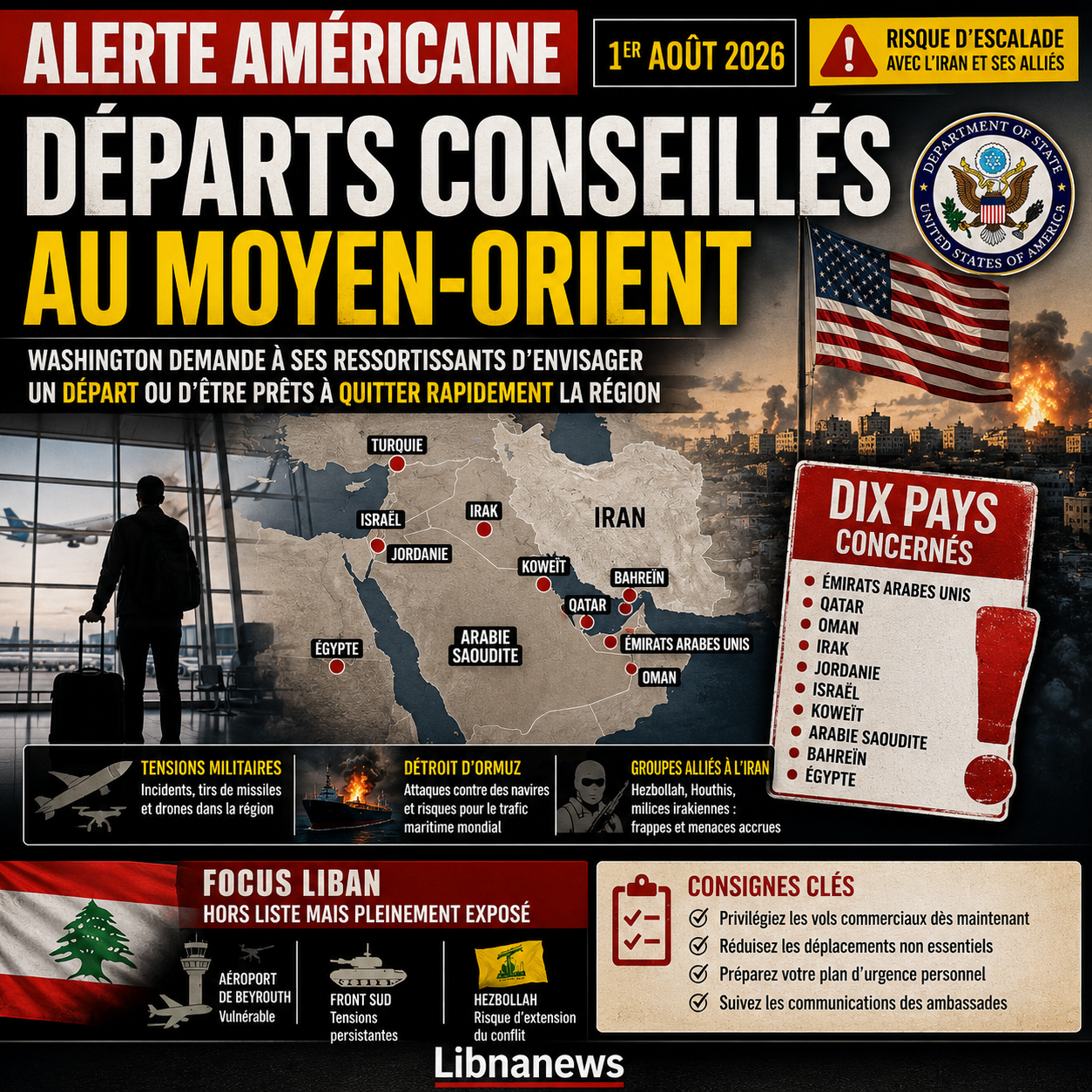
On Saturday, 1 August, the United States asked its nationals in several countries in the Middle East to consider a departure or stand ready to leave the region quickly, while Washington feared a new escalation with Iran and its allies. The alert, now relayed by several US diplomatic representations, covers ten countries and comes after a series of military incidents in the Gulf, Iraq, Jordan and around the Strait of Ormuz. It does not constitute the announcement of a general evacuation, but it clearly tightens the current rules: commercial departures must be preferred as long as they remain possible, non-essential travel must be reduced and personal emergency plans must be updated. In Lebanon, where Washington is already maintaining its maximum level of warning, this sequence rekindles concerns around Beirut airport, the southern border and the role that Hezbollah could play if regional confrontation widened.
Washington turns prudence into a starting point
The change of tone is clear. Over the past several weeks, US authorities have been calling on their nationals to exercise greater vigilance, to monitor embassy communications and to prepare for possible air disruptions. The message broadcast Saturday goes further. Americans in the Middle East must now consider leaving or be prepared to do so if the situation deteriorates. The representations concerned are in the United Arab Emirates, Qatar, Oman, Iraq, Jordan, Israel, Kuwait, Saudi Arabia, Bahrain and Egypt. This list brings together the main diplomatic and military support points of the United States, as well as several major air and energy hubs. The set-up is based on an operational reality: partial closure of airspace, reduction of company programmes or an attack on an infrastructure can quickly reduce the number of seats available. Washington therefore insists on commercial means, without promising a public evacuation that would depend on much more stringent security conditions.
The decision of 1 August extends the global warning issued on 22 July by the State Department. It already described a complex regional environment, exposed to unforeseen escalation and flight cancellations. The Americans outside the Middle East were then invited to reconsider any movement to or through the region. Since then, several embassies have added local instructions. In Jordan, the U.S. mission on Saturday asked those present to take shelter after reporting missiles, drones or rockets in airspace. In Iraq, an alert of 28 July had already warned that airspace closures and transport disruptions could occur without notice. These separate messages show the same evolution: Washington no longer treats risk as a distant threat. It considers that simultaneous incidents can now affect countries that are not directly engaged in combat, through projectiles, interceptions, attacks on bases or reprisals by armed groups.
A new military sequence around Iran
The alert comes after a week of renewed US threats against Iran and new operations involving groups close to Tehran. US President Donald Trump mentioned the possibility of further strikes if the Iranian authorities did not return to the negotiating table or continue their attacks against American interests. Tehran responded by threatening to hit States that would facilitate operations against its territory. This verbal confrontation is accompanied by concrete incidents. Kuwait reported attacks on sensitive infrastructure by Iranian drones, while several vessels reported explosions or impacts in the Strait of Ormuz. At the same time, attacks attributed to the Houthis and Iraqi armed groups have targeted Saudi interests. The proliferation of fronts reduces the capacity of mediators to isolate each crisis. Most importantly, it increases the risk that a limited operation will lead to a response in another territory.
The United States fears less of a single offensive than a succession of coordinated or converging actions. Iran has a network of allies that can work with different time frames, means and objectives. Hezbollah in Lebanon, the Houthis in Yemen, Kataeb Hezbollah and other factions in Iraq, as well as Hamas in the Palestinian file, hold separate positions but can exert simultaneous pressure. The United States authorities therefore took into account a wide range of threats: missiles, drones, attacks on bases, maritime operations, cyber attacks, abductions or actions against diplomatic installations. This dispersion explains the geographical scope of the alert. It also explains the importance attached to hotels, airports, shopping centres and other places frequented by foreign nationals. A diplomatic representation may be protected by several security perimeters. A civilian airport, an access road or a private establishment remains much more difficult to secure when an alert concerns several countries at the same time.
Gulf countries now at the forefront
The Gulf monarchies have been seeking for months to avoid direct confrontation, while welcoming most of the US military apparatus in the region. Qatar is home to the Al-Udeid base, a major centre of American air operations. Bahrain hosts the Fifth Fleet Headquarters. Kuwait serves as a logistics platform, while the United Arab Emirates and Saudi Arabia have major military, air and energy infrastructure. Oman controls one of the banks of the Strait of Ormuz and retains a role of mediator between Washington and Tehran. This combination makes these States particularly exposed. They may be targeted because of their cooperation with the United States, even if they refuse to appear as parties to the war. They can also suffer the indirect consequences of an attack carried out elsewhere: closing an air corridor, suspending a maritime link, raising the level of defence or slowing port activity.
The reported drone attack in Kuwait reinforced this concern. So far, the emirate had avoided the most serious incidents of regional confrontation. Targeting sensitive infrastructure shows that this relative protection can no longer be taken for granted. The Gulf States have strengthened their air defences, but no cover can guarantee the interception of all drones and missiles. Debris can also fall on civilian areas after interception. U.S. embassies therefore recommend staying inside during alerts, moving away from windows, maintaining communications and checking routes to airports. These instructions are subject to immediate protection. They also reflect a deeper political concern: the Gulf countries could gradually be drawn into a confrontation they seek to contain through diplomacy.
Ormuz Strait, regional tipping point
One of the main concerns is the safety of the Strait of Ormuz. This narrow route ensures the transition of an essential part of Gulf hydrocarbon exports. Any attack on a ship, any mine anchorage or any lasting restriction would have immediate effects on markets, insurance and marine programs. Several incidents were reported Saturday around LNG tankers and tankers. Responsibilities were not always established, but the accumulation of reports is sufficient to change the behaviour of shipowners. Some slow down their entry into the area, others wait for instructions or negotiate new insurance terms. The US naval authorities and those of the riparian states monitor Iranian movements, while Tehran regularly recalls its ability to disrupt navigation in the event of an attack on its own infrastructure.
For Washington, the risk is not limited to the price of oil. Qatar exports most of its liquefied natural gas via this route, while the ports of the Emirates, Kuwait, Bahrain, Iraq and Saudi Arabia depend on the free passage of ships. A prolonged disruption would affect Europe and Asia, but also local economies. It could lead to a concentration of civilian buildings in waiting areas, increase the risk of accidents and complicate military operations. The recommendation addressed to US nationals takes this dimension into account. Large Gulf airports remain open, but their functioning depends on a stable regional environment. A maritime crisis can quickly be accompanied by air closures, restrictions around bases and changes in routes imposed on international companies.
Commercial flights become the first barometer
Airlines are often the first visible indicator of safe degradation. They have their own watch cells, consult with aviation authorities and assess the risks associated with missile or drone trajectories. A company may suspend service prior to any formal closure if it considers that crews, aircraft or insurance are no longer adequately protected. The disturbances observed since the beginning of the confrontation with Iran have already led several carriers to reduce their frequencies or bypass certain airspace. The U.S. opinions for the UAE, Qatar and Saudi Arabia explicitly mention significant disruptions. Washington therefore asks travellers to check their flight directly, to plan a replacement route and not to travel to the airport without confirmation.
This dependence on commercial connections explains the firmness of the new policy. An evacuation organised by the US state is not automatic. It involves available aircraft, overflight clearances, a secure airport and practical access routes. In the event of a simultaneous crisis in several countries, needs could exceed the available capacities. Citizens who wish to leave are therefore invited to do so before the system is saturated. The message is also intended for people with family, medical or professional responsibilities who make leaving more complex. They must collect their documents, check the validity of passports, provide the necessary medicines and follow official channels. It is not a uniform order to leave all the countries concerned immediately, but a clear recommendation not to wait until the options close.
Lebanon, absent from the list but fully exposed
Lebanon does not appear among the ten countries mentioned in the messages broadcast on Saturday. This is less due to a reassuring assessment than to the level of alert already applied in the country. The State Department maintains Lebanon at level 4 and recommends not to go there. The risks involved include armed conflict, abductions, terrorism, civil unrest and the limited capacity of United States authorities to provide assistance in certain areas. The United States Embassy in Beirut continues to operate, but the movement of its staff remains highly supervised. The South, the border with Syria, the Palestinian camps and several areas of the Bekaa are subject to special restrictions. In this context, the 1 August regional alert reinforces an already high posture rather than creating a new category for Lebanon.
The main Lebanese fragility remains the Beirut International Airport. The country does not have any other major civilian platform and land routes pass through Syria. Maritime options remain limited and cannot quickly replace air traffic. A closure of airspace, a suspension of foreign flights or an attack on access to the airport would thus drastically reduce departure possibilities. Even without official closure, companies can cancel their rotations if the neighbouring corridors become dangerous. Previous crises have shown that foreign carriers often withdraw before domestic companies. The Lebanese authorities thus monitor air programmes as well as military movements. Continuity of flights is a security, economic and diplomatic issue.
Hezbollah at the centre of expansion scenarios
Hezbollah is one of the organizations that Washington associates with the Iranian regional network. Its role makes Lebanon particularly sensitive to any new confrontation between the United States, Israel and Tehran. The movement has missiles, rockets, drones and a military settlement in several areas. He remains engaged in a confrontation with Israel, despite the ceasefire mechanisms and international efforts to contain incidents in the South. Israeli strikes continue to target party-related positions, infrastructure and officials, while operations are being claimed against Israeli forces. A Hezbollah decision to expand its action in the name of support for Iran could lead to a rapid intensification of strikes on Lebanese territory.
On the contrary, the Lebanese authorities seek to keep the country away from a regional war. They are based on the army, liaison mechanisms with the United Nations Interim Force and diplomatic contacts with the United States, France and the Arab countries. However, their scope remains limited when a military decision is taken by armed actors or Israel. The US alert does not provide any timetable for attacks against Lebanon. It indicates, however, that Washington views Iran’s allied groups as capable of acting in a coordinated manner. This assessment may lead to a strengthening of measures around the embassy, American companies and places frequented by Western nationals. It can also influence the decisions of airlines and foreign governments about their own citizens.
A new threat to the Lebanese summer season
The sequence comes at the heart of the summer season, during which time Lebanon depends heavily on the arrivals of the diaspora and Arab visitors. A multiplication of foreign alerts can lead to cancellations of reservations, advanced departures and a reduction of stays. Hotels, restaurants, shops, travel agencies and transport services quickly experience these effects. International companies can also postpone travel or ask their employees to leave the country. The consequences appear even before the airport is closed. They are the result of risk perception, insurer decisions and flight availability. In an economy further weakened by the banking crisis, any contraction in tourism reduces foreign exchange inflows and directly affects many households.
Tensions around Ormuz and the Red Sea add a second risk. Lebanon imports most of its fuels, medicines and food products. An increase in insurance premiums or an increase in shipping routes has an impact on costs. Distributors can build up additional stocks, while consumers increase their purchases for fear of shortages. These reactions can create temporary tensions without a real shortage. The authorities must therefore provide regular information on the reserves, arrivals and operation of the ports. They must also avoid conflicting announcements at the airport. In a crisis phase, the quality of public information becomes as important a factor of stability as the available stocks.
Embassies prepare without general evacuation
The strengthening of orders does not mean that American embassies close their doors. Missions can reduce appointments, limit travel and reposition some employees on telework while maintaining their essential services. They verify continuity plans, emergency communications, assembly sites and non-essential personnel departure opportunities. In some countries, Washington had already ordered or authorized the departure of non-essential employees and their families at the beginning of the confrontation with Iran. The opinions issued for the United Arab Emirates and Qatar recall that these measures had been taken as early as March. The current alert shows that the expected standardization has not taken place or remains too fragile to remove the precautions.
For nationals, the difference between a departure recommendation and an official evacuation remains significant. The first leaves the decision to everyone and is based on commercial transport. The second involves an operation organised by the State, often paid and subject to strict conditions. Since the beginning of the crisis, Washington has stressed the need for a plan that does not depend on government aid. This doctrine aims to prevent thousands of people from waiting for intervention as roads close. It also explains why the messages are broadcast before a specific attack. The aim is to reduce the number of people exposed, not to publicly predict the place and time of an operation.
Diplomacy still trying to contain confrontation
Despite the military tightening, diplomatic channels remain active. Oman and Qatar continue their contacts with Washington and Tehran. Other Gulf States are seeking guarantees that their territories will not serve as battlefields. They call on Iran not to target civilian installations and in the United States to limit any response that could cause open war. These efforts, however, are hampered by the proliferation of actors. An attack by an Iraqi militia, a Houthi fire or a Hezbollah operation can trigger a response that goes beyond the original framework. The governments concerned must then deal with the consequences of a decision they do not necessarily take.
The crisis is also taking place against the backdrop of difficult negotiations concerning Gaza, Lebanon and Iran’s nuclear programme. Each case has its own calendar, but the fronts are now bound by threats and alliances. Progress on Gaza can reduce pressure on one side without resolving tensions in the Gulf. A truce between Washington and Tehran can be weakened by a maritime attack or a strike in Iraq. In Lebanon, the stability of the South depends as much on local decisions as on regional calculations. The American alert of 1 August does not close the diplomatic route. It shows, however, that Washington is preparing for the failure of mediation and wants to reduce the exposure of its nationals before a possible new military sequence.
Future signals expected
The next few hours will be dominated by concrete indicators. The first will be the maintenance of commercial flights and the evolution of the programmes of the major Gulf and Levant companies. The second will be the publication of new alerts by American or European embassies. The third concerns military movements around bases, the Strait of Ormuz and Iranian positions. An increase in interceptions, airspace closures or port restrictions would confirm a rapid deterioration. Conversely, the resumption of discussions and the absence of new incidents could temporarily stabilize the situation.
In Lebanon, attention will be paid to Beirut airport, the southern front and Hezbollah statements. The authorities should also monitor company reactions, tourist bookings and movements of foreign nationals. No general order of departure was announced by the American embassy in Beirut on Saturday night. Nevertheless, the country remains included in regional vigilance and subject to a maximum-level opinion. The actual scope of the alert will therefore be less measured by its vocabulary than by the decisions taken after its dissemination: reductions in diplomatic personnel, commercial departures, suspension of flights, new strikes or resumption of mediations. It is on these elements that the Lebanese chancelleries and authorities now base their next decisions.