

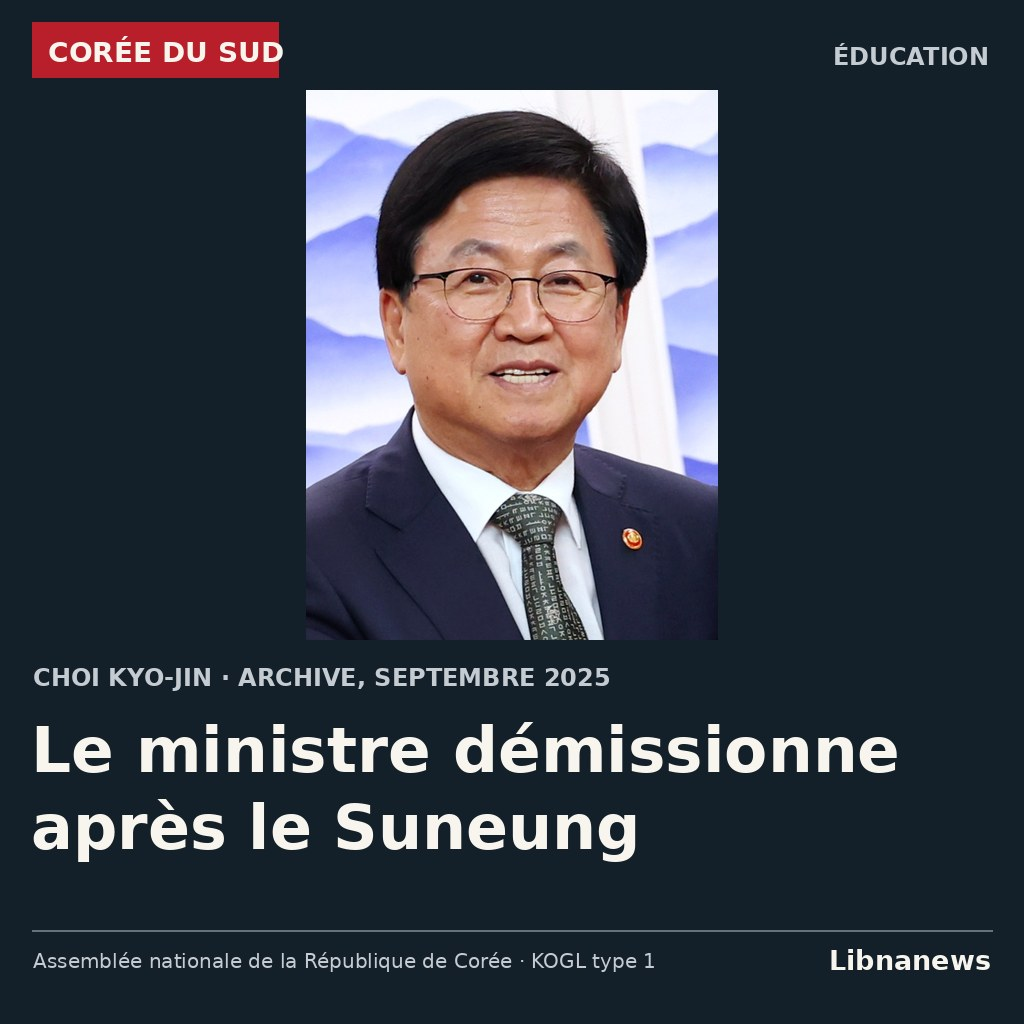
South Korea’s Minister of Education, Choi Kyo-jin, left office on Sunday November 22, three days after the national university exam. President Lee Jae Myung accepted his resignation, said the President’s spokesman, Kang Yu-jung. The minister acknowledged that last minute changes to prevent cheating, including artificial intelligence, had disrupted candidates.
South Korean Minister resigns after Suneung
Choi found, in a statement circulated by his ministry, that the preparations had not been sufficient. He resigned after the event was over. The Presidency instructed Prime Minister Han Seong-sook to oversee the outcome of the review. She indicated that the choice of successor would follow the procedure, without announcing a name.
The Suneung of 19 November corresponds to the academic year 2027. The authorities had strengthened the supervision instructions on 17 and 18 November, while the candidates were preparing to compose. The alert was triggered by a separate case, linked to a professional examination. This case does not prove that artificial intelligence was used during the Suneung.
Separate surveys of reforms
As early as 20 November, the Prime Minister convened an interdepartmental group to verify suspicions of fraud and prepare for future sessions. The police were tasked with reviewing reports, including those posted online. The opening of these checks does not provide information on the number of frauds established during the test.
The rules for 844 public examinations reviewed
At the Council of Ministers on 24 November, Lee Jae Myung requested that all reports be examined and that administrations work to prevent unauthorized photography and dissemination of subjects. The Presidency reported that its Chief of Staff, Lim Kwang-hyun, had then received a statement of measures for 844 ministerial reviews. This figure refers to examinations, not fraud files.
The study included a ban on representing up to 10 years in some cases, as well as a five-year extension of the storage period for subsequent verifications. These are proposals to be considered, not sanctions adopted or applied retroactively to the Suneung of 19 November. The communiqués consulted do not give a final assessment of the alerts or timetable for adoption.





Comments