

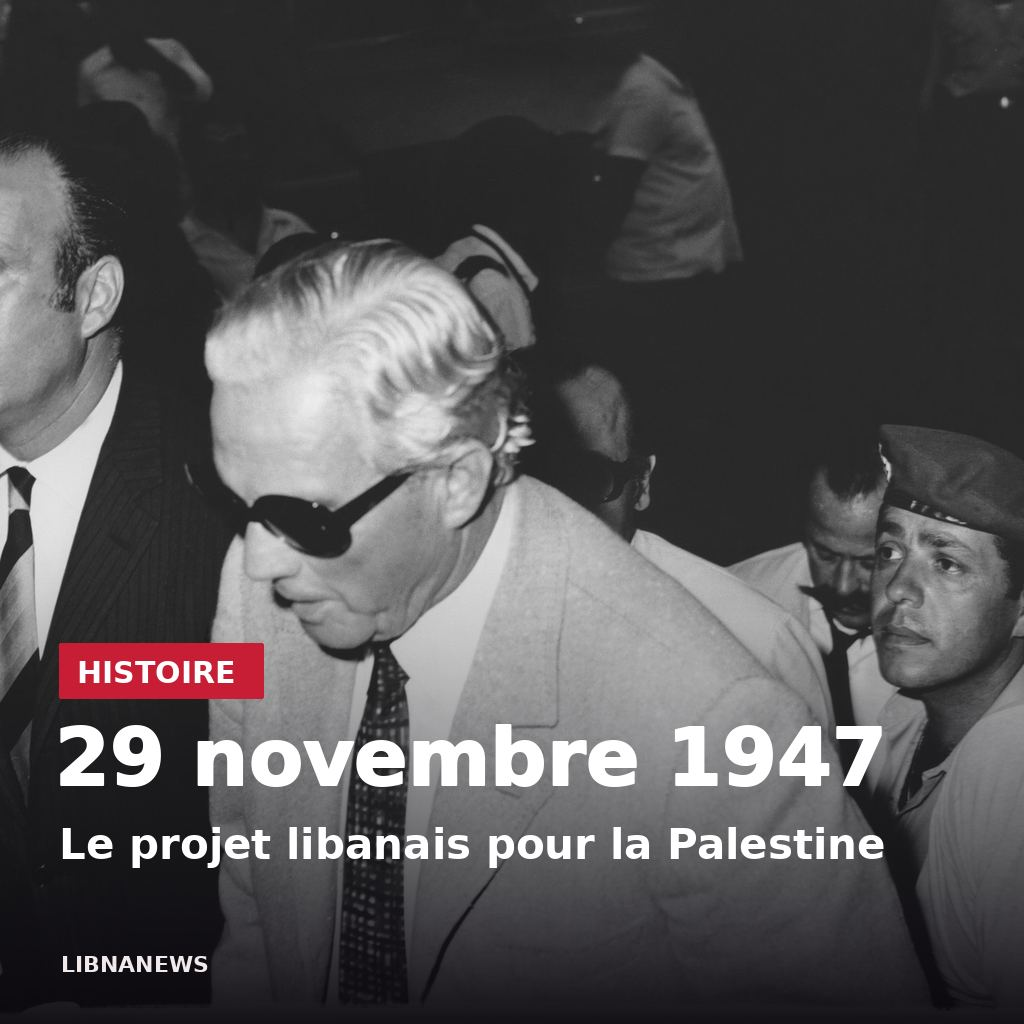
Before the General Assembly of the United Nations recommends the division of Palestine proxy, the representative of Lebanon, Camille Chamoun, put forward another formula: one federal state, with Arab and Jewish cantons. The record of the meeting shows what Beirut stands for and why its representative resumed the floor just before the vote.
On Saturday, November 29, 1947, in Flushing Meadow, New York State, the President of the General Assembly, Brazilian Oswaldo Aranha, is about to vote on the report on the future of Palestine. Camille Chamoun asked for the floor on behalf of Lebanon. On that day, the future President of the Republic was not content to announce that his country would oppose division. It sets out the principles of another project and goes back, just before the roll call, on how the text was prepared.
Two categories of cantons, one common State
The day before, the representative of France had requested a 24-hour adjournment to consider whether a conciliation formula was still possible. Chamoun thanked the representatives of France and Colombia for their statements. However, he criticized the organizers of the debates for not having, in his view, engaged in a genuine conciliation process with the Arab delegations. He acknowledged that the time elapsed since the previous meeting had not allowed for a full text.
The UN report lists the six principles put forward by Chamoun. Palestine would be established as an independent federal State before 1 August 1948. A federal government would coexist with the Arab and Jewish cantons. Their limits would be drawn in such a way as to reduce the number of people who would be in minority in their canton. A Constituent Assembly, elected by direct universal suffrage and composed in proportion to the different components of the population, would draft the Constitution.
Chamoun proposes to draw on the American system in order to distribute powers between the federal state and the cantons. He also cites Swiss local autonomy. The Constitution would protect holy places and guarantee freedom of access, visitation and worship, as well as the rights of religious institutions. However, the document does not give a map of the cantons or a definitive distribution of powers. His delegation presented those principles as a basis for discussion, not as a Constitution ready to enter into force.
Lebanon among the thirteen votes against
Before the election, Chamoun intervened a second time. He asked that the Assembly first decide on the recommendations which, he said, had been agreed in a subcommittee. He felt that the technical votes on economic union did not answer the main question: whether or not to divide the territory into two states. Aranha replied that these recommendations were included in the reports of the subcommittees and not in the draft transmitted to the Assembly. He shall vote without a separate vote on those items.
Resolution 181 (II) was adopted by 33 votes to 13, with 10 abstentions and one member not voting. Lebanon is among the opponents, including Egypt, Iraq and Syria. France, the United States and the Soviet Union voted in favour; the United Kingdom, then acting power, remains. The text recommends two states, one Arab and the other Jewish, linked by an economic union, and a separate international status for Jerusalem. It is a recommendation for sharing, not an agreement signed by both parties.
From the UN rostrum to the Naqoura Armistice
Lebanon had been a founding member of the United Nations since 1945. Two years later, his delegation had been able to present a solution that maintained a common political framework, although it had not been put to the same vote as the sharing plan. Chamoun’s intervention thus makes it possible to distinguish, in the archives, the Lebanese refusal from the final text and the proposal he actually defended.
The frontiers envisaged in 1947 did not enter into force as they had been drawn. After the 1948 war, Lebanon and Israel signed a general agreement in Ras Naqurah on 23 March 1949. This document regulated the cessation of hostilities on their front. It did not reflect the division recommended by the Assembly or the federal draft presented by Chamoun.





Comments