

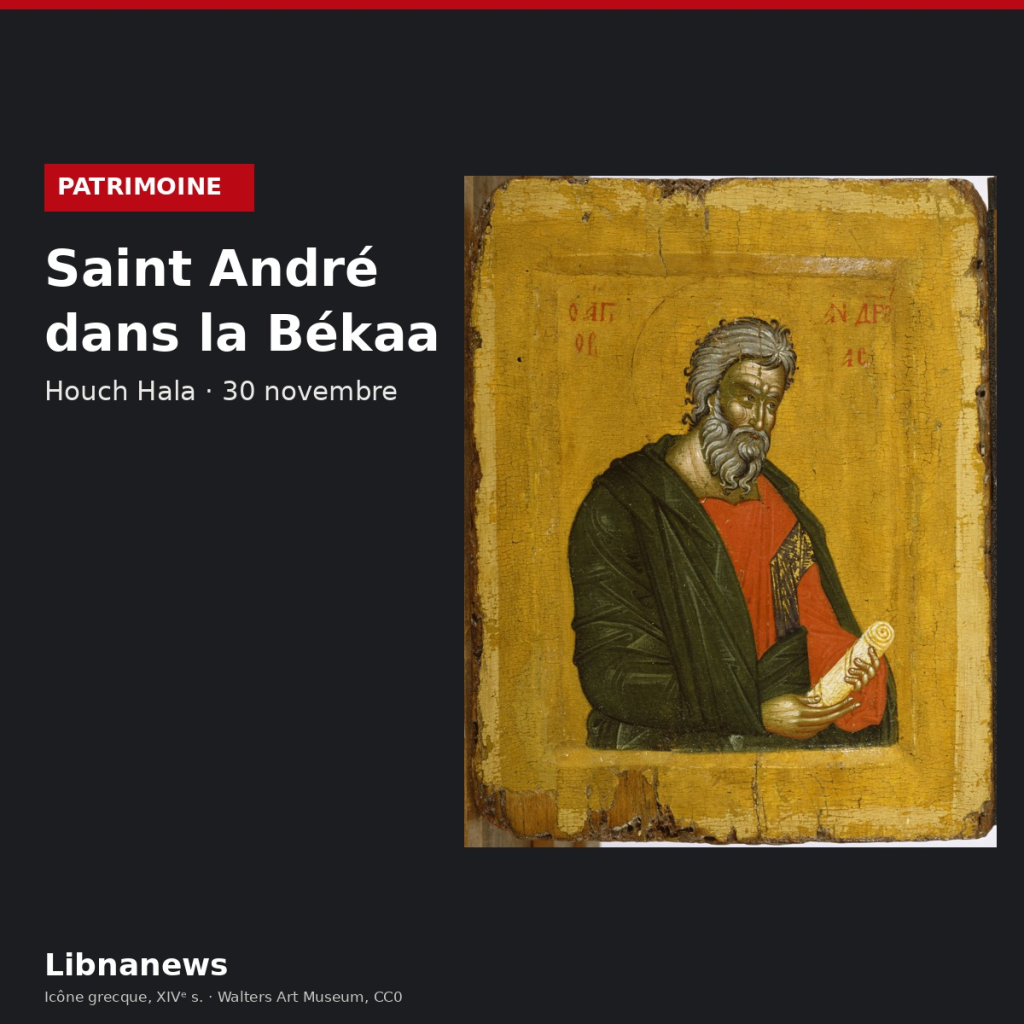
On Monday, November 30, the Orthodox calendar of Antioch commemorates St Andrew, the « first called ». In Houch Hala, near Rayak, the parish archives tell of a feast inscribed in the life of the Bekaa: a vigil, offices, and the consecration of a mosaic in 2024.
At St. Andrew’s church in Houch Hala, the feast is not only on the date of the calendar. On November 30, 2024, after the mornings and the liturgy, Metropolitan Antoine al-Souri dedicated an icon in mosaic of the apostle. He then found the parishioners in the church hall. The archdiocese of Zahlé and Baalbek also keeps track of the vespers of the day before. These archives shed light on how the parish honors its boss, without being a program for 2026.
Saint Andrew in the Bekaa, from the vigil to the liturgy
Another archive of archdiocese already places a vigil of Saint Andrew in Houch Hala on November 29, 2016. The celebration of 2024 makes it possible to clarify the gestures: to meet in the evening, to come back in the morning and then to participate in the liturgy. Mornings are the morning office. In the Orthodox calendar of 2026, the great evening and morning services are part of the apostle’s commemoration.
The liturgical guide to the patriarchate of Antioch gives the texts to sing and read for this feast. During the liturgy, the reading of the Gospel according to John resumes the meeting of Andrew with Jesus, then that of his brother Simon. The guide also mentions songs of the Nativity in the mornings. At the end of November, the apostle’s memory thus fits into the preparation of Christmas without getting confused with it.
Where does the name « first called » come from?
In the Gospel according to John, Andrew follows Jesus after hearing John the Baptist. He then goes after his brother Simon, whom the account calls Peter. The Byzantine tradition gave André the name of protoclet, which means « first called ». Matthew’s account presents the scene differently: Jesus calls the two brothers as they fish along the lake of Galilee. The two stories do not emphasize the same gesture. One follows Andrew going to get his brother; The other shows two fishermen leaving their nets.
Christian tradition places Andrew’s death in Patras, Greece. The X-cross associated with him belongs to this later tradition, not to the Gospel narrative. The 14th century Greek icon preserved at the Walters Art Museum also shows the apostle with a roll, turned aside. According to the museum, it may have belonged to a set of icons. It illustrates a way of representing André, different from the mosaic of Houch Hala.
A common date, different celebrations
November 30 also appears in the Maronite calendar for the apostle’s memory. In 2026, the calendar of the Maronite Archdiocese of Beirut places this date in the week of the Visitation, opened on Sunday 29 November. The coincidence of dates does not imply the same office or arrangement of readings. Houch Hala offers an example of Orthodox practice in a church under the patronage of the Apostle, not a model to be extended to all Lebanese parishes.
The same church remains a place of prayer outside the party. On April 8, 2026, during Orthodox Holy Week, the Archdiocese documented another office and a meeting with the faithful. This appointment confirms the parish activity this year, without constituting an announcement for November 30th. The schedules of the Vespers and the liturgy of Saint Andrew 2026 have not been publicly confirmed.





Comments