

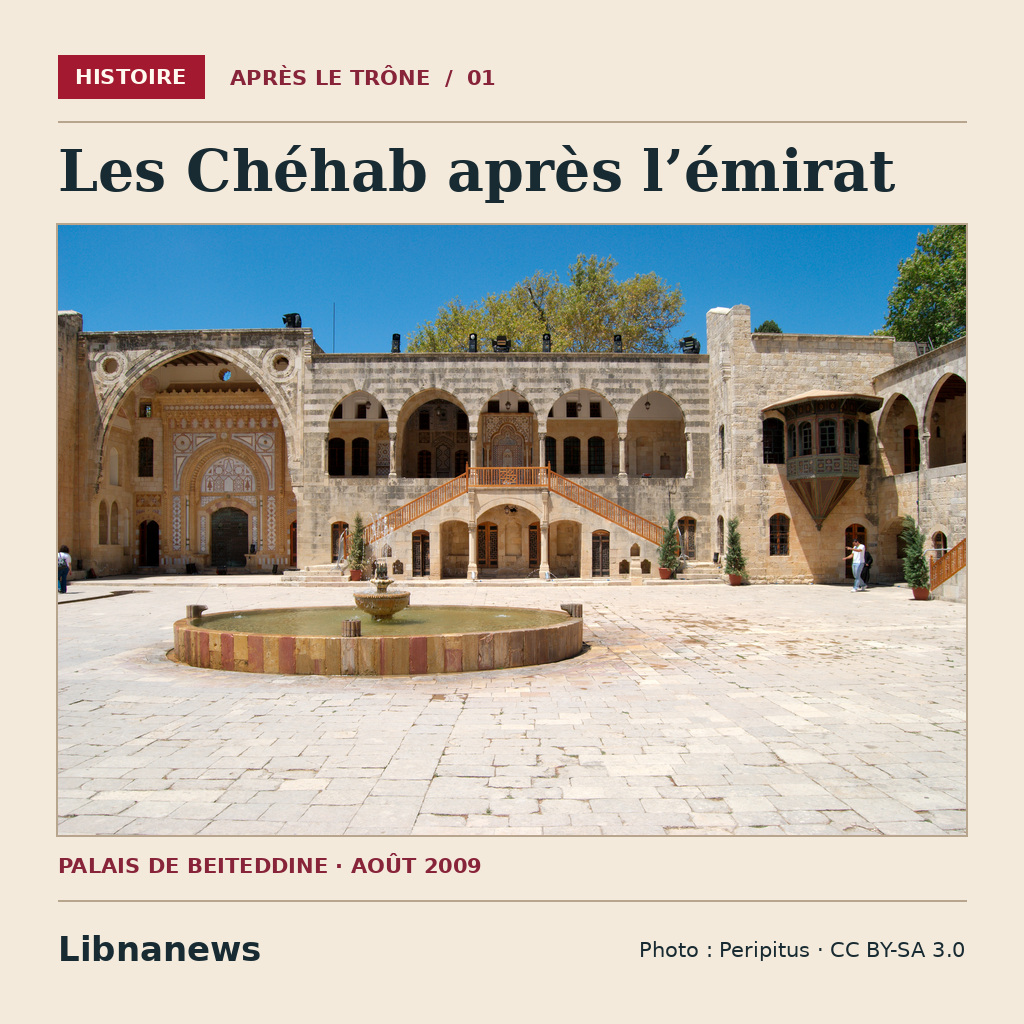
After the throne, episode 1.The fall of Bechir II in 1840 did not erase the Shehab. In the Chouf, his palace in Beiteddine passed into the hands of the administration and belongs to the Lebanese state. In Hasbaya, members of the family carried the safeguard of a seral to which their name remains attached. Between these two places, the history of the Shehab after the emirate also leads from the citadel to the institutions of the Republic.
The Shehab after the Emirate: the fall of a court, not a whole family
Beiteddine and Hasbaya were not two interchangeable residences. The first was the court of Béchir II, which ruled Mount Lebanon. The second was an older family seat in Wadi al-Taym, where other Shehab held a local authority. The emirs of the branches of Hasbaya and Rachaya remained Sunni, while the branch of Behir II became Christian. The same name covered local authorities, confessions and alliances that were not all passed on in the same way.
Bashir II had taken the side of Mehemeth Ali, the leader of Egypt, whose forces had been imposed on the Levant since 1831. Their retreat from the Ottoman Empire and its European allies led to his deposition in 1840. The emir went into exile. His successor, Behir III, was also a Shehab, from the branch of Rachaya. His brief passage into power did not save the emirate, abolished in 1842. The end of this function alone did not imply the disappearance of the other branches or the transfer of all their homes.
In the Wadi al-Taym, the break was also played in 1860. In June, during the massacres in Hasbaya and Rachaya, Sunni emirs of the family were killed with Christians. The historian Taylan Paksoy, who took back the testimonies of the time, recalls that some of these Shehab took the side of protecting Christian inhabitants. This fact prevents reading violence only through the confession of victims. He also said what the loss of the alliances that had supported them had cost these branches. It does not allow to declare them extinguished.
Beiteddine, from the palace of Bechir II to the palace of the Republic
Bechir II built his palace between 1788 and 1818. The organisation of the courses separated the reception and affairs of the residence of the emir. This separation helps to understand what the following administrations found in Beiteddine: not only a home, but a place designed to receive, house and govern. After 1840, the palace served the Ottoman authorities and then the French mandate. It was classified as a historical monument in 1934 and in 1943 became the summer residence of the Lebanese presidency.
The Lebanese war has again changed the management of the place. The palace suffered damage. Work was financed by the civil administration of the Chouf in the 1980s, before the building returned to the state in 1992. ICOMOS, which examined the Beiteddine and Deir el-Qamar records in the early 2000s, indicates that the palace belongs to the Lebanese State and is under the control of the General Directorate of Antiquities. The old stables, which house mosaics, give an idea of the other change: part of the palace’s service spaces has become a place of presentation of the heritage.
In Hasbaya, a family and a conservation administration
In the case of Hasbaya, the World Monuments Fund was still documenting its use by descendants when the serail was added to its watch list for 2006. It’s a period record, not a survey of the current occupants. The President of the Safeguard Foundation explained in 2015 that a serail structure had been created in 2000 and that the Antiquities Branch had funded a study to set priorities. At that time, she pointed to the lack of resources for the restoration of the site.
More recently, the vice-president of the Chahab Association of Emirs indicated, in an interview with the Ghassan Salamé Minister of Culture, that the seral belonged to several family members. He proposed a letter signed by the owners to ask antiques for a comprehensive study. His statement provides information on the process and the issue of owners as presented by the association. It is not worth publishing a cadastral state, works contract or confirmation of financing. This is where the trajectories of the two monuments diverge: in Beiteddine, the state manages its own palace; In Hasbaya, consultation with the owners is part of the backup file.
From Ghazir and the South to Lebanese institutions
The journeys of the twentieth century did not amount to a succession of Bechir II. According to the Lebanese army, the future President Fouad Chehab was descended from Emir Hassan, the eldest brother of Bechir II, and not from Bechir himself. Born in Ghazir, Fouad Chehab worked very young in the court of Jounieh to help his family, before his career as an officer. He became head of the army and then president of the Republic from 1958 to 1964. The last name was the same; the load was no longer hereditary.
Khaled Chehab’s experience is that the parliamentary archives gave him the president of the House from 1935 to 1937, and the government’s records attest to his return to the head of the Council in 1952. General Security publications relate its origins to the Hasbaya region, without establishing its precise filiation with the serail owners. On the heritage side, archaeologist Maurice Chehab directed the antiquities of Lebanon and launched theBeirut Museum Bulletin. The family itself today publishes translations of testimonies and portraits in itsChehab Chronicles. This is an archive project, not a census of all branches.
Two international protections, not two announced construction sites
Both buildings have been granted temporary enhanced protection under the Second Protocol to the Hague Convention on Cultural Property in the Event of Armed Conflict: since 18 November 2024 for Beiteddine and 1 April 2026 for the Hasbaya Serail. It is not an inscription in World Heritage. These decisions do not change the ownership of buildings or prove that a restoration site is being financed. In Hasbaya’s view, the Committee still asks Lebanon to document national protection measures where circumstances permit, in order to initiate the ordinary procedure.





Comments