

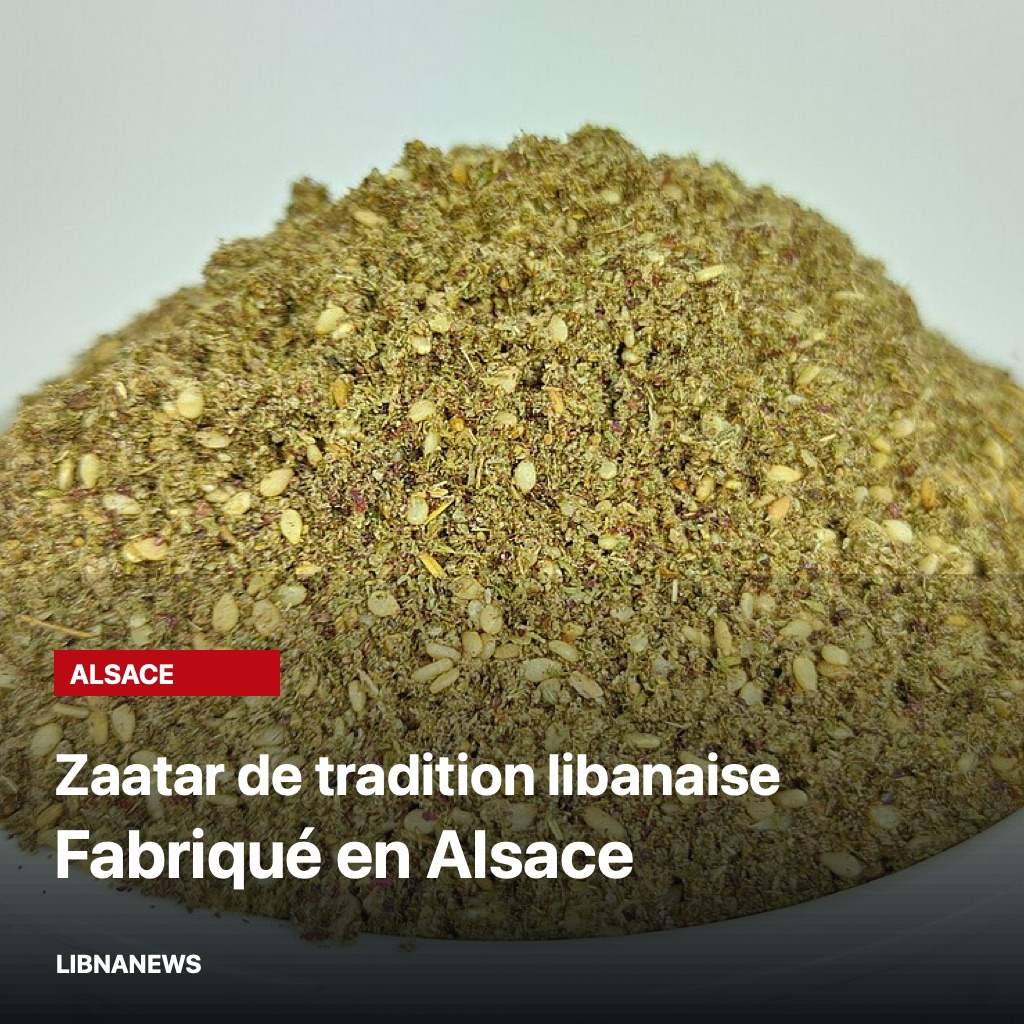
Sesame is roasted in Schiltigheim. The recipe comes from Sarah Kanj’s Lebanese grandmother. In a report from the series « L The subject places manufacturing in Alsace and mixing in the Levant tradition. A few weeks after the controversy over the homos presented by France 3 Provence-Alpes as « Israeli street food », this distinction deserves to be noted.
Lebanese thyme and sumac, a mixture prepared in Schiltigheim
To launch Levanthym, Sarah Kanj took over a family recipe. In this version, the wild thyme and sumac come from Lebanon, while sesame is roasted on site. Olive oil and salt complete the mixture. The product is prepared, potted and shipped from the ESAT Anne-Claire Staubes in Schiltigheim, a nearby municipality of Strasbourg. It is the work of this team that the report highlights.
Managed by Apedi Alsace, the establishment offers catering, industrial cleaning and packaging activities with adapted accompaniment. For Levanthym, workers do not only intervene on the packaging: they also make the mixture. The distinction between the origin of the recipe and the place of production makes their role more visible. It allows us to say what comes from Lebanon and what is done in Schiltigheim, without assigning to one another’s work.
What France 3 Provence-Alpes had mistold about Homos
In the French 3 Provence-Alpes report Libnanews had examined, the homos bassar, a preparation of chickpeas with meat, was presented on Instagram as « Israeli street food ». The publication also spoke of a « speciality of the Middle East ». It was a misrepresentation: the Israeli label was precise, but the regional formula, much more vague, did not name any of the Arab traditions that transmitted this dish. Homos is well consumed in Israel today. This does not make its adoption an origin. In Lebanon, Palestine and Syria in particular, it belongs to culinary repertoires whose history precedes the creation of the State of Israel.
The Alsatian report is neither a correction nor an official response by France 3 to the controversy. It shows, on the other hand, how to avoid: the place where a product is prepared or served does not exempt from naming the tradition from which it originates. In the case of Levanthym, Lebanese descent is precise, since it is the recipe of a family, within a wider Levantian heritage.
What Unesco has written: the manouché, not the jar
In Lebanon, the zaatar is mainly the garnish of the manouché, the flat bread that is eaten at breakfast. In 2023, Unesco listed manouché as Lebanon’s emblematic culinary practice. The sheet describes a garnish of thyme, sumac, roasted sesame, salt and olive oil. This inscription recognizes the gestures and transmission that surround the bread; it does not attribute to Lebanon the exclusivity of all the mixtures of zaatar of the Levant.
In Schiltigheim, the jar allows to name the two know-hows. The recipe is Lebanese; those who prepare it today work in Alsace.
Photo of illustration: mixture of zaatar photographed in 2020, unrelated to the production of Levanthym. Fshadid / Wikimedia Commons, cropping and titration Libnanews undercC BY-SA 4.0 license.





Comments