

Bernard Raymond Jabre
The counting of the Israeli elections of 27 October 2026 already obliges us to correct the photograph given by the polls.
Last night, Israel seemed almost perfectly cut into three blocks: about 51 seats for Benjamin Netanyahu and his allies, 51 for the Zionist opposition and 18 for the Arab parties.
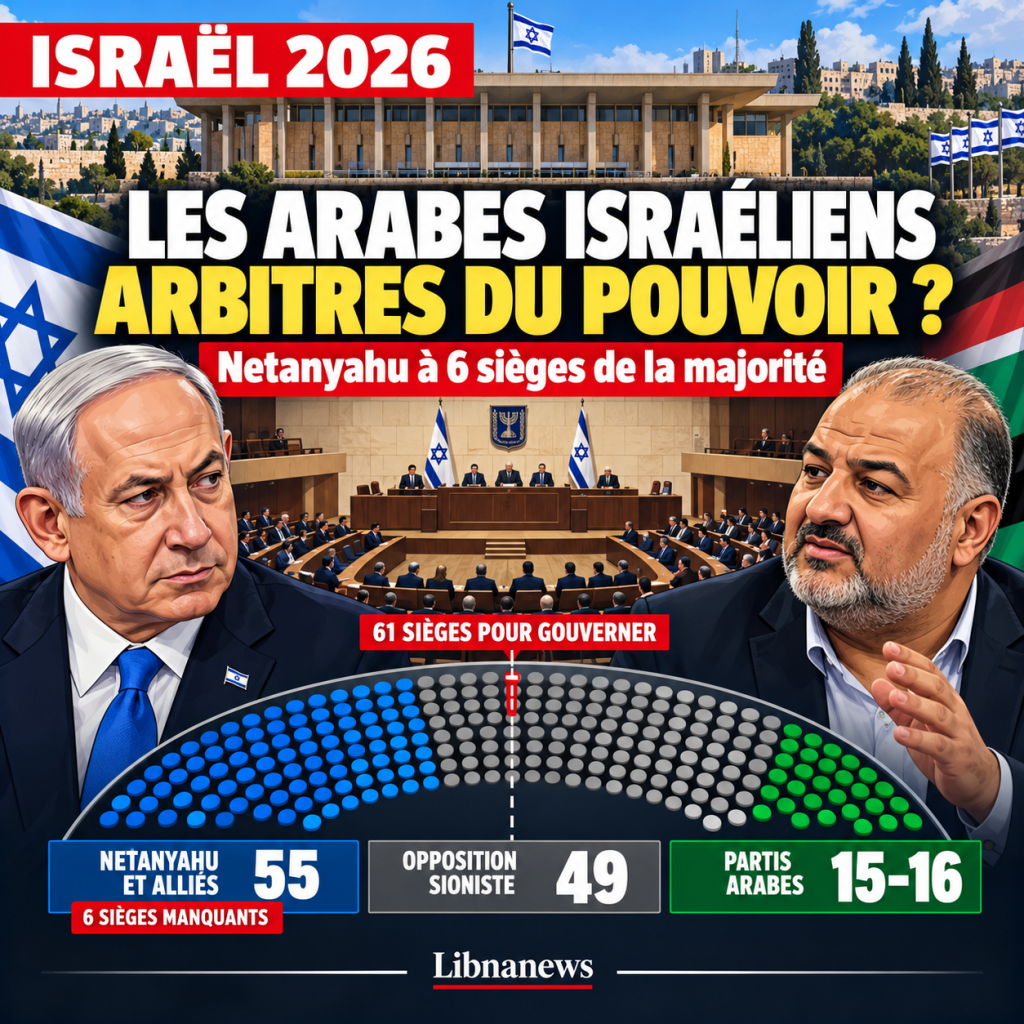
This morning, with more than half of the offices stripped, the image is different. Partial results give around 55 seats to the Netanyahu bloc, about 49 to the opposition and 15 to 16 to the Arab parties.
The figures can still evolve: votes under double envelopes, especially those of the military, are counted later. But one thing is already clear: no one has yet the 61 seats to have a majority in the Knesset.
That’s where the paradox begins.
Arab citizens account for about 21-22 per cent of the Israeli population. For decades, their demographic weight was far greater than their real influence on the formation of governments. Forbearance, political divisions and reciprocal refusal between Arab parties and Zionist parties kept them largely on the periphery of power.
This time, their vote could directly affect the political outcome of the election.
The demonstration is based on a few figures:
120 deputies.
61 to govern.
Netanyahu: about 55.
Zionist opposition: about 49.
Arab parties: about 15 to 16.
Netanyahu is now closer to the majority than the first projections suggested.
But 55 is not 61.
He still misses six deputies.
And until these six deputies are found, the question of Arab parties remains at the heart of the equation.
Let’s take the other side. A Zionist opposition around 49 seats obviously cannot govern alone. But 49 plus 15 or 16 Arab deputies theoretically produce a majority of 64 or 65 seats.
49 + 15 = 64.
49 + 16 = 65.
So arithmetic is simple. Politics is much less.
The Arab parties are not a homogeneous bloc. Mansour Abbas and the Joint List have different strategies. Netanyahu excludes an alliance with them. And several components of the Zionist opposition have themselves placed strong limits on a coalition dependent on Arab parties.
But that is precisely what makes their position interesting.
To influence power, they do not necessarily have to enter the government.
They can support an outside coalition. They may negotiate an abstention. They can bring their votes on certain essential votes. They can also prevent an adverse coalition from having a stable majority.
In other words, they can influence power without necessarily directly exercising power.
The precedent already exists.
By 2021 Mansour Abbas had crossed a historic border when he participated in the Bennett-Lapid coalition. For the first time, an independent Arab party became a partner of an Israeli government coalition.
What was then exceptional could eventually become a structural feature of Israeli policy.
Because the phenomenon goes beyond this election alone.
The more the Israeli Jewish vote is fragmented between several parties and several blocks unable to reach the majority alone, the more the relative weight of Arab deputies increases.
It’s a parliamentary mechanism.
In a Knesset where a block has 70 seats, 15 Arab deputies do not determine who governs.
In a Knesset where the first block has 55 and the second 49, these same MPs become potentially decisive.
They have not become the majority.
It’s the others who aren’t.
And that’s where the demographic weight can turn into political power.
Israeli Arabs vote, pay their taxes, work in the country’s businesses, universities and hospitals, elect their deputies and live daily on the same issues of public services, housing, security and infrastructure as other citizens.
Their parliamentary weight can therefore become a very concrete negotiating instrument: municipal budgets, the fight against crime, schools, roads, housing, employment and economic development.
The reasoning becomes almost contractual:
You need our Members to govern.
We need the state to get our share of budgets, infrastructure and public services.
Thus, a demographic minority becomes a pivotal minority.
However, the current recount provides an essential nuance to this thesis.
If the Netanyahu block progressed up to 61 seats, it would no longer need any external support. The role of arbiter of Arab parties would disappear immediately.
But if it remains around 55 seats, the whole question remains: where can the six missing MPs be found?
And if the opposition wants to form an alternative majority, it too will have to answer a question that some of Israel’s policy has long preferred to avoid: can it govern without any form of cooperation with representatives of about a fifth of the population?
Perhaps this is the real issue raised by this election.
For a long time, we could ask:
What will the Jewish majority of its Arab minority do?
A second question must now be added:
What can a Jewish majority no longer do without it?
The final results will tell whether this issue immediately becomes the issue of the next government or if it is rejected.
But political change is already visible: the more Israel divides itself into similar blocs of force, the more its Arab citizens can acquire a power of arbitration over their parliamentary weight.
The 22 per cent do not govern Israel.
But when no one reaches 61 seats, they can help determine who will be able to govern him.
On one condition, however, that the Jewish parties themselves remain divided.
For a great coalition, or a recomposition between Jewish parties, could always bypass the Arab parties and remove this arbitrariness from them.
That would then be the other paradox of this election: Israeli Arabs may have the key to power precisely as long as the Jewish parties fail to get along.
Bernard Raymond Jabre
Note: article updated on 28 October 2026 based on partial results. The counting is not definitive and the distribution of seats can still evolve.





Comments