

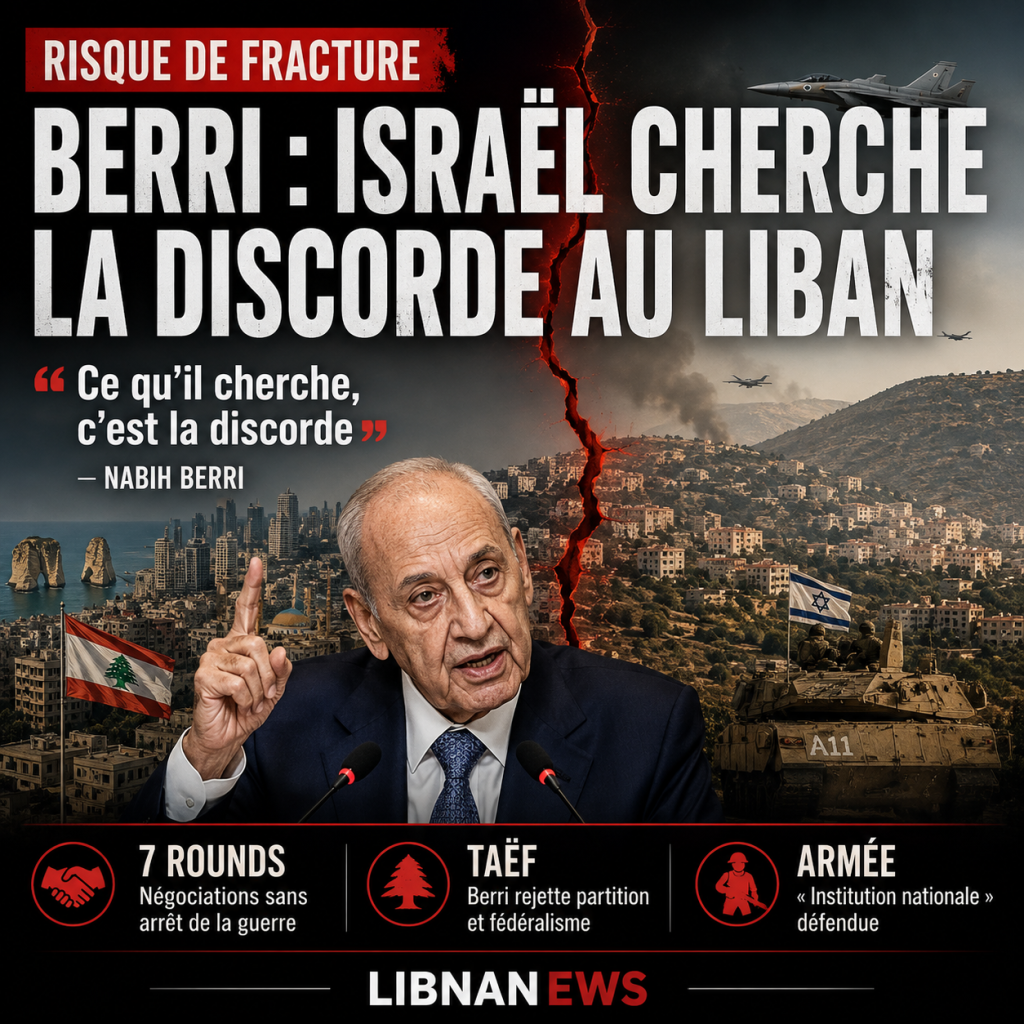
The President of the Lebanese Parliament, Nabih Berri, accused Israel on Monday 31 August of seeking to provoke internal discord in Lebanon rather than to attack only Hezbollah and its arsenal. In a speech on the occasion of the 48th anniversary of the disappearance of Imam Moussa Sadr, the leader of the Amal movement linked this threat to internal political tensions, negotiations with Israel and debates on the institutional future of the country. He also defended the Lebanese army and rejected any questioning of the Taif agreement.
The President of Parliament, Nabih Berri, now places the risk of internal conflict at the centre of his diagnosis of the Israeli strategy in Lebanon. In his speech on Monday, 31 August, he said that Israel was not only seeking to weaken Hezbollah militarily or achieve its disarmament. It gives it a broader objective: to provoke « discord » within the country.
« Israel does not attack Hezbollah and its weapons, neither the Amal movement, nor the Shiite community. What he seeks is discord, » said Nabih Berri. This is one of the main political messages of his speech on the anniversary of the disappearance of Moussa Sadr.
The term used refers, in Lebanese political vocabulary, to the risk of confrontations between communities or political groups. In a country marked by the civil war from 1975 to 1990, this reference is particularly relevant. Nabih Berri thus enshrines the current tensions with Israel in a direct internal issue: the preservation of the political and institutional stability of Lebanon.
Berri accuses Israel of seeking discord
The Speaker of the Chamber therefore did not describe the current conflict as a limited confrontation between Israel and Hezbollah. He explicitly rejected that reading.
His message comes as the issue of Hezbollah’s weapons remains at the heart of political and diplomatic power relations. In particular, Israel makes its withdrawal conditional on measures concerning the arsenal of the Shiite movement. At the same time, the Lebanese authorities are under pressure to restore the state’s arms monopoly and to extend the full authority of the army.
Berri considers, however, that Israeli pressure cannot be isolated from its consequences on the internal balance of Lebanon. By claiming that neither Hezbollah, Amal nor even the Shiite community are the true purpose of the Israeli strategy, it shifts the debate towards the risk of confrontation between Lebanese.
This position extends the warnings he had already issued against denominational tensions. On 27 June, the Speaker of Parliament called on the Lebanese not to fall into the trap of sectarian discord.
The speech of August 31 goes further. It directly associates this threat with the objectives it lends to Israel.
This reading also takes place in a context of deep disagreement on how to deal with the issue of weapons. Part of the Lebanese leadership calls for the State to impose its military monopoly without delay. On the contrary, Hezbollah and its allies maintain that this issue must be dealt with within a national framework and that it cannot be separated from Israeli operations and the maintenance of Israeli positions in Lebanese territory.
Seven rounds of endless war negotiations
Nabih Berri also used the record of negotiations to support his accusation. According to him, the discussions initiated did not reduce the Israeli presence in Lebanon.
» After seven rounds of negotiations, the occupied area expanded and Israel continues its war, » he said.
This statement is aimed directly at the effectiveness of the negotiating process on the situation in southern Lebanon. Berri had already warned against the principle of negotiations as Israeli military operations continued.
The President of Parliament maintains this position. He claims to have exercised his « democratic right » by rejecting the framework agreement and recalls that he warned against negotiations with Israel « under fire ».
The issue is central to the current balance of power. The discussions should theoretically help to establish security arrangements for Israeli withdrawal and the re-establishment of Lebanese State authority in the South. But there are still deep differences on the order in which these measures must be taken.
Berri has for several weeks been defending a sequence in which the cessation of Israeli operations and the withdrawal of Israeli forces occupy a pre-emptive or decisive place. With this in mind, asking Lebanon to unilaterally resolve the issue of Hezbollah weapons as Israeli operations and presence continue would change the balance of obligations.
His speech of 31 August now places this disagreement within an even more sensitive framework: any external pressure that would accentuate internal divisions could, according to his reasoning, fuel the discord sought by Israel.
Lebanese Army at the centre of Berri’s line
At the same time, Nabih Berri provided explicit support to the Lebanese army. He rejected any questioning of his role while the military institution occupied a central position in the security arrangements discussed for the South.
» We categorically reject any questioning of the role of the army as a national institution, » he said. He described it as the protector of the hopes and aspirations of the Lebanese.
This defence of the army complements his warning about internal divisions. Berri thus seeks to distinguish two issues which tend to overlap in the political debate: support for the military institution and disagreement over the political or diplomatic conditions in which it must carry out its tasks.
The army is called upon to strengthen its authority in the areas of the South affected by the security arrangements. However, this mission remains particularly sensitive when Israeli forces continue to operate or maintain their presence in certain areas.
The role entrusted to the army therefore exceeds the military dimension alone. It directly affects the principle of the State monopoly on force, but also the capacity of Lebanese institutions to implement arrangements without being drawn into internal confrontation.
It is precisely this hypothesis that Berri’s speech seeks to rule out.
Taif opposed to partition and federalism scenarios
The President of Parliament linked his warning against discord to the defence of Lebanon’s institutional architecture. It reaffirmed its commitment to the Taif Agreement, which served as the basis for the political settlement ending the civil war.
» We confirm our commitment to the Taif agreement and reject any other project, » Berri said.
He focused on proposals for partition or federalism. According to him, « any call to partition or federalism is incompatible with the Taif agreement » and constitutes « an adventure that threatens the existence of Lebanon ».
These statements give a precise internal dimension to his accusation against Israel. The risk mentioned is not only that of ad hoc confrontations between political parties or communities. Berri also warns against political or territorial fragmentation of the country.
Federalism is regularly debated in Lebanon, particularly in some quarters that consider the current political system incapable of resolving institutional and community crises. Berri rejects this option by placing it in the same set of risks as the partition.
He thus maintained Taëf as a political reference. The 1989 agreement had reorganized power-sharing and paved the way for the end of the civil war. For Berri, leaving this framework in the current period would create an additional risk at a time when military and diplomatic tensions are already weakening the country.
Berri refuses sovereignty arrangements
The President of Parliament has also issued a warning regarding agreements or arrangements that may affect Lebanon’s sovereign prerogatives.
« The present phase, with its existential risks, does not give anyone the right to act on any sovereign issue under any pretext, » he said.
Berri explicitly mentioned the hypothesis of a framework agreement, but also that of « secret annexes » or other devices.
This statement comes in a context where the modalities of security arrangements with Israel are the subject of considerable controversy. Discussions included the guarantees required in Lebanon, the role of the army, the Israeli withdrawal and the mechanism to oversee the implementation of the commitments.
The President of Parliament therefore sets a limit: no negotiated mechanism can, in his view, make it possible to decide sovereign issues without respecting Lebanese political institutions and balances.
This position joins his main argument. If the country’s security decisions themselves become a source of fracture among the Lebanese, they could aggravate the tensions Berri says he wants to prevent.
The South as a State responsibility
The leader of Amal finally insisted on the status of South Lebanon. He affirmed that this region is « an integral part of Lebanon » and that its protection is not only the responsibility of its inhabitants or the political groups that have a strong presence there.
For Berri, the responsibility lies with the State.
This responsibility concerns the preservation of the territory and its population, but also the reconstruction of areas affected by fighting and destruction.
This is an important point in his speech. By making reconstruction a national responsibility, Berri implicitly refuses that the South should be treated as a matter specific to the Shiite community, Hezbollah or the Amal movement.
This approach directly joins his warning against discord. The President of Parliament seeks to present the fate of the South as a national issue in order to avoid a Community reading of the conflict with Israel.
The destruction, displacement and difficulties of return of the inhabitants continue to exert great pressure on this region. The restoration of infrastructure and housing also conditions the possibility of a sustainable return to several localities.
The anniversary of Moussa Sadr as a political cadre
The choice of August 31 gives a special focus to the speech. Nabih Berri spoke on the occasion of the 48th anniversary of the disappearance of Imam Moussa Sadr and his two companions on a trip to Libya in 1978.
Moussa Sadr, founder of the Amal movement and major figure of the Lebanese Shiite community, had also included his political action in the defence of the people of the South and in the participation of the State in their development and protection.
Forty-eight years after his disappearance, his fate remains unsolved.
Berri used this commemoration to send a message that thus exceeds the ranks of Amal. His speech links the defence of the South, the role of the army, the Taif agreement and the refusal of partition around the same priority: to prevent confrontation with Israel from turning into confrontation between Lebanese.
In this regard, Israel’s « discord » approach is the political heart of its intervention. It is tantamount to considering that the management of internal tensions is now an integral part of the ongoing confrontation.
The next step will be in the diplomatic field. Discussions on security arrangements must continue, while there is still complete disagreement over Israeli withdrawal, military operations and Hezbollah’s weapons file. Berri set his course ahead of the next few deadlines: he refused to negotiate which, in his view, would affect sovereignty or expose Lebanon to an internal divide.




