

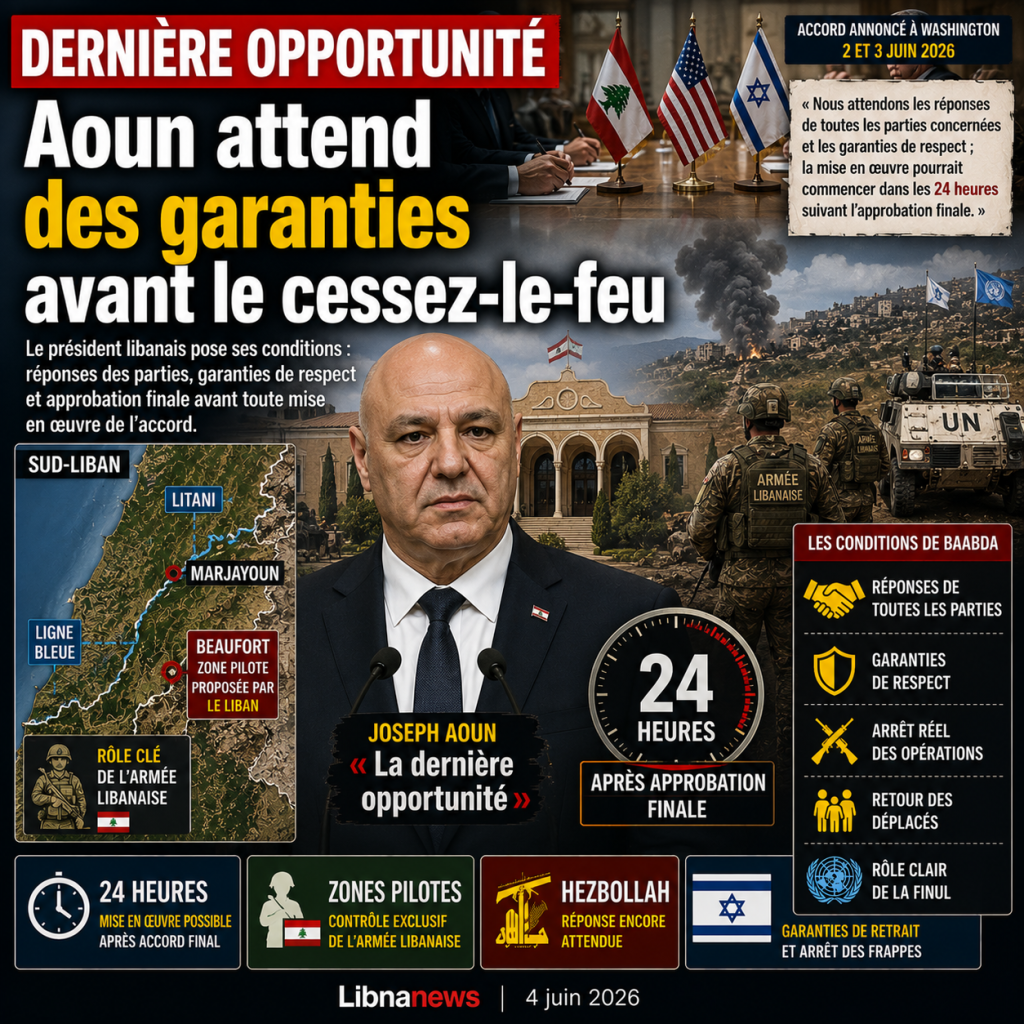
Joseph Aoun presented Thursday, June 4, the ceasefire announced in Washington as a narrow window, but not yet acquired. The Lebanese President stated that the agreement reached the previous day between Lebanese and Israeli representatives, under American mediation, was « the last opportunity » before each party assumed its responsibilities. He also stated that Beirut was still awaiting responses from the parties concerned and guarantees of implementation. According to his remarks reported during the day, « we await the answers of all parties concerned and guarantees of respect; implementation could start within 24 hours of final approval. » This formulation places the Presidency at the centre of a decisive moment. It confirms that Lebanon does not consider the cease-fire to be already implemented, but rather as a mechanism suspended from still uncertain commitments, including Hizbullah and Israel.
A presidential speech between urgency and prudence
Joseph Aoun’s remarks came after two days of discussions in Washington, D.C., on 2 and 3 June, at a fourth high-level trilateral meeting between Lebanese and Israeli representatives. The United States has announced an agreement in principle on the implementation of a ceasefire. The text requires the cessation of hostilities upon the complete cessation of Hizbullah fire and the evacuation of Hizbullah agents from the area south of the Litani River. It also provides for the rapid establishment of pilot areas under the sole control of the Lebanese Armed Forces.
In Beirut, the Presidency chose not to present this announcement as a definitive victory. Joseph Aoun spoke of a possible agreement, but submitted to answers and guarantees. This nuance is essential. It avoids making it appear that the ground has already followed diplomacy. It also allows the Head of State to remain in a traditional Lebanese position: Lebanon accepts the path of negotiation, but calls for a real halt to the fighting, an Israeli withdrawal and return conditions for displaced civilians.
The phrase on the « last opportunity » gives the sequence a political ultimatum dimension. It is addressed to several actors. It targets Israel, which still claims freedom of military action in southern Lebanon. It targets Hezbollah, whose official silence on the agreement keeps uncertainty. It also targets American mediators, who are called upon to transform their text into a binding mechanism. For Joseph Aoun, the failure of the process could no longer be referred to a simple technical difficulty. It would hold each party accountable.
The exact quotations that frame the Lebanese position
In the remarks reported on Thursday, the Lebanese President first determined the decisive character of the moment: « The agreement reached is the last opportunity; Otherwise, each party will have to assume its responsibility. This sentence summarizes Baabda’s line. It does not promise automatic de-escalation. It warns that Lebanon now considers the Washington text as a test. The actors will have to say whether they agree to apply it or whether they are taking the risk of a new phase of war.
Joseph Aoun then specified the possible timetable: « We await the responses of all parties concerned and the guarantees of respect; implementation could start within 24 hours of final approval. The formula is prudent. It does not say that the ceasefire begins in 24 hours. She said he could start after final approval. The President therefore conditions the entry into force of two elements: agreement of the parties and guarantees of respect. It is a way of responding to Lebanese criticism of a text that is considered incomplete.
These statements complement a position already expressed by Joseph Aoun this week. In statements relayed by the National Information Agency, he had stated: » لا 的يار The French translation is clear: there is no other choice than negotiation, and it should not be considered as surrender, concession or defeat. He added that strength lies not in the continuation of war, but in the courage and wisdom necessary to put an end to it through negotiation, in the interests of the country.
This continuity gives coherence to the presidential speech. Joseph Aoun wants to remove the word negotiation from the prosecution registry. He seeks to say that diplomacy does not mean the abandonment of Lebanese rights. The message is aimed at internal opinion, divided between refusal to discuss with Israel, demand for sovereignty and fear of prolonged war. It also targets foreign partners, to whom Baabda recalls that Lebanon cannot sign a text without concrete guarantees.
Washington announces, Beirut expects guarantees
The Washington communiqué states that Lebanon and Israel have agreed to implement a ceasefire. He also mentioned the continuation of direct negotiations to build confidence, resolve outstanding issues and move towards a comprehensive peace and security agreement. This formulation has a strong political significance. It sets up a framework that goes beyond the mere military truce. It opens a sequence where border security, the role of the Lebanese army and Hezbollah weapons will be discussed in a more structured way.
For Beirut, however, this framework remains incomplete. The most specific public obligations concern Hezbollah and the Lebanese camp. The text calls for the complete cessation of fire and evacuation of Hezbollah agents south of Litani. It provides for pilot areas under the sole control of the Lebanese army. However, it does not publicly set an Israeli withdrawal schedule. It does not detail the cessation of Israeli operations. He did not mention a clear mechanism for the return of displaced persons from the South. These absences explain presidential caution.
Joseph Aoun must therefore hold two lines at the same time. The first is to support the principle of negotiation to avoid the enlargement of the war. The second is to refuse Lebanon to enter into a mechanism that would force it alone. His remarks of 4 June show this double requirement. The President agreed to talk about rapid implementation, but linked it to final approval and guarantees. It does not suggest that Lebanon will be content with an American announcement without territorial translation.
Israel still claims freedom of action
The day of 4 June was also marked by Israeli statements that complicated the announcement of the ceasefire. Israeli Defense Minister Yisrael Katz claimed that the army would continue its fire operations and ground operations in southern Lebanon, while remaining in the safe area to the « yellow line », including in the Beaufort Castle area. He also mentioned the lack of return of the population to the areas concerned and the continued dismantling of infrastructure attributed to Hezbollah.
This contradicts the idea of a complete ceasefire. They mean that Israel accepts the principle of an agreement, but retains the possibility of striking, remaining on the ground and preventing the return of civilians to certain areas. For Lebanon, this position is the main dead end of the communiqué. It raises fears of a scenario in which Hezbollah would withdraw, while Israel would maintain de facto occupation in the name of its security.
The Lebanese Presidency cannot ignore this contradiction. If the cease-fire enters into force without a clear halt to Israeli operations, the Lebanese State will be exposed to immediate criticism. He will be accused of accepting a text that requires concessions on the Lebanese side without imposing equivalent counterparts on Israel. Joseph Aoun therefore tries to frame the sequence by requesting guarantees. The 24 hours mentioned will only be credible if accompanied by a real drop in strikes and a verifiable commitment to withdrawal.
Pilot zones at the centre of the test
The pilot areas provided for in the communiqué represent the operational tool of the next phase. They must be under the exclusive control of the Lebanese Armed Forces and exclude any presence of non-State armed actors. Joseph Aoun reported on Thursday that Lebanon had proposed that these areas include Beaufort Castle, a strategic area recently occupied by the Israeli army. In this scheme, Israeli forces should withdraw from the areas concerned and they would be under the control of the Lebanese army.
This is essential for Beirut. A pilot zone cannot be an area administered under Israeli pressure. It must become an area of effective Lebanese sovereignty. This implies the departure of Israeli forces, the presence of the Lebanese army, a clear role for UNIFIL and guarantees of non-attack. Without these elements, pilot areas could be seen as experimental enclaves more than as a return from the state.
The Lebanese army is therefore at the centre of the arrangement. Washington says it wants to build capacity. But the success of its deployment will depend less on diplomatic formulas than on the ground. The army will not be able to control an area if Israel retains freedom of action. She will not be able to convince the inhabitants if they cannot return. It cannot neutralize non-State armed actors if the Israeli withdrawal is not visible. Joseph Aoun’s proposal on Beaufort stresses this requirement: it is not enough to name pilot zones, they must also be freed from any foreign presence.
Hezbollah, absent actor and central condition
Hezbollah has not yet given a clear public response to the Washington agreement. Its official absence from the table complicates the application of the text. The movement refuses direct negotiations between Lebanon and Israel and has already expressed its rejection of any partial ceasefire. However, the communiqué specifically conditions the truce on his behaviour. This situation puts the Lebanese government before a difficult equation: it must engage the state in a logic of sovereignty, while obtaining from an armed non-signatory actor that it respects the conditions.
Joseph Aoun’s comments on « answers from all concerned » seem to be aimed at this node. They suggest that Lebanon also awaits a Hezbollah position, even if the movement is not named as an official party. Without its membership, or at least without its operational silence, the ceasefire will remain fragile. But without Israeli withdrawal, Hezbollah can say that the agreement does not protect Lebanon and that it maintains the justification of its weapons.
The Presidency is therefore looking for a narrow path. She wants to avoid a wider war. She wants to restore the role of the army. She wants to maintain internal unity and prevent the fitna. It also wants to prevent the state being accused of abandoning the South. Joseph Aoun’s quotations on negotiation, wisdom and responsibility take on their political meaning here. They aim to make a diplomatic exit accept without implying a surrender.
Displaced persons, absent but decisive
The issue of the return of internally displaced persons remains one of the major absences from the communiqué. However, it will condition the perception of the agreement in the country. Hundreds of thousands of people have left exposed areas since the beginning of the war. For them, the ceasefire is not measured in a communiqué. He is aware of the possibility of returning, checking the condition of the houses, reopening shops, retaking agricultural land and returning children to school.
The Israeli statements on the lack of return of the population to areas under military control exacerbate this concern. If the inhabitants of the South cannot return, the agreement will be lived as incomplete. It may even be considered an occupation freeze under another name. Joseph Aoun will therefore have to make this issue a central point of the following discussions. The return of displaced persons cannot be returned to a distant phase.
Lebanon needs a concrete mechanism: mapping accessible areas, securing roads, the role of the army, assessing destruction, coordinating with UNIFIL and Israel’s commitment not to hit areas of return. Without this mechanism, the truce will remain diplomatic. She will not become civilian.
UNIFIL affected at the most sensitive time
The death of a UNIFIL blue helmet near Marjayoun, announced on the same day, recalled the violence on the ground. The peacekeeper succumbed to critical injuries following the fall of mortar shells at his position. Two other peacekeepers were injured. The UN mission opened an investigation to determine the exact circumstances of the incident. It also reported a high number of trajectories and impacts in southern Lebanon.
This event comes at the worst moment for negotiators. It shows that the announced ceasefire has not yet produced real security. It also shows that the forces responsible for supporting the implementation of resolution 1701 remain exposed. If UNIFIL is not protected, the pilot areas will find it difficult to operate. If international observers are affected, civilians will not be reassured.
For Joseph Aoun, this incident reinforces the urgency of an effective cessation of fire. It also gives more weight to the demand for guarantees. Lebanon cannot accept an agreement that leaves UNIFIL, the army and the inhabitants caught between continued operations. Resolution 1701 cannot be implemented in half. It implies the withdrawal of unauthorized weapons from the South, but also full respect for Lebanese sovereignty.
Political deadline before 22 June
Political and security discussions are scheduled to resume during the week of June 22. Until then, Joseph Aoun will have to turn his statements into a negotiating position. Lebanon’s demands must be precise: cessation of Israeli operations, withdrawal schedule, maps of pilot areas, the role of UNIFIL, United States guarantees, return of internally displaced persons and the gradual deployment of the army. Without these elements, the ceasefire will remain exposed to the first violation.
The Lebanese President has set the public framework. He said the deal was the last opportunity. He said implementation could start within 24 hours of final approval. He recalled that negotiation is neither surrender nor defeat. These sentences give the Presidency a course of action. They do not yet guarantee the result.
The suite will be played on the ground and in the written guarantees. If Israel maintains its operations, the credibility of the process will be reached immediately. If Hezbollah refuses the agreement, Washington will have to measure the limits of a text concluded without the armed actor it aims at. If the displaced do not return, the population will find the agreement incomplete. For now, Joseph Aoun has opened a diplomatic window. South Lebanon will say whether it is leading to a real ceasefire or to a further arms suspension.




