

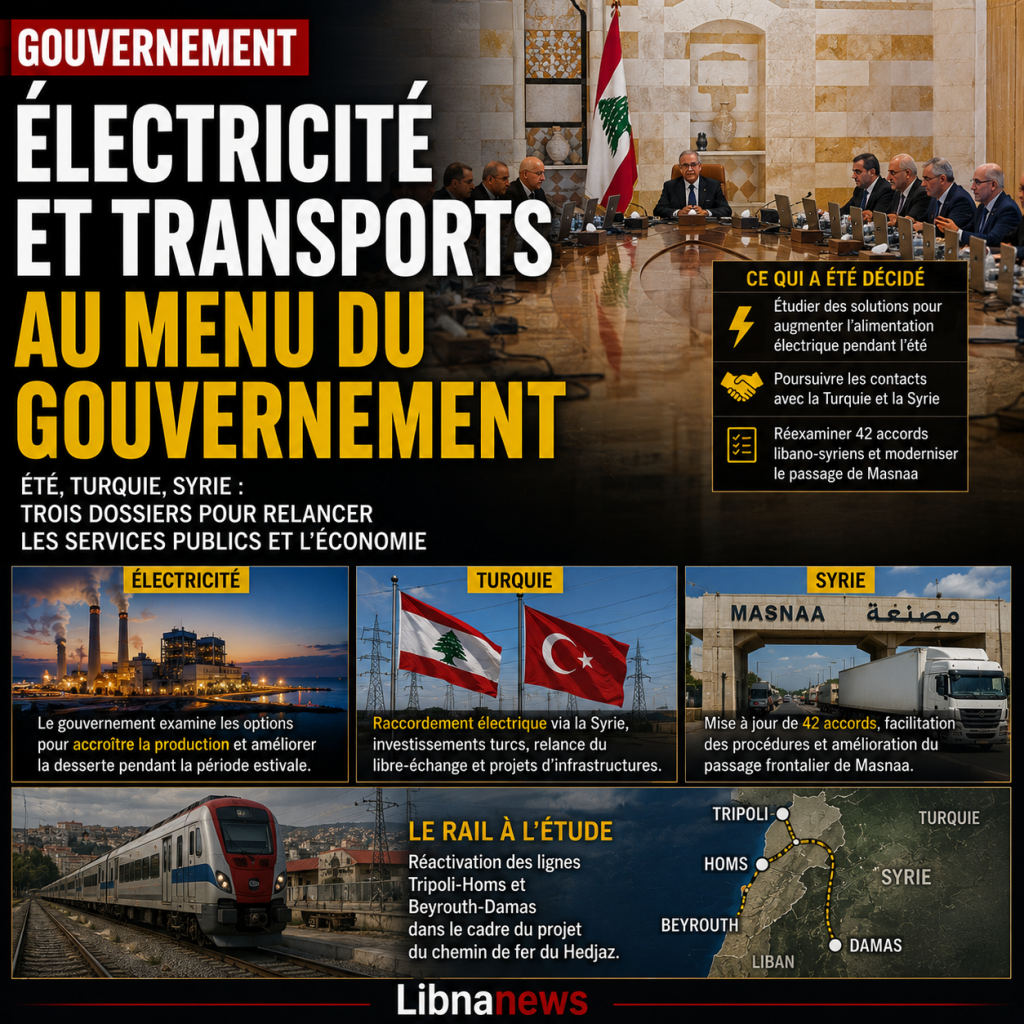
The Lebanese government devoted its weekly ministerial meeting to three issues directly related to public services and regional economic relations: the increase in power supply during the summer, the follow-up of Prime Minister Nawaf Salam’s visit to Turkey and the first results of the move of the Minister of Economy and Trade to Syria. Meeting under the chairmanship of the Head of Government, the small cabinet asked the ministers concerned to continue the contacts with Ankara and Damascus. Discussions focused on electricity in Lebanon, infrastructure, reactivation of railway links, Turkish investment, revision of the Lebanese-Syrian agreements and improvement of the functioning of border crossings. Information Minister Paul Morcos presented these three points after the meeting. He also recalled Nawaf Salam’s position in Turkey: Lebanon intended to maintain the independence of its decision in the negotiations and called for an acceleration of Israeli withdrawal.
Three folders on the weekly appointment menu
On Monday, the Prime Minister convened several members of the government as part of the ministerial meeting organized at the beginning of each week. This approach allows the Cabinet to monitor cases involving several administrations without waiting for a full meeting of the Council of Ministers. Paul Morcos indicated that the participants had focused their discussions on three topics and the operational follow-up to be given to them.
The first concerned the generation and distribution of electricity during the summer period. The second concerned the results of Nawaf Salam’s visit to Turkey, with a political component and several economic projects. The third was devoted to the relocation of the Minister of Economy and Trade to Syria, presented by the Head of Government as the continuation of the work undertaken with Damascus after the resumption of the joint commission.
The meeting did not result in the announcement of a detailed timetable for each of these projects. However, it has established a method. The Lebanese ministers will have to take over the files with their foreign counterparts, each in its own field. The administrations concerned will also have to review existing legislation, identify technical obstacles and prepare decisions that are the responsibility of the government.
This organization shows that official travel should not remain limited to general statements. The Prime Minister now calls for sectoral follow-up. The Ministries of Energy, Public Works, the Economy, Trade and Transport are among the actors directly concerned with the routes mentioned.
Electricity in Lebanon at the centre of the meeting
The first topic was the strengthening of power supply during the summer. At the end of the meeting, the Government did not communicate the number of overtime hours it wished to provide or the financial means it had chosen. He announced the study of available solutions to improve service during a period when consumption increases with high heat, use of air conditioning and tourist activity.
The file involves several constraints. Any increase in production requires a sufficient supply of power plants, available credits and a technical capacity of the grid to transport electricity. It also involves coordination between the Ministry of Energy and Water, Electricity of Lebanon and other facilities operating services.
The ministerial meeting placed the summer emergency ahead of longer-term regional projects. The government must first determine which measures are immediately applicable. It then needs to consider options that can reduce cutbacks on a sustainable basis and diversify supply sources. The record does not specify whether new fuel purchases, temporary contracts or demand management measures were discussed.
The improvement of public supply also remains linked to Lebanon’s electricity revenues, the collection of invoices and the reduction of losses. These questions were not included in the detailed statement by Paul Morcos. However, they will have to be taken into account if the government wants to avoid a one-time increase in summertime followed by a further fall in production.
A project to link Turkey, Syria and Lebanon
Nawaf Salam’s visit to Turkey brought back a project of electrical connection between the three countries. The Prime Minister spoke with President Recep Tayyip Erdogan about a connection through Syria. Such a mechanism would aim at bringing electricity to Lebanon from the Turkish network, subject to the availability of the lines and agreement between the three governments.
The project requires a thorough technical review. The teams will have to assess the state of infrastructure on Syrian territory, the interconnection capacity and the work required to the Lebanese network. They will also have to determine the quantities available, the cost of electricity, the transit costs and the methods of payment.
No date of commissioning was announced. The dossier therefore remains at the stage of political and technical follow-up. Nevertheless, the Lebanese government wants to use the resumption of trade with Ankara and Damascus to explore a regional solution. It would not replace Lebanese power plants, but could complement domestic production if conditions of transport and financing were met.
The competent ministers will now have to establish direct contacts with their Turkish counterparts. The Lebanese Ministry of Energy will be responsible for examining the feasibility of the connection. Other administrations will intervene for transit agreements, contractual guarantees and financial transactions necessary for a possible purchase of electricity.
Technical and contractual barriers to be addressed
Crossing Syrian territory places Damascus at the centre of the project. Lebanon and Turkey cannot establish this connection without a tripartite agreement on the use of the network. The three parties will have to define their responsibilities in the event of a breakdown, loss on the lines or interruption of supply.
Infrastructure security will also need to be addressed. Power lines across several regions require regular maintenance, protection and repair. The technicians will have to establish a precise condition of the equipment before setting a volume of transit.
Another issue to be addressed is funding. The Lebanese Government will have to know the final price of the kilowatt hour delivered at the border and then calculate its cost after transport and distribution. Negotiations should specify the currency of payment, the guarantees requested and the duration of a possible contract.
The Monday meeting did not resolve these issues. It gave Ministers a mandate to continue the work. The first expected results will therefore be feasibility studies, technical meetings and, where appropriate, a draft agreement submitted to the governments concerned.
Salam reaffirms the independence of the Lebanese decision
The political aspect of the visit to Turkey was also presented to Ministers. Nawaf Salam claimed that Lebanon would retain the independence of its decision in the negotiations. This position is intended to recall that the discussions initiated by Beirut must be conducted by the Lebanese institutions and according to the interests defined by the State.
The Head of Government also stressed the need to speed up the Israeli withdrawal. This request is one of the priorities defended by the Lebanese authorities in their international contacts. Ankara was thus called upon to support Beirut’s position and efforts to end the Israeli presence in the areas concerned.
Paul Morcos did not detail the Turkish response on this point. However, the report shows that the visit was not limited to economic projects. It linked sovereignty and security issues to discussions on energy, transport and investment.
The Government wishes to maintain this dual approach. It seeks diplomatic support while opening concrete economic issues. Ministers must now transform political exchanges into administrative contacts, particularly for projects requiring intervention from several countries.
The Hedjaz railway returns in trade
The Prime Minister was also interested in a memorandum of understanding between Turkey and Saudi Arabia on the Hedjaz railway. He discussed the possibility of reactivating two links directly related to Lebanon: Tripoli-Homs and Beirut-Damas.
These railway lines cannot be put back into service by a simple political decision. Tracks, stations, rights-of-way and equipment must be evaluated. Part of the infrastructure is no longer operational for a long time. The authorities will therefore have to determine the existing sections, those requiring reconstruction and the land whose status needs to be clarified.
The Tripoli-Homs link could provide an outlet for the port of Tripoli and facilitate the transport of goods to Syria. The Beirut-Damas line would restore a rail connection between the two capitals. In both cases, the project involves close cooperation between the Lebanese and Syrian administrations and substantial funding.
The interest expressed by Nawaf Salam is not yet a launching decision. However, it places the rail on the agenda that Lebanon wants to discuss with its partners. Follow-up will be carried out by the Ministries of Public Works and Transport, with the agencies responsible for railways and ports.
Links to be included in a transport strategy
Reactivation of lines could serve several purposes. The freight would transport agricultural, industrial and material products. Passenger traffic could be studied in a later phase, depending on the state of infrastructure, border controls and identified needs.
The government will have to choose between a complete restoration of the old roads and the creation of new sections that meet current standards. It will also have to decide how to operate, how to charge and how to allocate revenues between the countries crossed.
Customs procedures should be adapted to rail transport. Cargoes cannot remain blocked at each border for long periods. The authorities will have to provide for control systems, common documents and tracking mechanisms for goods.
No financial estimates were reported at the press briefing. Ministers are therefore still expected on the preliminary studies. These will need to specify the cost, duration of the work and the potential partners for funding.
Turkish investment targets infrastructure
Nawaf Salam also discussed Turkish investment in Lebanon, particularly in the infrastructure sector. The Government is seeking to attract companies that are able to participate in transportation, energy, construction and utilities projects.
The record does not mention a signed contract or an amount committed. It indicates an interest and the opening of follow-up between ministries. Lebanese officials will have to submit defined projects with clear legal and financial conditions. Investors will need to know the bidding rules, guarantees and administrative deadlines.
The government also wants to relaunch the free trade agreement between Lebanon and Turkey. This will require a review of current trade, tariffs and sectors exposed to increased competition. Importers can benefit from a reduction in barriers, while Lebanese producers will demand guarantees on access to the Turkish market.
Ministers will therefore have to consult with economic actors. Chambers of commerce, industrialists, farmers and transport companies will be directly involved. The relaunch of a trade agreement can produce balanced results only if the rules of origin, standards and customs procedures are clearly established.
The visit to Syria produces a first ministerial follow-up
The third case concerned the relocation of the Minister of Economy and Trade to Syria. Nawaf Salam felt that the visit was beginning to produce concrete results. It intervened after its own visit to Damascus and after the launch of a joint Lebanese-Syrian commission.
The Minister of Economy said that 42 agreements exist between Lebanon and Syria. These texts must now be reviewed by the relevant ministers. Each member of the government will study those within their sector to identify the provisions that are still applicable, those that need to be amended and those that no longer meet current needs.
This revision potentially covers many areas. Agreements may concern trade, transport, agriculture, energy, border crossings or administrative cooperation. The government did not publish the complete list at the press briefing. However, it chose a sector-specific approach rather than a single department-wide review.
The work of the Joint Committee should be based on these assessments. Ministers may propose the reactivation of certain texts, the negotiation of amendments or their replacement by new agreements. Final decisions will have to follow legal procedures in each country.
Forty-two agreements to be reviewed
The number announced shows the extent of the bilateral framework accumulated over the years. It does not mean that all 42 agreements are implemented. Some may be suspended, incomplete or outdated. Others may require the designation of functional commissions that have no longer met.
The revision should begin with a specific inventory. Each department will have to verify the date of the text, its purpose, its performance and the obligations it creates. It will also need to determine whether legislative or administrative changes that have occurred since its signature prevent its implementation.
The Ministry of Economy will have to follow trade agreements and the rules governing the movement of goods. The Ministry of Public Works will examine transport and infrastructure. The Ministries of Agriculture and Energy will intervene on matters within their competence.
The government will then have to set priorities. Texts that can rapidly improve trade can be dealt with first. Agreements that incur significant spending or complex reforms will require more time. The next ministerial meetings are expected to monitor the progress of this inventory.
Masnaa’s passage among the priorities
The Minister of Economy also discussed the operation of border crossings in Syria, including Masnaa. Discussions focused on the revision of port, road and administrative procedures to facilitate traffic.
Masnaa is an essential point for movements between Beirut and Damascus. Timeliness, documentation requirements and inter-service coordination directly affect the cost of transportation. A lengthy procedure increases business spending and slows the delivery of goods.
However, the authorities must reconcile fluidity with customs and security requirements. Simplification does not mean the removal of controls. It can involve better coordination of schedules, digitisation of documents, reduction of repetitive formalities and exchange of information between administrations.
The term port procedures mentioned in the report also refers to the processing of goods transiting through Lebanese ports before reaching Syria. Both countries may seek to harmonize the formalities between arrival at port and crossing the land border. This coordination is of particular interest to carriers and importers.
Facilitating trade without delay
An improvement in the Masnaa crossing would require concrete decisions. Governments could establish joint monitoring teams, set indicative deadlines and establish dedicated freight windows. They could also review the required documents to avoid multiple requests for the same information.
Truck processing must also be organised. Queues, successive checks and different times between the two sides can slow down traffic. Operational coordination would reduce these bottlenecks without reducing checks.
Companies will most likely expect regular application of the rules. Clear procedures lose their effectiveness if they change without notice or if their interpretation varies by service. Ministerial follow-up should therefore include administrations in the field.
No new action was announced immediately after the meeting. Exchanges in Syria must now be translated into proposals. The first indicators will be the holding of technical meetings, the publication of new procedures and a measurable evolution of time limits at border crossings.
The same method for three construction sites
The three files reviewed have different schedules. Electricity requires quick responses for the summer season. Regional connections and rail links require studies and agreements between several States. The revision of economic relations with Syria requires administrative work on dozens of texts.
The government chose to entrust the follow-up to sectoral ministers. This method is intended to prevent announcements made during official visits from remaining unimplemented. However, it requires regular monitoring, deadlines and coordination since the Council Presidency.
Paul Morcos announced no new committee or date for a next public evaluation. However, the weekly appointment can be used to hold departments to account. Each official should indicate the contacts made, the documents received and the difficulties encountered.
Future developments should first concern summer electricity measurements, then technical exchanges with Ankara and Damascus. The Government is also awaiting an inventory of the forty-two Lebanese-Syrian agreements and proposals on Masnaa, while the electricity and rail reactivation projects remain subject to further studies.




