

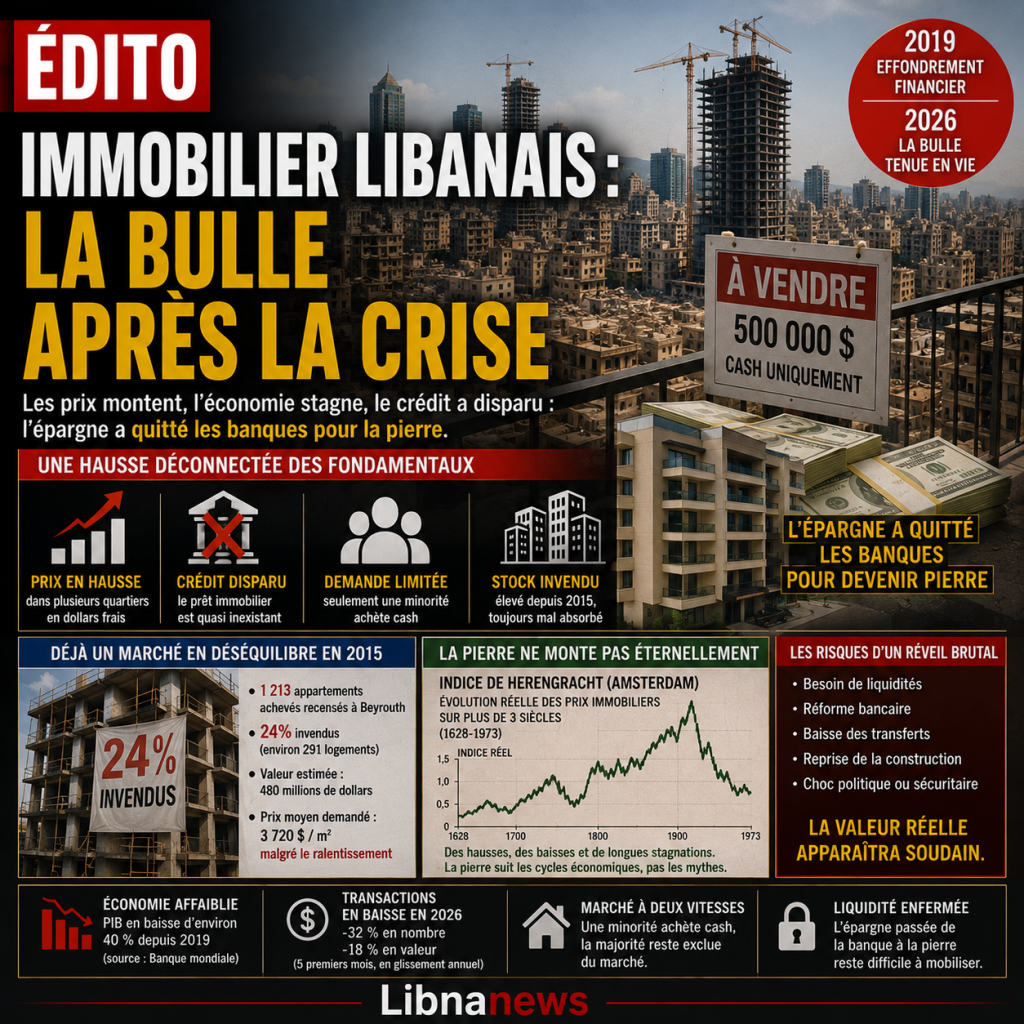
The financial collapse of 2019 did not create the Lebanese real estate crisis. It has transformed an imbalance already visible since 2015 into a forced refuge for private bank savings. Ten years later, the paradox remains complete. Prices are increasing in several neighbourhoods and transactions in fresh dollars give the impression of a return to life market. However, the economy remains weakened, real estate credit has virtually disappeared and the old stock has never been properly absorbed. Real estate still receives part of the capital that no longer trusts the banking system. This demand for protection supports the values, but it does not re-create income, purchase loans or mass market. The Herengracht index, which follows centuries of real estate prices in Amsterdam, recalls that stone does not rise forever in real terms. In Lebanon, the question is no longer whether prices are disconnected from fundamentals. It is to know how long this disconnection can last and what event will suddenly make visible the real value of a stock today not very liquid.
In 2015, almost one new apartment out of four unsold
By 2015, the market had already ceased to function normally. The prices posted still resisted, but sales slowed down, delays extended and promoters increased discreet discounts. A study of 56 completed projects in 51 neighbourhoods in Beirut identified 1,213 apartments completed. Approximately 24 per cent remained unsold, or close to 291 dwellings, valued at $480 million. The sales rate had fallen to 76 per cent, from 78 per cent in 2013 and 82 per cent in 2012. The average price charged for an apartment under construction on the first floor was still $3,720 per square metre, despite an annual decrease of 4%.
These figures covered only buildings listed in municipal Beirut. They did not include the entire enlarged capital, the Metn, the Kesrouan, or areas where major projects had grown after the boom from 2007 to 2010. The actual stock was therefore higher. A university study published in 2015 mentioned up to 50,000 empty luxury apartments in Beirut. This estimate, much higher than the completed project censuses, must be handled with caution: it included vacant housing, not just new units officially offered for sale. However, it was a central problem: Lebanon was building a much richer and much larger clientele than the one actually present.
The slowdown was also visible in the activity indicators. Real estate transactions declined by 7.2 per cent in 2013 and their value by 3.4 per cent, before a slight rebound in 2014. Building permits and cement deliveries then signaled a further loss of speed. The market did not collapse, as sellers refused to drop their prices. He was blocking himself. Volumes decreased before the values displayed, a classic phenomenon in real estate when owners, banks and developers all have an interest in not recognizing a correction.
When an economic alert becomes a lack of patriotism
It was at this time that an altercation on social networks summarized, better than a report, the psychology of the sector. The economist, JJ, discussed the deterioration of demand, the gap between prices and incomes, dependence on subsidized credit and the accumulation of projects. A very active promoter, engaged in several developments, had not replied to the figures. He had accused me of not being patriotic and not supporting Lebanon.
I told him that patriotism does not flow an unsold apartment. It does not transform a salary of two thousand dollars into the ability to buy a five hundred thousand dollar dwelling. Nor does it repay the bank when sales stop. I added that many BTP and promotion companies were run by engineers, sometimes excellent in their field, but not by economists trained to read a cycle, solvent demand, liquidity risk or credit reversal.
It was not a question of opposing two professions. An engineer knows if a building can be built, with what materials, within what time and at what cost. An economist asks if the same building can be sold, to whom, with what funding and at what real price. Lebanon had a lot of answers to the first set of questions and very little to the second. The building could be technically successful and economically unsold.
The criticism was nevertheless treated as an attack on the country. This confusion allowed us to maintain a fiction: since Lebanese love property, prices cannot fall. But the desire to own is not worth buying. The scarcity of land does not cancel disposable income. The diaspora does not replace an internal market indefinitely. An apartment may be rare, well located and nevertheless too expensive to find a tenant.
What the Herengracht index shows
The Herengracht index illuminates this point. Built on the basis of transactions on a prestigious Amsterdam canal between 1628 and 1973, it shows that real real estate prices are growing much slower than their nominal trajectory. Over more than three centuries, they have experienced increases, decreases and long stagnations. After adjusting for inflation, the stone did not offer a continuous rise. It has mostly reflected wars, credit, income, demography and currency crises.
Lebanon has long confused nominal price with real wealth. This error became spectacular after 2019. When banks blocked deposits, savers bought apartments with bank checks that became hard to convert. They sometimes agreed to pay a high facial price to turn an uncertain bank debt into tangible assets. The seller received a « bank dollar » that was not worth a dollar available. The transaction could be recorded at $500,000, while the actual economic value exchanged was much lower.
This rush was not a return to residential demand. It was a heritage rescue operation. The saver did not always choose real estate because he anticipated a high return. He was trying to get out of the bank. The stone became a replacement safe, at a time when the bank safe had ceased to function.
This forced demand absorbed part of the stock. It also protected facial prices and reinforced a bubble already present before the crisis. Assets were not purchased through increased income, economic growth or a dynamic mortgage market. They were purchased because other savings instruments had lost credibility. This mechanism supports the price as long as the liquidity holders seek an exit and the sellers refuse to adjust their expectations.
Current increase difficult to measure
The increase observed today should therefore be interpreted with caution. Lebanon still does not have a reliable national index based on repeated sales and adjusted housing characteristics. Land registry data measure the number and reported value of transactions, but they do not always indicate whether the same type of property has actually been valued. A market can record more costly sales because the composition of transactions changes, without all housing gaining the same value.
In 2025, transactions rebounded sharply from a depressed base, and the first months of 2026 showed more hesitant activity. The first five months of 2026 totaled approximately 19,000 transactions, accounting for nearly $2 billion, a decline of nearly 32 per cent per year in number and 18 per cent in value according to the land data collected by bank research services. This divergence is revealing: fewer transactions, but a higher average amount. It may reflect a concentration on expensive goods and buyers with fresh dollars, not a general resumption of demand.
In several neighbourhoods of Beirut, Metn and areas sought by the diaspora, the prices charged went up. This increase is based on four factors. The first is the dollarization of transactions. The second is the refusal of the owners to sell at a loss after the monetary collapse. The third is the relative scarcity of new projects, with many promoters suspending their projects. The fourth is the arrival of capital seeking tangible assets outside the banking system.
None of these factors demonstrate a healthy recovery. Gross domestic product has experienced a cumulative contraction of nearly 40% since 2019 at the end of 2024. The income of a large part of the population remains well below housing prices. The Bank of Lebanon itself recognizes that bank real estate loans remain suspended or severely limited, that subsidized programmes have disappeared and that purchasing power continues to reduce demand.
Prices backed by a moribund economy
The Lebanese real estate market thus presents a major anomaly. The values demanded are increasing in some sectors, while the productive economy remains unable to generate the income needed for their acquisition. The increase is not mainly due to wages, growth or credit returns. It comes from the fear of the bank, the need to protect capital and the concentration of purchases in the hands of a minority with fresh dollars.
This increase can be described as partially artificial. It does not mean that the goods concerned have no value. It means that their price is driven by a demand for shelter, not a large and sustainable residential demand. The same phenomenon can occur on gold, currencies or works of art when a financial system loses public confidence.
The price then becomes the result of a particular rarity. Housing is not necessarily lacking. There is a lack of recent housing that their owners agree to sell, goods adapted to the needs of buyers and sellers forced to adjust their claims. A small amount of transactions in fresh dollars is sufficient to establish new references, then applied to the entire neighbourhood.
An apartment sold very expensive on a street in Beirut can push ten owners to raise their prices. This does not mean that ten buyers exist. The display market is growing faster than the transaction market. As long as volumes remain low, a few transactions may give a misleading impression of a general increase.
Real estate credit almost disappeared
The sector now operates without its main historical driving force: credit. Before 2019, a household could bring a fraction of the price and finance the rest over fifteen, twenty or thirty years. Today, the purchase often requires immediate fee dollars or instalment payments directly from the sponsor. The market is aimed at a minority: diaspora, cash holders, investors who have recovered funds from outside banks or households assisted by their families.
This disappearance of the mortgage prevents the normal disposal of the stock. Housing at $300,000 is not only expensive. It becomes inaccessible to almost any household unable to pay cash. The displayed price can therefore increase while the liquidity of the asset decreases. The owner is richer on paper and less able to sell quickly. It is one of the most dangerous forms of heritage illusion.
Banks no longer have the confidence, sound balance sheets or the long resources needed for a normal resumption of financing. They still manage the consequences of losses accumulated since 2019. Government subsidized loan programmes that formerly supported demand have also disappeared. The promoter must therefore finance schedules himself or expect buyers able to pay cash.
The result is a two-speed market. A minority buys cash. The majority remains excluded. Transactions can show large amounts, but they are not a normal real estate market. A healthy market allows a household’s future income to finance its housing. The current system requires that the buyer already owns almost the entire sum.
Savings left an illiquidity for another
Refugee savings in real estate are thus blocked. She left an illiquid bank to enter an illiquid asset himself. The difference is important because the owner now owns a real property. But he cannot necessarily sell it at the expected price. It must wait for a buyer with cash, accept a discount or retain a dwelling whose rental yield may remain low.
This immobilization is often underestimated. A depositor who owned $500,000 in bank could expect to gradually withdraw his money or transfer it. The owner of an apartment valued at the same amount cannot sell a room when he needs $50,000. He must dispose of all the property, borrow against it — which the banks no longer normally do — or wait.
Real estate has saved a heritage value, but it has also frozen capital. A portion of Lebanese savings remains locked in empty, low-rented or overly expensive apartments during the conversion phase of bank deposits. This saving does not finance companies, industry, technology or infrastructure.
The movement of capital towards the stone limited the individual losses of some depositors. At the same time, it strengthened the misallocation of resources. A impoverished country maintains considerable amounts of uninhabited housing, while its productive sectors lack financing.
An unsold stock that is still impossible to identify
The unsold stock is difficult to measure today. There is no comprehensive public census of unsold new apartments, vacant housing, goods withdrawn from the market and units purchased as a value reserve but never occupied. This lack of data contributes to the fiction of solid prices. A transparent contract would publish the number of months required for sale, the vacancy rate, actual discounts and the share of credit-financed transactions. Lebanon has mainly requested prices and declared values.
The scarcity of new buildings can mask the old surplus. When developers stop building, the new offer decreases. Recent and well located goods can then be sold more expensive, even if thousands of old units remain empty or inadequate. The market is segmented: some liquid products are growing, while a mass of housing too large, too expensive or poorly located remains immobilized.
The stock must also be distinguished according to its nature. An unsold apartment in a new building does not pose the same problem as a dwelling purchased as a valuable reserve and kept empty. In the first case, the promoter is still seeking to recover its investment. In the second, the owner can wait for years without publishing adverts.
This invisible offer prevents the proper measurement of the pressure that might appear if owners suddenly needed liquidity. Thousands of goods considered to be withdrawn from the market could return to sale simultaneously after banking reform, economic shock or a change in household needs.
When can the real estate bubble burst?
The question of a bubble burst cannot receive a date. A real estate bubble does not always end with a sharp and visible fall. It can deflate for years through inflation, price stagnation in dollars, erosion of real rents and the absence of transactions. In Lebanon, this slow scenario is already underway for part of the park.
A clearer correction could be triggered by several events. The first would be a banking reform requiring certain actors to sell real estate guarantees or recognise losses. The second would be a need for liquidity for households that have placed their savings in stone and can no longer wait. The third would be a weakening of diaspora transfers. The fourth would be a resumption of construction which would increase supply in the most sought after segments. The fifth would be a political or security shock affecting trust.
Conversely, the market can remain suspended for a long time. Lebanese owners have often had little debt on their property since the credit disappeared. They are therefore not under the same pressure as a US or European household faced with an increase in rates. Until they need to sell, they can maintain a high price. This rigidity reduces the volume of transactions and delays the discovery of the real price.
The paradox is that the absence of a bank prevents both the healthy rise of the market and its rapid adjustment. Without credit, mass demand disappears. Without margin calls, numerous seizures or regular refinancing, sellers are not forced to decline. The market remains frozen between ambitious prices and few solvent buyers.
The day the market will have to recover a real price
Exit requires three reforms. The first is a credible resolution of the banking crisis, so that savings become mobile again and loans can gradually resume on a sound basis. The second is the creation of an independent real estate index, based on the prices actually signed, the method of payment, the location and characteristics of the property. The third is a housing policy that favours income-friendly surfaces rather than products designed as safes.
Until these conditions are met, the current increase will remain partially artificial. She will tell more where the money goes than what the economy produces. The market will be able to display more expensive square meters in the middle of an impoverished country, precisely because the bank no longer fulfils its role and the stone absorbs the mistrust.
In 2015, the sector refused to hear that prices had exceeded market capacity. In 2019, the frozen savings gave a second breath to this overvaluation. In 2026, the banking system still does not finance the buyer who would allow for the sustainable disposal of housing. The next move will depend less on a patriotic slogan than when the holders of these assets want, or will have to, find cash.
References and links
- Lebanese real estate market study in 2015: 1,213 completed apartments registered in Beirut, of which 24 per cent were unsold, valued at $480 million.
- Sector report by Bank Audi on the evolution of prices, transactions, building permits and deliveries of cement in 2015.
- BankMed’s analysis of the 7.2% decrease in real estate sales in 2013 and the 3.4% decrease in their value.
- University study suggesting an estimate of about 50,000 empty luxury apartments in Beirut, a figure to be distinguished from the only officially unsold new stock.
- Bank of Lebanon macroeconomic review on the suspension of real estate loans, the end of subsidized loans and the continuing weakness of demand in 2024 and 2025.
- Land data on transactions in the first five months of 2026: annual decline in the number and total value of transactions.
- World Bank: a cumulative contraction in the Lebanese economy close to 40% since 2019 at the end of 2024.




