

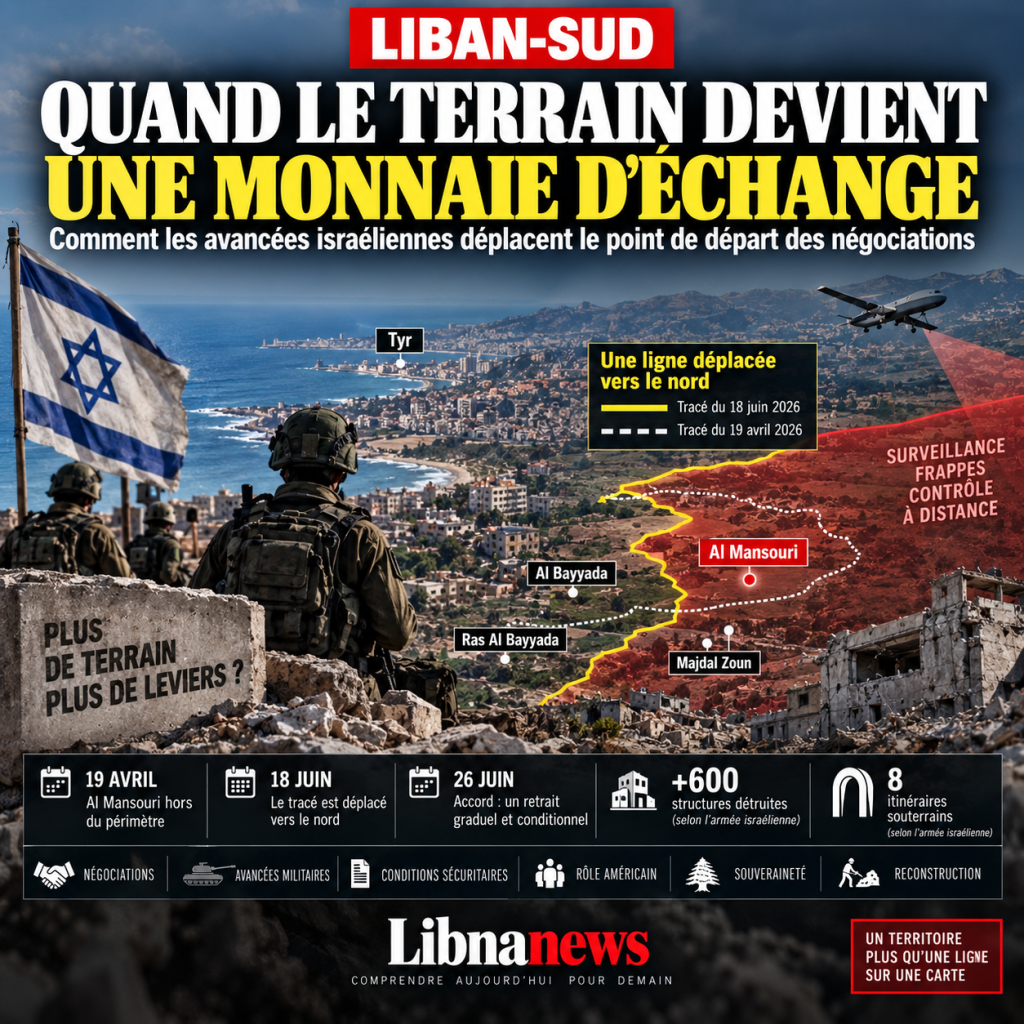
A negotiation that does not start at the border
The problem posed by the discussions on the Israeli withdrawal from the South is not only the slow pace. It is the point from which they begin. The agreement of 26 June 2026 did not establish an immediate return of Israeli forces to the international border. It has installed a gradual mechanics, with so-called experimental sectors, a gradual transfer of responsibilities to the Lebanese army and an Israeli withdrawal linked to security measures. In this system, the geography of the day when application begins becomes decisive. If a force advances before the agreement is reached, the new military position will then enter the perimeter from which its withdrawal will be discussed. The territory conquered or placed under control then ceases to be only a tactical gain: it becomes a variable of the diplomatic calendar.
The case of Al Mansouri illustrates this mechanics with unusual precision. On 19 April, the locality was not included in the first map of the area imposed by Israel after the war. On 18 June, the route defining the Israeli space for action was moved north in the western sector towards Al Bayyada, Majdal Zun and Al Mansouri. A Lebanese military official indicates that the latter has just been integrated into the area of occupation. Eight days later, the June 26 agreement formalises a gradual withdrawal process. The succession of dates is more important than any interpretation: extension of the perimeter, transformation of the military situation, and the opening of a mechanism in which this new situation becomes the practical basis for the next steps. There is no evidence that progress was decided solely to make a trading card. On the other hand, its effect on negotiations is tangible.
« Experimental zones » that transform withdrawal into measures
The formula adopted on 26 June profoundly changes the nature of the withdrawal. It is not a single movement in which Israel would evacuate all positions and the Lebanese army would deploy simultaneously. The process starts with test sectors. Israeli officials link the continuation of the withdrawals to the action of the Lebanese army against Hezbollah’s military infrastructure. The mechanics thus become sequential: a Lebanese measure must be observed, verified or deemed sufficient before a new Israeli measure takes place. This principle can be summarized by an equation of fact: Lebanese steps against Israeli steps. It is no longer just a question of knowing where the recognized border is, but what conditions must be met for the Israeli army to abandon a position within Lebanese territory.
This architecture creates an asymmetry. Lebanon regards the occupied areas as territories in which the authority of the State must be restored. At the same time, Israel treats them as areas that guarantee its security until certain conditions are met. The same square kilometre therefore has two opposing political statutes: for Beirut, it is a territory whose withdrawal is due; For Israel, it can become a lever for obtaining changes in the Hezbollah military apparatus. The longer the Israeli perimeter is extended at the time the mechanism begins, the more the number of areas that can be restored in stages increases. It is here that the advance ahead acquires a bargaining value, even when it was initially motivated by operational considerations.
Al Mansouri: the most legible precedent
Al Mansouri is particularly instructive because the timeline is documented. The village is located south of Tyre, at the junction between the coast and the reliefs that extend inwards. It was not part of the first Israeli perimeter in April. Its integration takes place on the eve of the agreement. Then the Israeli army led a several weeks operation in the area. On 28 September, it announced that it had engaged a brigade-level force, with elements of the 55th Brigade under the command of the 91st Division and engineering specialists. It claims the destruction of more than 600 military structures, eight underground routes and dozens of launch devices. These figures are those of the Israeli army and do not constitute an independent assessment. They nevertheless show the importance attributed to the locality in its own reading of the terrain.
The value of Al Mansouri does not lie solely in the infrastructure Israel claims to have found there. The town extends northward a set formed with Ras Al Bayyada and Majdal Zoun. The first sector controls a part of the coastal axis from Naqurah; the second gives depth on the hills; Al Mansouri brings this device closer to the southern area of Tyre. An Israeli military study of the western sector during the 1982 war recalls the permanence of this geographical constraint: the heights and entrances between coastline and relief allow the monitoring and cutting of the axes without occupying each portion of the land. The technological means of 2026 give this old logic a new efficiency. A position can be physically evacuated while under observation and threat of strike.
Can withdrawal become a concession in a territory that was to be evacuated?
It is the political heart of the problem. When an army withdraws from an area it has just taken, it can present its movement as the execution of a compromise or as a measure conditioned by adverse behaviour. For Lebanon, the reading is the opposite: the evacuation of an occupied territory is not a territorial concession but the restoration of a normal situation. The two narratives can thus describe exactly the same movement in opposite ways. This divergence becomes particularly important when withdrawals are split. Each rendered sector can be associated with a Lebanese step, gradually transforming a withdrawal obligation into a series of operational exchanges.
However, a shortcut should be avoided. There is no evidence to suggest that Israel is systematically occupying new sectors for the sole purpose of making them back against concessions. A military advance can respond to a threat, destruction or a desire to create a depth of security. But once the diplomatic process starts from the existing ground and not from the international border, the effect is the same: the army that holds more ground has more steps of withdrawal to negotiate. This distinction between intent and effect is essential. It allows the balance of power to be analysed without transforming a strategic hypothesis into a reality.
New architecture of the South under American supervision
The file now goes beyond the question of a few positions. Lebanese officials describe a shift towards broader military, security and intelligence management in South Lebanon under American supervision. In particular, Antoine Rifi felt that the process had moved from a simple negotiation on withdrawal to a more general architecture in which withdrawal was only one element. This assessment is a political position and must be read as such. However, it reflects an observable development in the debate: discussions on verification mechanisms, the role of the Lebanese army, control of military infrastructure, international presence, field incidents and withdrawal modalities are now interlocked.
This transformation changes Washington’s role. The United States is no longer merely an intermediary to bring two diplomatic positions closer together. They potentially become the guarantor or arbitrator of an operational sequence: determine whether a measure has been applied, assess whether the conditions are met for an additional step and prevent an incident from causing the process to collapse. For Lebanon, such supervision can be a means of obtaining withdrawals that cannot be imposed by the military power ratio. It also carries a risk: if every Israeli movement depends on an external security assessment, the return to sovereignty can become a process without a firm deadline. The challenge is not only to get a mechanism, but to set it a destination, objective criteria and a timetable.
The Lebanese Armed Forces caught between the transfer of territory and the obligation of result
The device places the Lebanese army at the centre of a particularly heavy equation. It must take over the evacuated areas, prevent the rebuilding of military infrastructure outside the State authority and ensure that the transferred areas do not become bases of action against Israel. At the same time, it must appear in the eyes of the inhabitants as the institution that restores sovereignty, not as the force charged with executing conditions imposed from the outside. The nuance is political as well as military. If the Israeli withdrawal is perceived to depend exclusively on the ability of the army to dismantle the Hezbollah system, each delay can be attributed to Lebanon. If Israeli operations continue despite the measures taken, the credibility of the mechanism collapses.
The question of verification therefore becomes central. Who determines that an area is effectively cleared of military infrastructure? Who decides in case of disagreement between the Lebanese army and Israeli intelligence? What role does the United States or a third party play? Is an Israeli charge enough to suspend a withdrawal? Conversely, what procedure exists if Israel maintains a position while Lebanese commitments are considered to be fulfilled? Without precise answers, « steps against step » can turn into a one-way mechanism. Lebanon would carry out verifiable actions on its territory while the Israeli calendar would remain subject to an evolving security assessment.
The departure of the Finul further complicates the equation
The territorial issue is even more sensitive to the approach to the end of the Finul’s mandate. An approach supported by 86 deputies stressed the interdependence of several obligations: the Israeli withdrawal, the handing over of the positions of the international force to the Lebanese army and the restoration of State authority throughout the territory. The problem is concrete. Some Finul positions lie along the Blue Line in an environment where the Israeli presence or occupied areas make their transfer difficult. The departure of international force without the resolution of these contradictions could create a vacuum instead of strengthening the State.
Finul also acts as a third party in incidents between the Lebanese and Israeli armies. Officials cited friction in areas such as Zawtar and Deir Mimas to illustrate this function. If this third party disappears at the same time as the withdrawal becomes gradual and conditional, the device will need another mechanism of de-escalation. Again, the American question reappears. Stronger external oversight could fill part of the gap, but it does not automatically replace an international field presence. The risk is to move from a UN-led multilateral system to a more political system in which Washington has a decisive arbitration capacity.
Military card may precede diplomatic card
The case of Al Mansouri finally reveals a simple rule of negotiations after a war: the moment when the card is frozen counts almost as much as the content of the agreement. An advanced line before the opening of a mechanism may change several months of negotiation. A village added to the operational perimeter becomes a village to evacuate. An occupied height becomes a position to transfer. A controlled road becomes an axis whose freedom of use must be guaranteed. The field thus produces new diplomatic dossiers. This mechanism explains why military movements that precede an agreement must be examined as carefully as the terms of the agreement itself.
For Beirut, the challenge is to prevent the situation created by force from becoming the political reference point for negotiations. The point of arrival must remain clear: Israeli withdrawal, State authority, Lebanese Armed Forces responsible for security and return of the inhabitants. Without this destination, a gradual mechanism can turn into an indefinite succession of tests. Israel would then retain the ability to shift the pace of withdrawal according to its security assessments, while Lebanon would be constantly called upon to demonstrate that it meets new conditions. The difference between a withdrawal process and permanent tenure management is precisely due to the existence of a deadline and criteria that cannot be changed unilaterally.
Preventing the provisional from becoming the new standard
The main danger is not necessarily an official annexation. It is the installation of a temporary regime which lasts. Sectors would be transferred, others would remain under Israeli control, some areas would be monitored remotely and each new step would depend on a security assessment. On paper, the process would continue. On the ground, a new de facto geography could be consolidated. The inhabitants of the villages concerned would pay the price directly: delayed return, uncertain reconstruction, difficult agricultural land and frozen investments. The longer this situation lasts, the more it produces its own economic and demographic realities.
That is why the question raised by the Israeli advances far exceeds Al Mansouri. It concerns the very definition of negotiation. If it departs solely from the line held by the forces on the day of the agreement, each prior modification of the terrain may become an advantage. If, on the contrary, it departs from a clear political principle – the restoration of the Lebanese authority to the recognized limits – the stages are no longer territorial concessions but the means of achieving a set objective. The entire diplomatic battle lies in this difference. The territory must not become a currency whose value increases as it is occupied. Otherwise, military progress, even temporary, would eventually produce a lasting political benefit and encourage the same method to be repeated in each new phase of negotiations.





Comments