





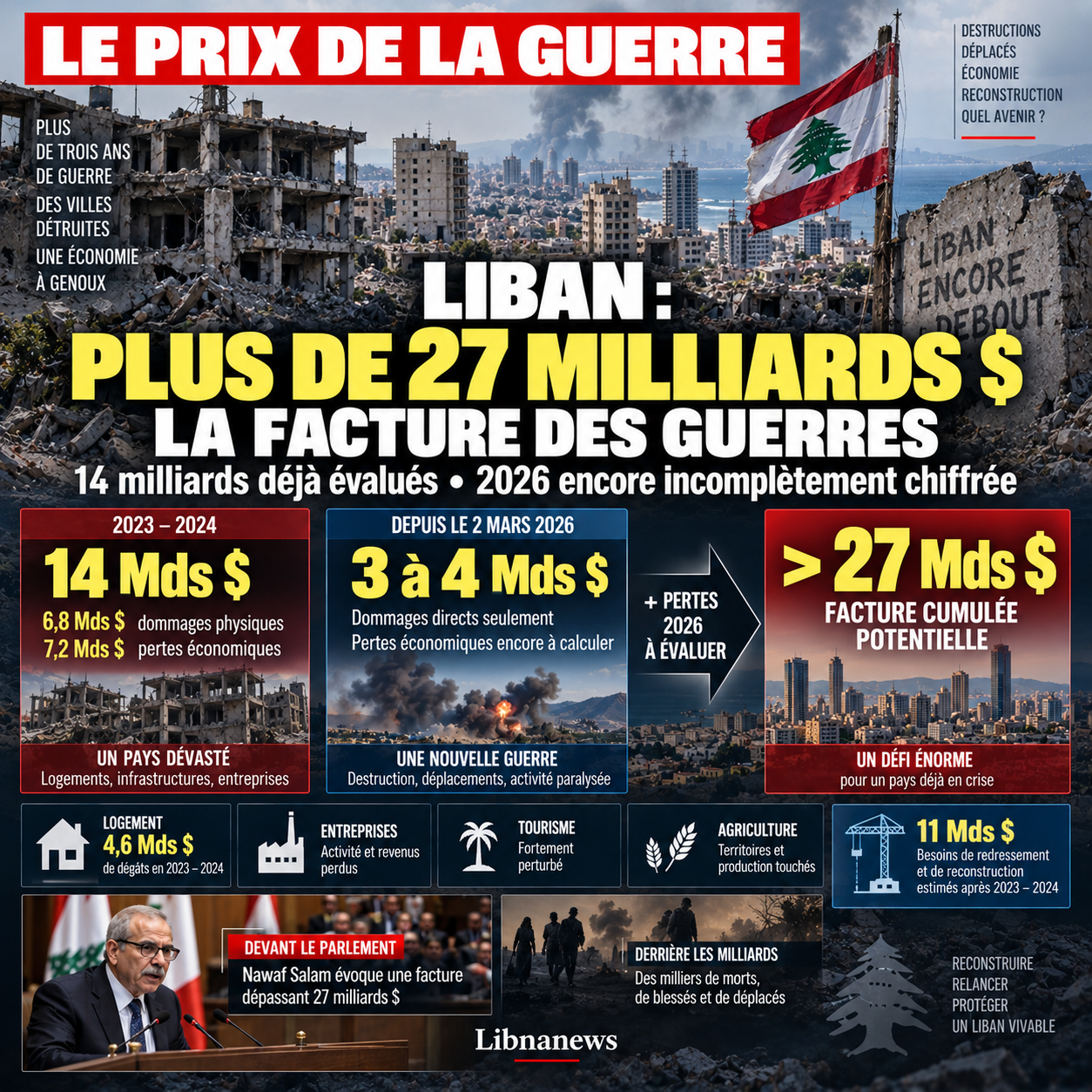
The cumulative cost of Israeli wars and strikes in Lebanon since October 2023 could exceed $27 billion when all direct damage and economic losses have been recorded. Before Parliament on Tuesday, September 15, 2026, Prime Minister Nawaf Salam recalled the $14 billion already assessed for the conflict of 2023-2024. He also referred to the first estimates of the new war launched on 2 March 2026.
Thewar in Lebanoncould leave an invoice over $27 billion since 2023. Prime Minister Nawaf Salam presented on Tuesday 15 September, before the deputies meeting in Beirut, a first reading of the cumulative economic impact of the two major phases of the conflict with Israel.
This estimate is made during the parliamentary session of « general debate », according to the formula used by the Speaker of the House, Nabih Berri. It does not yet constitute a definitive assessment. Some of the damage caused since 2 March 2026 remains to be assessed, including indirect losses for businesses, tourism, agriculture, infrastructure and economic activity.
The first conflict, which began on 8 October 2023 and intensified strongly in 2024, had already cost the Lebanese economy about $14 billion. The World Bank had estimated physical damage at 6.8 billion and economic losses at 7.2 billion.
This bill is now added to the war that began on 2 March 2026. The government’s first estimates place its only direct material damage between $3 billion and $4 billion. This sum does not yet include all the indirect economic consequences.
Once integrated, the cumulative cost of conflict since 2023 could exceed $27 billion.
Lebanon: 14 billion already lost in 2023-2024
The first reference number is now accurately documented. The rapid assessment of damage and needs after the war of 2023-2024 had set its economic cost at approximately $14 billion.
This estimate covers the period from 8 October 2023 to 20 December 2024.
Material destruction amounted to $6.8 billion. These included housing, infrastructure, business, public facilities and various assets destroyed or damaged.
At the same time, economic losses were $7.2 billion. They correspond to the activity that could not be carried out because of the conflict: drop in production, lost income, interruption of business activities and additional costs imposed on businesses.
This distinction is essential. The cost of a war is not only the value of buildings, roads or infrastructure destroyed. An intact business can lose several months of activity. A hotel can remain empty. Farming can become inaccessible. Trades can close while population displacements permanently disrupt the local economy.
For the 2023-2024 conflict alone, the needs for recovery and reconstruction had been estimated at $11 billion.
Housing was then the hardest hit sector. Habitat damage was approximately $4.6 billion, or more than two thirds of the physical damage reported.
Trade, industry and tourism had also paid a particularly high price. Their economic losses were estimated at approximately $3.4 billion.
The governorates of South Lebanon and Nabatiyah were among the most affected territories. Mount Lebanon, including the southern suburbs of Beirut in this assessment, had also suffered considerable destruction.
Between 3 and 4 billion damage since 2 March
The problem for Lebanese finances is that this first bill was not yet absorbed when the war resumed on a large scale the2 march 2026.
By July, the government had provided an initial estimate of the further destruction. The Minister of Information, Paul Morcos, had indicated after a meeting of the Council of Ministers that the direct material damage was between $3 billion and $4 billion.
The government then insisted on the preliminaryity of this amount.
These 3 to 4 billion do not include indirect economic losses or all the consequences of the interruption of activity. They are also distinct from the damage already caused during the first phase of the conflict.
The final balance sheet will therefore necessarily be higher.
Since March, strikes have again affected the south of the country, the Bekaa and the southern suburbs of Beirut. Infrastructure, housing and economic activities were affected. Population displacement also affected both the regions directly concerned and those that received the displaced.
The Lebanese Government has begun work on the destruction census to provide a basis for the reconstruction. The National Council for Scientific Research is involved in the mapping of damage.
This step is essential to move from an estimate of visible destruction to a complete economic assessment.
Why the bill can exceed 27 billion
The $27 billion threshold before Parliament does not mean that this amount already corresponds to materially recorded destruction.
Available figures should be read in different categories.
For 2023-2024, the estimate of 14 billion includes both6.8 billion physical damageand7.2 billion economic losses.
For the war that began on 2 March 2026, the amount of 3 to 4 billion is for the moment mainly for direct material damage assessed on a preliminary basis.
Adding just $14 billion and $4 billion would therefore give an incomplete picture of the situation.
It remains to be measured the loss of production, the interrupted business activity, the unrealised tourism income, the consequences for agriculture, transport and services, and the costs incurred by households and businesses.
It is this second layer of losses that could push the cumulative balance sheet beyond $27 billion.
The experience of the previous conflict gives an indication of the potential extent of this effect. By 2023-2024, economic losses, at $7.2 billion, had even slightly exceeded 6.8 billion physical damage.
However, it would be premature to apply the same proportion mechanically to the war of 2026. Its duration, geographical distribution of strikes, the sectors concerned and the level of economic activity are different. A detailed assessment is still needed.
A considerable bill for an already fragile economy
The magnitude of the amounts takes on a particular dimension in the Lebanese case.
The country has not entered this series of wars with a solid economy. Since 2019, he has been facing a major financial and banking crisis. The Lebanese pound has lost most of its value, the banking sector remains deeply weakened and the State’s fiscal capacity is limited.
The war of 2023-2024 had interrupted part of the expected recovery. The new confrontation of 2026 thus strikes an economy that had not yet financed the previous reconstruction.
This superimposition of damage considerably complicates the State’s response.
Rebuilding housing and infrastructure requires substantial funding. But the recovery also requires restoring business activity, transport networks, public services and local economies in the affected regions.
Public finances do not allow Beirut to assume such a burden alone. After the first conflict, reconstruction and recovery needs had already been estimated at $11 billion, a significant portion of which had to come from the private sector.
The question of external financing therefore remains central. It will depend on international aid, loans to Lebanon, private investment and the ability of the authorities to present a credible reconstruction programme.
The loss of life is accompanied by economic destruction
The financial balance sheet also accounts for only part of the consequences of the war.
According to the Lebanese Ministry of Health, the cumulative record of Israeli attacks since 8 October 2023 approached in early September 2026 the 9,000 dead and over 30,000 wounded.
For the period beginning on 2 March 2026 alone, more than 4,300 people had been killed and more than 12,000 injured according to official reports published in early September.
These figures give another dimension to the economic estimates presented to Parliament. The destruction of homes and businesses is accompanied by displacement, loss of income and lasting consequences for thousands of families.
Full economic valuation will therefore have to measure a war that has simultaneously struck the physical capital and productive activity of a country already weakened by several years of crisis.
The$27 billionremains, at this stage, a potential order of magnitude and not a definitive count. The amount of $14 billion for 2023-2024 is based on a detailed assessment already published, while the $3 to $4 billion announced for the 2026 war remains an estimate of direct damage.
The next challenge will be precisely to quantify the indirect economic losses accumulated since March 2. This calculation will allow us to know how far the actual bill of more than three years of conflict can now exceed the threshold mentioned before Members.