

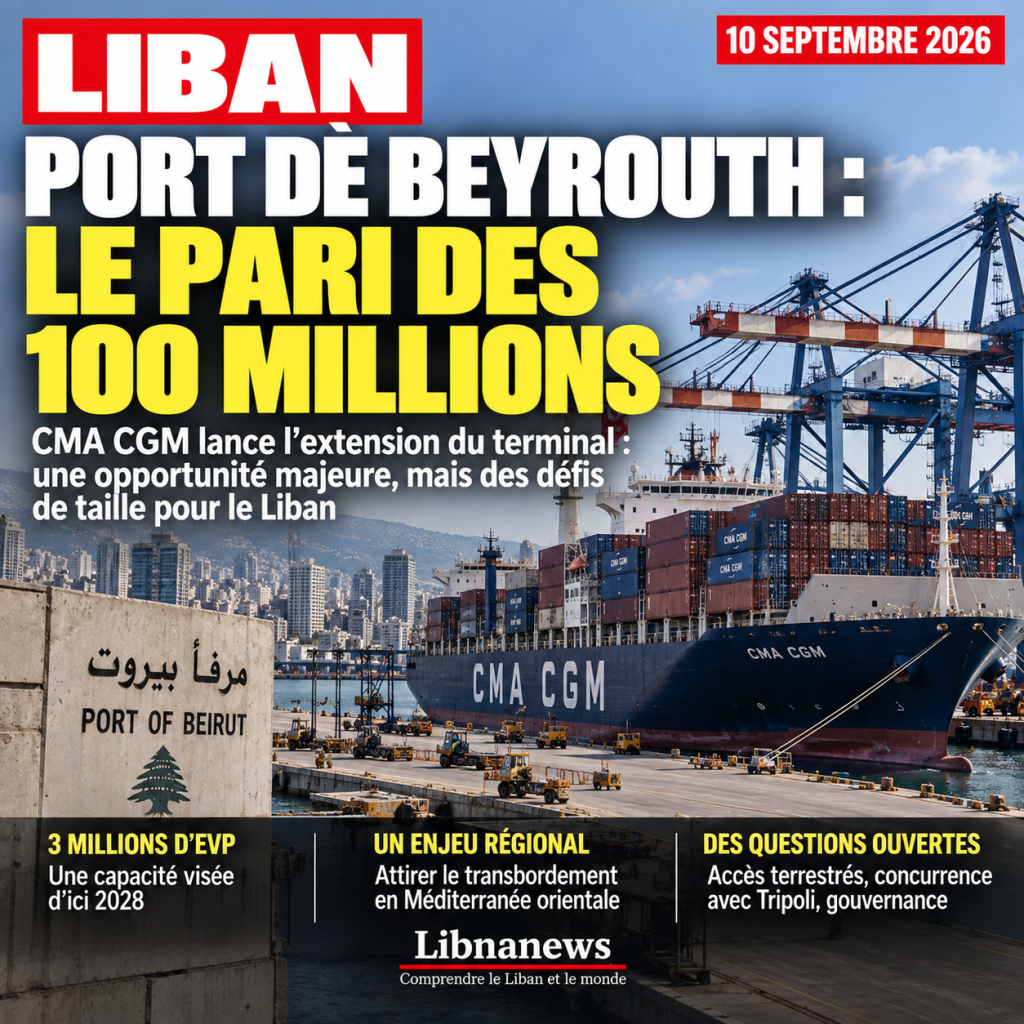
The port of Beirut is to launch Thursday 10 September a new expansion phase of its container terminal, with an announced investment of approximately 100 million dollars carried by the French group CMA CGM. The objective is ambitious: to increase the maximum terminal capacity from approximately 1.2 million to 1.3 million TEUs per year today to nearly 3 million by 2028. The project can place Beirut on the trans-shipment map in the eastern Mediterranean and attract flows that are not intended for the Lebanese market. But the doubling of capacity also raises an essential question: does Lebanon already have the volumes, the infrastructure and the governance needed to make a facility of this size profitable?
The first stone laying ceremony is scheduled for Thursday evening at Pier 16, in the presence of Prime Minister Nawaf Salam, several members of the government and the CEO of CMA CGM, Rodolphe Saade. Behind the symbolic dimension of the event is one of the largest investments announced in Lebanese infrastructure in several years. For the port, still marked by the destructions of 4 August 2020, the stake goes beyond its reconstruction: it is now a matter of changing scale.
Increased capacity from 1.2 to 3 million TEUs
The project must be carried out in stages until 2028. According to the president and CEO of the port of Beirut, Marwan Naffi, the investment will reach about $100 million and will increase the capacity of the terminal to about 3 million TEUs per year. The TEU, or equivalent 20 feet, constitutes the international unit used to measure containerized traffic.
The port’s official website currently estimates the terminal’s nominal capacity at 1.2 million TEUs per year. Its storage area covers approximately 600,000 square metres. The equipment includes twelve wharf portals, six on dock 16 and six on its eastern extension, as well as 39 park gates.
A first phase of reorganisation of spaces should already allow 1.3 to 1.4 million TEUs to approach. The second phase is of another magnitude: the port managers evoke a capacity of between 2.4 and 3 million, the aim now being to get closer to the top of this range.
The gap is considerable. At 3 million TEUs, the theoretical capacity would be about150 % higherthe 1.2 million currently announced by the port.
But capacity and traffic should not be confused.
Marwan Naffi indicated in August that Beirut was expected to cross the threshold of one million containers in 2026, returning to the levels observed before the explosion. If this result is achieved, the current terminal would already be close to its practical limits. The investment is therefore not only a distant projection: it anticipates a possible saturation if the recovery continues.
However, moving from a traffic close to the million to a capacity of 3 million means finding, in the long run, almost two million additional TEUs to make full use of the facility. The Lebanese market alone cannot provide them.
This is where the real economic bet of the project is located.
Beirut cannot fill 3 million TEUs with Lebanon alone
The Lebanese economy is too small to justify, by its imports and exports alone, a capacity of 3 million TEUs.
The port officials recognize this. The desired growth must mainly come from thetranshipment, i.e. containers unloaded in Beirut and then transferred to another vessel to a third market.
This distinction is fundamental.
A container imported for consumption in Lebanon depends on domestic economic activity. A transhipment container can pass through Beirut without its goods entering Lebanese territory. The port then becomes a regional platform and not just the country’s maritime gateway.
During the periods of conflict, the port also saw an evolution of this structure. According to his management, more than 95 per cent of Lebanese import and export flows went through Beirut, but low domestic consumption weighed imports into the local market. An increase in transhipment offset part of this decline.
It is this activity that the extension wants to amplify.
The potential exists. Beirut enjoys a favourable geographical position in the eastern Mediterranean, close to the roads linking the Suez Canal to Europe. Syria’s gradual return to regional trade channels can also change the geography of trade, as well as the projects of corridors linking the Mediterranean to the Middle East.
But transhipment is also an extremely competitive market. Shipowners choose their platforms based on the cost, depth of docks, crane productivity, time of call, reliability of operations and the quality of maritime connections.
A terminal of 3 million TEUs therefore does not guarantee a traffic of 3 million.
CMA CGM brings an advantage that concrete cannot offer
The presence of CMA CGM, however, significantly changes the equation.
The French group is not simply a financial investor. It is one of the world’s leading shipowners and already operates the Beirut container terminal. It can therefore bring to the port what an isolated infrastructure often lacks: traffic.
This is probably one of the strongest arguments in favour of the project.
Building an additional capacity without a maritime partner would have been a much more speculative bet. On the contrary, a large shipowner has the possibility of integrating Beirut into its own rotations and of directing part of its trans-shipment operations.
The management of the port also insists on this point when it refers to its future investments. It no longer seeks only operators able to finance infrastructure, but partners able to provide « commercial guarantees », i.e. effectively bring activities to the site.
This strategy can reduce the risk of building docks that would remain underutilized.
However, it creates another question:how far does a public port have to depend commercially on a single large shipowner?
CMA CGM has a clear interest in developing Beirut. The group has important historical links with Lebanon and controls a significant share of the country’s maritime activity. But the interests of a private operator and those of the port are not automatically identical.
A national port normally seeks to attract as many companies as possible, maintain competition and maximize revenues. A shipowner seeks to optimize his own global network.
The details of the economic conditions of the new investment therefore become essential: duration of the commitments, ownership of new equipment, revenue sharing, traffic obligations, conditions of access of the competing companies and exit of the installations upon expiry of the contracts.
An investment of $100 million can be very beneficial for the State if private capital finances infrastructure and assumes a significant share of commercial risk. It is much less so if excessive benefits are granted in return.
The immediate advantage: avoid massive public investment
In Lebanon’s current financial situation, the use of private capital has a clear advantage.
The State has virtually no margin to spend $100 million on the expansion of a container terminal. Its needs are already considerable in electricity, water, roads, telecommunications, social infrastructure and reconstruction. The financial system itself remains deeply disorganized.
Financing the extension by an international operator therefore enables a strategic infrastructure to be modernised without immediately mobilising an equivalent amount in the State budget.
The port also generates growing revenues. Its management indicated in July that its revenues increased by about25% year-on-yearand that transfers to the Consolidated Revenue Fund had increased by about35 %. These performances give investment an additional interest: more traffic can increase public revenues if the contractual structure is favourable to the state.
The effects would go beyond port. An additional activity generates requirements for handling, road transportation, maintenance, marine services, storage, insurance and logistics. A larger transshipment platform can also strengthen Beirut’s position in regional supply chains.
But these benefits depend once again on the model chosen. Transshipment generates a lot of volume, but its local economic value is generally less than that of goods imported, processed or re-exported from the country. Counting containers is therefore not enough to measure economic benefits.
The risk of building faster than the infrastructure around the port
One of the main weaknesses of the project may be outside the port area.
A maritime capacity of 3 million TEUs requires access capable of absorbing the corresponding activity. Beirut is already suffering from chronic road congestion, and Lebanon no longer has an operational rail network to evacuate goods massively.
The government seems to be aware of the problem. On 4 September, Nawaf Salam brought together the Council for Development and Reconstruction, the Port Authority, the Municipality and the Governorate of Beirut to work precisely on the roads surrounding the port, access to the capital and coordination with public transport projects.
This meeting takes place less than a week before the extension announcement. The calendar is probably not fortuitous.
The problem must nevertheless be distinguished according to the traffic sought. A transhipment container remains in the harbour enclosure and goes back by boat: it does not add any trucks to the streets of Beirut. On the other hand, an increase in imports, exports or regional land traffic would put much greater pressure on access.
The 3 million TEU strategy is therefore really coherent only if a significant part of the growth comes from trans-shipment, or if land infrastructure is moving forward at the same time.
Beirut or Tripoli: Do we have to double capacity everywhere?
Another issue concerns national port policy.
Lebanon does not only develop Beirut. The port of Tripoli also has a container terminal and an important potential for expansion. A 25-year concession granted to Gulftainer had planned to increase its capacity from 400,000 to 800,000 containers per year, while the Ministry of Public Works now refers to a target above one million.
A public procedure also covers the development and extension of the Tripoli terminal.
The Government states that both ports are complementary. The argument is not unfounded. Beirut has a critical mass, an established maritime network and direct access to the country’s main economic centre. Tripoli has more space available and is closer to Syria, which could become a major advantage if land trade corridors develop.
But this complementarity must be organised.
Bringing Beirut to 3 million TEUs and Tripoli beyond the million would create a national capacity of over 4 million TEUs. For a country of about six million people whose economy remains weakened, this capacity only makes sense if Lebanon is effectively becoming a regional transit and transshipment platform.
Otherwise, the two ports would run the risk of competing for insufficient traffic.
The strategy cannot therefore be solely port-based. It requires regional trade policy, transport agreements, road and possibly rail infrastructure, as well as sustainable normalisation of trade with the environment in Lebanon.
Governance remains the most sensitive issue
The other controversy is institutional.
The port of Beirut is not an ordinary infrastructure. The explosion of 4 August 2020 revealed the extreme consequences of decades of administrative dysfunction, fragmented responsibilities and lack of effective control. More than six years after the disaster, any decision that commits the future of the port to a long term should therefore be examined with a higher level of transparency than in the past.
The announcement of a $100 million private investment is positive in itself, but it does not answer governance questions.
It is necessary to know precisely the legal nature of the investment, the respective obligations of the port and CMA CGM, the duration of the commitments, the control mechanisms, the conditions of competition and the additional revenue expected for the Treasury.
Transparency is all the more important as the terminal is potentially one of the most cost-effective infrastructure in the country.
The presence of a recognized international operator can improve technical and commercial standards. It does not exempt the State from clearly defining the rules of the game.
A promising investment, provided that traffic follows
The extension therefore has strong economic arguments. The terminal is again approaching one million containers per year, its current capacity is around 1.2 million TEUs and the port claims to record a significant increase in its revenues. Private financing reduces the immediate burden on the State. Most importantly, CMA CGM has the necessary commercial capacity to attract some additional traffic.
But the change to 3 million TEUs changes the nature of the port.
On this scale, Beirut can no longer depend primarily on the Lebanese economy. It must become a real regional platform. Success will therefore be measured less by the capacity built than by the number of maritime lines attracted, the volume of additional transhipment, the revenue actually paid to the Treasury and the logistical activities created around the terminal.
The cost of $100 million is ultimately only part of the equation. Road infrastructure, governance, competition between operators, complementarity with Tripoli and regional stability will equally determine the economic profitability of investment.
The ceremony scheduled for Thursday at Pier 16 will launch a project whose financial risk appears to be largely assumed by the private sector, but whose stake is national. The contractual details and traffic commitments of CMA CGM will now be decisive to determine whether the 3 million TEUs announced correspond to an identified commercial demand or, in part, to a capacity built pending a future regional hub still to be created.




