

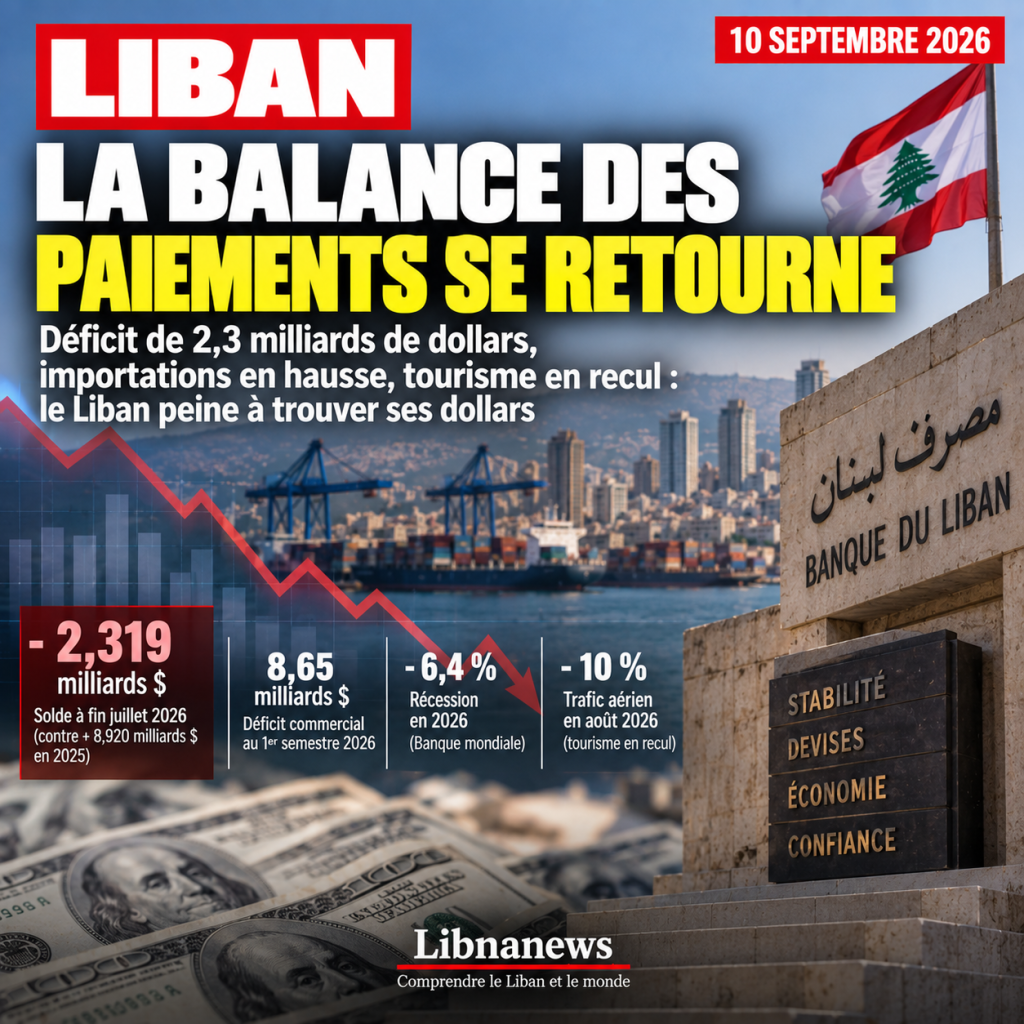
The reversal is spectacular. At the end of July 2026, Lebanon’s balance of payments, measured by changes in net external assets of the financial system, had a cumulative deficit of $2.319 billion, compared with a surplus of $8.920 billion a year earlier. The gap is $11.239 billion. The gross comparison, however, exaggerates the real deterioration of foreign exchange flows, as the statistics now include the monetary gold of the Bank of Lebanon and hence its changes in value. The economic signal, however, remains worrying: the deficit comes at a time when the country has returned to recession, the trade deficit has widened further and tourism, one of the main providers of fresh dollars, has suffered the shock of the war.
However, the figures for July show inflection. The Bank of Lebanon’s net external assets increased by $367.9 million over the month and commercial banks by $168.8 million. The monthly improvement thus reached $536.7 million. It coincides with the seasonal return of the diaspora and the partial recovery of tourism activity. The question now is whether July marks the beginning of a stabilization or only a summer break in a year when Lebanon’s external financing needs have increased significantly.
A reversal of $11.2 billion
The breakdown of data published by the Bank of Lebanon makes it possible to better measure the phenomenon. Between January and July 2026, the net external assets of the central bank declined by $3.287 billion. In contrast, commercial banks increased by 967.7 million. The balance of the two components produces the cumulative deficit of $2.319 billion.
| Indicator | End of July 2025 | End of July 2026 | Change |
|---|---|---|---|
| Balance of payments by NFA | +$8.920 billion | -$2,319 billion | -$11,239 billion |
| BDL NFA, cumulation 2026 | — | -$3.287 billion | — |
| NFA of banks, cumulation 2026 | — | +$0.968 billion | — |
| Monthly change in NFA in July | — | +$0.537 billion | — |
| BDL Liquid Reserves end of July | — | $11.53 billion | — |
| Gold of the BDL end of July | — | $37.45 billion | — |
Comparison with 2025, however, requires major caution. Since January 2024, in accordance with a decision of the Central Council and the methodological recommendations of the International Monetary Fund, the BDL’s external assets include monetary gold, foreign securities held by the central bank and foreign currencies and deposits with foreign correspondents and international organizations.
This change mechanically inflates the effect of gold price changes on the balance of payments calculated from the NFA. BLORINvest further states that the strong increase in the BDL’s net external assets previously observed was mainly due to the appreciation of the gold stock.
The $8.92 billion surplus at the end of July 2025 did not therefore amount to $8.92 billion in new capital in Lebanon. The 11.24 billion difference with 2026 does not represent an equivalent leakage of dollars.
This methodological correction is essential, but it is not enough to rule out the negative signal. Once the dramatic effect of comparison with gold has been offset, the other indicators also show a deterioration in the external position of the economy.
Trade deficit already stands at $8.65 billion
The first problem is in external trade. In the first half of 2026, Lebanese imports reached about$10.1 billion, up 5.6% over one year. Exports followed the opposite direction: they fell around1.4 billion, a decrease of 14.1%.
The trade deficit thus reached$8.65 billionagainst 7.87 billion in the first half of 2025. It has been dug by 786.6 million, or 10 per cent in one year.
This trend is particularly unfavourable because it occurs during a recession.
In times of strong growth, an increase in the trade deficit may result from faster investment and consumption. Enterprises import more machinery and raw materials, households consume more and activity creates additional income.
The Lebanese situation of 2026 is different. The World Bank forecasts a contraction in real GDP of6.4%, after an estimated 4.2% growth in 2025. Despite this decline in activity, imports are increasing and exports are decreasing.
In other words, the recession did not even produce the compression of imports, which usually accompanied a sharp contraction in domestic demand.
Lebanon must therefore find more dollars to finance its external purchases at the same time as its economy produces less.
The rate of import coverage by exports illustrates this weakness. On the basis of data for the first half of the year, exports finance only around14 % of imports. For each $100 of goods purchased abroad, the Lebanese economy therefore finances only about 14 dollars by its sales of goods.
The rest must be covered by services, tourism, diaspora transfers, investment and other financial flows.
This is where the balance of payments deficit is becoming much more significant.
War strikes precisely the sources of dollars
The Lebanese external model has always been based on a paradox: the country imports far more goods than it does to export, but offsets part of this gap by inflows of capital and income from abroad.
Before 2019, the banking system played a central role. High interest rates and confidence in fixed parity attracted deposits, especially those of the diaspora. The banks placed some of these dollars with the Bank of Lebanon, which itself financed the State and defended the exchange rate.
This model collapsed when new entries were no longer sufficient to finance accumulated liabilities.
Since the crisis, the mechanism has been different, but dependence on external dollars remains. Tourism, expatriate transfers and the cash economy replaced part of the old banking circuit. Dollars come more directly into the economy and much less through traditional banking intermediation.
The War of 2026 is about this new model.
The World Bank believes that the March conflict has reduced the10.4 percentage pointsgrowth that could have been recorded in his absence. It identifies tourism and private consumption as one of the main channels of transmission of the shock.
While the summer tourism season has improved from spring, it has not compensated for the accumulated losses. Cancellations, air disruptions and security uncertainty reduced expected revenues.
The problem then becomes macroeconomic: Lebanon continues to need billions of dollars to pay for its imports, while one of the main sources of foreign exchange inflows is weakened.
11.53 billion liquid reserves, not 49 billion
The distinction between gold and reserves that can be truly mobilized becomes decisive here.
At the end of July, the Bank of Lebanon’s liquid external reserves reached about$11.53 billion. The value of the gold stock was parallel37.45 billion.
Adding both gives an impressive heritage image, close to $49 billion. But economically, the two categories do not fulfil the same function.
The 11,53 billion liquid reserves can contribute to the monetary management and foreign exchange needs of the central bank. It is protected by Lebanese law and cannot be freely sold by the BDL. Its increase in value reinforces the institution’s balance sheet but does not automatically create dollars that can be used to finance imports or intervene in the exchange market.
This distinction explains why a country with gold worth more than $37 billion can simultaneously remain vulnerable to a decrease in its foreign exchange inflows.
It also explains why the evolution of liquid reserves is probably more significant in the short term than the total value of external assets.
Between the end of June and the end of July, they remained broadly stable, rising from about 11.55 billion dollars to 11.53 billion dollars after a decline in the first fortnight and a rise of 86 million dollars during the second.
This stability is a good thing. It means that the cumulative deficit of the NFA did not translate into an equivalent drain on the central bank’s liquid reserves.
But it must be placed in an environment where the need for dollars increases.
The stability of the book also depends on these entries
The Lebanese pound remains remarkably stable around its current level despite war, recession and inflation. This stability is one of the main breaks with the first years of the crisis.
However, it is based on a particular balance.
The World Bank points out that the exchange rate has been supported by the use of reserves and a much more restrictive policy of liquidity in books. In particular, the central bank avoids recreating the national currency volumes that had fuelled depreciation and inflation in the early years of the crisis.
Mass dollarization also reduces the demand for books. A significant portion of private salaries, rents, purchases and transactions are now directly dollar-denominated.
This system stabilizes the exchange rate but does not remove the external constraint. He’s moving it.
A dollarised economy needs a steady flow of physical and banking dollars. If tourism receipts, transfers or other inflows decline permanently while imports remain high, tensions reappear elsewhere: on reserves, liquidity, consumption or prices.
The World Bank also warns that the exchange rate may be subject to further pressure if external inflows decline or conflict-related shocks persist.
The balance of payments deficit therefore becomes less the signal of an immediate devaluation than an indicator of the margin available to maintain the current stability.
Banks improve their NFA, but still do not finance the economy
The growth of $967.7 million in net external assets of commercial banks since the beginning of the year could be seen as good news for the financial sector.
It must also be interpreted with caution.
In July, banks’ claims on the non-resident financial sector increased by $210.8 million to $5.9 billion. Other external assets grew by nearly 78 million, to $2.93 billion, and non-resident securities portfolios by 75.7 million, to 1.7 billion.
At the same time, deposits of non-resident clients reached$21.25 billion.
This improvement in the external position does not mean that the Lebanese banking system has returned to normal functioning.
Credit remains extremely low and banks continue to bear the consequences of the 2019 crisis. S&P recently noted that deposits from non-resident clients, around $21 billion in June, remain well below the $43 billion recorded at the end of 2017. The dollarization of deposits is also approaching 98%.
Another figure shows the extent of the rupture. The letters of credit opened to finance imports represented only around$21.3 million in the first half of 2026. Compared to over $10 billion in imports, this amount is marginal.
External trade therefore operates largely outside traditional banking mechanisms.
Six years after the onset of the crisis, Lebanon finances its imports, trade and part of its activity through savings of fresh dollars and liquidity rather than through a normal credit system.
This is one of the reasons why the balance of payments must now be read differently than before 2019.
July brings 537 million: improvement or simple seasonal effect?
The most encouraging figure in the July report is finally in the monthly evolution.
The BDL NFA increased by $367.9 million and the banks by $168.8 million. The positive balance thus reached$536.7 million.
This improvement comes at the heart of the summer season, when Lebanese expatriates traditionally return in numbers and inject currencies into the economy.
It would therefore be premature to see a structural reversal.
If August confirms a further improvement despite a lower-than-expected tourist season, the deficit accumulated in the first half of the year may begin to decrease. If NFAs begin to degrade again after the summer, July will appear as the temporary effect of seasonal inflow.
This makes future data particularly important.
Lebanon’s external problem is not limited to the $2.319 billion deficit announced in July. This figure is strongly influenced by a methodology that integrates gold and makes comparison with 2025 spectacular. However, real economic data provide a more worrying diagnosis:a trade deficit of $8.65 billion in just six months, imports up 5.6%, exports down 14.1%, an expected economy down 6.4% and tourism revenues affected by the war.
In this context, the question is no longer just whether the balance of payments is positive or negative over a month. She asked whether the economic model that had emerged since 2019 — dollarization, diaspora transfers, tourism and cash financing of imports — could continue to generate enough currency to compensate for a structural trade deficit, without restoring the financial imbalances that had led to the crisis.
The August figures will provide an initial answer. Most importantly, they will determine whether the $536.7 million raised in July is an improvement in the external position or the last effect of a summer season that this year did not provide Lebanon with the revenues it hoped for.




