

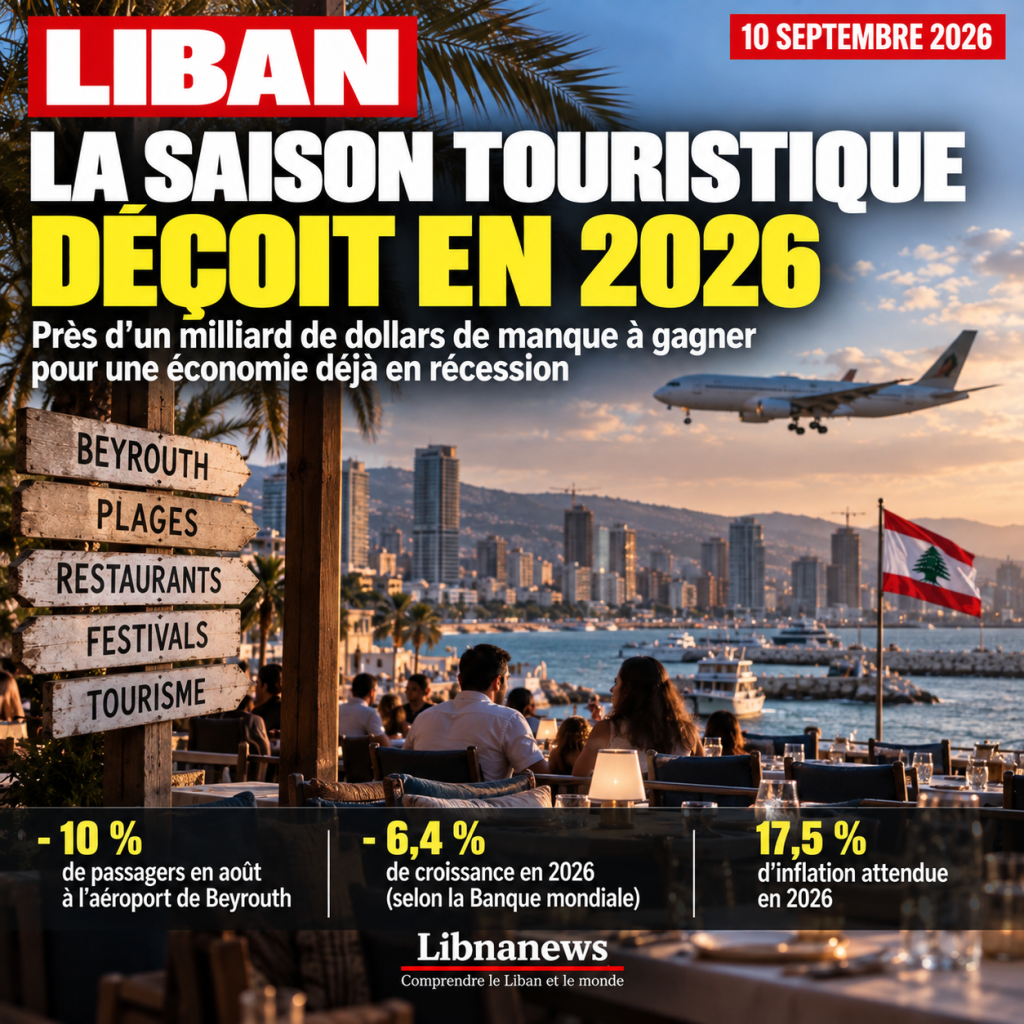
The expected rebound did not occur. In Lebanon, the summer tourism season of 2026 ends well below expectations, despite a sharp recovery in July and August. Traffic from Beirut airport fell further by 10 per cent over a year in August, while the loss of profits from the season is estimated at around $1 billion by the Lebanese economic press. This counter-performance far exceeds the hotel sector: it deprives the foreign exchange sector of a new economy in recession after the March war, reduces the incomes of thousands of companies and weakens one of the few engines capable of rapidly supporting consumption without relying on bank credit.
The paradox is important. Restaurants full some evenings, frequented beaches, festivals maintained and return many expatriates gave the impression of an active summer. But this visible activity is not enough to compensate for the losses accumulated since the beginning of the year. In the first seven months of 2026, the total number of passengers at Beirut International Airport was about 2.75 million, compared with 3.80 million during the same period of 2025, a drop of 27.5 per cent. July had however marked a strong monthly improvement, with 722,313 passengers. The level remained below the 793,367 recorded a year earlier.
Tourism in Lebanon: August does not catch up with the beginning of the year
The data available for August confirm this weakness. Air traffic decreased by about 10% compared to August 2025. Departures exceeded arrivals by about 9%, while transit traffic decreased by 12%. These figures are particularly disappointing for a month that traditionally concentrates a significant part of Lebanese tourism activity.
However, they should be interpreted with caution. Not all passengers passing through the airport are tourists. A significant proportion of these are Lebanese expatriates, residents and business travel. Conversely, the number of travellers does not measure their average expenditure or the length of their stay. However, the evolution of traffic provides a sufficiently robust indicator of the general trend: summer made it possible to catch up after the spring shock, without restoring the expected volumes.
By the end of August, airport officials reported 12,000 to 13,000 daily arrivals, compared with 13,000 to 15,000 departures. The attendance in July and August was therefore close to previous summer levels. The problem lies mainly in the months lost before this recovery.
The March military escalation abruptly interrupted the recovery begun in 2025. Flight cancellations, warnings to travellers, the perception of a high security risk, and uncertainties about a further expansion of the fighting affected reservations. Even when the situation was partially stabilized, part of the demand did not return.
Tourism works with several months of anticipation. A Gulf family or a European tourist who cancels his stay in the spring does not necessarily reserve Lebanon again in July when the situation improves. He often chooses another destination. The losses in the first semester cannot be recovered simply by a few weeks of high summer attendance.
A billion dollars missing from the entire economy
The estimate of a shortfall of nearly $1 billion gives a better measure of the problem than airport statistics alone.
A dollar spent by a visitor does not stay in a hotel. It circulates between restaurants, cafes, taxis, car rental companies, shops, private beaches, leisure venues, event organizers and local producers. A portion is then used to pay wages or suppliers. Tourism thus has a particularly important driving effect in an economy where bank credit is virtually absent.
This effect has been even more decisive since the financial crisis of 2019. The banking system no longer normally plays its role of financing the economy. Companies invest heavily from their own resources, fresh dollars or capital from abroad. Tourism expenditure is therefore a direct injection of liquidity.
Their decline primarily affects companies that had prepared for the summer by anticipating high demand. Restaurants and tourist establishments engaged seasonal staff, stockpiling or work before the season. When the turnover is lower than expected, these expenses directly weigh on their margins.
The impact also affects employment. Tourism, hotels and restaurants absorb a large workforce, especially among young people. The low season limits seasonal hiring and reduces variable incomes, from tips to commissions. It is then passed on to domestic consumption.
This mechanism is particularly problematic in 2026, as households are already experiencing further price acceleration.
The recession of 2026 changes the scope of bad summer
A disappointing tourist season would have been absorbable in a fast growing economy. It is becoming much more serious in the current context.
The World Bank is now planning a contraction in the6.4 per cent of lebanese gross domestic product in 2026. This recession erases the fragile recovery observed in 2025, when the economy grew by about 4.2% according to the institution’s latest estimates.
The turn is brutal. After a cumulative contraction close to 40% between 2019 and 2024, Lebanon had finally recovered positive growth. Tourism was one of the main drivers of this improvement, with consumption, diaspora transfers and a limited recovery in investment.
The war started in March changed the course.
The World Bank believes that the conflict reduces the growth of10.4 percentage pointsagainst a scenario without a new war. Two channels play a central role in this shock: private consumption and tourism revenues.
The bad summer is therefore not a peripheral consequence of the recession. It is one of the mechanisms by which it occurs.
Inflation further exacerbates the problem. The World Bank forecasts an average increase in17.5% in 2026, mainly due to supply disruptions, increased transport and oil growth. Tourism companies are therefore simultaneously experiencing lower demand and higher costs.
A restaurant can receive fewer guests while paying more for its energy, some imported products and transportation. A hotel may have less than expected occupancy while its fixed costs remain virtually unchanged. The drop in attendance is thus becoming faster and less profitable.
Lebanon remains highly dependent on tourism dollars
The banking crisis makes this dependency even stronger.
In an economy with a functional financial system, a bad season can be amortised by credit. A company borrows to temporarily cover its needs and reimburses when the activity returns. This mechanism remains deeply flawed in Lebanon.
Since 2019, much of the economy has been operating in cash and in fresh dollars. Revenues from the diaspora, visitors and exports of services directly feed this flow.
Tourism provides a resource that Lebanon cannot easily replace: currencies that enter the country without debt creation.
These inflows contribute to household and business incomes, but also indirectly to public finances. Each meal, overnight, purchase or service generates VAT, duties, taxes or income. A lower season also reduces the tax base when the state is facing additional needs.
The government must fund reconstruction, conflict-related expenditures and public services. At the same time, he was under increasing pressure from civil servants and the military to raise salaries and pensions still far below their pre-crisis level.
The World Bank continued to report in August that public finances had resisted relatively well in the first half of the year, after an overall surplus estimated at3.9% of GDP in 2025. But it warned that the slowdown in revenues, humanitarian spending, reconstruction and wage demands would put increasing pressure on the latter half of 2026.
Tourist weakness occurs precisely at the wrong time.
The Gulf remains the clientele Lebanon struggles to recover
The composition of visitors counts as much as their number.
The return of Lebanese expatriates strongly supports activity. They often have income in foreign currency and spend with their families, in catering or in leisure. But their economic behaviour differs from that of a foreign tourist staying at the hotel throughout his stay.
An expatriate sometimes has accommodation or stays with his family. Part of its expenditure takes the form of direct support to relatives. It remains important for the economy, but it does not necessarily produce the same revenue for the hotel industry.
This is why the return of visitors from the Gulf countries remains particularly sought after by professionals.
Before successive crises, this clientele was one of the most profitable segments of Lebanese tourism. Stays were often accompanied by significant expenses in hotel, catering, commerce and leisure.
The re-establishment of relations with several Arab countries had provided hope for a more massive return in 2026. The resumption of the conflict has again delayed this movement.
The issue is not only diplomatic. A destination can have good political relations and remain commercially penalized if travellers fear airspace closures, flight cancellations or sudden security deterioration.
Airlines become an economic indicator
Air service illustrates this problem.
Most carriers have resumed operations in Beirut, but some major European companies remain absent or maintain reduced programming. This situation does not prevent access to Lebanon: Middle East Airlines and other airlines continue to provide many routes. However, it reduces choices, available capacity and sometimes price competition.
Connectivity is an essential factor for tourism.
A traveller who has to change his itinerary, accept additional connections or pay a more expensive ticket may choose another destination. International companies and tour operators are even more sensitive to the predictability of connections.
The situation also creates a difference between diaspora and international tourism. A Lebanese living abroad can accept more constraints to return to his family. A visitor without a special connection with the country has dozens of Mediterranean alternatives.
This is one reason why a resumption of air traffic does not automatically mean an equivalent recovery of tourism revenues.
The risk of an economy that depends on a few weeks of summer
The counter-performance of 2026 finally shows a more structural weakness.
Lebanon has considerable tourist benefits, but its activity remains extremely concentrated around a few periods: summer, end-of-year holidays and some weekends or festivals. This concentration makes the sector particularly vulnerable to security crises.
A war or an alert in March may compromise reservations for July. An escalation in June can lead to the loss of most summer. A few weeks of stability in August is no longer enough to recover revenue.
The development of less seasonal tourism — cultural, religious, rural, gastronomic, medical or business — would theoretically make it possible to further allocate income over the year. But this diversification also requires minimum conditions: stability, reliable air transport, infrastructure, electricity, public services and international visibility.
However, tourism companies still bear part of these shortcomings at their own expense. They finance their electricity, pay high logistical costs and work in an economy where normal access to bank financing remains limited.
The sector therefore remains competitive in part thanks to the private initiative and intrinsic attractiveness of the country, but with a higher cost of operation than many competing destinations.
The result of summer 2026 recalls the limit of this model. Tourism can speed up a recovery very quickly when stability returns. It can also transmit just as quickly a security shock to the rest of the economy.
The next few weeks will determine whether part of the loss can be offset in the fall and the end-of-year holidays. Professionals rely in particular on a lasting improvement in the security situation and the return of a larger Arab clientele. After a summer that did not generate the expected revenues, year-end bookings will now be the next concrete indicator of the sector’s ability to limit losses by 2026.




