

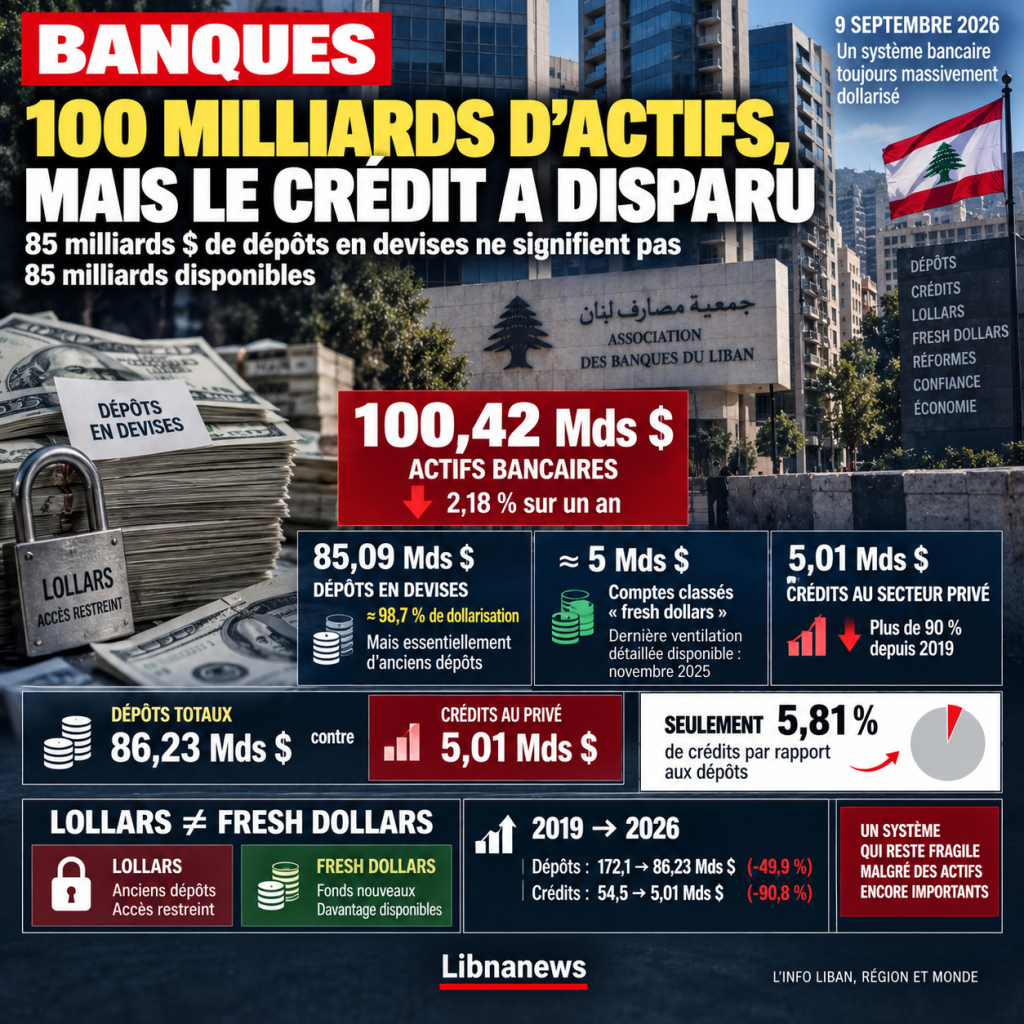
Lebanese commercial banks ended July 2026 with $100.42 billion in consolidated assets, down 2.18% year-on-year and 1.84% since December 2025. Behind this relatively moderate decline, however, is a much more severe reality: the banking system remains massively dollarized, deposits continue to erode and credit to the private sector has almost disappeared. Above all, the $85.09 billion in foreign currency deposits do not correspond to 85.09 billion fresh and immediately available. The bulk remains made up of former deposits blocked since the 2019 crisis, the « lollars », while the real liquid share remains much lower.
A balance sheet of $100.42 billion, but a very small bank capacity
The consolidated balance sheet of the commercial banks at the end of July reached 8,98777 billion Lebanese pounds. Converted at the official rate of £89,500 per dollar, this amount is equivalent to $100.42 billion. At the end of December 2025, assets amounted to £9,156.11 billion, or $102.30 billion at the same conversion rate.
The contraction has thus reached about $1.88 billion since the beginning of the year. Over 12 months, assets decreased by 2.18%, accounting for £9,188.30 billion in July 2025. This decline prolongs the slow compression of a banking sector which, since 2019, no longer fully fulfils its traditional functions of saving collection, deposit processing and financing of the economy.
The total value of the balance sheet should also be interpreted with caution. Bank assets recorded in dollars or converted at the official rate are not necessarily liquid assets, recoverable at face value or immediately available to repay depositors. In the Lebanese case, this distinction is central because of the accumulated losses on investments with the Bank of Lebanon, exposure to public debt and the absence, so far, of a complete bank restructuring.
| Indicator | July 2026 | Change |
|---|---|---|
| Consolidated assets | $100.42 billion | -2.18% year-on-year |
| Customer deposits | $86.23 billion equivalent | -3.36% year on year |
| Foreign currency deposits | $85.09 billion | -1.87% since december |
| Deposits in books | LBP 101 720 billion | -8.61% since december |
| Private loans | $5.01 billion equivalent | -7.76 % over one year |
| Accounting own funds | $5.38 billion | +12.59% year-on-year |
| Credit/deposit ratio | 5.81 % | 6.09 % in july 2025 |
Deposits fall to $86.23 billion
Total customer deposits have declined by 1.96% since the beginning of 2026, reaching £7,717.29 billion by the end of July. At the official rate, this represents about $86.23 billion. One year earlier, deposits reached £7,985.92 billion, representing an annual decrease of 3.36 per cent.
The breakdown by category shows that residents’ deposits remain largely dominant. They reach £5,756.54 billion, or about $64.32 billion at the official rate. Non-resident deposits amount to £1,901.80 billion, or approximately $21.25 billion, while public sector deposits amount to approximately $659 million.
Since December, residents’ deposits have declined by 2.22%, non-resident deposits by 0.75% and public sector deposits by 13.55 %. The latter decline is the largest in percentages, but it involves a much lower stock than private deposits. The general trend continues to be the gradual erosion of banking resources, fuelled by the withdrawals allowed under the circulars of the Bank of Lebanon and the limited capacity of the sector to attract new deposits on a sustainable basis.
85.09 billion in foreign currency: the most confusing figure
At the end of July, foreign currency deposits amounted to $85.09 billion. They have decreased by 1.87 per cent since December, a decrease of $1.62 billion and $179.9 million over July alone. Pound deposits have declined 8.61 per cent since December to £110,720 billion, or about $1.14 billion at the official rate.
This structure brings the dollarization rate of deposits to 98.68%. In practice, therefore, almost all the deposit liabilities of the Lebanese banking system are denominated in foreign currency, mainly in dollars. But this dollarization rate does not mean that banks hold the equivalent of 98.68 per cent of their deposits in the form of dollar liquidity available to customers.
The main point is that the foreign currency deposit statistics combine very different economic categories. It includes former dollar deposits that have been subject to restrictions since 2019, commonly referred to as « lollars », but also accounts in « fresh dollars », financed by funds entered into the system after the crisis or by certain restitution mechanisms provided by the Bank of Lebanon.
Lollars and Fresh dollars: two dollars not worth the same
A lollar is a bank debt denominated in dollars, but which the depositor cannot dispose of freely as a dollar in cash or a dollar transferable abroad. Since 2019, banks have limited withdrawals and transfers to these old accounts. Their economic value therefore depends on the withdrawal mechanisms, the applicable circulars and the rate at which depositors can recover their funds.
The fresh dollar is different. In principle, it corresponds to new money, deposited after the start of the crisis or transferred from abroad, which remains available in dollars or transferable under the terms of the account. It is this type of deposit which still functions as a real bank deposit in foreign currency in the economic sense of the term.
The latest detailed breakdown available from the Bank of Lebanon indicated that, in November 2025, deposits qualified as « fresh » amounted to about $5 billion. However, 3.2 billion of this amount already corresponded to balances from the mechanisms in Circulars 158 and 166. In other words, only about $1.8 billion could then be considered as new deposits fully liquid and independent of the mechanisms for returning old assets.
These figures do not provide an accurate breakdown of July 2026, as the Bank of Lebanon does not publish in its monthly balance sheet a series separating old dollars from new dollars. They nevertheless give an order of magnitude useful. If the stock of fresh deposits remained close to $5 billion, about 80 billion of the 85.09 billion foreign currency deposits would still consist of old deposits or balances not comparable to new free dollars.
A useful estimate but not to be confused with official data
The calculation is simple: 85.09 billion foreign currency deposits, minus about 5 billion fresh deposits, gives around 80.09 billion dollars of old deposits and other non-fresh balances. Under this assumption, the Fresh dollars would represent only about 5.9% of the foreign exchange deposits, compared with about 94.1% for other deposits.
But even this estimate probably overestimates the really new liquidity of the system. If we subtract from the 5 billion fresh deposit the 3.2 billion from the balances of Circulars 158 and 166 observed in November 2025, the real new and fully liquid share was then close to $1.8 billion. Compared to the 85.09 billion deposits in July, this amount would be just over 2%.
Three levels must therefore be distinguished. The first is the book value of foreign currency deposits, or $85.09 billion. The second is the stock of accounts classified as fresh, which was close to $5 billion at the latest detailed date available. The third is the really new part and unrelated to the mechanisms of restitution of old deposits, which was much weaker.
This distinction explains why it would be wrong to present $85.09 billion as a bank reserve. Most remains a claim by depositors on a system that still cannot fully meet these commitments at face value.
Since 2019, almost half of deposits have disappeared from balance sheets
Comparison with the pre-crisis situation gives the measurement of the shock. As of June 2019, bank deposits reached approximately $172.1 billion. By the end of July 2026, they represent only about $86.23 billion at the official rate.
The contraction is approaching $85.9 billion, or almost 50% of the deposit stock. It is explained by a combination of withdrawals, conversions, repayments of loans with blocked deposits, depreciation of deposits in pounds and a gradual reduction of old balances through the mechanisms established by the Bank of Lebanon.
Foreign currency deposits also declined sharply. They were close to $123.1 billion in June 2019 and now reach $85.09 billion. The decrease is over $38 billion, or nearly 31 per cent.
This decline, however, does not mean that $38 billion in cash came out of the banks. Part of the movement reflects accounting transactions, offsets between loans and deposits, as well as progressive repayments at rates or on terms that do not always correspond to a full refund in fresh dollars.
Credit collapses to only $5.01 billion
The other major figure in July concerns loans to the private sector. Their stock has declined by 3.63% since December to £448,470 billion, or about $5.01 billion. Over a year, the decrease is 7.76%.
Foreign currency credits alone represent about $4.86 billion, after a 4.49 per cent decrease since December. Pound credits reach £13,930 billion, or approximately $156 million at the official rate. Although they have increased by 33.71% since the beginning of the year, their weight remains marginal in the overall balance sheet.
The ratio of loans to deposits fell to 5.81%, from 5.91 per cent in December and 6.09 per cent in July 2025. In other words, per $100 equivalent of deposits recorded in banks, less than $6 is now private sector loans.
This ratio is exceptionally low for a normal banking system. A bank traditionally collects deposits to turn part of them into loans to households and businesses. In Lebanon, this function of intermediation has become almost residual.
Loans have fallen by more than 90% since the pre-crisis period
Prior to the financial collapse, bank loans to the private sector reached approximately $54.5 billion in September 2019. With only $5.01 billion at the end of July 2026, the stock decreased by about $49.5 billion.
This corresponds to a contraction of more than 90%. This is much more severe than the decline in deposits and illustrates the changing nature of the Lebanese banking sector. Banks continue to manage accounts and payments, but they finance very little business investment, housing, consumption or working capital requirements.
The ratio of foreign currency loans to foreign currency deposits was only 5.71%, compared to 6.05 % a year earlier. For loans in books, the ratio is 13.70 per cent, but this increase is mainly due to the extreme weakness of the national currency deposit base and to a one-off increase in some loans, particularly to the resident financial sector.
The disappearance of bank credit has helped push a growing part of the economy towards self-financing, cash payment and off-bank financing. Investment firms need to rely more on their own funds, shareholders, transfers from abroad or private lenders.
Capital upturn does not yet mean recapitalisation
The banks’ capital accounts have grown by 9.33% since the beginning of the year to reach £481,630 billion, or about $5.38 billion. Over a year, the increase was 12.59 per cent, and July saw a significant monthly increase of £29,600 billion, or about $331 million.
This could give the impression of a rapid improvement in bank strength. However, a detailed reading shows that it is largely due to accounting valuation effects. In July, the increase in principal capital benefited from an increase in the book value of the portfolio of Lebanese Eurobonds and foreign securities held by banks.
An increase in own funds linked to the upgrading of assets does not amount to an injection of fresh capital by shareholders. Nor does it mean that the losses accumulated since 2019 have been absorbed. The actual solvency of institutions can only be properly assessed after recognition of losses, realistic valuation of assets and definition of a restructuring framework.
Moreover, the contrast remains considerable between $5.38 billion in own funds and over $86 billion in deposits. This report alone is not enough to measure a capital deficit, but it shows why the quality and valuation of assets is a central issue.
The official rate gives a unit of account, not a salvage value
Using the rate of £89,500 to convert the balance sheet makes it possible to compare the different accounting lines. However, it does not solve the fundamental problem of the economic value of assets and liabilities.
Thus, $100.42 billion in accounting assets cannot be directly compared with $86.23 billion in deposits to conclude that the system has a sufficient surplus. Some assets may be difficult to recover, highly depreciated or related to counterparties themselves in difficulty.
The same reasoning applies to deposits. A $100,000 lollar is still recognized as a dollar receivable, but its immediate availability for the client is very different from that of a $100,000 frish account. The existence of a common unit of account does not therefore eliminate the difference in liquidity and economic value.
It is this asymmetry that makes Lebanese banking statistics particularly difficult to read without reprocessing. They correctly describe the accounting entries, but they do not tell themselves how many real dollars depositors can recover or how much cash banks can mobilize immediately.
Fresh dollars come back, but they don’t repair the system yet
However, the activity on fresh accounts shows that a small part of banking intermediation is starting to function again. At the end of July 2026, 76,180 cheques in fresh dollars had been cleared since the introduction of the new clearing system, with a cumulative value of approximately $960.7 million.
This figure represents a flow of payments since 2023 and not a stock of deposits. It is therefore not necessary to add to the 5 billion fresh deposits or to use it to estimate the amounts on the accounts directly. It shows, however, that real usable dollars circulate again through banks.
The Bank of Lebanon has established a separate clearing system for such cheques to distinguish between fresh and old deposits. This institutional separation itself confirms that a fresh dollar and a former bank dollar cannot be analysed as a single financial product.
The increase in these instruments reflects a limited recovery in some banking services. It does not yet represent a return of confidence sufficient to restore credit or attract tens of billions of dollars of new savings.
July shows above all a sector that continues to contract
The figures for July 2026 therefore describe less a $100 billion banking sector than a system that is still in the phase of reduction. Assets are falling, deposits are falling and loans are contracting even faster. The increase in accounting own funds provides a limited positive signal, but it does not change the central problem of asset valuation and depositor repayment.
The $85.09 billion in foreign currency deposits remains the best example of the gap between accounting statistics and economic reality. The vast majority of this amount is not made up of new freely available dollars. At the latest detailed breakdown available, the fresh accounts amounted to only a few billion dollars and their actual new part was even smaller.
The next issue will therefore be whether the bank balance sheet varies by a few percentage points from one month to the next, rather than how the losses will be recognized and distributed. Until a restructuring framework clearly distinguishes recoverable assets, lollars, fresh dollars and losses to be absorbed, the $100.42 billion posted by banks will remain more an accounting photograph than a measure of their real financial capacity.




