





Heraclius, Persia, Christian Arabs and what this story still teaches us about Lebanon
By Bernard Raymond JABER
There is an error of perspective deeply rooted in our modern way of looking at the history of the Middle East: we project on the 7th century the religious and political categories that formed after it.
We are happy to imagine, on the one hand, a « Christian » world identified with Byzantium and Europe, and, on the other hand, an « Arab » world that we almost spontaneously associate with Islam. At the beginning of the seventh century, however, this opposition did not yet exist.
Islam has just appeared. And for centuries, Arabs have been Christians. They have their tribes, their leaders, their bishops, their monasteries, their poets, their soldiers. They travel between Syria, Palestine, Mesopotamia and the Arabian Peninsula. Some are allies of Constantinople, others live in the Persian political space, while others retain a great autonomy.
Understanding this reality profoundly changes our reading of the birth of Islam and, more broadly, the history of Eastern Christianity.
Arabs don’t wait for Islam to enter history
The Arabs of the 6th and early 7th centuries do not live in a desert isolated from the rest of the world. The Arabian peninsula and its margins are caught in a gigantic trading system linking Constantinople, Antioch, Damascus, Jerusalem, Alexandria, Mesopotamia, Persia, Yemen and the Red Sea.
Two great powers then dominate this part of the world: the Eastern Roman Empire, which we now call Byzantine, and the Persian Sassanid Empire. But between these two empires exists an entire Arab world.
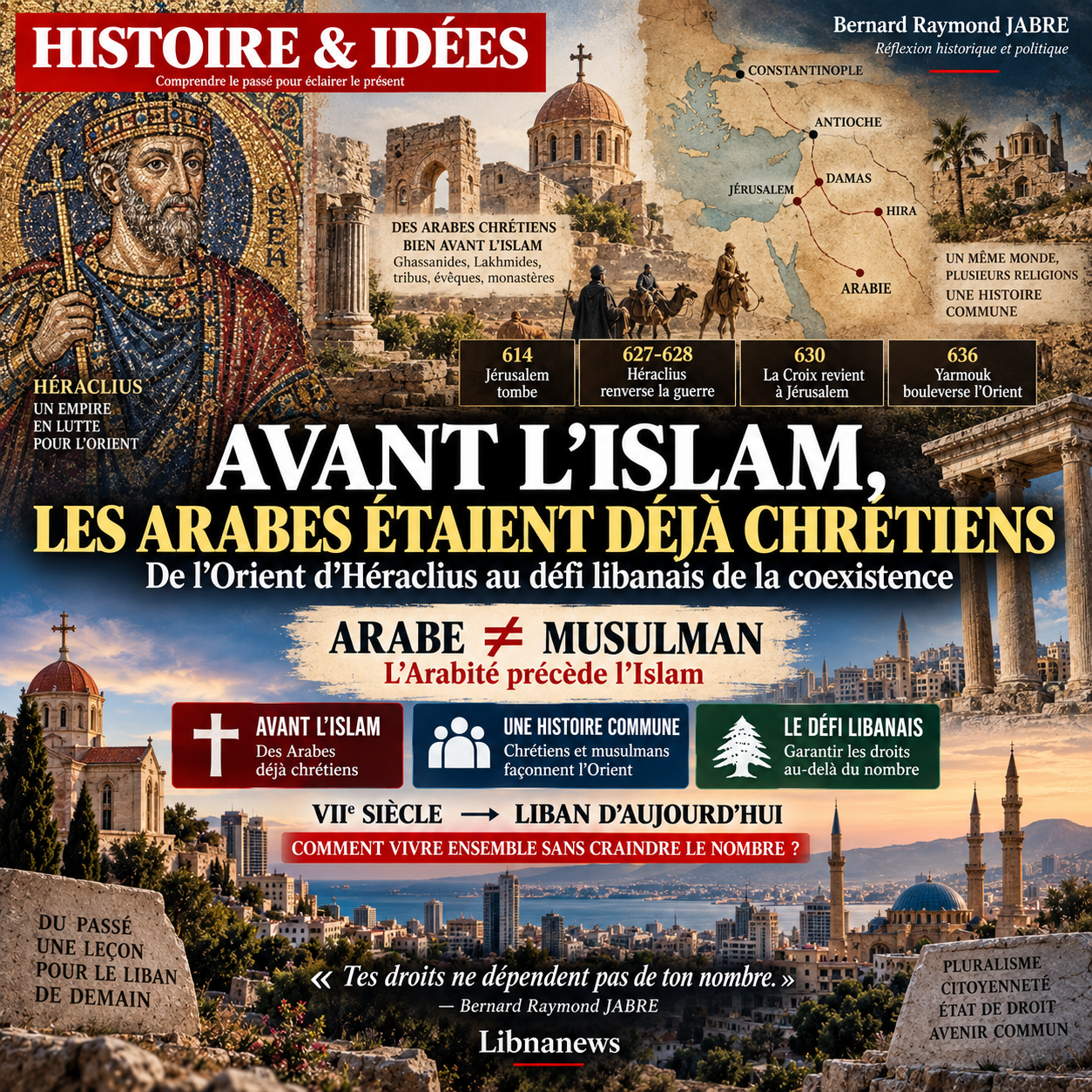
On the Byzantine side are the Ghassanids, a Christian Arab dynasty that plays a role as a frontier power and provides military contingents to the Empire. On the Persian side, the Lakhmids of Hira constitute for centuries another Arab kingdom, linked to the Sassanids. Hira also became an important home of Arab culture and Christianity.
This is what we must understand: the border between Byzantium and Persia is not a border between « Christians » and « Arabs ». Arabs are present on both sides. The Arab identity therefore largely precedes the Muslim identity.
614: Jerusalem falls
In 614, the centuries-old war between Rome and Persia took a dramatic turn. The sasanid armies of Khosro II seized Jerusalem. The city is experiencing very serious violence. Christian shrines are destroyed or damaged and the relic known as the True Cross is carried away into Persian territory.
The conquest of Jerusalem then opened the road to a wider Sassanist occupation of the Middle East. The Persians also take Egypt. The Byzantine Empire then appears close to collapse. Constantinople seems to have lost a considerable part of his East.
For the Christian populations of Syria and Palestine, the shock is immense. And it is precisely in this historical context that an extraordinarily interesting text appears: the Surah Ar-Rûm of the Qur’an.
The Koran speaks of the Romans
Surah XXX begins with the evocation of the defeat of the Rum, i.e. the East Romans, and then announces that after their defeat they will again be victorious in a few years.
The historical scope of the passage is considerable. It means that the community around Muhammad is not intellectually cut off from the events that shake the Romano-perse world. What is happening in Jerusalem, Syria and the Eastern Roman Empire counts.
The Arabian peninsula is therefore not a hermetically closed universe to which a religion without a historical environment suddenly appeared. It belongs to the space of late antiquity: a world traversed by Judaism, different forms of Christianity, Arab traditions, Greek culture, Syriac culture, Persian power and commercial networks linking all these societies.
Islam is born within this changing world, not outside it.
Then comes the impossible: Heraclius reverses the war
When Heraclius took power in Constantinople in 610, the Byzantine situation was catastrophic. Yet, a few years later, he launched a counter-offensive that led his armies to the heart of the sassanid system.
In 627, Byzantine victory became decisive. In 628 Persia accepted peace and restored the conquered territories. The relic of the Cross is finally recovered and brought back to Jerusalem at the beginning of the year 630 according to the chronology generally retained by modern historians.
A few years earlier, such a spectacular restoration of Roman power would have seemed virtually impossible. It is this historical reversal that gives all its strength to the passage of Surah Ar-Rûm. But history holds an even more extraordinary irony.
Two empires come out victorious and defeated at once
Heraclius just saved his Empire. Persia has just been pushed back. The Cross returns to Jerusalem. The old order seems restored. He’s not.
For the two superpowers have just exhausted themselves for more than twenty years in a gigantic war. Their armies are weakened. Their finances are exsanguous. Their provinces were devastated. Their populations have been affected by occupation, taxation, violence and displacement.
The old Romano-perse system is approaching its end. And at the very moment when Heraclius believes he has restored world order, a new power is being born in Arabia.
Just a few years after the Cross returned to Jerusalem, Muslim armies began their conquests. In 636 the Byzantine army suffered a major defeat in Yarmouk. Syria and Palestine are gradually out of control. A few decades later, the Sassanid Empire itself disappeared.
In a generation, the political system that had structured the Middle East for centuries was disrupted.
But this does not mean that Arabs suddenly become Muslims
The Arab conquest did not cause the former populations to disappear instantly. Millions of Christians continue to live in Syria, Lebanon, Palestine, Egypt and Mesopotamia.
They speak Greek, Syriac, Coptic, Armenian and increasingly Arabic. Christianity gradually becomes itself deeply Arab-speaking.
There is therefore a need to reverse an accepted idea: Arab Christianity is not a European import into the Arab world. It belongs to the constitutive history of the Middle East. Arabs were Christians before Islam.
History destroys a dangerous equation: Arabic = Muslim
This equation is historically false. Arab is first and foremost a linguistic, cultural, historical and civilizational reality.
Islam will obviously become one of the central forces of Arab civilization. But it does not create ex nihilo the existence of Arabs, nor does it immediately erase the Arab Christianity that precedes it.
This distinction is still fundamental today. It allows us to understand why the Christian of the Levant is not necessarily the remnant of a Western presence. It may belong to a tradition that plunges deeply into the indigenous history of the Middle East.
The same world has several civilizations
The episode of Heraclius therefore obliges us to look differently at the beginnings of Islam. Eastern Christianity and Islam are not born in two hermetic universes that suddenly meet with war. They belong to the same huge historical space.
They share territories. They know some common stories. They are gradually using common languages. They debate God, Revelation, Abraham, Moses, Mary, Jesus, prophecy, judgment, and eternal life.
The Qur’an itself bears witness to this intellectual proximity to the biblical universe and to the events of the Romano-Eastern world. Surah Ar-Rûm is a particularly striking manifestation.
Arabity is therefore not a religion
This is probably one of the most important intellectual consequences of this story. Arabity was not born with Islam. She existed before him.
She was pagan, Christian, Jewish, then Muslim. It has traversed several empires, several liturgical languages, several political cultures and several conceptions of the sacred.
Confounding Arabity and Islam therefore amounts to transforming a civilization into a unique religious identity. But history tells us exactly the opposite. Arab space has always been plural. And this plurality is not a modern anomaly. It belongs to its very origins.
Christian Arabs are therefore not « guests » in the Arab world. Nor do they constitute an accidental presence tolerated by a majority that is historically the only one. They belong to one of the founding layers of this civilization.
After the conquests: Christians do not disappear
When the Muslim Arab conquests began in the seventh century, they did not cause the immediate disappearance of Eastern Christianity. For centuries, many of the people of Syria, Palestine, Mesopotamia and Egypt remained Christian.
Conversions to Islam are progressive. They span generations, sometimes centuries. This means that after the conquest, today’s so-called Arab-Muslim civilization was also built thanks to the work of Christian populations who already lived in these territories.
The Arabic language gradually becomes their language. The Eastern Christian becomes Arabophone. And Arabic ceases to be only the language of a particular population to become one of the great intellectual vehicles of the Mediterranean and Near Eastern world.
Christians participate in the birth of the great Arab civilization
The first centuries of the Islamic era saw an immense movement of translation and transmission of knowledge. Christian scholars, including Syriac scholars, play a major role in translating Greek works of medicine, philosophy, mathematics and science into Arabic.
Aristotle, Galien, Hippocrates and much of the ancient philosophical tradition go gradually through Syriac and Arabic.
This means that classical Arab civilization is not only the product of a religion. It is the result of an interaction between several traditions: Arabic, Islamic, Syriac Christian, Greek, Persian and Mediterranean.
The greatness of this civilization arose precisely from its ability to absorb, translate, transform and transmit. Civilization appears when identity ceases to be afraid of otherness.
Perhaps this is the great forgotten lesson of the East
A civilization becomes strong when it does not require all its members to be identical. It becomes strong when it manages to produce a political unit capable of containing several belongings.
It is here that the history of the seventh century directly joins the modern history of Lebanon. For the fundamental problem of Lebanon may not be having several religions. His problem is that he never finally solved the political question that this plurality poses: how can we make several religious communities live in the same State without one being able to impose its conception of society on others tomorrow?
The question is much deeper than an administrative distribution of posts. It touches on the very basis of political legitimacy.
Lebanon still bears a question of fifteen centuries old
When we look at the history of the Middle East from Heraclius to today, we discover an extraordinary continuity. Empires disappear. The borders are changing. Languages are changing. Political regimes follow. But one question remains: how can we legally organize the coexistence of communities that do not necessarily share the same religious conception of power, law and society?
This question goes through Byzantine history. It goes through Islamic history. It goes through Ottoman history. And it still crosses Lebanon.
The Lebanese problem cannot therefore be reduced to a simple « community dispute ». He’s a lot more serious. It raises the universal question of political coexistence between communities each with a historical memory, a conception of the sacred and sometimes a different vision of the relationship between religion and power.
Digital majority is not enough to create legitimacy
One of the most dangerous mistakes is to believe that democracy could mechanically solve this problem through the mere rule of the majority.
In a homogeneous society, the majority principle can function relatively easily. In a deeply plural society, it can become explosive. For when a majority is not only an electoral but also a religious or community, a minority can perceive each election as an existential threat.
Democracy then ceases to be a political alternation. It becomes a demographic battle. And when a community begins to believe that its future depends on the number of its children, the number of its voters or its military capacity, the state begins to disintegrate.
The central question is not, who is the majority? The question must become: what rights can never be withdrawn from anyone, regardless of demographic change in the country? That is where the rule of law really begins.
The minority must be able to lose an election without fear of losing its existence
Perhaps this is the simplest definition of a truly pluralist democracy.
A community must be able to lose an election today without fear of losing tomorrow its religious freedom, schools, culture, personal status, political representation, heritage, security or right to participate in the definition of the state.
Otherwise, election is no longer a democratic mechanism. It becomes a permanent referendum on the survival of everyone. And when a population believes that its survival depends on the control of power, it almost inevitably ends up seeking external protection, militia or territorial autonomy.
This is exactly how pluralistic societies can move towards civil war.
The real problem is not diversity
Diversity is not necessarily a weakness. It can become an extraordinary wealth. The problem begins when no superior legal architecture organizes this diversity.
A plural society without a solid political contract produces fear. Fear leads to Community withdrawal. The withdrawal produces identity mobilization. Identity mobilization produces the logic of the blocks. And when the blocs begin to consider the state as an instrument allowing one to dominate the other, violence is no longer far away.
Lebanon knows this mechanics perfectly. He paid him for several wars.
This is why Lebanon needs more than a compromise
Political compromises are necessary. But they’re not enough. A compromise lasts as long as the balance of power which produced it. When the balance of power changes, the compromise is challenged.
A founding contract, on the contrary, must be designed to survive demographic, military and geopolitical changes. It must say: whatever the majority tomorrow, whatever the demography, whatever the regional political evolution, certain freedoms and political rights can never be abolished.
It is this certainty that transforms suspicious communities into citizens capable of living in the same state.
Lebanon could then regain its true vocation
Lebanon was never interesting because it was homogeneous. It is precisely because it is not.
In a tiny territory there are several inheritances of the Middle East: Eastern Christianity, Sunni Islam, Shiite Islam, Druzism, Mediterranean, Arab, Syriac, Ottoman and European traditions.
What has often been described as his weakness could become his contribution to the world. For if Lebanon truly succeeded in building a system where no community can dominate others and where fundamental rights are guaranteed independently of demography, it would become an exceptional political laboratory.
It would demonstrate that coexistence in the East is not only possible under the authority of an empire or authoritarian power. It can be freely, legally and democratically organized.
A Middle East Westphalia?
Christian Europe itself has gone through centuries of religious wars. Catholics and Protestants massacred themselves. Whole States have been destroyed. People have been displaced. Europe was not born tolerant. She learned tolerance because she discovered the huge price of intolerance.
The peace of Augsburg, then the peace of Westphalia, obviously did not immediately create our modern conception of religious freedom. But they have gradually imposed a crucial idea: religious difference can no longer be resolved by the political or physical elimination of the other.
The Middle East today faces the same historical issue in different forms. Not to copy Europe. But to resolve legally its own pluralism.
Lebanon could be the place of this new contract
Not a Westphalia between states, but a Westphalia between memberships.
Reciprocal recognition between Christian and Muslim communities that none will seek to abolish the other politically. A strong constitutional guarantee that the number will never give the right to remove the identity of a minority. A clear separation between religious affiliation and the availability of fundamental political rights.
A simple statement: no one will ever be a provisional citizen in their own country.
That is what could profoundly transform Lebanon.
And this is where the story of Heraclius regains all its strength
We thought we were telling a 14-century-old battle. We discover that we are talking about ourselves.
The Christian Arabs were there before Islam. Islam then became one of the great historical expressions of Arabity. Both traditions lived together for fourteen centuries. They’ve come together sometimes. They have been constantly influenced. Together they produced a considerable part of the Middle East civilization.
No serious reading of history thus allows one to declare the other alien. Perhaps that is what Lebanon should be at the heart of its national contract.
We are not condemned to live together because we are locked up in the same territory. We must learn to live together because our stories have been mixed for centuries.
The future of Lebanon may depend on this awareness
The modern state can no longer ask citizens to forget their religions. That would be unrealistic. He must do something smarter: make religion politically non-threatening to those who do not share it.
A Christian must not fear Islam. A Muslim must not fear Christianity. A Sunni must not fear the Shiite. A Shiite must not fear the Sunni. A believer must not fear the atheist. And no one should fear that a demographic change may one day turn him into a stranger in his own homeland.
This, perhaps, is the true political sense of coexistence: not juxtaposition, not provisional tolerance, not opportunistic power sharing, but mutual existential security.
From memory to civilization
14 September can therefore be read differently. It not only commemorates, in Christian tradition, the Exaltation of the Holy Cross. It brings us back to an extraordinary moment when Byzantines, Persians, Christian Arabs and early Muslims still belong to the same historical horizon.
An ancient world disappears. A new world is born. But men, cultures and memories remain intertwined.
That is why history must never be used to build artificial walls between peoples. It must show us precisely how recent these walls are. Below the political and religious boundaries that we believe to be eternal is a much older history, made up of contacts, metisages, conflicts, translations and transmissions.
And perhaps Lebanon could become again what it has often tried to be: not the border between two worlds, but the place where two worlds discover that they have always belonged to a common history.
Conclusion
Arab Christianity is not an accident. Islam is no stranger to the biblical and near-eastern history that precedes it. Arabity does not belong exclusively to any religion. And Lebanon will probably only be able to survive for a long time when it turns these historical truths into constitutional principles.
For a plural nation cannot live on the good will of the communities alone. She needs a pact superior to their fears.
A pact saying to everyone: Your presence is definitive. Your rights don’t depend on your number. Your religion will never diminish your citizenship. And no demographic change will affect your belonging to the common homeland.
Only then will coexistence cease to be a fragile balance. It will become a civilization.
» Your presence is definitive. Your rights don’t depend on your number. Your religion will never diminish your citizenship. »
Bernard Raymond JABER
Article of historical and political reflection
Page