

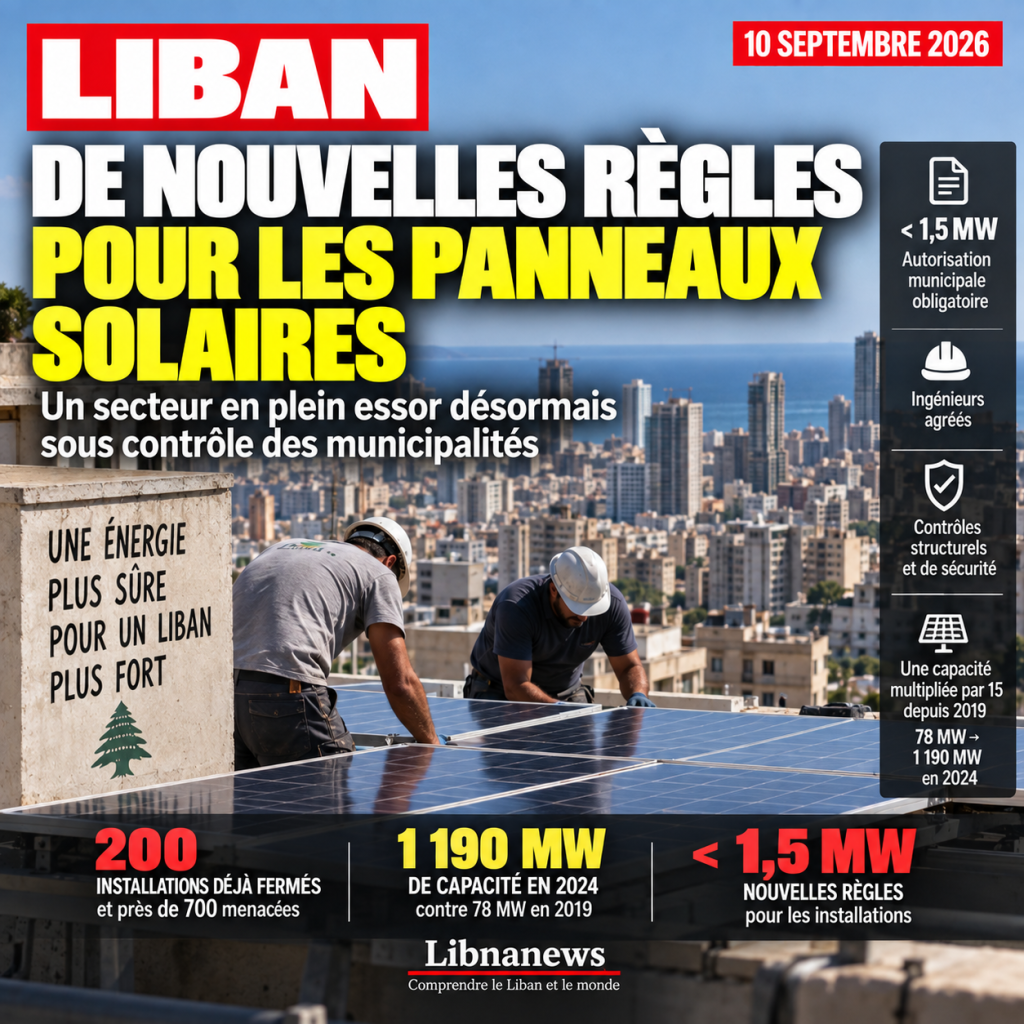
Lebanon is trying to restore order in an area that has grown much faster than its regulation. Ministers of Interior and Municipalities, Ahmad Hajjar, Public Works and Transport, Fayez Rasamny, and Energy and Water, Joe Saddi, have adopted a joint decision governing the installation of photovoltaic systems with a power of less than 1.5 megawatts. Published on Wednesday 9 September and relayed on Thursday by the Ministry of the Interior, it imposes a procedure with municipalities, the intervention of approved engineers and controls related to building structure, electricity and public safety.
This regulation comes after a dramatic transformation of the Lebanese energy landscape. Decentralised photovoltaic capacity increased from 78 MW in 2019 to about 1,190 MW in 2024. In five years, it has been multiplied by more than fifteen. This development did not result from an energy transition organised by the State, but largely from the collapse of public electricity. Households and companies have invested directly in panels, batteries and inverters to reduce their dependence on private generators.
The new text seeks to frame this already accomplished energy revolution. It must improve facility safety and clarify responsibilities. But it also introduces additional administrative procedures into a market which had developed precisely outside a public apparatus which could not provide enough electricity.
Local authorisation for plants less than 1.5 MW
The decision concerns photovoltaic plants with a production capacity of less than 1.5 MW. This threshold covers almost all residential facilities, but also much larger projects on buildings, shops, farms, industrial establishments or other private facilities.
The owner, legal occupant or his representative shall file an application with the municipality concerned. In localities without municipalities, the file will be handed over to the caimacam.
Several documents must accompany the application. The text includes a specific form and a certificate of responsibility signed by a structural engineer registered with the Order of Engineers of Beirut or Tripoli. A second certificate must come from an electrician or electromechanical engineer who is also registered on one of the two orders.
A certificate on easements and urban planning issued by the departments of the Directorate-General for Urban Planning supplements the main administrative requirements.
The distinction between responsibilities is important. The Order of Engineers will not issue authorization. Its role is limited to authenticating the signatures of engineers on plans and conventions. The final decision belongs to the municipality or the caimacam, which must verify compliance with administrative, urban and technical conditions and public safety requirements.
The Internal Security Forces and the municipal police will be responsible for verifying facilities in violation of the arrangements.
Once authorization is granted, the beneficiary will have one year to complete the work. After this period, the authorisation will automatically lapse and a new application will have to be submitted.
A regulation that comes after the solar explosion
The importance of the text becomes more apparent when we observe what has happened since the beginning of the financial crisis.
In 2019, Lebanon had only about78 MW of decentralized photovoltaic. Capacity increased to 92 MW in 2020 and 206 MW in 2021. The acceleration became spectacular in 2022: the country reached 869 MW. In 2023, the total climbed to 1,081 MW, before reaching about1 190 MW in 2024According to the National Renewable Energy Action Plan 2025-2030.
| Year | Decentralised photovoltaic solar |
|---|---|
| 2019 | 78 MW |
| 2020 | 92 MW |
| 2021 | 206 MW |
| 2022 | 869 MW |
| 2023 | 1 081 MW |
| 2024 | 1 190 MW |
The year 2022 is the real point of break. In 12 months, an additional 663 MW were installed. The increase then slows down, but structural change has already been achieved.
This increase cannot be understood without the electricity crisis in Lebanon. With the financial collapse of 2019, the shortage of currency and the inability of the state to normally finance fuel purchases, public production collapsed. Households had to choose between long cuts and expensive subscriptions from private generators.
The increase in fuel prices after the abolition of subsidies further altered the economic calculation. A solar system required a large initial investment, but it then reduced the generator’s bill.
Tens of thousands of households and businesses made this choice without waiting for a public strategy.
The result is exceptional at the scale of the Lebanese electrical system. Renewable generation represented only 2.6% of the electricity actually supplied in 2018. Its share reached21.6% in 2024, mainly solar and hydraulic.
This is one of the few massive changes in the Lebanese economy since the start of the crisis, which was financed mainly by private investment from households and businesses.
Building safety becomes a real challenge
However, this extremely rapid growth produced its own risk.
A photovoltaic installation is not just a household appliance. The panels add a permanent load on the roofs. Metal structures must withstand wind. Wire transports large continuous currents. Batteries, where they exist, require suitable conditions for installation and ventilation.
These issues take on a particular dimension in Lebanon, where part of the housing stock is old and where uncontrolled modifications of buildings are frequent.
The requirement to involve a structural engineer responds directly to this risk. The latter must take responsibility for the capacity of the building to support the installation. The intervention of an electrician or electromechanical engineer must at the same time reduce the risks associated with connections.
The rapid growth of solar companies had also created an extremely heterogeneous market. In addition to specialised companies, many installers with very varying levels of qualification have emerged.
The Lebanon Center for Energy Conservation also maintains a list of recommended companies and carries out their assessment. In 2026, this qualification continues to be regularly updated, precisely in order to improve the quality of facilities and consumer confidence.
However, the new mechanism is shifting part of the responsibility to engineers and local authorities. In the event of a failure in installation, the documents will theoretically make it possible to identify professional responsibilities more clearly.
Administrative costs can become the main criticism
This improvement in security has a counterpart: it makes the installation more complex.
The individual will now have to build up a file, seek engineers, obtain a certificate of urban planning and wait for the agreement of the municipality or caimacam before beginning the work.
Each step can generate a cost.
For a large commercial facility of several hundred kilowatts, these costs are likely to remain low compared to the project amount. For a household that wants to install a few panels on its roof, the situation is different. Professional fees and procedures may represent a significant part of the investment.
It is probably in this field that the new regulation will be really judged.
A rapid, standardised and inexpensive procedure can professionalize the sector without slowing down its development. A slow or different procedure from one municipality to another could, on the contrary, discourage small facilities and encourage undeclared work.
The capacity of municipalities is also a question. Not all have the same technical and administrative resources. Some large communities can handle complex issues. Smaller municipalities, particularly in rural areas, have much more limited resources.
The use of caïmacam in localities without a municipality makes it possible to legally cover the whole territory. It alone does not guarantee the speed of treatment.
A provisional framework pending the electricity regulator
Perhaps the most revealing aspect of the decision is its legal basis.
The text specifies that these rules will apply until the publication of the corresponding procedures and standards by the Electricity Regulatory Authority, in accordance with Article 26 of Law 462 of 2002.
This mention summarizes part of the history of the Lebanese electricity sector.
Law 462, passed almost a quarter of a century ago, provided for the creation of an independent regulator. For years, this institution has not actually been in place, blocking some of the reforms planned for the electricity market.
The installation of the Regulatory Authority is therefore a significant change. But definitive technical rules still have to be produced in several areas.
The joint decision of the three ministries thus serves as a transitional mechanism: it immediately creates rules for a market which already has more than one gigawatt of capacity, without waiting for the completion of the whole regulatory architecture.
This calendar illustrates a particular feature of the Lebanese energy transition:the market preceded the state.
The panels were installed massively before the country had an institutional framework adapted to their importance.
Solar now provides as much energy as a major player in the system
The installed capacity also gives an idea of what photovoltaics now represent.
In 2024, decentralised facilities produced about1 706 GWh of electricity, according to the national renewable energy plan. Total renewable production, including hydropower, reached 2,223 GWh.
The national electricity demand was estimated at 17,278 GWh that year, while the actual supply available was only 10,290 GWh.
Decentralised solar energy alone produced about16.6% of electricity actually supplied in the countrythat year. This comparison should be interpreted with caution, as part of solar production is self-consumed and does not go through the public network. However, it shows the weight gained by technology that remained marginal five years earlier.
The sector also absorbed the shock of the 2024 war. The LCEC estimates that131 MWc of photovoltaic panels were destroyedMore than 244,000 panels. In parallel, an additional 240 MWc were installed during the year. The net gain would thus have been about 109 MWc despite the destruction.
This resilience explains why regulation becomes urgent. Solar is no longer a temporary solution used by a few households during cuts. It is now a structural component of the national electricity supply.
Regulating without breaking one of the few investments that works
The government must therefore find a delicate balance.
The first objective is legitimate: to prevent potentially dangerous installations from being placed on buildings without structural or electrical control. As systems become more powerful, monitoring becomes essential.
The second issue is economic. Solar has developed precisely because it allows households and businesses to bypass some of the electrical system failures. Adding deadlines, fees or excessive bureaucracy would reduce this benefit.
The third concerns territorial equity. A regulation whose application depends heavily on the administrative capacity of municipalities could create significant differences between regions. The procedures will therefore have to be uniform enough to avoid the installation being simple in one municipality and much more difficult in another.
Finally, the issue of existing facilities remains important. Lebanon now has hundreds of thousands of panels installed during the years of extremely rapid market growth. The new text covers installation applications, but the security challenge is not limited to future projects. Some of the existing fleet may also require controls, particularly when the work was carried out without a thorough structural or electrical study.
The 9 September decision thus marks a new stage. Between 2019 and 2024, decentralized solar capacity increased from 78 to 1,190 MW because Lebanese were looking for an alternative to power cuts and generators. The state now intervenes to organize this market after its expansion.
The next step will be the Electricity Regulatory Authority. The common text of the three ministries is explicitly transitional. The standards adopted by the regulator will have to determine whether Lebanon is able to transform the solar boom born of the crisis into a real regulated component of its electrical system, without making it more difficult to invest in its development.




