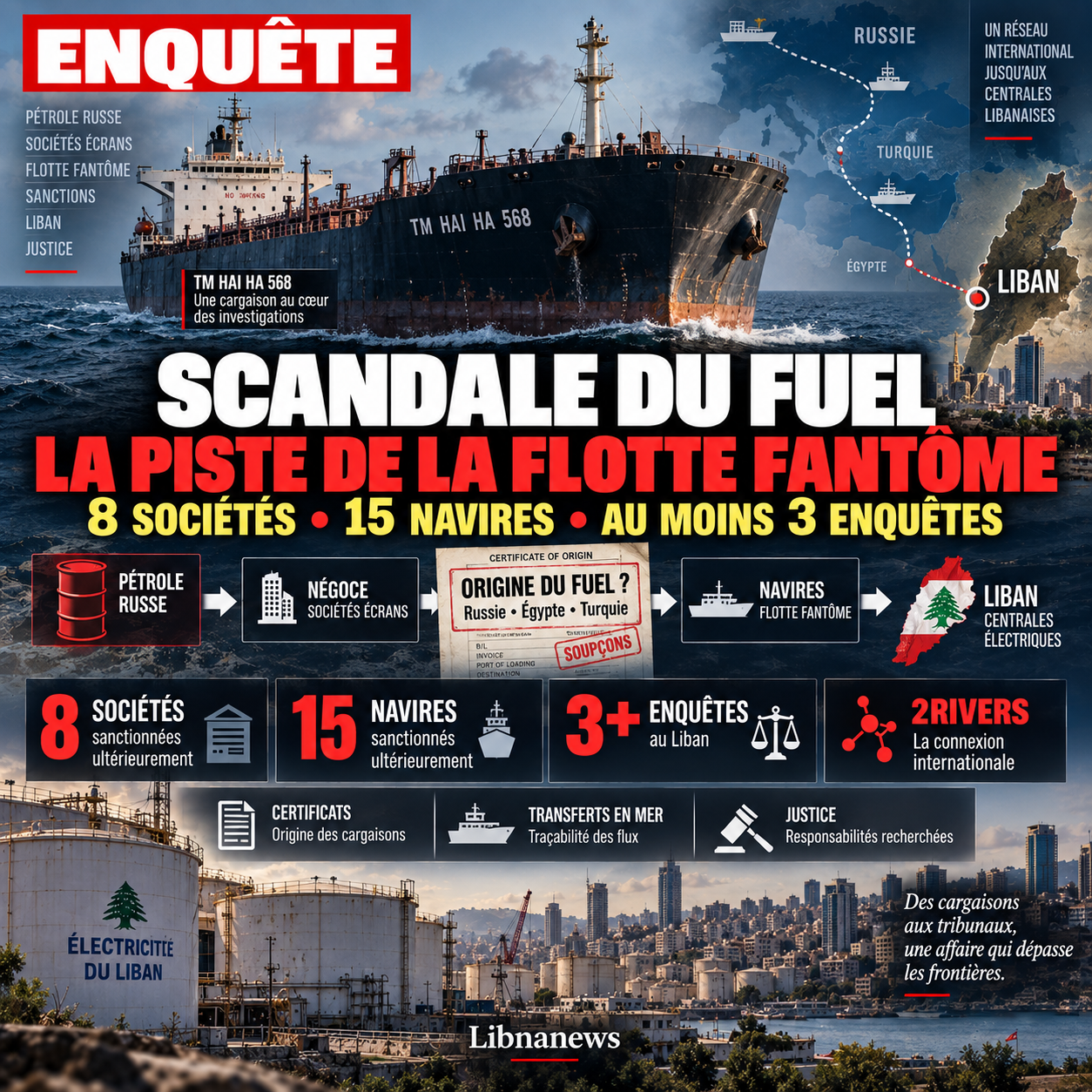
New maritime and judicial documents link the oil import scandal in Lebanon to a vast network of companies and ships associated with the Russian oil trade. At least eight companies and fifteen ships operating in the Lebanese supply chain between 2023 and 2025 have since been subject to Western sanctions, notes Nada Maucurrent Atallah inThenationalnews.com. In Beirut, new judicial proceedings now bring the number of investigations related to this case to at least three.
The oil scandal in Lebanon is taking on an international dimension. Commercial, maritime and judicial documents highlight the links between several shipments to Lebanese power plants and a network of traders and ships associated with the Russian oil trade. Some of these actors were subsequently sanctioned by Western governments.
The case concerns deliveries made between 2023 and 2025, while Lebanon relied heavily on imports to maintain already very limited public electricity production. Suspects include the declared origin of certain cargoes and the use of certificates that allegedly presented Russian fuel as originating from Egypt or Turkey.
If these manipulations were established by the courts, they would have been able to circumvent the commercial constraints of Russian oil and sell fuel on more advantageous terms. For the Lebanese State, potential losses would amount to tens of millions of dollars.
Fuel scandal in Lebanon wins justice
The new element concerns the extension of judicial investigations in Lebanon. Two additional procedures have been opened for companies involved in procurement, bringing the number of cases related to this case to at least three.
Investigations must determine how the cargo was purchased, transported and certified prior to delivery to Lebanon. They also address the possible responsibilities of companies involved in the country’s tenders and procurement.
Financial prosecutors have, among other things, prosecuted two separate cases. The first concerns Iplom International SA and concerns suspicions of fraudulent practices. The second concerns Sahara Energy Resources DMCC and suspicions of corruption resulting in illicit enrichment.
At this stage, no final judicial finding was made against these companies. The files were forwarded to an investigating judge. Iplom did not respond to the requests regarding the ongoing investigation, while Sahara Energy Resources did not comment on the new disclosures.
The Lebanese Minister of Energy, Joseph Saddi, who has been in office since February 2025, claims that he was not personally aware of the suspicions of violation of price cap mechanisms before the case became public. He stated that his department had subsequently changed the terms and conditions of calls to limit the risk of further irregularities.
In his view, suspicions of operations prior to his arrival at the Ministry had been transmitted to the judicial authorities.
Eight companies subsequently placed under sanctions
The documents available also help to rebuild part of the international chain that has fed Lebanon.
At least eight companies involved in this chain between 2023 and 2025 were subsequently sanctioned for their links with the 2Rivers network. This group, formerly known as the Coral Energy Group, was placed under British sanctions and is presented by London as a major player in the Russian oil trade and ghost fleet.
On 24 February 2026, the United Kingdom announced sanctions against 175 companies associated with the 2Rivers network. London also targeted 48 oil tankers accused of transporting Russian oil in circuits that allowed Moscow to maintain its exports.
This chronology remains legally important. The fact that a company was sanctioned in 2026 does not automatically mean that its operations in Lebanon several years earlier were illegal. Investigators must therefore establish precisely the legal situation of each actor at the time of the transactions.
Companies that won Lebanese tenders included BB Energy DMCC, Sahara Energy Resources DMCC, OQ Trading and Iplom International SA.
Maritime documents indicate that some cargo destined for Lebanon originated from entities linked to 2Rivers. A company called LINXOIL appears in particular in the supply chain of a cargo delivered in 2025 by tanker TM Hai Ha 568.
LINXOIL was then one of the companies associated with 2Rivers covered by the UK sanctions. However, it was not itself subject to sanctions at the time of the transaction concerned.
BB Energy states that the checks carried out during this operation did not reveal any problems related to the sanctions. The company also points out that a company subsequently designated becomes prohibited for its transactions covered by the applicable regime.
Fifteen ships linked to Lebanese deliveries
The maritime dimension is the other major aspect of the case. At least 15 ships directly involved in Lebanese supplies between 2023 and 2025 were subsequently sanctioned by Western governments for their role in Russian oil transport.
These ships are associated with what Western authorities call a « phantom fleet ». This term refers to a set of oil tankers that are often old, operated through complex legal structures and that can use different methods to make it more difficult to identify the origin, owner or actual route of a cargo.
The tanker TM Hai Ha 568 occupies a central place in the Lebanese file. As a Vietnamese flagman, he had delivered fuel to Lebanon in 2025 after a journey including Cyprus and Egypt as well as cargo transfers between ships.
Ship-to-ship transfers are not in themselves an illegal activity. They are common in maritime trade. However, the US authorities regard them as an indicator requiring special vigilance when they are associated with other practices that may mask the origin of a cargo.
Lebanese justice is particularly interested in the passage of TM Hai Ha 568 by Egypt. Investigators suspect the vessel did not load the product then delivered to Lebanon. This stopover could then have been used to present the fuel as Egyptian origin.
This assumption remains subject to judicial investigation.
In 2026, TM Hai Ha 568 was subject to sanctions from several Western jurisdictions, including the European Union, the United Kingdom, Canada and Switzerland. The European authorities are associated with the transport of sanctioned oil and maritime practices considered irregular or high risk.
Certificates of origin at the heart of suspicion
The question of the origin of fuel is crucial because the G7 countries and their partners have imposed restrictions on Russian oil-related maritime, financial and insurance services.
The capping mechanism allows certain Western transport services to third countries where Russian oil or petroleum products are sold below the applicable thresholds. For the products concerned by the Lebanese case, the ceilings distinguished fuel from refined products such as diesel and diesel.
Presenting Russian fuel as from another country could therefore, if such falsification were demonstrated, alter the commercial conditions of the cargo and allow its sale without the constraints associated with its actual origin.
However, Lebanese contracts imposed several obligations on suppliers. In particular, they had to identify the port of loading, enable vessels to be monitored by their automatic identification system and comply with restrictions on loading at sea.
The integrity declarations accompanying the tenders also provided for compliance with applicable Lebanese and international laws.
Investigations must now determine whether these obligations have been met and whether suppliers have information to identify any discrepancies in trade documents or certificates of origin.
The oil agreement with Iraq
The mechanism that allowed these imports dates back to 2021. At that time, Iraq had agreed to provide heavy fuel oil to Lebanon on favourable terms of payment to help the country facing the collapse of its electricity sector.
Since Iraqi fuel was not directly suitable for Lebanese power stations, Beirut had set up an exchange system. Companies selected by tender recovered the Iraqi product and supplied fuel compatible with the electricity facilities in Lebanon.
This has given international traders a central role in the country’s energy supply. It also multiplied the commercial and maritime stages between the initial delivery of Iraqi oil and the arrival of usable fuel in Lebanon.
The exchange agreement ended in 2025.
The new investigations now focus on this complex chain and the companies that used it. In particular, they will have to establish the exact origin of the cargoes, verify the authenticity of the certificates submitted to the Lebanese authorities and determine whether public or private officials have benefited from irregular operations.
For a country where electricity cuts remain linked to decades of underinvestment, public deficits and mismanagement, the challenge is beyond compliance with international sanctions. Lebanese justice must now determine whether public funds have been lost in these transactions and, where appropriate, identify responsibilities in the various contracts concluded between 2023 and 2025.