






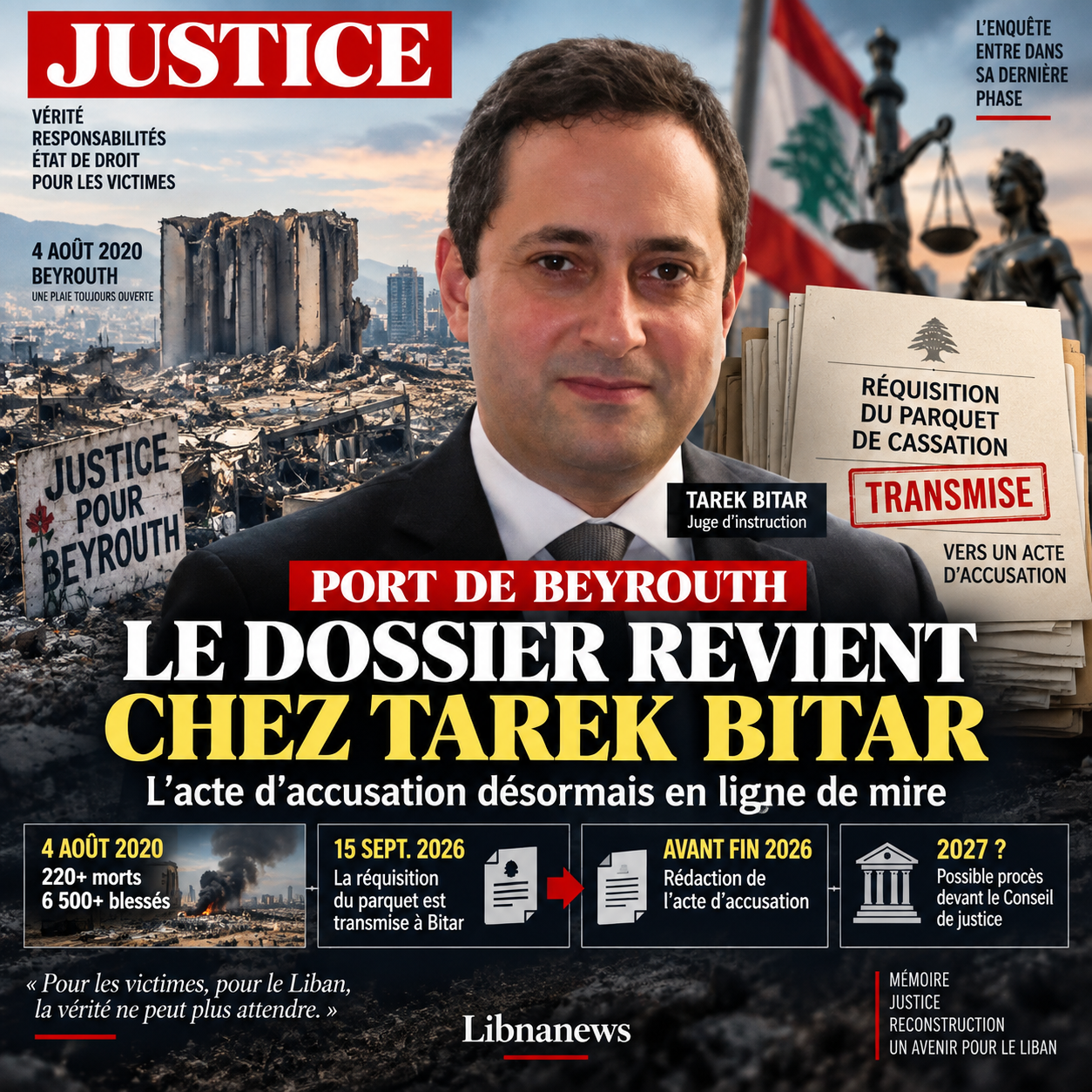
Judge Mohammad Saab transmitted to the investigating judge Tarek Bitar the request of the cassation prosecutor in the investigation into the explosion of the port of Beirut. This step paves the way for the final drafting of the indictment, expected before the end of 2026. Six years after the disaster of 4 August 2020, the judicial file thus enters one of its final stages before a possible trial before the Judicial Council.
The surveyexplosion of Beirut portthis is a major judicial step. Judge Mohammad Saab, a General Counsel at the Court of Cassation, transmitted to the investigating judge Tarek Bitar the request of the prosecution on the merits of the case.
This transmission now allows Tarek Bitar to regain direct control of a procedure which he had closed at the level of education. The magistrate had already prepared a draft indictment before handing over the case to the prosecutor’s office to collect his requisitions.
It must now consider the observations made by the prosecution. It may take this into account in its indictment or hold a different assessment when it considers that the facts and evidence gathered during its investigation warrant it.
According to consistent judicial information published in recent days, Tarek Bitar intends to issue his indictment before the end of 2026. Some press reports referred to a publication in the coming days. However, a judicial source pointed out that the judge was not subject to any specific time limit.
This shade is important. The transmission of the prosecutor ‘ s document is a concrete and now accomplished procedural step. The exact date of the indictment, however, is not yet officially decided.
Explosion of the port: Bitar recovers a decisive file
The requisition transmitted by Mohammad Saab sets out the position of the Public Prosecutor’s Office after the examination of the case file of Tarek Bitar.
The prosecutor has studied the investigations, documents and procedures carried out in recent years. It then signed and finalized its substantive assessment.
This intervention by the prosecutor does not replace the decision of the investigating judge.
Tarek Bitar retains responsibility for the indictment. It is up to the State party to determine which persons should be referred to the competent court, under what qualifications and on what basis. It may also decide not to retain certain responsibilities if it considers the elements insufficient.
Therefore, the issue is considerable for both the persons surveyed and the families of the victims.
According to media reports, the judge should also establish hearings to notify the accused of the court decisions taken against them.
In particular, the indictment will be the document providing detailed information on the findings reached by Tarek Bitar after several years of investigation.
An indictment expected before the end of 2026
The calendar has accelerated in recent weeks.
The Minister of Justice, Adel Nassar, reported in early September that Tarek Bitar had completed his investigation and forwarded the case to the prosecution. He then referred to the completion of this stage in October.
The requisition of the prosecution was finally completed more quickly.
Several Lebanese media had announced Monday, 14 September, that it would be handed over to Tarek Bitar as early as Tuesday, 15 September, or in the following days. As the transmission has now taken place, attention is moving towards the final drafting of the indictment.
Different estimates flow over time.
Some information only evokes a few days. Other judicial sources are more cautious and exclude the existence of a period of one or two weeks imposed on the magistrate.
The point which is the subject of the most consistent information remains the objective of a publicationbefore the end of 2026.
If this timetable is respected, 2027 could open a new phase with the commencement of proceedings before the Justice Council.
However, this perspective remains conditional on the content of the indictment and the procedural decisions that follow its publication.
Six years of judicial and political confrontations
The importance of this stage is also due to the exceptionally difficult course of the survey.
On 4 August 2020, a huge explosion had devastated the port of Beirut and several parts of the capital. More than 220 people were killed and more than 6,500 injured.
Deflagration was linked to a large stock of ammonium nitrate stored for years in the harbour under hazardous conditions.
Investigations have since sought to determine the responsibilities for the arrival of this cargo in Lebanon, its storage, its retention and the absence of measures to remove the danger despite warnings to several officials.
Tarek Bitar interviewed or summoned several political, judicial, administrative and security officials during his investigation.
None of the officials involved in these investigations are currently detained in connection with the case.
The judge’s work was mainly interrupted or slowed down for several years by a succession of appeals, jurisdictional challenges and confrontations within the judiciary itself.
Several officials prosecuted or summoned had challenged the judge ‘ s decisions. The proliferation of procedures had gradually paralyzed the investigation.
The confrontation had also won the Public Prosecutor’s Office, creating an unusual institutional situation around the investigation.
The progressive release of the investigation
The case has undergone a significant change with the resumption of investigations and the improvement of institutional relations between the investigating judge and the prosecutor.
The former Attorney General of the Court of Cassation, Jamal Hajjar, had instructed Mohammad Saab to examine the case and prepare the requisitions of the prosecution.
After his arrival at the head of the prosecution, Ahmad Rami el-Hajj maintained this mission. Mohammad Saab therefore continued to examine the evidence gathered by Tarek Bitar until the completion of his document.
This continuity led to a stage that seemed long inaccessible.
On 30 March 2026, Tarek Bitar had completed his investigations. The case file was then forwarded to the Public Prosecutor ‘ s Office so that it could carry out its own examination before the case was returned to the investigating judge.
It is precisely this return that has just taken place.
It does not mean that responsibilities are already definitively established. The indictment must still specify the facts of the case, the persons referred to the court and the corresponding legal qualifications.
However, it will represent the most important judicial result achieved since the initiation of the investigation.
What Tarek Bitar must now decide
The judge must now confront his draft indictment with the observations of the prosecution.
It has several possibilities. It may follow certain requests made in the requisition, dismiss others or maintain its own conclusions when its analysis of the evidence differs from that of the prosecution.
This independence explains why the content of Mohammad Saab’s requisition alone does not make it possible to know the content of the future indictment.
The next step is no longer to look for new elements in the ordinary context of the investigation, but to turn the years of investigation into specific judicial decisions.
For the families of the victims, this development is particularly expected. Six years after the explosion, no proceedings have yet resulted in a final judgement establishing criminal responsibility for the disaster.
The publication of the indictment will not itself constitute a verdict. Persons brought before the courts will remain presumed innocent until a court decides on their responsibility.
But it will enable the case to be removed from the long phase of investigation and to formally identify the facts and responsibilities which the judge considers sufficiently substantiated to justify prosecution.
The case of the explosion of the port of Beirut is thus at a very different time than that of the years of blockade. The requisition of the prosecution is now in the hands of Tarek Bitar. It remains to be seen how long the magistrate will take to finalize his indictment and what responsibilities he will decide to retain.