






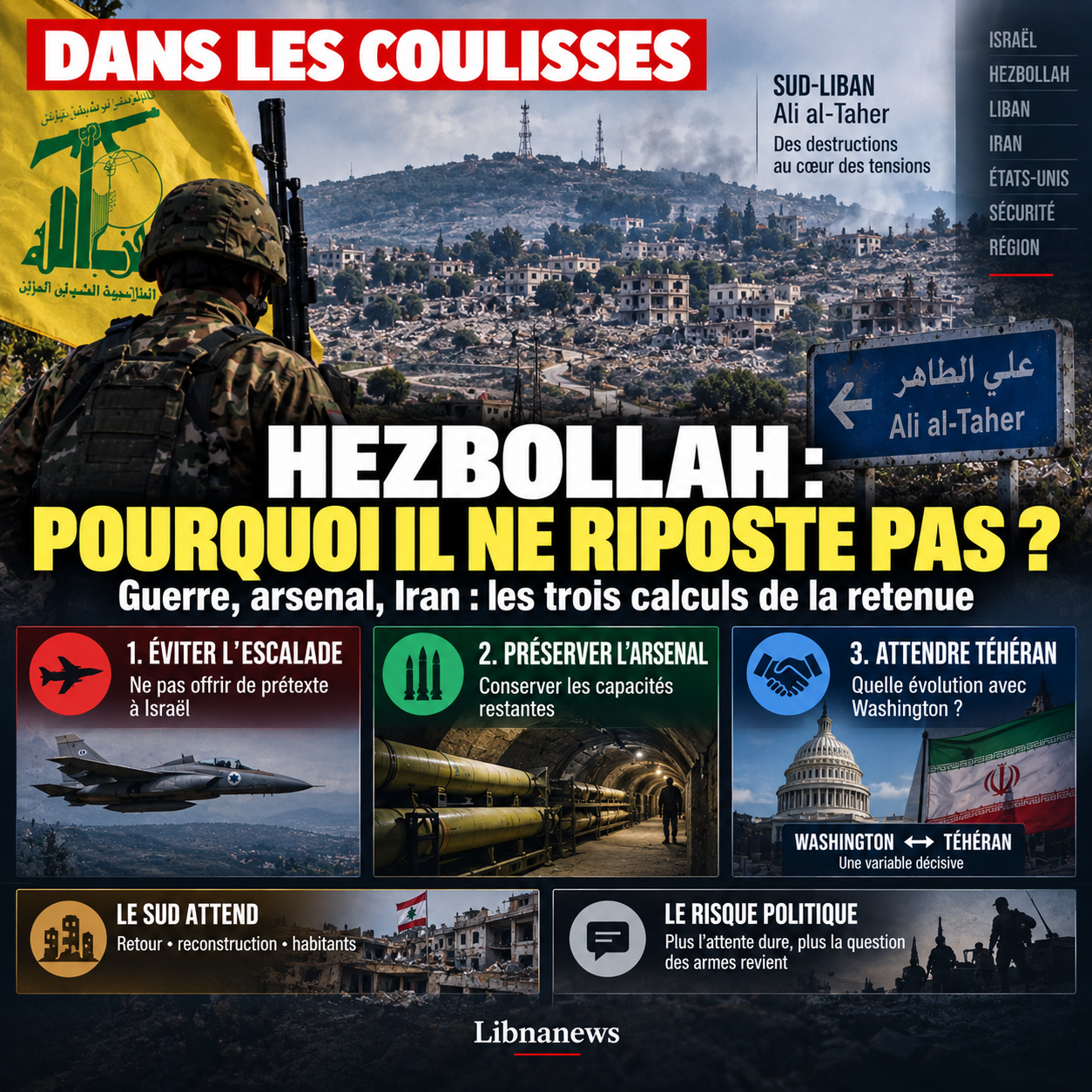
Hezbollah’s military restraint against developments in the South, particularly around the heights of Ali al-Taher, feeds several readings in the press of 15 September 2026. Ad Diyar provides three main explanations from sources close to the issue: to avoid providing Israel with the pretext of a wider confrontation, to preserve the remaining capacities of the party and to wait to see how the relationship between Washington and Tehran will evolve. These elements are not an official explanation of Hezbollah. However, they allow us to understand why the absence of a response cannot only be interpreted as a sign of impotence.
A lack of response that feeds questions
The events of Ali al-Taher have placed Hezbollah in a particularly difficult situation. Several newspapers on 15 September 2026 describe the destruction in the area and Israeli statements concerning its control. In particular, Al Binaa notes the contradictions between various Israeli communications. The Israeli Defense Minister first presented the control of the heights as an element completing the security zone. The army then announced a withdrawal to a rear position while keeping the area under surveillance. Then new statements referred to the ability to regain control of the area.
Beyond this battle of narratives, a question arises in several publications: why does Hezbollah not respond militarily to the pressure exerted on the ground?
Ad Diyar of 15 September 2026 reports that the party is faced with difficult choices. Any major response can lead to a broader Israeli response. But a prolonged absence of response can, conversely, give the impression that the rules of confrontation have changed to the detriment of Hezbollah.
This contradiction explains part of the observed caution.
The party must take into account the military situation, but also the political consequences of a further escalation. The South has already suffered significant destruction. People remain displaced. It’s not easy to rebuild. A resumption of a major war would therefore have a considerable human, material and political cost.
The first hypothesis put forward by the sources of Ad Diyar is precisely that Hezbollah wants to avoid giving Israel a motive for expanding its operations.
Avoid providing Israel with the pretext for a wider war
According to Ad Diyar, Hezbollah officials believe that a direct and significant response could serve Israeli objectives. Israel could present it as evidence that the military threat persists and use this argument to expand its operations.
This assumption is of particular importance in the context of the negotiations. Lebanon is seeking an Israeli withdrawal and strengthening the deployment of its army. Washington is working on security mechanisms. Paris is preparing a meeting to support the military institution.
A major Hezbollah operation could upset this sequence.
It could allow Israel to argue that the guarantees sought are not sufficient. It could also strengthen demands for party weapons and complicate the Lebanese Government’s diplomatic position.
Deduction can therefore be interpreted as a calculation designed not to alter the ratio of diplomatic forces at the worst time.
This explanation does not mean that Hezbollah would have accepted the new realities on the ground. Rather, she suggested that he might consider the timing unfavourable to an open response.
The party would thus seek to avoid a situation in which an ad hoc military reaction would have far greater strategic consequences.
This caution is consistent with the public discourse reported by Al Binaa. At a joint meeting, the Hizbullah and Amal leaderships insist on civil peace, reconstruction and the return of the inhabitants. They also call for political disputes to be addressed through dialogue and institutions.
This language contrasts with an immediate escalation strategy.
Preserving capacity after loss
The second explanation put forward by Ad Diyar is directly military. Hezbollah would seek to preserve its capabilities after the losses accumulated in previous clashes.
The 15 September newspapers contain several elements showing the intensity of operations around Ali al-Taher. In particular, Al Binaa reports on the destruction of an important underground network. The newspaper mentions a considerable amount of explosives used during the Israeli operation.
Al Quds Al Arabi reports the denial of Iranian agency Fars regarding the presence of members of the Revolutionary Guard Corps in the tunnels of Ali al-Taher. According to Fars, 48 Hizbullah members were in the two tunnels and eight were reportedly killed. The Agency does not give a full explanation of the situation of the other members in the extract. These figures come from Fars and are not independently confirmed by other sources.
However, they show that the battle around underground infrastructure has become an important topic.
In this context, a strategy of means conservation can have a military logic. An organization that believes it has suffered losses may prefer to avoid a confrontation in which it would be forced to use part of its remaining capabilities quickly.
This reading is very different from that which presents the lack of response as evidence of the complete disappearance of Hezbollah’s military capacity.
The sources of Ad Diyar do not say that the party still has the same power as before the clashes. They suggest that he would seek precisely to preserve what remains of his abilities.
Nuance is essential.
The party publicly refuses to be presented as weak
The statements of deputy Hussein Hajj Hassan, reported by Al Sharq of 15 September 2026, shed some interesting light on this point. He claims that the resistance, its population and its allies show patience based on their own calculations. He warns against the idea that this patience could be interpreted as a weakness.
Hajj Hassan claims that his camp is not weak either in the resistance, political or popular.
This statement does not specify which military capabilities remain available. Nor does it provide a timetable for a possible response.
His interest is elsewhere: Hezbollah clearly feels the need to publicly combat the idea that its failure to react would be imposed only by its weakening.
The important word is « calculations ».
The Member described restraint as a decision and not a mere disability.
Al Sharq adopts a much more critical interpretation. The newspaper believes that Hezbollah seeks to display a force that it would no longer possess at the same level and that it moves part of its confrontation to the Lebanese State.
This assessment clearly belongs to the newspaper’s editorial line. It cannot be presented as an established fact.
But the confrontation between the two accounts is instructive. Hezbollah says: we wait because we have our calculations. His opponents answer: you wait because your power ratio has deteriorated.
The confidences of Ad Diyar offer a third possibility: both phenomena can exist simultaneously. The party can be weakened while maintaining a decision-making capacity and choosing to preserve its remaining resources.
Waiting for development between Washington and Tehran
Ad Diyar’s third hypothesis is political and regional. Hezbollah would wait to see how the relationship between the United States and Iran evolved before making a major decision.
This is essential because the news of 15 September shows that the relationship between Washington and Tehran is itself in a phase of uncertainty.
Donald Trump says Iran wants to reach an agreement quickly. He said he was open to American involvement in this research. At the same time, military, economic and nuclear pressures continue.
Tehran called for the lifting of American measures and refused to recognize the legitimacy of several Washington demands.
Dialogue is therefore possible without a clear path.
For Hezbollah, an evolution of this relationship could profoundly change the choices available.
An agreement between Washington and Tehran could produce regional arrangements indirectly affecting Lebanon. Conversely, failure of contacts and further escalation could put Hezbollah in a much wider regional confrontation.
In this perspective, using a significant portion of its military capabilities now could be considered premature.
The party would benefit from knowing the direction of the Iran-American report before choosing between a strategy of confrontation, indirect negotiation or retention of restraint.
This hypothesis also makes it possible to understand why the events in Yemen, in Ormuz and in the Gulf are being followed so closely in Lebanon. They are not completely separate crises. They are involved in defining the relationship of regional forces between Iran, the United States and its partners.
Iranian silence around Ali al-Taher also feeds questions
Al Jumhouria of 15 September 2026 reports, in a regional analysis, Tehran’s restraint against the events of Ali al-Taher. The newspaper questions in particular the contrast between the importance attributed to the events and the low intensity of the Iranian reaction.
The Fars agency intervenes mainly to deny the presence of members of the Corps of Revolutionary Guards in the targeted tunnels.
This priority is significant.
Tehran seeks to challenge the idea of a direct Iranian military presence on the site rather than announce a response to Israeli operations.
This does not prove the existence of an Iranian order requiring Hezbollah not to react. There is no evidence of this.
But this parallel restraint feeds the hypothesis that Iran and its allies are currently seeking to avoid an immediate extension of the Lebanese confrontation.
Caution may respond to different reasons. Iran must simultaneously manage Ormuz, the nuclear issue, its relations with the Gulf States and the possibility of dialogue with Washington. A new large-scale war in Lebanon would add an additional front to this equation.
The reconstruction of the South also limits Hezbollah’s room for manoeuvre
The situation of the population is another constraint, although it does not appear to be one of the three main explanations attributed to the sources of Ad Diyar.
Hezbollah and Amal place reconstruction at the centre in their joint statement by Al Binaa. They demand compensation for the inhabitants, their return to their villages and the mobilization of all available resources.
This priority is hardly compatible with a new immediate war.
A resumption of large-scale clashes would further delay the return of the inhabitants. It would increase destruction and make it more difficult to obtain international aid.
Hezbollah must also take into account its own social basis.
Al Joumhouria reports, through an intermediate political personality, that the Shiite population in the South bears a very large share of the cost of the current situation. This source speaks of fatigue and exhaustion, although it also highlights the persistence of the support and resistance of this population.
The interest of this confidence lies in the distinction between political loyalty and availability for a new war.
A population can continue to support Hezbollah while hoping that the destruction period will end.
This reduces the margin for a permanent escalation strategy.
The possibility of an internal dialogue appears in the background
Al Jumhouria of 15 September 2026 also reports the words of a centrist personality in favour of a resumption of dialogue between Joseph Aoun and Hezbollah.
This source considers that the two sides remain deeply opposed to the means but share several objectives: stop attacks, Israeli withdrawal, reconstruction and return of the inhabitants.
According to her, the dialogue could help narrow the gap between Baabda and Hezbollah.
Nabih Berri could play an important role in this process because of his ties with the party and his channels with Joseph Aoun.
This hypothesis remains that of a political source. Nothing in the corpus shows that a formal dialogue of this nature has already been decided.
However, it is important to understand military restraint. If some actors think that a political window can still be opened, an immediate escalation could close it.
Hezbollah may therefore have an interest in preserving several options simultaneously: maintaining its weapons, avoiding a new war, waiting for regional developments and leaving open the possibility of an internal arrangement.
A restraint that cannot last indefinitely without political cost
However, this strategy poses a significant risk to Hezbollah.
The more Israel changes the terrain without a direct military response, the more the party’s opponents can question the utility of its weapons.
Michel Sleiman already asks that positions be handed over to the army. Several political forces are using Ali al-Taher’s events to strengthen their argument in favour of the State arms monopoly.
The restraint that allows Hezbollah to avoid war can thus simultaneously weaken its inner argument.
The party faces a contradiction.
If it reacts strongly, it risks causing a new military campaign and compromising reconstruction. If he does not respond, his opponents may ask why he keeps an arsenal that does not prevent Israeli operations.
Hussein Hajj Hassan’s statements seek precisely to address this contradiction by presenting patience as a calculated choice.
All three assumptions can work together
The confidences of Ad Diyar do not allow us to choose a single explanation.
Hezbollah’s restraint can respond simultaneously to the three factors mentioned.
The party may wantavoid giving Israel a pretext to expand the war.
He can look forpreserve capabilities diminished by previous clashes.
He can finallywaiting to know whether the relationship between Washington and Tehran is evolving towards an agreement or a new escalation.
To these three elements are added the need for reconstruction, the fatigue of the affected populations and the internal debate on the role of the army.
What the sources do not permit to establish, on the other hand, is the existence of a formal decision by Hezbollah to renounce any response, an Iranian order imposing silence or a secret agreement already reached on its weapons.
The interesting confidence is therefore more limited but stronger:the current restraint would be a multivariate calculation rather than a simple lack of reaction. Its duration would depend on the terrain in the South, the evolution of the Lebanese-Israeli negotiations and, above all, the direction of the relationship between Washington and Tehran.