

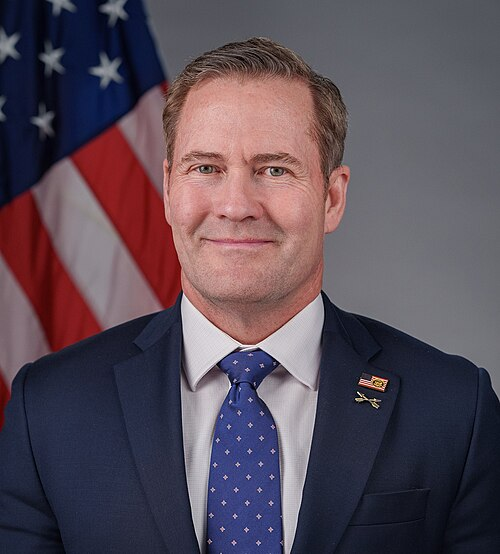
Mike Waltz called on Hizbullah on Monday, 16 November, to voluntarily hand over his weapons to the Lebanese state, following an interview with the Speaker of Parliament, Nabih Berri, in Ain al-Tiné. The US Ambassador to the United Nations has linked this requirement to the restoration of Lebanese sovereignty, while his visit to Beirut focuses on the future of the international presence in the South.
The American diplomat insisted on the impossibility, according to him, of operating a country with two armies. He sent this message to Hezbollah and its Iranian supporters and presented the Lebanese armed forces as the institution to ensure the restoration of State authority.
This appeal constitutes an American position, not the announcement of a disarmament agreement. The public statements consulted do not indicate a new commitment by Hizbullah to surrender its weapons or a timetable agreed by the various parties.
Disarmament at the heart of the discussions
The meeting with Nabih Berri is part of a tour with key Lebanese officials. Mike Waltz also met with President Joseph Aoun in Baabda and Prime Minister Nawaf Salam in the Grand Serail. The American Ambassador to Lebanon, Michel Issa, participated in the discussions.
In Baabda, Simon Karam, who leads the Lebanese delegation to the negotiations, was also present. The Presidency report refers to discussions over the period following the end of the UNIFIL mission, as well as the continuation of Israeli attacks and what the Presidency describes as Israel’s non-compliance with the provisions of the framework agreement.
The discussions covered two related issues: the extension of the authority of the Lebanese State and security guarantees in the South. The American requirement for Hezbollah weapons alone does not regulate the modalities of Israeli withdrawal or those of the future international arrangement.
Salam defends a UN-mandated presence
In the Grand Sérail, Nawaf Salam pleaded for the continuation of an international presence in the South under Security Council mandate. The functions he defends include observation, reporting, coordination, liaison and support to the Lebanese army. It wishes to retain resolution 1701 as a fundamental reference for international arrangements in that region.
The Prime Minister also called for concrete results from the principles of reciprocity and step-by-step implementation of the Trilateral Framework Agreement. It calls for a clear timetable for parallel progress towards full Israeli withdrawal, the extension of State authority in the territory and the monopoly of arms by legitimate institutions.
This includes the request for a reliable mechanism to verify the commitments of both parties. For Salam, the objective is a lasting solution restoring Lebanon’s sovereignty, rather than simply managing the conflict.
After FINUL remains to be specified
The debate is approaching the end of the UNIFIL operational mandate, scheduled for 31 December 2026. This deadline must be distinguished from the drawdown of the contingents in a later phase. The choice of missions to be preserved and their international framework remains central to the consultations.
At this stage, the Beirut talks do not amount to the adoption of a replacement mandate. American declarations and Lebanese requests set priorities, but do not yet make it possible to announce the composition, command or means of a successor arrangement.
Follow the evolutions in ourthe situation in southern Lebanon.
Illustration: Official portrait of Mike Waltz, September 2025. This archive photograph does not represent the interviews of November 16, 2026. United States mission to the United Nations, public domain.





Comments