

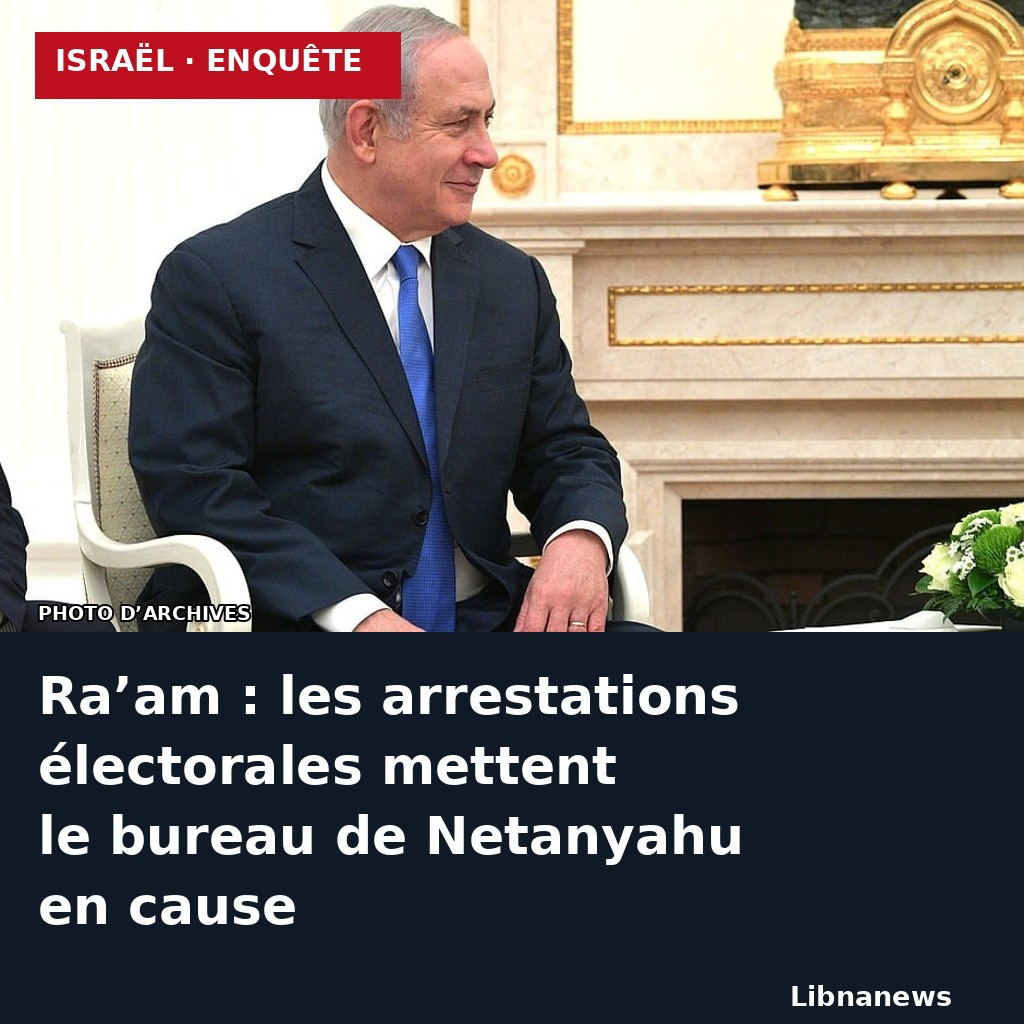
The Israeli police announced on Monday, 16 November, an internal review of the arrests of activists in Ra Revelations question the role of Benjamin Netanyahu’s Chief of Staff, Ido Norden, in transmitting the information that led to the operation. The Prime Minister’s office rejects any manipulation.
Information transmitted to the police, three Arab activists arrested before the opening of the polling stations, followed by accusations of electoral fraud relayed by Benjamin Netanyahu. It is this chain that the Israeli authorities must now clarify. Police chief Daniel Levy on Monday ordered a review of the decisions taken around the 27 October election. His deputy, Yair Hezroni, is to present his findings within one week.
This decision comes after Sunday evening revelations about the origin of the intelligence that led to the arrests. The announced review focuses on the functioning of the services, their organization and the chain of command. It does not at this stage constitute a conclusion establishing political manipulation or criminal responsibility of a member of the Prime Minister’s office.
Ra
According to an Israeli television investigation, Ido Norden contacted the police chief’s office on 26 October, the day before the legislative elections. He reportedly reported suspicious activities by militants from Rasam in southern Israel. But his role would not have been limited to this complaint: he would also have directed the police to a person presented as a source with relevant information.
This person would have recently worked in the Prime Minister’s office. She would be close to Yossi Shelly, former general manager of the administration. A police intelligence officer reportedly contacted him that night. His information was then reported to have been recorded in police systems, before the operation began the next day.
The question is therefore the independence of the information used. Were the complaint and the intelligence supposed to support it coming from two autonomous sources, or from the same political circles? The revelations evoke a suspicion of information deliberately introduced to provoke arrests. This suspicion remains to be demonstrated by the competent investigations.
Arrests without a warrant, according to the investigation
Fourteen police officers reportedly participated in the interventions in the homes of three activists, at dawn on 27 October. Among those arrested were Dr. Sayaf Abu Riash, a Rahat doctor. The images show his wife asking officers to present a search warrant. According to the investigation, they had neither a search warrant nor an arrest warrant.
Suspicions related to moneys in cash and bulletins from Rasam, which the police associated with a possible vote purchase operation. The arrests were then put forward by Netanyahu during election day to denounce an attempt to distort the election.
The detainees have since been released. The last suspect on the file came out eight days after the vote, without restrictive conditions. In his decision, Judge Eran Tzabari of the Beersheba Court of First Instance criticized the weakness of the case and the lack of sufficient progress in police verification.
These releases do not constitute a judgment demonstrating the manufacture of suspicions. However, they show that the detention could not be extended on the elements then produced. The presence of money and electoral material alone is not sufficient to establish the purchase of votes.
Netanyahu’s office denies an uphill operation
The Prime Minister’s office states that Ido Norden simply received information about a possible violation. He claims that his chief of staff fulfilled his duty by putting his interlocutor in contact with the police, as any law-abiding citizen should have done.
He denied any further involvement, disputed that Norden had spoken to the police intelligence officers or investigators in charge of the case and denounced defamatory accusations. His answer therefore does not deny the initial relationship. She rejects the interpretation of an organized intervention to trigger arrests.
Gadi Eisenkot, responsible for seeking a government majority, asked for an immediate investigation. The Yashar leader wants to have the role of the Prime Minister’s office reviewed and the behaviour of the security services before and during the vote. He considers these revelations as an additional reason to end Netanyahu’s continued leadership of the government. This is a political accusation, separate from the conclusions still expected from the authorities.
A separate intelligence component
The revelations also evoke a request by Shin Bet leader David Zini to wire five Arab MPs on polling day. This approach, linked to suspicions of foreign interference, was reportedly refused by the Government’s legal adviser, Gali Baharav-Miara. It is a separate part of the report concerning Ra’am activists.
The Shin Bet claims to have investigated suspicions of subversion and foreign influence within its legal jurisdiction. It states that the information published on the persons concerned or the means employed does not come from him. Verifications must now establish the origin of the information, its control and the decisions that led to the police operation of 27 October.





Comments