

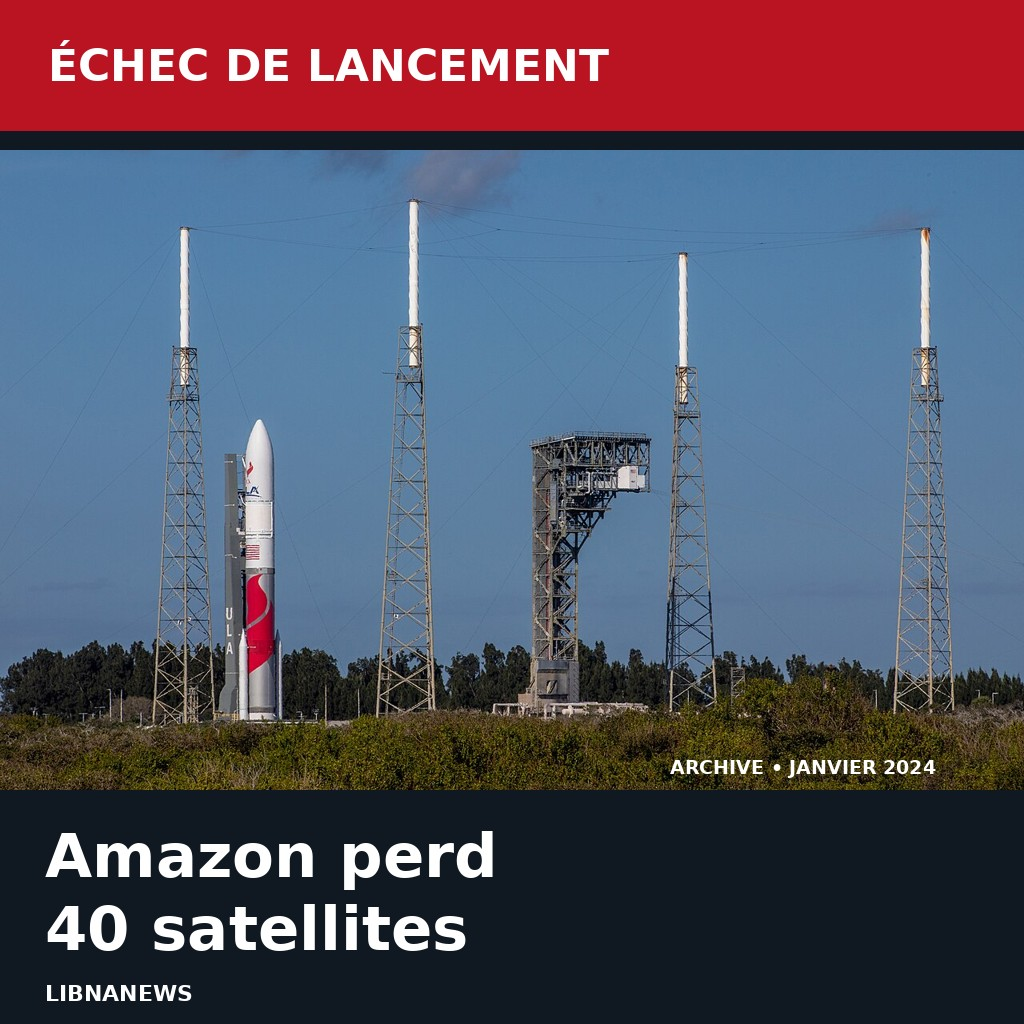
Amazon lost the 40 Leo satellites on a Vulcan rocket on Sunday 15 November in Cape Canaveral. An anomaly that occurred during the flight prevented their orbit. This first Vulcan launch for Amazon was to launch a series of 38 missions to accelerate the deployment of its space internet network.
Flight Leo Vulcan 1, or LV-01, failed. Amazon confirms the loss of the payload of 40 satellites after an anomaly of the United Launch Alliance (ULA) launcher. The rocket took off Sunday, November 15, 2026 from the launch complex 41 at Cape Canaveral, Florida.
ULA places the anomaly about ten minutes after takeoff. The company states that the mission did not reach the expected orbit. She announces that she is working with her client and the relevant agencies to determine the cause, define the necessary corrections and prepare for the return flight. No specific technical reasons were confirmed in the communications consulted on Monday, 16 November.
Amazon loses 40 satellites on a pivotal mission
This loss concerns the largest batch of Leo satellites ever embarked on a single launch. It intervenes as Amazon seeks to increase the number of aircraft deployed per mission. Vulcan has to occupy a central position in this rate increase: the contract provides for 38 launches and the transport of more than 1,500 first-generation satellites.
Amazon reaffirmed its confidence in ULA after failure, while recalling the risks associated with launches. The group had chosen several providers to deploy its constellation, including Arianespace, Blue Origin and SpaceX. This diversification does not allow the whole programme to be based on a single vehicle.
The immediate impact is certain: the 40 satellites transported on Sunday will not strengthen the network. On the other hand, no revised schedule of the entire programme or final loss was announced in these communications.
A new Vulcan configuration
LV-01 used the VC6L version, equipped with six powder boosters and a long cap. The launcher also had a version of the second floor Centaur V optimized for low orbit. Shorter than the variant for high-energy missions, this floor carries less fuel to free up satellite capacity.
The flight plan included two Centaur V ignitions and a series of payload separations. Deployments were to begin approximately 70 minutes after take-off and last 25 minutes. The abnormality reported by ULA therefore occurred well before this phase.
The mission also launched a preparation chain dedicated to Amazon flights to Cape Canaveral. The launcher had been assembled in the VIF-A building on a new mobile platform. This infrastructure was intended to allow for the parallel preparation of two Vulcan missions and to reduce flight intervals.
The case remains to be established
Prior to this launch, ULA had described corrections to the nozzles of booster thrusters after an anomaly encountered in February. The work involved analysis, component testing and a fire test. This history does not make it possible to attribute the failure of 15 November: the investigation must determine what actually happened.
The resumption of the Vulcan programme will depend on the technical findings and the measures taken. The following mission, LV-02, was previously considered a few weeks after LV-01, subject to the successful completion of this first flight. This earlier forecast therefore no longer constitutes a confirmation of the timetable.
Ariane 6 remains on the programme of 23 November
Amazon maintains in its public follow-up another mission, Leo Europe 4, announced at the earliest on Monday 23 November from Kourou, French Guiana. Ariane 64 must carry 36 satellites. The precise launch window remains to be communicated.
After separation, these aircraft must be checked before reaching their operational altitude. The Leo network, formerly Project Kuiper, aims to provide Internet access to areas underserved by terrestrial infrastructure. For Vulcan, the next step is to publish the results of the investigation and a return flight schedule.





Comments