

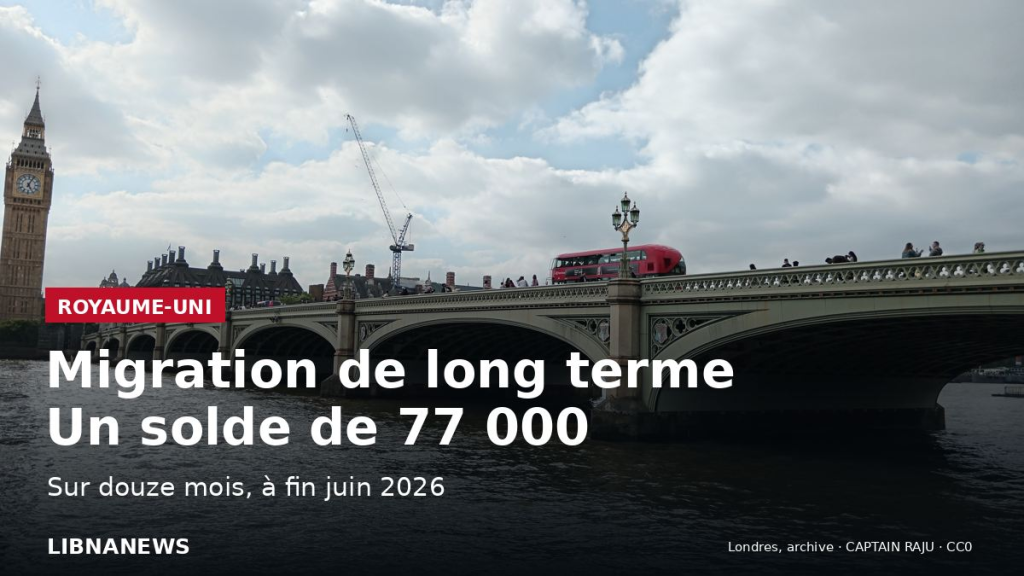
The United Kingdom recorded 77,000 more arrivals than long-term departures in the 12 months completed in June 2026, according to provisional estimates published on Thursday 26 November by the Office for National Statistics (ONS). The balance was 204,000 a year earlier, after revision. The decline is mainly due to the decline in arrivals of nationals from countries outside the European group defined by the ONS.
The UK office had 738 000 arrivals, compared with 893,000 in the previous 12 months, and 661,000 departures, compared with 689,000. The figure of 77,000 measures the difference between these two flows, not the number of immigrants. The calculation is for persons arriving or leaving for at least 12 months, British or foreign. It therefore does not correspond to the number of visas issued or asylum applications.
The hindsight comes above all from arrivals
Among nationals outside the EU+ group, the ONS estimates arrivals at 550 000, compared with 671,000 one year earlier. Departures remained broadly stable. The balance of this group increased from 379,000 to 258,000. In this nomenclature, « EU+ » means nationals of the European Union, the European Economic Area and Switzerland, outside the UK.
School-related arrivals remain the first reason among non-EU+ nationals, with some 257 000 people, compared with 290 000 a year earlier. Labour-related arrivals have fallen further in proportion: the Office estimates them at 135,000, compared with 180,000, including accompanying persons. Asylum arrivals are also falling back. This last count includes persons who apply for asylum after having entered by regular means such as those who entered without authorisation; It is not limited to crossing the Channel.
More departures than arrivals among the British
The balance of the British population is estimated at -137 000 and that of EU+ nationals at -45 000. However, the British component is more uncertain than usual. In the absence of updated administrative data, the Office had to extend its projection to 15 months. It plans to revise these figures at its next publication on 27 May 2027.
Without periods of Covid-19 restrictions, ONS presents this balance as the lowest since 1997. The long-term comparison remains to be read with caution: the Office then relied on surveys and today mainly uses administrative data.





Comments