

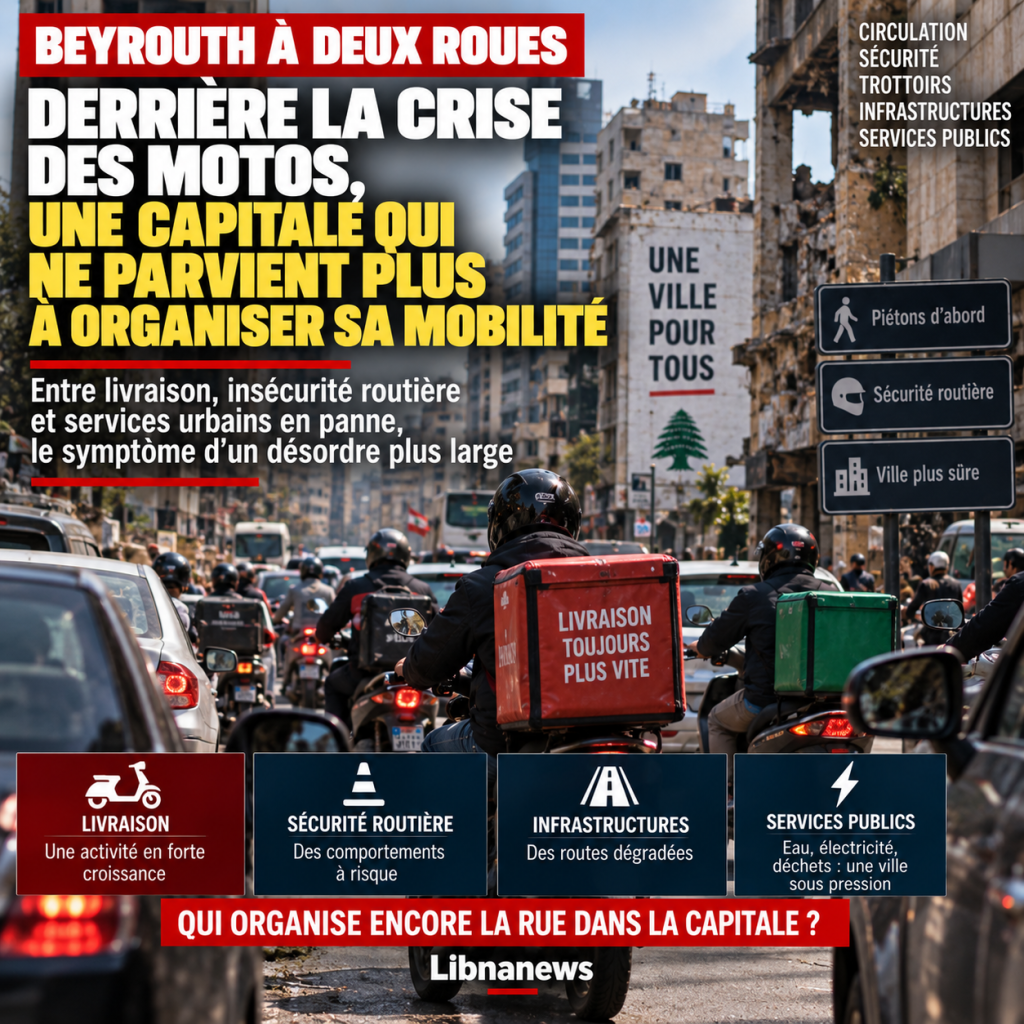
The motorcycle has become the most visible face of a wider disorder
In Beirut, the multiplication of motorcycles today concentrates much of the exasperation related to traffic. They slip between cars, borrow spaces that are not intended for them and occupy a growing place in the delivery economy. But reducing the problem to the indiscipline of drivers would be too simple. The file describes a capital where several urban services are deteriorating at the same time: roads, traffic, signalling, water, electricity and waste. The motorcycle then becomes the most mobile and visible symptom of a system that no longer manages to organize the public space.
The development of delivery services has strengthened this presence. Part of daily business activity now depends on drivers able to quickly cross a crowded city. The bike therefore meets a real economic need. It allows you to bypass traffic jams and maintain a delivery activity in conditions where the car becomes slow and expensive. The same vehicle that facilitates a consumer’s life can, however, make the street more dangerous when it travels without a sufficiently applied framework.
The corpus does not provide reliable statistics on the total number of motorcycles travelling in Beirut, the number of accidents or the exact share of two-wheelers used for delivery. These figures should therefore not be invented. What documents establish is the perception of proliferation becoming a daily problem and its association with a more general disorder of circulation.
Delivery turns the street into a production tool
The delivery driver does not travel for its own use. Its speed becomes a component of the service sold. The more he runs, the more profitable the activity can be. This economic logic changes the relationship on the street. Car lines, lights and detours are no longer just travel constraints; they become lost time in a working day.
This pressure explains some of the behaviours observed without justification. Passing between vehicles, looking for the shortest route or stopping as close to the customer meets a logic of performance. When the city does not offer suitable spaces and the control is irregular, the delivery economy ends up producing its own uses of the road.
The problem then becomes collective. The pedestrian sees his space reduced. The motorist must anticipate trajectories that can arise on both sides. The motorcycle driver himself works in a more dangerous environment. The crisis cannot therefore be dealt with solely by ad hoc campaigns against motorcyclists. It obliges us to look at how a new economic activity has settled in an urban infrastructure that has not been adapted.
Sidewalks, the first frontier of the conflict
The sidewalk should be the simplest space in the city: pedestrian space. In a capital where public space is already heavily contested, however, it becomes an area of traffic, parking or stopping. When a motorcycle gets on a sidewalk to bypass a traffic jam or reach an address, the problem is not limited to an offence. It reveals the absence of a truly protected separation between the different uses of the street.
This occupation penalises first those who have the least opportunity to adapt: elderly people, children, people with reduced mobility or parents with strollers. A valid adult can sometimes get off the road to bypass an obstacle. For others, this displacement becomes difficult or dangerous.
The conflict around motorcycles thus joins that of the general occupation of public space. The street beyrouthine absorbs multiple functions without clear hierarchy. Traffic, parking, delivery, commerce and pedestrian movement overlap. Until this hierarchy is restored, each control operation may only move the problem from one space to another.
When signalling itself depends on electricity
The file also links the traffic disorder to the difficulties in the operation of signalling. A city cannot demand constant discipline if its own regulatory instruments are intermittent. When traffic lights do not work normally, a junction becomes a space where each driver tries to interpret the behaviour of others.
For a motorcycle, the situation is particularly sensitive. Its small size allows it to move in the gaps left by the cars. At a poorly regulated crossroads, this mobility advantage can quickly become a risk factor. The driver thinks he can pass; the motorist did not necessarily see it; the pedestrian no longer knows what flow is actually stopped.
The link between electricity and traffic shows why mobility cannot be treated as an isolated case. One urban service depends on another. A fire needs stable power. The carriageway shall be maintained. The markings shall be visible. Control must be present. When only one link disappears, traffic becomes more difficult; When several degrade simultaneously, the road order is increasingly based on improvisation.
Degraded carriageways that further penalize the two-wheelers
Road problems also occupy a place in the observation on Beirut. A degraded surface hinders all vehicles, but the consequences are not the same for a car and a motorcycle. The two-wheeler has less stability and needs to change its trajectory faster to avoid an obstacle. In dense traffic, this movement can immediately place it in the path of another vehicle.
The deterioration of the road thus nourishes the behaviour which is then criticized to the drivers: sudden changes in direction, traffic between lines and permanent search for the least bad passage. Again, this does not remove individual responsibility. This simply shows that a road safety policy must act both on the driver and on the infrastructure.
The corpus does not provide a costed inventory of damaged roads in the capital. However, he describes this degradation as one of the elements of daily malaise. It would therefore be abusive to produce a ranking of neighbourhoods or a precise number of potholes. The documented issue is more general: the quality of the roadway is part of the mobility problem that the authorities are accused of not addressing sufficiently.
Beirut MPs questioned the most common problems
The dossier contains a direct critique of the representatives of the capital. He reproaches them for multiplying meetings, statements and statements without producing sufficiently visible answers to the ordinary difficulties of the inhabitants. Traffic is just one example. Water, electricity and waste appear in the same table.
This criticism is politically interesting because it reverses the usual order of priorities. National officials are often assessed on major crises: war, presidency, public finances or external relations. He also considers public action based on much more immediate problems. How long does it take to cross a neighborhood? Is water coming? Does the fire work? Is the sidewalk practical?
The motorcycle crisis thus becomes a local representation test. A Member is not a traffic agent and cannot regulate urban mobility alone. However, elected officials can push administrations to coordinate their actions, obtain budgets, monitor the work and turn a diffuse problem into a follow-up political issue. It is this institutional translation that seems insufficient in the criticism formulated.
A capital where crises overlap
The two-wheeler problem cannot be separated from the way Beirut operates after years of crisis. The city has difficulties in providing essential services and managing space. Waste, water and electricity are mentioned alongside traffic. This reconciliation is revealing: the citizen does not experience every breakdown as a separate administrative file. He’s going through their accumulation on the same day.
An electrical interruption may affect signaling. A degraded street slows down traffic. A busy sidewalk pushes the pedestrian towards the pavement. A motorcycle is trying to bypass cars. A delivery man stops in front of an address. Every behavior taken in isolation seems minor. Their superposition, however, turns an ordinary street into a conflicted space.
This accumulation also explains the feeling of loss of control. The problem is not necessarily that no rule exists. It is that the rule becomes difficult to perceive when it is not consistently applied and when the infrastructure itself does not always allow it to be respected.
Control without criminalizing those who work
A serious policy must avoid two opposing mistakes. The first would be to consider each motorcycle driver as an offender by nature. A significant part of the two-wheeler is linked to a professional activity and responds to a demand created by the consumers themselves. The second mistake would be to consider that economic utility justifies any behaviour on the road.
The framework must therefore cover dangerous practices and working conditions rather than an entire social category. This requires regular monitoring, understandable parking rules and responsibility of delivery companies in the organisation of the work of their drivers. However, the corpus does not provide a detailed regulatory framework or data to evaluate each enterprise. It therefore does not allow to go so far as to attribute the situation to a particular platform or employer.
What can be established is that the delivery economy is now part of the urban landscape. The public response must be based on this reality. A city cannot act as if these thousands of business trips could simply disappear. It must organise their coexistence with cars, public transport and especially pedestrians.
Mobility does not repair with a single campaign
The structural nature of the problem appears in the diversity of the causes mentioned: state of the streets, signs, occupation of space, delivery, motorcycles and weak political monitoring. A ticket campaign may have a one-time effect, but it does not repair an out-of-service fire or make a sidewalk workable. Conversely, renovating a road is not enough if traffic rules are not respected.
The answer therefore requires coordination between several levels of administration. Infrastructure, control and organization of uses must be addressed. It is precisely this type of coordination that becomes difficult when each service operates under its own constraints and public resources are limited.
The subject of motorcycles has the advantage of making this weakness visible. It is easy to identify a driver who goes up a line. It is much more difficult to see immediately the chain of public decisions that has produced a poorly organized crossroads, an unusable sidewalk or a delivery system without adequate stopping spaces.
The real subject is Beirut’s ability to become an organized city again
The motorcycle crisis is therefore less a vehicle issue than an indicator of Beirut’s operation. The two-wheeler thrives because it is suitable for a crowded city. It becomes problematic when its flexibility unfolds in a space where boundaries are blurred, fragile infrastructures and irregular control.
The available documents do not allow for a complete mobility plan or for encrypting the motorcycle fleet. On the other hand, they make the problem clear: the capital is accumulating ordinary dysfunctions that eventually change behaviour. Drivers improvise because the city itself too often works by improvisation.
Putting back in order therefore does not only mean multiplying sanctions. Rules must be made applicable and visible. A sidewalk must become a sidewalk again. A fire must work. A carriageway must be practicable. Delivery must be possible without turning each stop into an obstacle. And the Beirut representatives must also be judged on these concrete results. Behind the bike slipping into a traffic jam is finally a much broader question: who is still organising the street in the capital?





Comments