

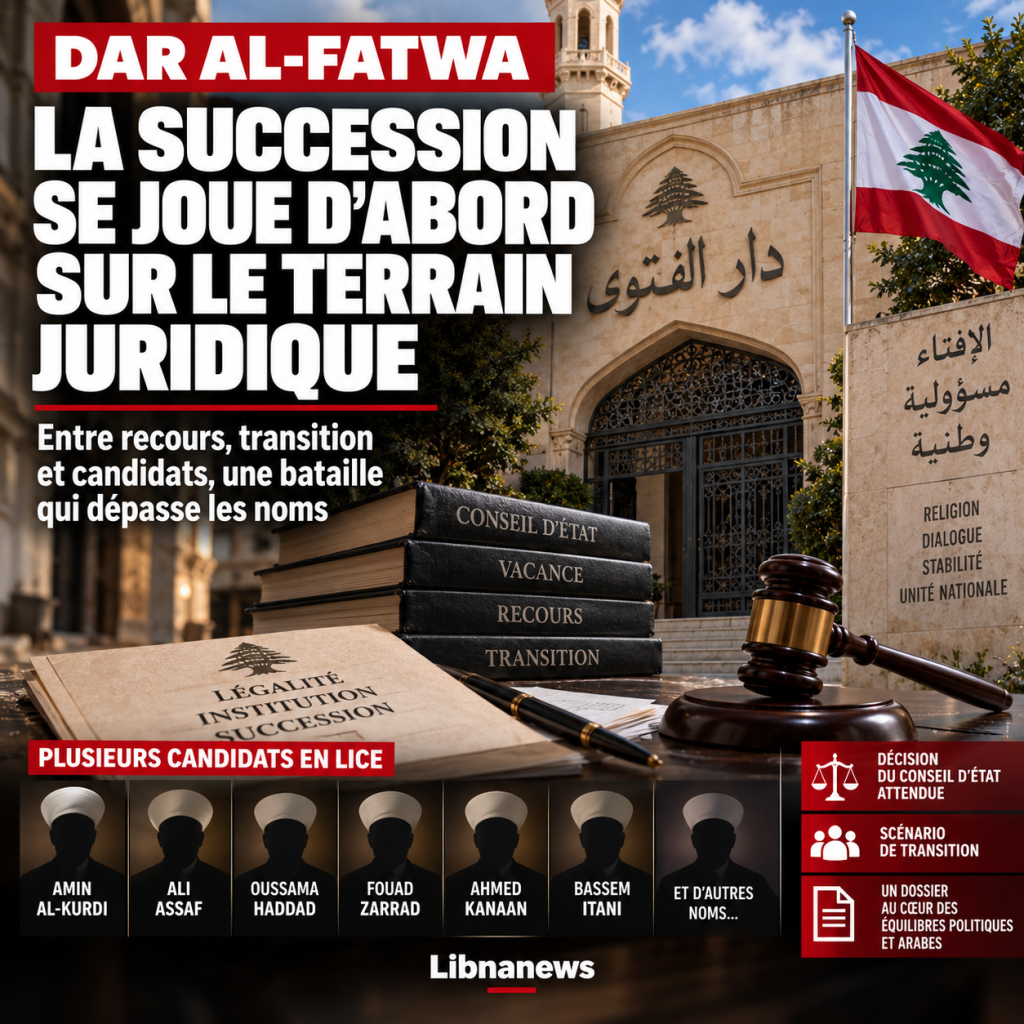
A succession that is not just a list of candidates
The battle around the succession of the Mufti of the Republic, Abdel Latif Deriane, has entered a phase where the institutional calendar counts almost as much as the relations of political power. For several weeks, the names of candidates have been circulating, the former Presidents of the Council have been following the file and Dar al-Fatwa’s balances have been scrutinized. Yet the first issue is not yet who will win an election. It is to determine under what conditions the post might become vacant and who would then be entitled to perform the duties of mufti during the period between the departure of Deriane and the election of his successor.
The dispute over the extension of Deriane’s mandate is therefore central to the equation. The expected decision of the Council of State may change the pace of the entire succession. The adversaries of the extension prepare in parallel a battle of recourse and contestation. Even a scenario that would appear to be politically resolved could thus be challenged before the competent courts. This dimension explains why the discussions on a « transition mufti » remain fragile: a personality chosen by political compromise cannot settle permanently if the mechanism used to place it at the head of the institution is itself exposed to recourse.
The file is also distinguished by the absence of a consensus candidate. Several religious figures have real establishment, institutional experience or a network of relationships. But each encounters reserves in a part of the Sunni landscape. This dispersion gives more weight to Dar al-Fatwa’s domestic law. In the absence of rapid political agreement, the existing institutional mechanism could impose itself and place the fatwa secretary, Amin Al-Kurdi, at the centre of a transition that some actors would have preferred to organize differently.
Amin Al-Kurdi, the legal variable that upsets scenarios
The name of Amin Al-Kurdi should not only be read as that of an additional candidate. Its institutional position gives it a different importance. In the event of the departure of Abdel Latif Deriane, the secretary of the fatwa is presented as the one who could perform the Mufti functions under the internal mechanism applicable to the vacancy. A precedent is recalled: after the assassination of Mufti Hassan Khaled, the institutional functioning had already led the Fatwa secretary to assume the necessary responsibilities during the transition period.
This data changes the nature of the battle. If the extension of Deriane’s mandate falls, the question would not necessarily be: what personality will politicians choose to manage the transition? It could become: does the institutional mechanism apply automatically? In this case, much of the discussion on the designation of a transitional personality would lose its obvious character. Any attempt to circumvent the succession provided for by the internal rules could open a new legal battle.
Al-Kurdi also has assets that go beyond its administrative function. There is evidence of family, political, religious and popular support. The recent circulation of his image on social networks has been interpreted as the expression of a trend favourable to his role. It is also stated that Riyadh would not oppose his assumption of responsibility, while Damascus would not be hostile to that assumption. These indications do not constitute official announcements of support. Above all, they show that his name does not seem to cause, at this stage, the external rejection which might suffice to block an application in such a sensitive dossier.
Fouad Siniora and the idea of a transition before the election
In the absence of consensus, another formula became more important: to introduce a transitional period before the election of the next mufti. The former president of the Fouad Siniora Council appears to be one of the leaders most involved in this reflection. The idea would be to temporarily entrust Dar al-Fatwa to a person who knows his or her functioning, has an institutional experience and is capable of conducting an internal reorganization before the opening of a new stage.
The profile sought would meet several conditions. The transitional personality should have a sufficient level of confidence. It should also be able to carry out an institutional reform and a reorganization of its functioning. Finally, his age or explicit commitment should prevent this provisional mission from becoming a springboard for his own candidacy. The aim would therefore be to separate two functions: to put Dar al-Fatwa in order and then to organize the competition for the Mufti post.
This formula responds to real concern. An immediate election in a climate of confrontation could transfer all current tensions to the next term. But it encounters the obstacle posed by the status of Amin Al-Kurdi. If the rules give the secretary of the fatwa the responsibility to perform the duties in the event of a vacancy, the political designation of another personality could be challenged. Siniora is particularly familiar with this file. He had publicly refused in 2023 the extension of Deriane’s term of office and had called for him not to engage in a solution which he considered contrary to the interests of the community.
Naguib Mikati relies on Ali Assaf, without creating consensus
The former President of the Council Naguib Mikati appears in another camp. He supports Ali Assaf, considered to belong to his close circle. For Mikati, the arrival of Assaf at the head of Dar al-Fatwa would be an obvious political gain: it would maintain a close interlocutor at the head of the country’s main Sunni religious authority, in a time when the internal power relations with the community remain particularly sensitive.
However, this support was not enough to transform Assaf into a consensus candidate. Nawaf Salam does not seem to be in favour of this option and Abdel Latif Deriane’s attempts to bring his positions closer to those of the Serail have not changed this reality. Fouad Siniora also expressed reservations about the possible accession of Assaf to the Mufti post. Mikati’s support thus becomes ambivalent: it enhances the visibility of his candidate, but it can also push other actors to join forces against an application perceived as too directly linked to a former President of the Council.
Ali Assaf, however, is not described as an isolated personality of Arab networks. He has evolved for years in decision-making circles and his name does not seem to provoke automatic opposition to Egyptian and Saudi representations. He was also the son of Sheikh Ahmad Assaf, murdered in 1982. The criticisms against him must be presented for what they are: assessments of his opponents, not established judicial facts.
Osama Haddad, the candidate with a popular settlement
Sheikh Osama Haddad belongs to a different category. Inspector of Islamic waqfs, his name has been among the possible candidates for several years. Its main asset lies in its social presence and in its network of religious and educational activities. It is described as a charismatic personality, known to a large number of Beyruthin families, especially through generations of people who have followed its teaching.
This is an election that cannot be reduced to the decisions of political leaders alone. Dar al-Fatwa is a national institution, but its beyruthin environment retains a significant social weight. Families, religious, members of the Islamic Higher Council and networks of former students are all relays that can influence the perception of a candidate.
However, popularity does not guarantee election. A mufti must manage a religious institution, political balances, relations with the state, Arab relations and often conflicting internal issues. The qualities necessary for preaching or teaching are therefore not the same as those required by the leadership of Dar al-Fatwa.
Fouad Zarrad, the internal opponent who resisted Deriane
Sheikh Fouad Zarrad presents another profile. He established himself as one of the most constant opponents of Abdel Latif Deriane within the Dar al-Fatwa structures. He made breakthroughs in the last two elections and for a long time embodied an almost solitary opposition to mufti in the Islamic Higher Council, before civilian judge Hamza Charafeddine joined the circle of opponents.
His followers highlight his religious knowledge, his calmness and his ability to listen. They consider that he has the qualities necessary to run the institution without repeating the conflicts of the current mandate. His political independence is also presented as an asset. But this same trait can become a weakness in a competition where external support and political networks play a considerable role.
Some interlocutors felt that its name might not be at the top of the preferences of Arab representations precisely because it would be less easy to integrate into the usual political balances. This assessment is not an official position of these capitals. However, it reveals a fundamental tension: should an autonomous person or candidate with political support be given priority to stabilize his or her mandate?
Ahmed Kanaan, Bassem Itani and remaining candidates
Sheikh Ahmed Kanaan was also mentioned. However, his name was accompanied by a campaign of suspicions concerning financial and legal records. There is no evidence available to turn these charges into established facts. They must therefore remain presented as allegations disseminated in the context of the battle of succession. Some link this campaign to the difficult relations between Kanaan and Abdel Latif Deriane.
Sheikh Bassem Itani also emerged in the discussions a few weeks earlier. His candidacy seems to have lost momentum, without disappearing completely. In such a fragmented competition, a name considered secondary at a given time can become more important if the main candidates neutralize each other.
Other religious figures were cited, including religious judges Abdel Rahman Al-Maghrabi and Mohammad Al-Naqri, who were presented as supported by Fouad Siniora, as well as Sheikh Ahmad Darwish Al-Kurdi. Their presence shows that the pool of candidates remains wide. It confirms above all that no personality has yet succeeded in transforming a possible candidacy into a collective solution.
Nawaf Salam keeps his distance
Prime Minister Nawaf Salam’s position is one of the most important elements of the case. In recent weeks, Abdel Latif Deriane has sought to improve his relations with the Serail and to obtain an intervention that could alter the balance of power. These steps did not produce any visible change. The relationship remains cold and Salam does not seem willing to use the Council Presidency to impose a favourable outcome to the mufti.
This restraint is significant. The Presidents of the Council occupy an important place in the balance surrounding Dar al-Fatwa. But intervening directly in the succession would expose Nawaf Salam to the accusation of further politicizing an institution already crossed by strong rivalries. Conversely, remaining totally behind leaves more scope for former Presidents of the Council, religious networks and external influences.
Naguib Mikati supports Ali Assaf. Fouad Siniora is working on exit and transition scenarios. Hassan Diab seems much further from the case, especially because of his past relationship with Deriane. The group of former Presidents of the Council does not therefore act as a homogeneous bloc. This fragmentation makes any solution prepared in advance more difficult.
Riyadh, present by its weight even when she claims not to choose
The Saudi dimension is probably the most paradoxical. Saudi officials claim that they do not intend to intervene directly in the selection of a candidate. However, the acceptability of a future mufti to Riyadh counts in the calculations of the protagonists. The absence of a veto can become almost as important as explicit support.
Therefore, it is not necessarily a matter of waiting for Riyadh to designate a name. Rather, it is a question of which candidates will not meet with opposition and which transition formula will benefit from a favourable Arab environment. In the case of Amin Al-Kurdi, the available information indicates a lack of Saudi opposition to his possible assumption of office. Ali Assaf, for his part, is not presented as a personality causing an automatic rejection of Saudi and Egyptian representations.
Fouad Siniora can know in detail the mechanisms of Dar al-Fatwa and be able to bring together some former Presidents of the Council. However, it does not control this external variable. This is one reason why a solution that seems consistent in Beirut can remain suspended in the way it will be received in the Arab environment.
A battle for the institution as much as for the post
The succession of Abdel Latif Deriane finally surpasses the competition between several Sheikhs. It involves the very functioning of Dar al-Fatwa after a period of controversy over the extension of the mandate, tensions with some of the former Presidents of the Council and the emergence of internal opposition. The central question is whether the institution will move directly from one mufti to another or whether it will undergo a transition period to review its functioning.
The transitional formula has a logic: to avoid an election organised in an emergency immediately reproducing existing divisions. But it also carries a legal risk. If the rules provide that Amin Al-Kurdi performs the functions in the event of a vacancy, creating another mechanism may open a series of appeals. A transition designed to stabilize Dar al-Fatwa could then produce the opposite effect if its legality is challenged from day one.
The other difficulty is political. None of the main candidates currently brings together all the actors. Ali Assaf has the support of Naguib Mikati but meets important reservations. Osama Haddad enjoys a popular location but must convince on institutional management. Fouad Zarrad has an internal opponent’s career and a reputation for religious seriousness, but his independence can complicate the constitution of a political bloc around him. Ahmed Kanaan and Bassem Itani remain in the race without appearing, at this stage, as consensual solutions. Amin Al-Kurdi, at last, can be at the centre of the game even before voters are called to choose.
The next step will not necessarily be the election of the new mufti. It could be a legal decision on the current mandate, followed by a battle over the interpretation of the vacancy rules. It is only after this passage that the electoral power relations can really be clarified. In this succession, law does not constitute the setting of politics. He can decide who first will enter the mufti’s office when Abdel Latif Deriane will be more.





Comments