

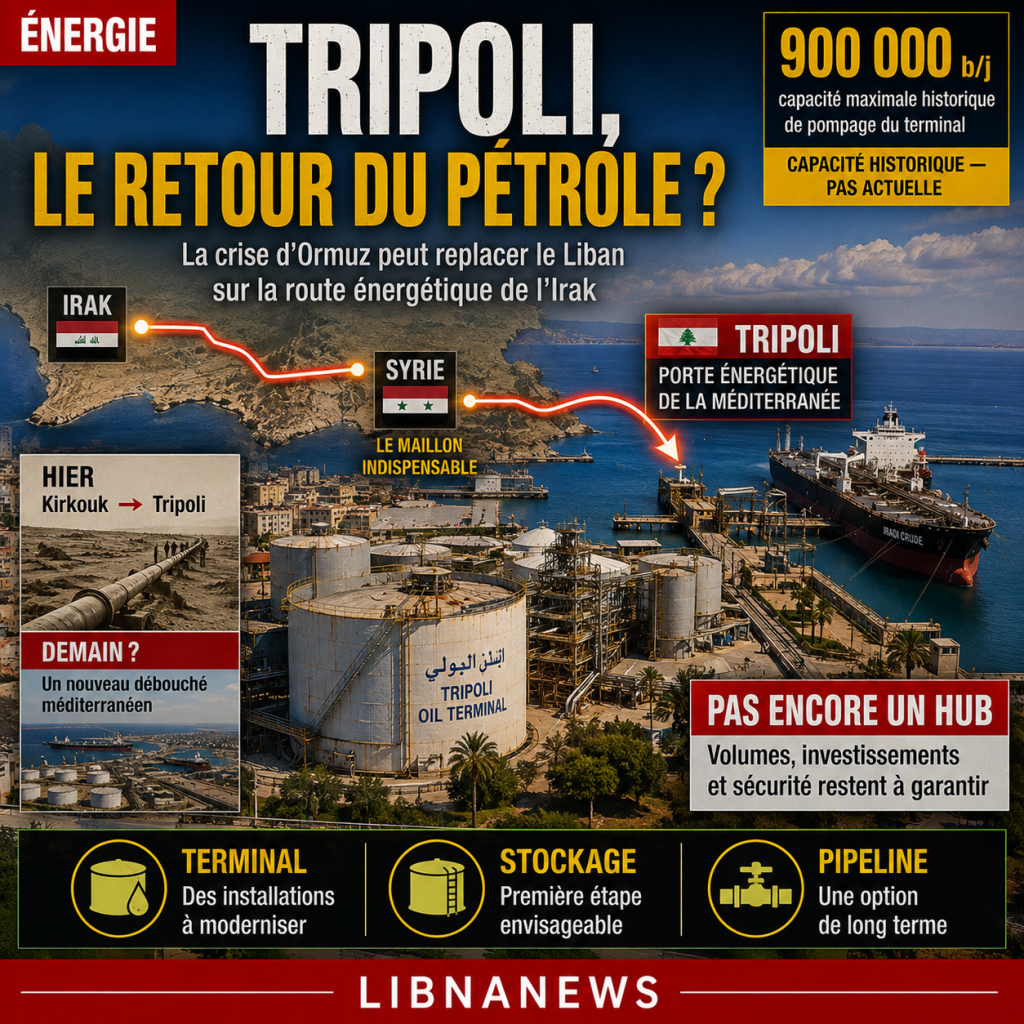
The crisis in the Strait of Ormuz puts on the table a function Lebanon had lost for several decades: to serve as a Mediterranean outlet for Middle East oil. Iraq is now seeking to diversify its export routes, while Beirut is preparing its infrastructure to host, store and possibly re-export Iraqi oil products. Tripoli has a favourable geography and facilities inherited from the former Kirkuk-Mediterranean corridor. But transforming this crisis opportunity into a sustainable energy function requires considerable investment, regular volumes and above all a secure corridor across Syria.
The question would have seemed largely theoretical a few months ago. It is much less so since the disruptions of the Strait of Ormuz have shown Iraq the cost of its dependence on Gulf terminals. Baghdad is now looking for several ways to transport its oil to the Mediterranean. Lebanon wants to take advantage of this movement to place Tripoli on an energy map whose country has gradually disappeared since the second half of the twentieth century.
The government of Nawaf Salam has begun to prepare this possibility. On 10 August, a meeting brought together the ministries and administrations involved in a possible Iraqi oil transit through Lebanese territory. At first, it is not a question of resurrecting the old pipeline. The scenario is based on land transport, storage and re-export.
This first step seems modest compared to the major pipeline projects studied between Iraq and Syria. However, it raises a strategic question:can Lebanon take advantage of the Ormuz crisis to become again an energy gateway to the eastern Mediterranean?
Ormuz restores value to Mediterranean markets
The Iraqi interest explains the return of the case. Oil exports are Iraq’s main source of government revenue and a considerable share of the crude oil normally leaves the country with its southern facilities. This organization makes Baghdad particularly vulnerable to disturbances in the Gulf and Straits of Ormuz.
The crisis of 2026 turned this theoretical vulnerability into an immediate problem. According to figures reported at the end of July, Iraqi exports fell from 4.2 million barrels per day in February to 1.5 million barrels per day in May, at the height of the disruptions related to the conflict with Iran.
For Baghdad, road diversification is no longer just a matter of commercial optimization. It becomes an insurance against the interruption of a seaway on which much of the state’s revenue depends.
The Mediterranean is the natural exit to the west. Oil transported directly to the Syrian, Turkish or Lebanese coast can reach international markets without crossing Ormuz. However, the question is not to replace the southern Iraqi terminals entirely. The necessary capacity would be considerable. Rather, it is a matter of having several corridors capable of maintaining a portion of exports when a road becomes vulnerable.
It is precisely this change of logic that creates an opportunity for Lebanon.
Tripoli has geography, but not yet modern tool
The main Lebanese asset is in Tripoli. The city is located on the Mediterranean, close to Syria and on the old energy road linking Iraqi oil fields to the Levantin coast.
This function is not new. Iraq Petroleum Company used to transport the Kirkuk crude oil through a pipeline network through Syria. One branch was in Tripoli, where oil could be exported or refined.
The facilities still exist in part. The Tripoli oil site includes a terminal and the former refinery. Oil Branch data indicate that the terminal had historically been designed to receive crude oil through three 12-, 16- and 30-32-inch pipes. Its maximum pumping capacity had reached 900,000 barrels per day on paper.
This figure should not be interpreted as a capacity available today.
Infrastructure has been ageing, several facilities require work and the old network linking Iraq to Lebanon cannot be considered operational. The refinery itself has been shut down since 1992. Some tanks in Tripoli facilities are also listed as out of service.
The real advantage of Lebanon is therefore less of having an immediate infrastructure capable of receiving hundreds of thousands of barrels than of having aexisting energy site, a right-of-way, reservoirs, port facilities and industrial memory that can reduce the cost of upgrading from a fully constructed project from zero.
The Iraqi corridor could put Tripoli back on the map
The most ambitious project is currently emerging between Iraq and Syria. Baghdad is studying the construction of a new pipeline linking its production areas to the Mediterranean by Syrian territory.
The old Kirkuk-Banias line is too damaged and too old to be the main solution. Current studies therefore focus on a new infrastructure. The proposed project would use Haditha as a connecting point between the fields of northern and southern Iraq before continuing towards the Syrian port of Banias.
Available estimates provide the measure of the project. The capacity studied could reach2 million barrels a day. Its construction would take about four years and would represent at least$15 billioninvestment. Technical and financial studies are under way, but there is still no definitive schedule for the construction of the corridor to be considered as acquired.
For Lebanon, the risk is obvious. If the new Iraqi network stops in Banias, Syria will concentrate most of the Mediterranean transit and export function. Tripoli will stay away from the main corridor.
Beirut therefore seeks to position itself before this architecture is finally stopped.
Iraqi oil could first arrive by road
The Lebanese strategy is pragmatic: start even before a pipeline exists.
The Government meeting on 10 August focused on roads, border crossings, customs, storage facilities and security conditions for transit. The scheme envisaged in a first phase is therefore based on tankers coming from Iraq across Syria.
Lebanon would then become a logistics provider. Oil or petroleum products would not necessarily be destined for the Lebanese market. They could enter the country, be stored in the facilities available and then re-exported from the Mediterranean.
The economic model would thus change in relation to the energy agreement already between Beirut and Baghdad. Since 2021, Lebanon has received Iraqi fuel to support its electricity production. In the new scheme, he would also seek to selltransit, storage, handling and re-export servicesprotection caps (if present).
No specific income can yet be advanced. The Government has not announced the volumes that could be transited, the tariffs that would be applied, or the date of the first shipments. Without these three data, it would be premature to attribute a specific financial value to the project.
Road transport also has an obvious physical limit. Truck convoys can start a corridor and test customs procedures. They cannot economically replace an oil pipeline capable of carrying several hundred thousand barrels per day.
Tripoli refinery poses another equation
The project could go further if Lebanon regained refining capacity. The Tripoli refinery was built in 1940 to process oil from Kirkuk. Its officially stated historical capacity is21,000 barrels per dayprotection caps (if present).
However, she has been arrested for more than thirty years.
Previous studies on the Lebanese energy sector had already raised doubts about the profitability of a simple rehabilitation of the facility, in particular due to its small capacity in the face of modern refineries in the region. Returning the site to service therefore does not necessarily mean restoring existing units to the same level.
The current discussions with Iraq also focus on several options. Energy Minister Joe Saddi said at the end of July that the possibility of building a refinery was one of the subjects to be studied by the Lebanese-Iraqian technical team. This is not yet an investment decision.
Projections of employment and income should be treated with the same caution. A refining activity would create requirements for operation, maintenance, safety, transportation and industrial services. A more active terminal would also generate handling revenues and increase port activity. But no official number of jobs or guaranteed annual earnings have yet been agreed.
At this stage, therefore, the most immediately accessible scenario remains that of the terminal and storage, not that of a fully restored refinery.
Syria remains the indispensable link
The geography that gives Lebanon its advantage is also its main weakness. There is no border between Iraq and Lebanon. Any reasonable land route must cross Syria.
An energy corridor to Tripoli therefore requires three political agreements, not two.
Customs procedures must be compatible. Trucks must be able to cross borders without undue delay. The safety of the axes must be guaranteed. For a pipeline, the constraints are even greater: rights of way, plant protection, pumping stations, maintenance and revenue sharing must be negotiated over several decades.
Syria’s political evolution opens up opportunities that did not exist under the same conditions before. Baghdad and Damascus discuss a new corridor directly. At the same time, Beirut and Damascus resumed work on several economic and border issues.
But Syrian instability remains a major risk factor. A pipeline is a fixed, expensive and vulnerable infrastructure. It crosses hundreds of kilometres and cannot change its route when a region becomes dangerous.
The profitability of the corridor will therefore depend as much on Syrian political stability as on the price of oil or the cost of Lebanese facilities.
Military risk does not disappear when leaving Ormuz
Contouring Ormuz reduces a risk, not suppressing geopolitical risk.
The Eastern Mediterranean remains exposed to regional tensions. Syria is still experiencing episodes of instability and Israeli strikes. Lebanon continues to face Israeli operations in the South and the uncertainty surrounding the security settlement with Israel.
For an investor, this situation translates directly into costs. Energy infrastructure must be ensured. The cargoes must be able to circulate. Operators must be certain that terminals will remain accessible and contracts will be executed for several years.
The comparison with Ormuz must therefore remain economic. If the cost of maritime risk in the Gulf becomes lastingly higher than the cost of a land corridor crossing Iraq and Syria, the Mediterranean route is becoming more attractive. If Ormuz quickly regains normal functioning while the Levant remains unstable, the advantage can disappear.
Regular volumes are essential
The real test will be volumes.
Rehabilitating roads, upgrading reservoirs, upgrading port facilities or building a pipeline industry represents significant investments. They cannot be amortized with a few occasional shipments sent during a crisis.
Lebanon must therefore obtain more than a transit possibility from Baghdad. It would require commitments that were sufficiently regular to justify the necessary expenditures.
This condition explains the importance of the joint technical team announced between the two countries. In particular, it should examine the feasibility of the various options and identify the volumes that may pass through Lebanon.
Competition will also be crucial. Iraq does not rely on a single solution. At the same time, he develops or studies several outlets, including Turkey and Syria. Each road will have to be compared according to the cost of transport, available capacity, transit charges and political risk.
Tripoli has one argument: offer Baghdad a second Mediterranean outlet and avoid an exclusive dependence on a single coastal terminal. But this diversification must have an acceptable price.
Tripoli can begin by proving its usefulness
The least risky strategy for Lebanon is therefore to move forward in stages. Road transport would test the corridor without waiting for several years of construction. The first shipments would show whether border crossings work, whether storage facilities meet standards and whether re-export from northern Lebanon is commercially competitive.
This phase would also have political value.
If Tripoli actually becomes useful for Iraqi trade, Lebanon will have a much stronger argument to demand that future permanent infrastructure not stop on the Syrian coast. A branch to Tripoli could then be studied as part of the large Irak-Syrian corridor.
On the other hand, if the country fails to bring its facilities back to standards or to smooth transit, Baghdad will have little economic reason to add a Lebanese detour to its Mediterranean facility.
The window opened by Ormuz is therefore both an opportunity and a test.
Strategic infrastructure or simple crisis project?
Two scenarios are now emerging.
In the first, the Ormuz crisis produces a temporary solution. A few Iraqi cargoes travel through Syria and Lebanon, Tripoli provides storage and re-export, and then flows decrease as the Gulf navigation normalizes. Lebanon will then gain a one-off activity without regaining a structural energy function.
In the second scenario, Baghdad considers that the crisis has demonstrated lasting vulnerability. Iraq maintains its diversification policy even after the normalisation of Ormuz, invests in Mediterranean corridors and guarantees volumes over several years. Tripoli can then claim a place in this new architecture, provided that it has modernised its facilities and negotiated its connection.
The difference between the two scenarios will not depend on Tripoli’s oil history. It will depend on much more concrete decisions: guaranteed Iraqi volumes, transit costs, state of reservoirs, investments undertaken, agreements with Syria and possible construction of a permanent branch to northern Lebanon.
The next steps will already test this ambition. The announced arrival of Iraqi experts, the assessment of storage capacity and, above all, the fixing of the first volumes will show whether Tripoli is actually becoming a Mediterranean energy outlet again or whether the Ormuz crisis has only temporarily reopened an old Lebanese dossier.




