

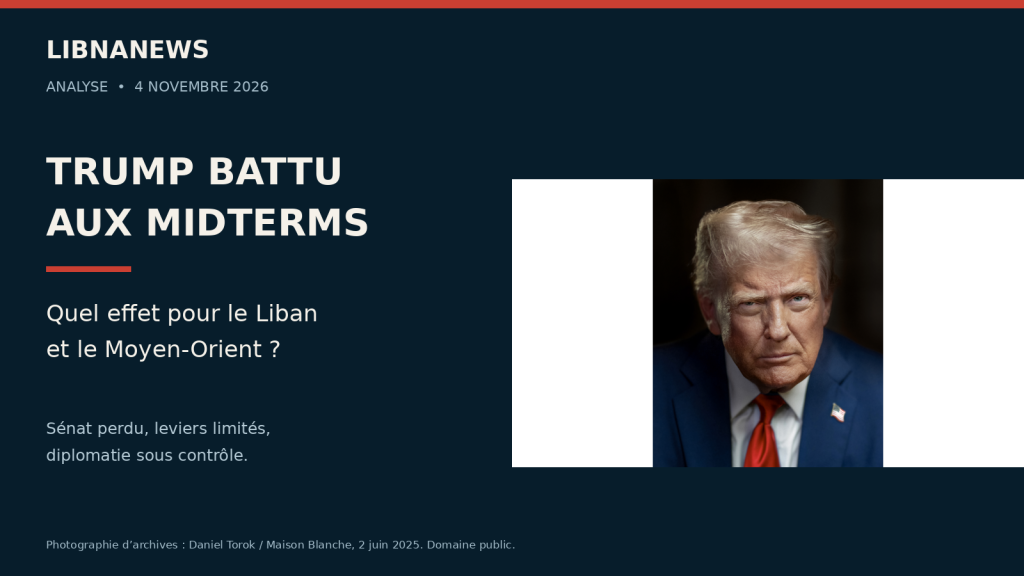
Trump’s defeat of the midterms opens up an opportunity for increased control over American policy in the Middle East. It does not guarantee peace in Lebanon or immediate change towards Israel or Iran. The Senate turned into the Democratic camp, according to the available journalistic powers. The majority of the House remained undetermined at 0628 UTC. For Beirut, the real issue now begins: turning the US President’s political weakening into lasting guarantees, without waiting for Washington to settle Lebanese crises instead of Lebanese.
Trump’s defeat at the midterms strikes a method
The setback first reached the presidential pretension to confuse American power, personal will and diplomatic success. Donald Trump promised to keep the United States away from protracted wars. The conflict with Iran, initiated with Israel in February 2026, went through the electoral campaign. Its economic cost has brought a crisis in the Middle East closer to the daily concerns of American households. A war presented as a mastery has become a problem of purchasing power and political confidence.
This contradiction gives defeat its regional scope. Trump’s ability to impose a victory story is now facing an election sanction. Spectacular announcements, threats and personal relationships with leaders do not deliver results. The security of a village in southern Lebanon is not measured by the number of triumphant communiqués. It depends on the withdrawal of foreign forces, effective State authority, protection of civilians and conditions of return.
However, it would be abusive to present the United States vote as a vote for Lebanon or for the Palestinians. Voters chose representatives on several issues. The rejection of an administration does not constitute the adoption of a specific regional programme. Democratic elected officials will have to arbitrate between Israel’s security, spending control, civil rights and opposition to prolonged war. Their victory opened a debate that republican domination made more difficult. It does not fix the outcome.
The Senate imposes constraints without leading diplomacy
Donald Trump remains president. Midterms do not function as a motion of censure in a parliamentary regime. It retains the executive leadership, diplomacy and important military prerogatives. The new parliamentary mandates begin on 3 January 2027. Until then, the outgoing Congress remains in place. For the Middle East, this difference in timing precludes the treatment of results as an instruction immediately transmitted to the US military or negotiators.
However, the Senate’s change brings about a concrete change. The Democrats will be able to influence the confirmations of ambassadors and many officials of the administration. They will also have the parliamentary means to request explanations, hold hearings and review presidential decisions. The choice of an American representative in Lebanon could become a place of political confrontation. A controversial appointment will no longer necessarily be supported by a majority of the President.
Budgetary power is another lever, but it requires compromises. Both chambers must vote on the same provisions. Trump can veto it, which only two-thirds of all majorities can overcome. If the Democrats also win the House, their negotiating capacity will increase. If it remains republican, disagreements will go through Congress itself. In both cases, controlling a commission or refusing credit is an influence, without turning Democrats into a substitute government.
Iran, first test of a weakened president
The Iranian case concentrates on the contradiction of diplomatic trumpism: promising a speedy outcome while maintaining objectives that are difficult to reconcile. The weakening of Tehran, maritime security, nuclear issues and regional stability are not solved by a single demonstration of force. At the beginning of November, the prospect of a wider resumption of fighting remained under discussion. Diplomatic approaches and military preparations coexist. The electoral verdict therefore comes in an open crisis, not after an assured settlement.
A sanctioned president may seek a compromise to reduce the internal cost of a conflict. He can also try to restore his authority by demonstrating firmness. These two scenarios are possible. None should be presented as a decision already taken. The danger for Lebanon would be to believe that the political need to calm down in Washington is enough to protect its territory. A nuclear- or navigation-oriented negotiation can leave Lebanese disputes unresolved.
Parliamentary oversight should address specific issues: what military objectives, what legal basis, what appropriations and what exit strategy? The resolution on the powers of war imposes, inter alia, obligations to notify and regulate the continuation of hostilities without authorization. The implementation of the Convention regularly leads to conflicts between institutions. A more demanding Senate can increase the political cost of escalation. He cannot promise that no strike will occur before he takes office.
In Lebanon, judge the June Agreement on its implementation
Trump’s criticism must begin by recognizing the initiatives that exist. A framework agreement between Lebanon and Israel was signed in Washington on 26 June 2026 under American mediation. It provides for a reciprocal and progressive process. The Lebanese army must extend the authority of the State, while the Israeli withdrawal is linked to the verification of the disarmament of non-State groups. The text also provides for further discussions. It is a negotiating architecture, the existence of which does not demonstrate the achievement of the objectives.
It is precisely on this gap that the Trump method deserves criticism. His risk is to present a signature such as peace, transforming conditional commitments into immediate political results. For Lebanon, the decisive question remains that of reciprocity. Who checks the bonds? On what calendar? What happens when one party considers that the other has not fulfilled its commitments? Without operational responses, the agreement can become a succession of demands imposed on the weakest rather than a path to sovereignty.
The Lebanese State must effectively exercise the arms monopoly. Hezbollah’s military decisions cannot replace those of national institutions. However, this requirement does not exempt Israel from its own obligations. It does not justify considering Lebanese territory indefinitely as a depth of Israeli security. Supporting the Lebanese State requires simultaneous treatment of weapons outside its control and outside its sovereignty. A diplomacy that separates these dimensions produces fragile stability.
The new Senate majority could ask for more detailed reports on the implementation of the agreement and on US commitments. Such monitoring would be useful if it documents the facts rather than reproduces the arguments of the parties. Beirut should present verifiable elements: deployments, material needs, obstacles, destruction and prevented returns. Trump’s defeat does not guarantee listening. It does, however, increase the number of interlocutors who can examine a policy so far largely embodied by the President.
Political responsibility should also address the criteria for success. A government may announce a delivery without specifying when it will be usable. It can promise a withdrawal without setting the steps to verify it. Parliamentary hearings can reduce this gap by requiring the administration to distinguish between intentions, commitments and achievements. For the Lebanese, this discipline would be valuable. It would shift the debate about personal insurance to obligations that can be followed and challenged.
Support the army rather than ask it the impossible
US aid to the Lebanese army did not disappear under Trump. A Lebanese military communiqué of 20 September announced the receipt of 70 containers of ammunition in Beirut port. This delivery, which is included in American programs, is a material fact. It prohibits simplistic narratives of total abandonment. It alone does not make it possible to conclude that the army has the necessary capabilities for all political missions assigned to it.
The problem lies in the alignment between objectives and means. Deploying units, securing areas, controlling weapons and accompanying the return of the inhabitants require resources. Equipment does not replace operational readiness or political cohesion. Demanding immediate results without ensuring predictable funding would risk failure. Coherent support must be able to be planned, evaluated and continued beyond a presidential announcement.
The future Congress can improve this predictability through its budgetary arbitrations. It can also impose poorly designed conditions and slow down funding. A democratic majority is therefore not automatically good news for each programme. The Lebanese issue is to defend a controlled aid that strengthens the national institution, without confounding support for the state and blank cheque to its leaders. Transparency on beneficiaries and the use of resources can protect funding rather than weaken.
Another support already exists: the Council of the European Union established a support mission to Lebanon on 12 October. It aims to strengthen the armed forces and the internal security forces. Its establishment does not replace Lebanese responsibilities or all UNIFIL functions. However, it provides an additional framework for organising assistance. The US debate should be articulated with these mechanisms, so that partners do not present conflicting demands or promises that cannot be added up.
UNIFIL sets closer deadline
An international calendar precedes that of the new Congress. Security Council resolution 2790, adopted in August 2025, last extended the mandate of UNIFIL until 31 December 2026. It then provides for an organised withdrawal within one year. This does not mean that all peacekeepers will leave Lebanon on the last day of December. Limited functions remain during withdrawal. But the security transition is becoming an immediate issue.
The gap is essential: this deadline comes before the beginning of the new US mandates. Lebanon cannot therefore wait until January to prepare the necessary arrangements. It must work with relevant actors on the capabilities of its army, monitoring and continuity of useful mechanisms. The United States Senate does not alone amend a Security Council resolution. Hope that Trump’s setback will erase this deadline would be a strategic mistake, as each week of preparation counts.
Israel: The announcement on aid reveals the limits of the show
On November 3, Trump announced that it would end the annual aid to Israel from 2027. In a TV interview taken over by a news agency, it is estimated to be $4 billion. He said arms sales would continue. This statement, reported during the election, does not constitute an already executed budget deletion. Congress must intervene. However, it illustrates the ease with which the President presents as a personal decision a dossier involving credits, procedures and a military relationship built over time.
For Lebanon, the key point is not just the amount paid. A reduction in free aid does not mean that arms deliveries are stopped. Moving from US financing to Israeli purchases can change the financial burden without immediately changing the military capabilities available. The announcement therefore does not prove a break with Israel or a guarantee for neighbouring populations. Its effect will depend on the texts adopted, contracts and decisions actually implemented.
Congress has procedures for reviewing arms sales. They include deadlines, thresholds and exceptions, particularly in cases of emergency invoked by the executive. A precedent illuminates the limits: in July 2019, Trump vetoed three resolutions contesting sales in the Gulf. The Senate did not gather the necessary votes to overrule. A parliamentary opposition may slow down, negotiate or make a sale politically expensive. It does not have an automatic switch on all military exports.
Democratic criticism must therefore be judged on its actions. Requesting information on the use of weapons, their consequences for civilians and compliance with American conditions would have a more concrete effect than a general condemnation. The elected representatives may differ on these requirements. Israel’s security retains support beyond the Republican Party. Trump’s setback weakens his personal political control; It does not dissolve the institutional alliances or the commitments that exist to it.
Gaza cannot remain outside the regional balance sheet
The Palestinian file is a test of credibility. A United Nations humanitarian report of 29 October still describes strikes, fire and demolitions in Gaza. It also reports incidents involving convoys and humanitarian premises. As winter approaches, displaced families remain vulnerable to lack of shelter and flood risk. That reality must count more than the proclamations that a diplomatic sequence had already resolved the conflict.
Trump’s defeat can open up more space for debate on aid conditions and obligations to civilians. It does not give Palestinians direct representation in the American Congress. Nor does it guarantee that democrats will place their rights at the centre of compromises. To measure change, humanitarian access, protection of people, funding and political perspectives will need to be examined. A better tone will not be enough if living conditions remain unchanged.
This distinction also concerns Lebanon. A regional arrangement that treats populations as secondary variables would remain vulnerable to crises it claims to close. Physical reconstruction does not replace security or rights. Criticizing Trump assumes to challenge this hierarchy when it favours the negotiator’s image and funding announcements. The same will have to be applied to the Democrats. Their disagreements with the President give them no presumption of success in the Middle East.
Banks and reconstruction: no US electoral solution
The Lebanese economic situation is constrained by constraints that the US election does not remove. In September, the IMF anticipated a significant contraction in activity in 2026 and observed double-digit inflation. He welcomed the amendments to the banking resolution law, while calling for a distribution of losses in line with the debt hierarchy. Depositors must not bear losses before shareholders and subordinated creditors. A possible financial agreement remained to be built.
The result of midterms therefore does not unlock bank deposits. It does not replace Lebanese decisions on losses or a credible recovery programme. Diplomacy can facilitate support, but it does not turn a promise into available resources. For households and businesses, the risk would be to substitute a new external expectation for national reforms. After waiting for a providential regional agreement, waiting for a providential American majority would recur the same dependency.
Sanctions are a separate issue. Their evolution depends on legal bases, executive decisions and sometimes Congressional provisions. A presidential defeat does not cancel them. Companies and banks should therefore not interpret the result as general permission to resume restricted operations. The political challenge is to obtain legible rules and mechanisms compatible with legitimate activity. It is not a matter of promising a relaxation of which no specific decision has yet proved its existence.
Gulf and Europe maintain their own priorities
The Gulf monarchies cannot sum up their security to the balance of power between Trump and the Democrats. They face immediate problems with navigation, infrastructure and the prevention of an extension of the conflict. A weakened US president remains a powerful interlocutor. But personally promised guarantees become more difficult to appreciate when their financing or implementation encounter parliamentary opposition. Regional partners will therefore benefit from seeking stronger institutional commitments.
On 18 October, the Gulf Cooperation Council called for a place in the negotiations that affect its security. His statement called for dialogue and stressed the need to protect Ormuz, Bab al-Mandeb and the Red Sea. It also recalls the risks to energy, food and medical supplies. This pre-election position is not a reaction to American results. However, it recalls a major limitation of individualized negotiations: countries exposed to the consequences must participate in the arrangements, not simply discover the decisions taken between Washington and Tehran.
Europe also defends its own priorities. On 12 October, the EU Foreign Ministers called for de-escalation and a negotiated outcome. They insisted on freedom of navigation, especially in Ormuz and Bab al-Mandeb. This position shows that the regional choice is not limited to supporting Trump or waiting for his opponents. For Beirut, convergences on maritime security, stability and reconstruction can broaden diplomatic opportunities.
The economic consequences relate directly to the Lebanese daily. A maritime crisis can affect energy, transport and business expectations. In September, the IMF had already seen a widening of the current account deficit, mainly linked to higher energy prices. A lasting relaxation would therefore have an interest that goes beyond military arrangements. But an election result does not restore a trade route: security decisions, applicable agreements and sufficient confidence for operators are needed.
Lebanese diplomacy less dependent on one man
American change calls on Beirut to diversify its interlocutors without breaking with the presidency. The White House will remain indispensable to the ongoing negotiations. The Senate, administrations, European partners and the Arab countries concerned will also count. A strategy based solely on proximity to Trump becomes more risky when its political capacity declines. The useful commitments must survive the fluctuations in its popularity and the rivalries that are already preparing the next presidential sequence.
This requires less spectacular work than the summit meetings. There is a need for documented files, prioritized applications and a clear distinction between security emergencies and financial needs. The Israeli withdrawal, the authority of the State, the means of the army and the protection of the inhabitants must form a coherent whole. Introducing each issue separately would allow partners to support the principle while deferring the means. The new American configuration offers an opportunity to defend this coherence, provided Beirut builds it.
The main contribution of the election is thus to make less credible the idea that only one leader will decide regional destiny on a lasting basis. Trump remains powerful, but his political mandate is limited. Lebanon can seek to use this openness to gain more control, continuity and reciprocity. The first tests will be precise: the budgetary arbitrations at the end of the year, the preparation of the transition of UNIFIL, and the appointments and hearings of the Senate from January 2027.
Sources and references
- Libnanews: Election Night Review and House Status.
- Associated Press: Midterm results, Senate and Chamber.
- Associated Press, 27 August 2026: Iran War and Electoral Campaign.
- American Senate: Beginning of Parliamentary Mandates.
- American Senate: Presidential Appointments.
- CRS: Congressional and executive powers over expenditure.
- American National Archives: Constitution and veto.
- CRS: Resolution on War Powers.
- British House of Commons: US–Iran negotiations in 2026.
- State Department, 26 June 2026: text of the framework agreement, reproduction of the official communiqué.
- France Diplomacy, 27 June 2026: Lebanon-Israel framework agreement.
- Lebanese Army, 20 September 2026: reception of United States ammunition.
- UNIFIL: resolution 2790 and timetable for withdrawal.
- Associated Press, November 3, 2026: Trump announces aid to Israel.
- CRS: Parliamentary arms sales control procedures.
- OCHA: humanitarian report of 29 October 2026.
- IMF, 18 September 2026: Lebanese economy and banking reforms.
- OFAC: Iranian sanctions authorities, rules and licences.
- Council of the European Union, 12 October 2026: Lebanon, Gulf and maritime security.
- Gulf Cooperation Council, 18 October 2026: ministerial communiqué.
- Cover photograph: official portrait, author and public domain.






Comments