

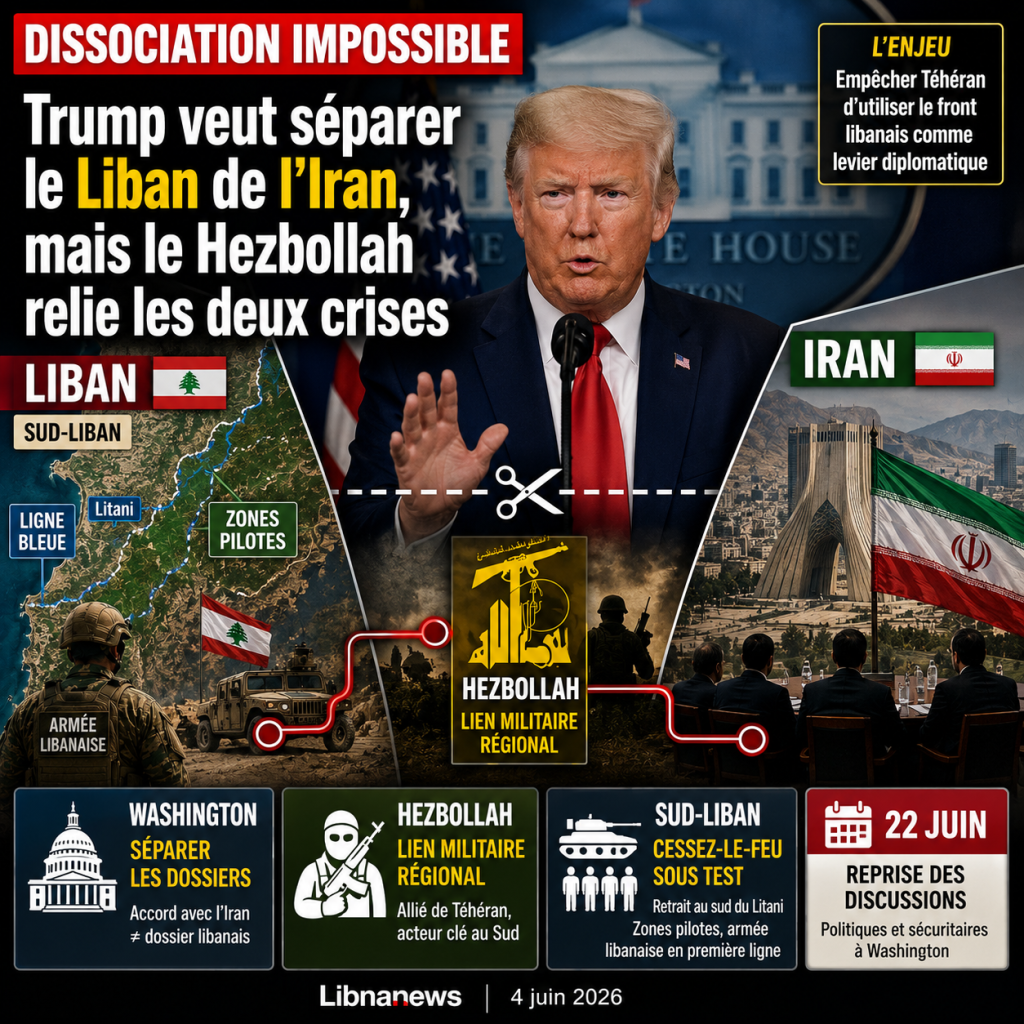
Donald Trump says he wants to separate the Lebanese issue from negotiations with Iran. The sentence, delivered on Wednesday, June 3, in Washington, however, comes at a time when both crises are advancing in the same diplomatic corridor. The US President presents the Lebanese front as a separate subject, while Tehran argues that any regional agreement should include the cessation of fighting in Lebanon. The Trump equation Lebanon Iran thus becomes the indicator of a diplomatic contradiction. This desire for dissociation therefore reveals the opposite of what it proclaims. Washington’s attempt to isolate Lebanon from the Iranian case is good because Hezbollah, Israel, the Lebanese army, the ceasefire and the negotiations with Tehran now form a single regional security equation.
Trump Lebanon Iran: A Showed Separation · Global Voices
Washington’s official argument
The sequence begins with a short but politically heavy statement. Donald Trump says he wants to deal with Lebanon separately from negotiations with Iran. It justifies this position by the different nature of the two files. On one side, the White House wants an agreement with Tehran on the end of the war, nuclear power and the stabilisation of the Gulf. On the other hand, it is trying to establish a ceasefire between Israel and Lebanon, with Hezbollah as a central but non-signatory actor. Apparently, the argument seems simple. Lebanon is a sovereign State. Iran is a regional power. Israel is negotiating in Washington with a Lebanese delegation, not with the Iranian leaders. Yet this legal distinction is not enough to explain the timetable. Both files intersect in fact, in threats, in mediation channels and in military calculations.
Trump’s formula does not come into a diplomatic vacuum. It follows a phase of high tension, marked by Israeli strikes in Lebanon, Hezbollah fire, threats to Beirut and American negotiations with Iran. At the same time, a conditional ceasefire agreement between Lebanon and Israel was announced after two days of discussions in Washington. This law requires the complete cessation of the Hezbollah fire and the evacuation of its operators from the southern Litani sector. It also provides for pilot areas under the sole control of the Lebanese Armed Forces. This architecture shows that the Lebanese case is being treated as an immediate test of regional de-escalation. Lebanon is now the place where Washington’s ability to compel armed actors, reassure Israel and keep negotiations with Tehran open.
The paradox is therefore central. By declaring that it wants to separate Lebanon and Iran, Trump implicitly acknowledges that the negotiations have already brought them together. We only dissociate what appears to be related. The White House is trying to prevent Tehran from using the Lebanese front as a lever in the talks. It also wants to prevent Israel from compromising an Iranian agreement through a prolonged military campaign against Hezbollah. This double constraint explains the firmness of American language. Washington does not want Lebanon to become an Iranian clause. But it cannot prevent Hezbollah, an ally of Tehran, from making the southern front part of the balance of power.
Lebanon, Iranian negotiating adjustment variable
Three doors to the regional crisis
The Lebanese case enters into the Iranian negotiations through three doors. The first one is military. Hezbollah opened a front against Israel in the context of the regional war and confrontation between Washington, Israel and Tehran. His action is not only Lebanese. It is part of a system of alliances and deterrence that links Lebanon, Iran, Iraq, Syria, Yemen and the Gulf. The second door is political. Iran refuses to give the image of an agreement that would sacrifice its regional allies. The third is diplomatic. American mediators must speak in Beirut, Israel and Tehran with the same objective: to prevent a general burning.
For Tehran, the Lebanese front is not a peripheral file. Iranian officials claim that the end of the regional war must cover Lebanon. Their logic is based on a simple idea: if Israel retains the freedom to strike Hezbollah while Iran negotiates with the United States, de-escalation would remain incomplete. It would weaken Tehran’s Lebanese ally without offering a regional guarantee. In this reading, an agreement limited to nuclear, Gulf or Ormuz Strait would not suffice. Stability should include all active fronts. That’s exactly what Washington is trying to circumvent.
The US position has an opposite objective. Trump wants to rip out an Iranian deal without letting Tehran expand the table. The wider the negotiation, the more difficult it becomes. If Lebanon enters fully, it is necessary to deal with the Israeli presence, Hezbollah weapons, resolution 1701, the Blue Line, the security guarantees of northern Israel, the role of UNIFIL and Lebanese sovereignty. If Gaza, Iraq or Yemen are added, the agreement becomes almost impossible to complete quickly. Dissociation thus allows Washington to reduce the number of variables. It also serves Trump’s political communication, which wants to present a possible agreement with Iran as a direct result of his pressure.
A statement that also protects Israel
Israeli freedom of action in question
The desire to separate Lebanon from the Iranian issue also meets Israeli expectations. Israel considers Hezbollah an immediate threat to its northern border. Its officials refuse to allow a compromise between Washington and Tehran to limit their freedom of action in Lebanon too quickly. They want to check first that Hezbollah stops firing, moves away from the southern Litani and does not reconstitute its positions in border villages. The American formula offers them a margin. It allows for discussions with Iran without automatically transforming every strike in Lebanon into a violation of a regional agreement.
But this margin remains fragile. Trump also expressed his annoyance at the continuing fighting in Lebanon. According to the American press, he acknowledged a tension with Benjamin Netanyahu about the conduct of the war and the risks of escalation. The U.S. President wants a quick diplomatic outcome. A major attack on Beirut, or a massive response by Hezbollah, could cause the talks with Iran to fail at a time when Washington claims a possibility of agreement. The White House must therefore spare Israel without giving it a complete blank. This is one of the most delicate balances of this phase.
Israel’s protection goes through the pilot areas provided for in the Lebanese-Israeli agreement. These areas must be under the exclusive control of the Lebanese army. The message is clear: the Lebanese State must become the legitimate security interlocutor. Non-State weapons must disappear from the areas concerned. This gradual approach allows Israel to demand visible evidence without immediately requiring a complete transformation of the Lebanese military landscape. It also allows Washington to assert that the Lebanese case is advanced by an institutional logic, not by direct negotiations with Iran.
Hezbollah in the centre, even without official headquarters
A non-signatory but decisive actor
Hezbollah is absent from official press releases as a trading party. However, it remains at the heart of all operational clauses. The ceasefire depends on the cessation of its fire. The stabilization of the southern Litani depends on its visible withdrawal. The credibility of the Lebanese army depends on its ability to avoid internal confrontation while imposing State authority. The relationship between the Lebanese case and the Iranian case therefore goes first through him. It is the actor who makes separation difficult, because its Lebanese anchor coexisted with its strategic alliance with Tehran.
For Hezbollah, American dissociation poses a political risk. If Lebanon is separated from Iran, the movement may find itself under local pressure without a regional guarantee. He may be called upon to withdraw from the south of the Litani while Israel would maintain certain positions or strike capacity. This asymmetry would be difficult to defend in front of its audience. The movement will therefore seek to link any withdrawal to a complete ceasefire, the end of Israeli attacks and a discussion on Israeli withdrawal. This line already appears in the positions reported by the Lebanese press.
However, Hezbollah’s margin is not unlimited. The people of the South have suffered permanent destruction, displacement and uncertainty. Part of the social environment of the movement wants to stop fighting and return to daily life. Hezbollah must therefore avoid appearing as a barrier to a respite. It must also preserve its deterrent capacity. Between these two imperatives, the most likely position is to accept a gradual decline in the visible presence, while refusing immediate global disarmament. This posture would complicate verification, but it would allow the movement not to present itself as defeated.
Beirut facing an impossible equation
Lebanese sovereignty and regional dependency
For the Lebanese authorities, Trump’s sentence creates an additional difficulty. Beirut has been seeking from the beginning to defend the idea of a sovereign case. Lebanon does not want to be treated as an annex to the Iranian negotiations. He also refuses to bear the consequences of a single arm between Israel, the United States and Tehran. In principle, dissociation may therefore seem favourable to the Lebanese State. It recognizes that Lebanon must negotiate for its own interests. It puts the Lebanese army back at the centre of southern security. It prevents the future of the country from being decided in nuclear bargaining.
But in practice, this dissociation can also weaken Beirut. If the Lebanese file is isolated, Lebanon must obtain Israeli withdrawal alone, the end of the strikes and security assurances. But its pressure power remains limited. The army lacks resources. The economy remains fragile. Institutions are emerging from years of crisis. The government must deal with Hezbollah, parties opposed to its weapons, international demands and Israel’s demands. A separate negotiation can give Lebanon a voice. It can also place him before a responsibility which he cannot afford to assume entirely.
This tension explains the caution of Lebanese officials. They must support the principle of the State holding legal weapons alone, without triggering an internal crisis. They must accept American aid, without appearing to be executing an Israeli agenda. They must obtain assurances about the Israeli withdrawal, without failing the open sequence in Washington. They must finally speak to the people of the South, who want concrete answers: when the roads are secure, when the houses can be rebuilt, when the schools will reopen, and who will prevent a resumption of strikes.
Resolution 1701 returns as a minimum framework
An old text, a new urgency
Resolution 1701 remains the legal basis to which everyone can refer without recognizing a new concession. It provides for the cessation of hostilities, the deployment of the Lebanese army to the south, the absence of non-State weapons between the Blue Line and the Litani, and the role of UNIFIL. Using this framework, Washington can present the pilot areas as a gradual application of an existing text. Beirut can defend the return of the state. Israel can demand the removal of Hezbollah. Iran can avoid recognizing direct negotiations on the movement’s weapons.
However, this framework has shown its limitations. Since 2006, it has never produced full stabilization. Hezbollah retained a military presence. Israel denounced the violations of the movement and continued operations. Lebanon has denounced Israeli violations of its territory, airspace and sovereignty. The novelty of 2026 is therefore not the existence of the resolution, but the attempt to give it an immediate operational translation. The pilot areas will be the first test. If they work, they can serve as a model. If they fail, they will become proof that the framework remains too weak.
Resolution 1701 also explains why the Lebanese case is not easily isolated. Its implementation depends on the Lebanese army, UNIFIL, Israel, Hezbollah and the regional climate. But the regional climate depends in part on Iran. Every engagement on the ground can be affected by a strike in the Gulf, a break in the nuclear talks, an attack on Beirut or Israeli pressure in the South. Trump’s intended dissociation therefore comes up against the very nature of the device. The security of Lebanon is not only Lebanese.
The calendar becomes a pressure instrument
The week of June 22nd as a test
The next step announced is the resumption of political and security discussions during the week of June 22. This deadline is not neutral. It gives the parties a few weeks to test the ceasefire, measure Hezbollah’s discipline, observe Israeli reactions and assess the ability of the Lebanese army to take positions in the planned areas. It also offers Washington a window to move forward with Iran. The Lebanese calendar and the Iranian calendar overlap, even if Trump wants to distinguish them.
This superimposition can become an American lever. If there is calm in Lebanon, Trump can tell Tehran that its regional allies do not need an active front to defend their interests. He could also tell Israel that the diplomatic path produced guarantees. If the calm breaks, each side will accuse the other. Iran will say Washington does not control Israel. Israel will say that Hezbollah remains an Iranian force. Lebanon will say that the absence of Israeli withdrawal makes the agreement inapplicable. The risk of a return to confrontation will therefore remain throughout the trial period.
The timetable finally serves American domestic policy. Trump wants to show that he can make quick deals and impose his pace on crises. He wants to avoid the image of a long war with Iran. He also wants to control tensions with Israel without breaking with Benjamin Netanyahu’s government. The dissociation of Lebanon makes it possible to tell a simple story: Washington negotiates with Tehran on Iran, and with Beirut and Israel on Lebanon. But chronology tells a more complex story: each statement on one of the files has an immediate effect on the other.
A dissociation that confirms interdependence
The real test will be in the field
The strength of Trump’s statement is therefore due to its involuntary effect. In trying to separate Lebanon and Iran, he confirms that the two issues are bound by war, alliances and perceptions. Lebanon is not Iran. Hezbollah is not the Lebanese state. Nuclear negotiation is not the same as a ceasefire south of Litani. But the decisions taken on each ground change the general balance of power. Tehran knows that. Israel knows that. Washington also knows this, even when he claims otherwise.
The question now is what separation is possible. A legal separation seems necessary: Lebanon must defend its sovereignty and not become a secondary variable in an American-Iranian agreement. An operational separation seems more difficult: Hezbollah remains linked to Iran, Israel acts according to its perceived threat, and Washington simultaneously wants to calm the Lebanese front and conclude with Tehran. A political separation, finally, will be almost impossible if the fighting resumes. The first major strike against Beirut, the first massive shot by Hezbollah or the first visible failure of the pilot areas would immediately place both issues in the same crisis.
This contradiction defines the current moment. Trump wants an Iranian deal that is not captured by Lebanon. He wants a Lebanese ceasefire that is not dictated by Iran. He wants to preserve Israel while preventing him from torpedoing a wider diplomatic sequence. He wants to strengthen the Lebanese army without opening an internal conflict with Hezbollah. These objectives may coexist for a few weeks if weapons are silent. They will become incompatible if one of the actors chooses to test the limit. The next Washington meeting, scheduled for the week of June 22, will say whether the separation claimed by the White House is a method of negotiation or only a form of communication.




