

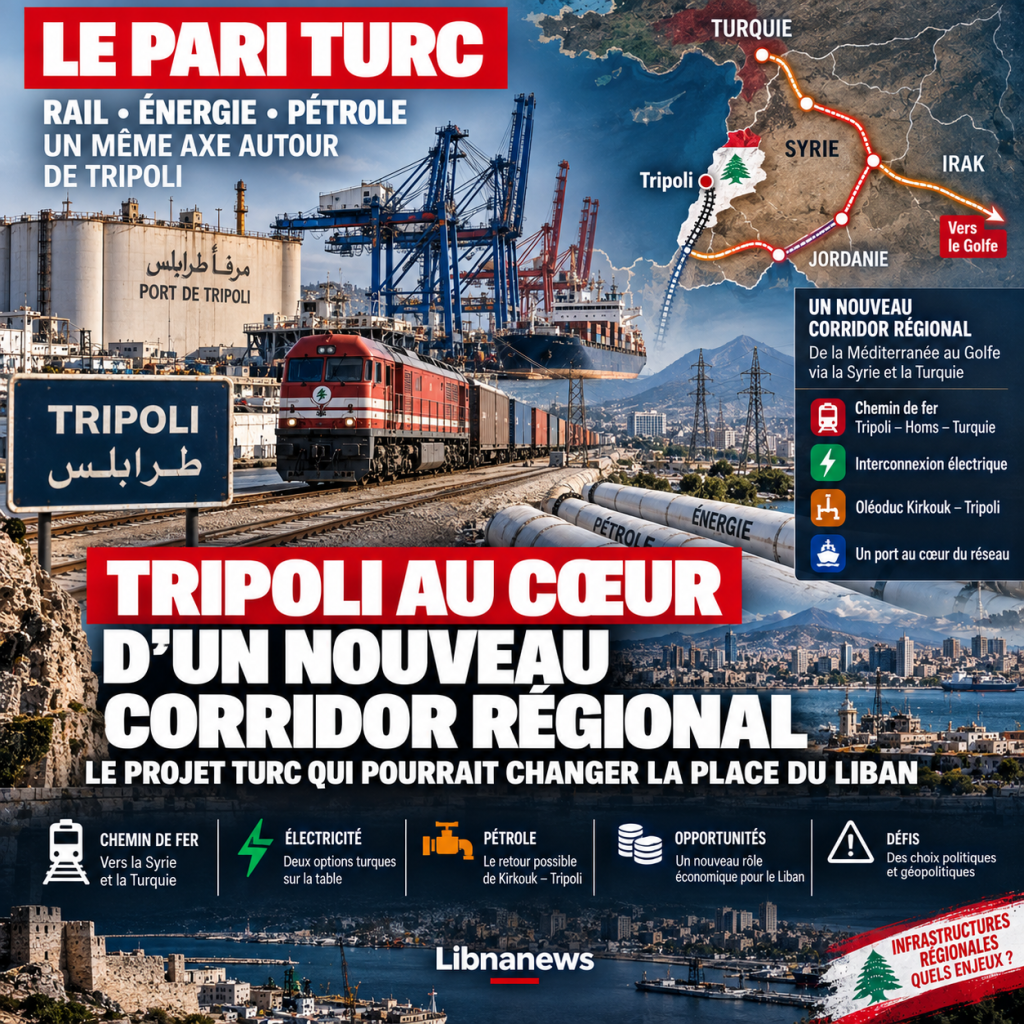
Three projects long treated separately begin to converge around Tripoli. The first concerns the return of the railway and a connection with Syria. The second concerns electricity and the possibility of connecting northern Lebanon to a network through Syrian territory. The third concerns pipelines and the assumption of a return to service of the Kirkuk-Tripoli link. Taken in isolation, everyone remains difficult to achieve. Together, however, they draw another perspective: turning Tripoli into a meeting point between rail transport, energy and maritime trade, in a package linking Turkey, Syria, Iraq, Jordan and the Gulf countries.
According to information gathered by the daily Al Akhbar, Ankara insists on associating Lebanon with a modernized version of the « Hedjaz Road ». The project would not be to rebuild the old Ottoman line. The aim would be to create a contemporary corridor by rehabilitating some existing sections and constructing missing links. Tripoli would be the Lebanese entry point of this network. The publication also mentions Turkish energy projects that could converge towards the city. This information is specific to Al Akhbar in the corpus available and must therefore be attributed to him.
A railway that would go far beyond the Lebanese-Syrian border
The first concrete element already exists in Lebanon. In May 2026, the Minister of Public Works and Transport, Fayez Rasamny, issued a call for tenders for the modernization and design of the railway line from Tripoli to Abboudiyé. The process followed a visit by the Minister to Syria and Turkey. On paper, the project can be presented as a limited national infrastructure in the north of the country. However, its real importance appears when it is placed in the envisaged regional network.
According to Al Akhbar, the idea is to connect this line to the Al Akkari station, then to Homs and the Syrian railway network. Tripoli would then cease to be the terminus of a small Lebanese link. It would become one of the Mediterranean gates of a much larger axis. The newspaper states that Turkey is pushing in this direction and hopes that Lebanon will participate in the corridor it seeks to develop with several states in the region.
The project takes the name and part of the historical geography of the Hedjaz railway, but its economic logic is different. The old line linked territories of the Ottoman Empire to the Arabian Peninsula. The current project focuses on creating a modern freight and passenger transport network between the Gulf, the Levant, Turkey and Europe. Some old tracks could be used when they are still usable. Others should be completely rebuilt.
Syria and Jordan have already shown their willingness to rehabilitate parts of their rail networks. Turkey has signed protocols with Saudi Arabia to develop transport. In the scenario presented by Al Akhbar, the corridor could start from Oman and Saudi Arabia, cross Jordan and Syria, reach Turkey and then extend to Europe. Ankara would start work on the Jordan-Syria-Turkey liaison in 2027.
Why Ankara wants Lebanon to enter the project
Lebanon has not officially announced its accession to this regional package. This is precisely where the most interesting information is located. According toAl AkhbarAnkara insists that Beirut participate and considers Tripoli as the natural starting point for this integration. The line could then, in a later stage, be extended to the interior of the country and possibly to Beirut.
The Turkish interest is not only railway. Turkey is seeking to develop a regional economic network of which Syria is now a central element. A Lebanese connection would add an additional maritime facade and make it possible to use the Tripoli port as an interface between maritime and land transport. Goods arriving by sea could be transferred to the rail network. In the other direction, products from Syria or more distant regions could reach the Mediterranean via the Lebanese port.
Tripoli therefore has an advantage that the only railway map does not show. The city brings together a port, oil infrastructure, immediate proximity to Syria and the location of an old railway link. It is this combination that gives it potential value in regional projects.
The new Syrian authorities would also attach particular importance to the city. According to information reported by Al Akhbar, Syrian officials insist in their discussions with their Lebanese counterparts on the possibility of developing economic partnerships around Tripoli. The economy could thus become one of the first areas of sustainable normalization between Beirut and Damascus.
A more political than financial difficulty
Building a railway is expensive. However, according to daily reports, Ankara would consider that the main Lebanese obstacle would not necessarily be financing. The difficulty could be to obtain a clear political decision from Beirut.
The project would not be perceived in the same way by all Lebanese actors. Its supporters can present it as an opportunity to place Lebanon on regional trade routes. The country has gradually lost part of its role as a bridge between the Mediterranean and its Arab environment. A modern rail link would offer Tripoli and the port a new logistics function. It could also reduce transportation costs and attract storage, handling and distribution activities.
The reservations concern the geopolitical dimension of the project. A network linking Lebanon with Syria and Turkey is not just an infrastructure. It creates lasting economic dependency. Some managers can therefore see this as a choice of regional direction, not a mere technical investment. Al Akhbar also mentions the existence of fears about Western reactions to a Lebanese position too closely integrated into an Ankara-dominated network.
The choice becomes all the more sensitive as Lebanon develops its economic relations with Cyprus and Europe in the eastern Mediterranean. Two logics of integration appear thus. The first looks to the Mediterranean, Cyprus and Europe. The second is through Syria, Turkey and the Middle East land networks. They are not necessarily incompatible, but they correspond to different geopolitical priorities.
Tripoli could also become an electric hub
The second part of the project concerns electricity. According toAl AkhbarAnkara offers Lebanon two tracks. The first would involve an electric exchange mechanism with Syria. This option would be the fastest if technical difficulties could be resolved. It would use the proximity of existing networks and allow Lebanon to access an additional source of electricity without waiting for the construction of an entirely new infrastructure.
The second option is more ambitious. It would be to install an electric cable connecting Turkey to the Syrian coast and then to Tripoli. Such a project would require more time, substantial funding and a feasibility study. But it would further change Lebanon’s place in regional networks. Tripoli would no longer be just the point of arrival of a temporary supply. It would become an energy interconnection node.
Energy and Water Minister Joe Saddi discussed these issues in New York with his Turkish counterpart Alparslan Bayraktar the week before publication. The exchanges covered electrical interconnection, pipelines and hydrocarbons. This meeting brings an official element to the general picture, even if it does not mean that a final agreement has been reached on one or the other project.
For Lebanon, the stake is considerable. The electricity crisis remains one of the main obstacles to the economy. Regional interconnection could help reduce the cost of some supplies and provide more flexibility. However, it would not solve the structural problems in the sector. Losses, network management, domestic production and finance for electricity in Lebanon would remain to be addressed. Importing more electricity does not replace system reform.
The unexpected return of the Kirkuk-Tripoli project
The third part concerns oil. It could give Tripoli an even greater strategic dimension. According to Al Akhbar’s exclusive information, the Turkish opening to Lebanon is also part of a reflection on a possible reactivation of the oil link between Kirkuk and Tripoli.
The idea has a strong historical dimension. Iraqi oil once reached the Mediterranean by Tripoli. Regional transformations, wars and political breakdowns have gradually ended this function. Today, the energy rapprochement between Ankara and Baghdad puts the issue of oil corridors at the centre of the game.
Turkey and Iraq signed an agreement in August to continue the transport of Iraqi oil through the Kirkuk-Ceyhan line. Their cooperation should also extend to production and investment in Kirkuk fields. In this configuration, a reflection on Kirkuk-Tripoli would allow Lebanon to find a place in the roads linking Iraqi resources to the Mediterranean.
However, we must remain precise. The sources do not describe a site launched or an agreement reached to return the pipeline to service. They evoke research and reflection on this possibility. The difference is great. Such an oil infrastructure would require agreements between several States, substantial investment, assessment of the state of the route and sustainable security guarantees.
Port, rail and energy start to form the same project
It is the convergence of these dossiers that gives Tripoli its importance. A single railway would improve transportation. An electricity interconnection alone would increase energy supply. An oil pipeline alone would restore a function to oil facilities. But the meeting of these three infrastructures around a port transforms economic logic.
Tripoli could become a logistics platform. The port would provide maritime access. The railway would connect the city to Homs and the Syrian and regional networks. Energy infrastructure could host or transit oil, gas and electricity. Industrial and storage activities could then develop around this set.
This perspective would give northern Lebanon a different place in the national economy. For decades, economic activity, investment and infrastructure have been concentrated around Beirut and the centre of the country. The creation of a regional corridor through Tripoli could shift part of this dynamic northward.
But this transformation would require much more than announcements. The Lebanese rail network is largely out of service. Existing facilities must be evaluated. The port must be able to absorb new flows. Road connections must follow. Customs administrations must be modernised. Finally, the security of the Lebanese-Syrian border must allow for regular commercial traffic.
Syria becomes indispensable to the project
None of these scenarios can work without Damascus. Geography imposes Syria between Lebanon and the Turkish, Jordanian, Iraqi and Gulf land networks. Economic normalization between Beirut and Damascus thus becomes a prerequisite.
This fact explains part of Turkish activism. Ankara seeks to bring the two countries together, starting with topics where a common interest can be identified. The most contentious issues can be set aside temporarily, while transport, trade and energy serve as areas of cooperation.
The method has a political logic. Common infrastructure creates shared interests. A railway, power grid or pipeline cannot operate on a sustainable basis if relations between the States concerned are constantly interrupted. The economy thus becomes a means of stabilizing the political relationship.
For Lebanon, this dependency also raises a question of economic sovereignty. A regional connection brings opportunities, but it makes the country dependent on the stability of its neighbours and transit decisions. The benefits will therefore need to be assessed without presenting the corridor as a risk-free solution.
A project that could partially bypass sensitive maritime routes
The regional context also gives the project another dimension. Turkey presents the development of land corridors as a means of diversifying trade routes between the Gulf, the Middle East, Asia and Europe. The crisis around the Strait of Ormuz has increased interest in alternative routes that can partially reduce dependence on sensitive sea crossings.
The modernized Hedjaz corridor would of course not replace the Gulf maritime transport. The volumes, costs and types of goods are different. But it could provide an additional path and improve the resilience of trade in the event of disruption.
In this map, Lebanon occupies a peripheral position as long as it remains disconnected from the network. Tripoli offers it a possibility of entry. The port could serve as a complementary Mediterranean outlet, while the land route to Homs would allow access to the main corridor.
The choice that awaits Beirut exceeds the construction of a railway
The Lebanese government will ultimately have to decide whether it considers these projects a series of distinct opportunities or a real national strategy. Tendering Tripoli-Abboudiye is a first step. It is not enough to determine the country’s place in the regional network.
A coherent strategy should define the role of the Tripoli port, the future of the railways, the future of oil installations, electricity needs and commercial relations with Syria. It should also determine the financial conditions for each project in order to prevent the country from engaging in infrastructure that it cannot finance or profitable.
Exclusive information published byAl Akhbar 2 October 2026show that Ankara already has its own vision. Turkey wants to integrate Lebanon into the regional corridor, starting with Tripoli and combining transport and energy. Syria also seems interested in the economic development of this axis. Lebanon, for its part, has not yet announced formal accession to the overall project.
Yet it is now that a part of Tripoli’s economic future is being played. For the first time in a long time, several regional infrastructures could converge towards the same city. If they remain separate projects, their effect will be limited. If they are thought together, Tripoli could regain a function that she had gradually lost: that of a Mediterranean door open to the interior of the Middle East.





Comments