

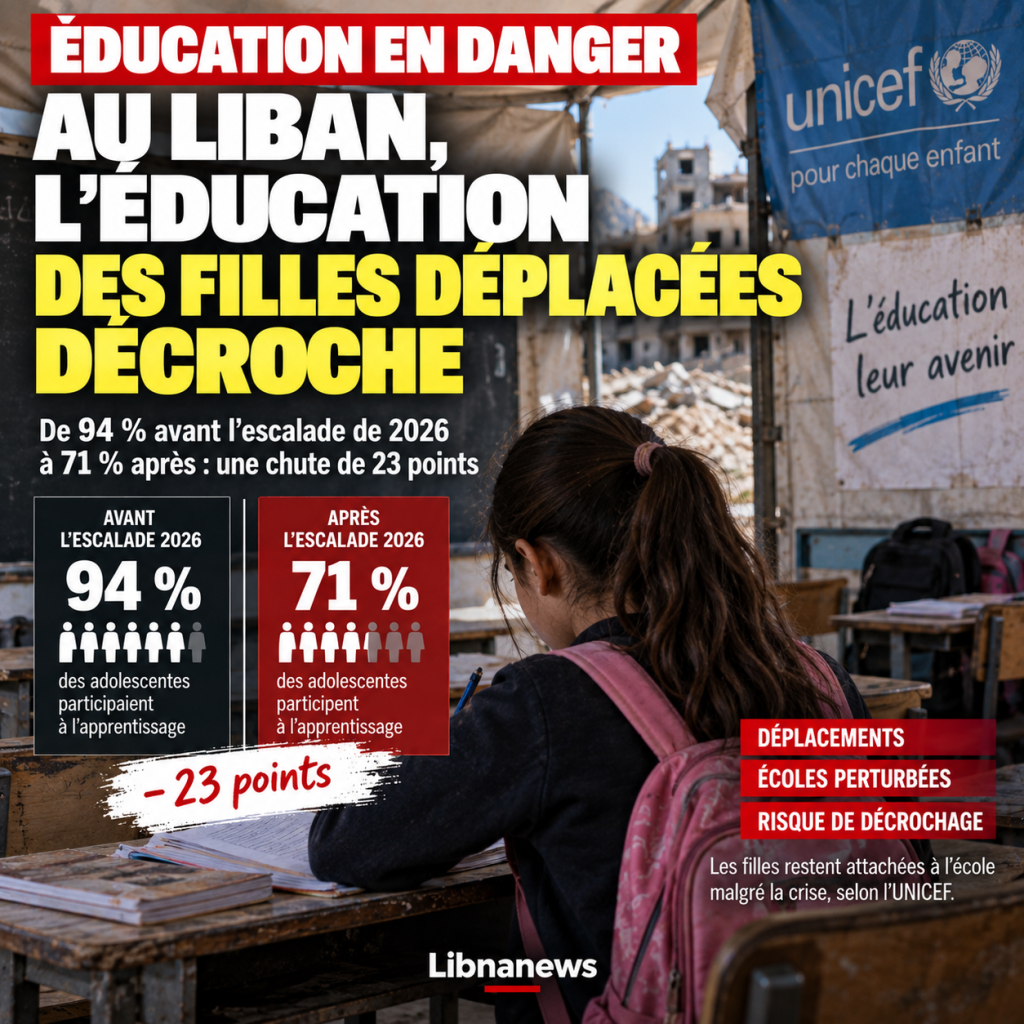
Participation in learning for displaced teenage girls in Lebanon has fallen by94 per cent before the escalation of hostilities from 2026 to 71 per cent after 2026according to a quick analysis published by UNICEF with the contribution of UN Women. This 23-point decline places school continuity at the heart of the humanitarian response. On Thursday, 1 October, Imran Riza, United Nations Resident Coordinator and Humanitarian Coordinator in Lebanon, found this development alarming and called for the retention of girls in education.
A drop of 23 points after travel
The figure is the main warning signal of the study on displaced adolescents who returned to their areas after the escalation of 2026. The analysis focuses on girls aged 11-17 and seeks to measure how conflict, displacement and return have changed their learning experiences.
Prior to the escalation, 94 per cent of adolescents surveyed participated in a form of learning. After travel, this proportion was only 71%. This is therefore not a general measure of the enrolment rate of all girls in Lebanon, but an indicator of participation in learning within the study group. This precision is important to correctly interpret the data.
Decline achieved23 percentage points. In other words, nearly three out of ten adolescents in the sample were no longer involved in post-climate learning, compared to about one in sixteen before. The gap illustrates the immediate effect of displacement on educational continuity.
United Nations organizations, however, point out that the school break did not remove the ambitions of adolescent girls. The girls interviewed continue to associate education with their independence, confidence and future prospects. The problem identified is therefore less a reduction in demand for education than the obstacles created by war and displacement.
Imran Riza warns about the education of displaced girls
In a message published on Thursday October 1, Imran Riza stressed the challenge of keeping girls in learning. The UN official has linked educational continuity to their autonomy and future possibilities, but also to Lebanon’s recovery.
His intervention comes at a time when UNICEF is highlighting its new « rapid gender analysis in emergency situations », carried out with a contribution from UN Women. The paper focuses specifically on the effects of the escalation of 2026 on adolescent girls aged 11-17 affected by displacement and return.
The alert thus goes beyond the question of attending a classroom. Prolonged interruptions can lead to long-term exclusion of adolescent girls from the education system, especially when families must simultaneously find housing, ensure their basic needs and adapt to successive displacements.
For the United Nations, therefore, the immediate challenge is to prevent an emergency disruption from turning into a lasting stall. Maintaining an accessible educational offer in reception areas, accommodation centres and return areas becomes crucial when security conditions prevent normal recovery.
Schools transformed by humanitarian emergency
The educational crisis is part of a massive population displacement triggered by the escalation of 2 March 2026. By March, more than one million people had been displaced in Lebanon. UNICEF estimated that approximately 390,000 children had had to leave their homes.
This wave directly affected the functioning of the school system. Hundreds of shelters have been opened across the country, many of them in public schools. In these structures, families have had to cope with promiscuity, health needs, access to water, care and protection of children.
The use of schools as places of reception creates a double difficulty. It responds to an immediate need for protection of internally displaced persons, but at the same time reduces the availability of buildings normally devoted to education. The mobility of students and teachers further complicates the organisation of courses.
At the height of the emergency in March, UNICEF and the Lebanese Ministry of Education and Higher Education had sought to maintain access to distance learning. Accounts and online classes had been prepared for 390,000 students and 40,000 teachers. Temporary learning schemes and more flexible programmes had also been deployed for displaced children.
These responses show the magnitude of the logistical challenge. However, they do not guarantee that an adolescent can actually attend classes. A theoretical access to a digital platform does not solve all the difficulties associated with travel, connectivity, equipment, change of place of residence or additional responsibilities that may affect family members in times of crisis.
Teenagers remain attached to school
One of the important lessons of the analysis published in autumn is the maintenance of educational aspirations. Despite the decline in participation in learning, adolescents interviewed continue to view education as an essential part of their future.
This finding changes the nature of the response. The data do not describe girls who would collectively give up their education. Rather, they show a gap between their willingness to continue their journey and their concrete ability to remain engaged in learning after a trip.
This gap can become decisive as the emergency continues. The longer a break, the more difficult it can be to return to a regular school rhythm. Learning gaps can accumulate and the pathways are fragmented between face-to-face teaching, temporary solutions and distance learning.
UNICEF had already deployed a number of mechanisms in the spring to limit this breakdown. Educational kits had been distributed in the collective centres. Centres and schools in areas considered safe also provided children with flexible educational pathways. Temporary learning spaces were planned in several regions, including Bekaa, Baalbeck, Saida, Mount Lebanon and Beirut.
However, the new data of 71 per cent indicates that a significant proportion of adolescent girls studied remain outside of learning despite these efforts. It thus provides a concrete indicator to measure the extent of the educational continuity still to be restored.
An educational crisis in a wider emergency
The alert on displaced girls comes as the humanitarian consequences of the escalation of 2026 remain heavy. By the end of March, the United Nations reported more than one million displaced persons. At the beginning of April, the United Nations Population Fund estimated that about 620,000 women and girls were displaced.
The hostilities also affected civilian infrastructure and disrupted access to several essential services. In this context, education must compete with immediate needs for housing, food, health and safety. For children, these dimensions are combined rather than replaced: a displaced family can have access to distance education while encountering material difficulties that prevent regular monitoring.
The Lebanese education system was also addressing this new crisis after several years of strong economic and social tensions. The response plan for Lebanon in 2026 estimated that 2,99 million people needed some form of assistance in the country, including a response covering education, protection, health and livelihoods.
In this context, dropout among displaced adolescent girls becomes an indicator of the longer-term effects of the emergency. The school does not only address an immediate academic need. It also structures the daily lives of children and maintains a link with institutions that can identify other vulnerabilities.
The next challenge will therefore be to measure the proportion of adolescents who have interrupted their learning due to displacement will be able to resume a regular course. The data published this week now provide a reference point: after the escalation of 2026, the participation in learning among the displaced girls interviewed fell to 71 per cent, while their educational aspirations remain strong.





Comments