

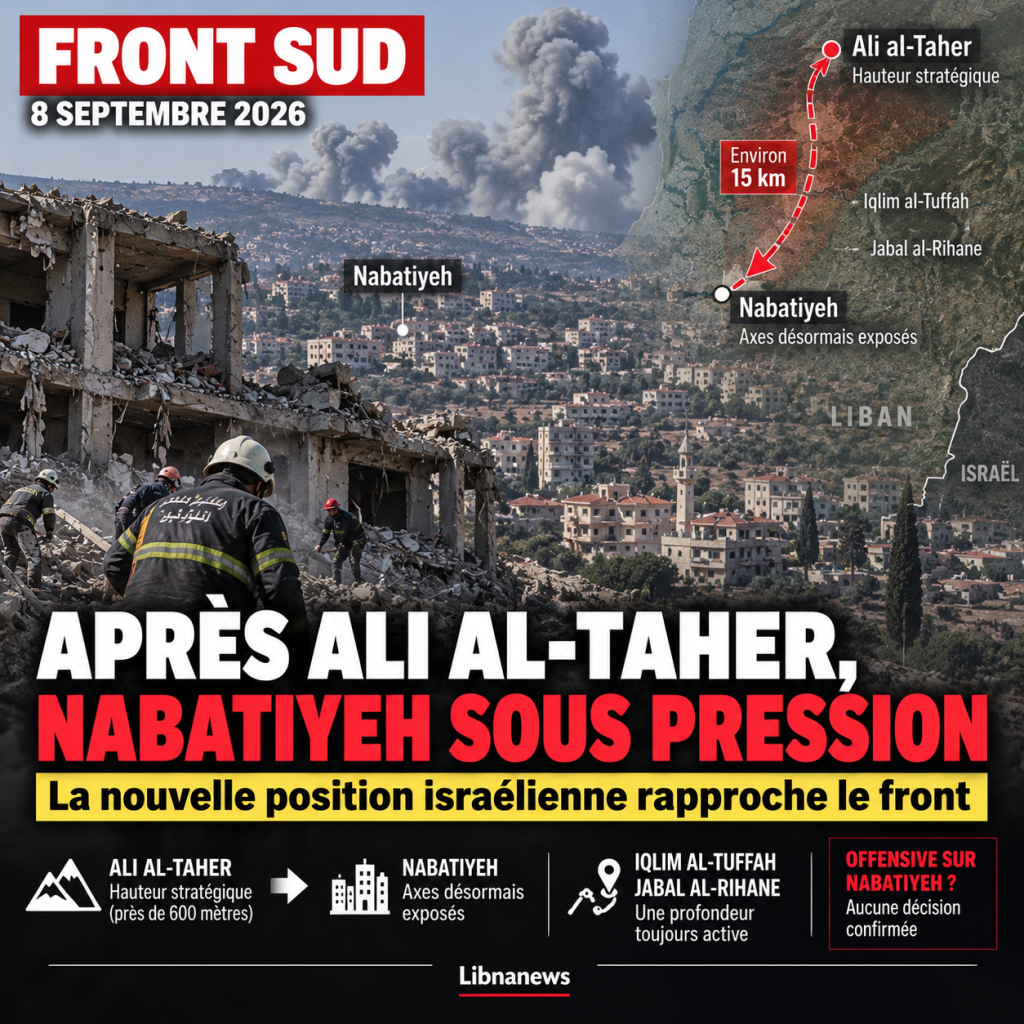
Ali al-Taher, a lock that brings Nabatiyah’s front together
The announced take of Ali al-Taher has moved concern to Nabatiyah. Reuters, September 3, 2026, presents this height as one of the main points of friction between Israel and Hezbollah. Located about 15 kilometres from the border, it peaks at nearly 600 metres. It dominates routes linking the border area to Nabatiyah and Iqlim al-Tuffah. This position gives relief a value that exceeds its only surface area. From the ridge, surveillance covers roads, valleys and several localities in the South Lebanon. Reuters, on 3 September 2026, also reported that the site would house underground facilities used by Hezbollah. Lebanese security sources refer to a command centre and weapons depots. These claims give Ali al-Taher a central place in Israeli objectives. However, they are not sufficient to establish the exact nature of the infrastructure still present below the height.
Israel announced on September 3 that it had obtained « operational control » over and below the ground. Reuters, September 4, 2026, reports that the Israeli army claimed to have driven Hezbollah fighters from tunnels under the ridge. However, a Lebanese military official quoted by the Agency provides an important nuance. According to him, Israeli forces control the south entrances of the network. The north access would be monitored by drones. He could not specify how far the soldiers had advanced in the galleries. Associated Press, September 5, 2026, also notes that the extent of Israeli control remains uncertain. A photographer from the agency present in Kfar Rumman had not observed an Israeli presence visible on the height. Hezbollah had not issued any official statements confirming its loss. These factors require a distinction between a capacity to dominate the sector and a complete occupation of each position. For Nabatiyeh, this distinction does not remove the risk. Operational control may be sufficient to observe movements, guide strikes and exert pressure on northbound tracks.
Geography directly feeds this fear. Al Jazeera, on 8 September 2026, lies Ali al-Taher between Kfar Tebnit and Nabatiyah al-Fawqa, north of Litani. The media points out that the height makes it possible to observe Nabatiyah to the west and the reliefs of Iqlim al-Tuffah to the east. Associated Press, September 5, 2026, estimates that its capture could open up possibilities for Nabatiyah, Iqlim al-Tuffah and Jabal al-Rihan. This is a military possibility, not evidence of an invasion plan. There is no public evidence available on September 8 that Israel has decided to enter Nabatiyah. Rather, the change is due to the options created by the new position. An army on a dominant height can increase its observation depth. It can also seek to neutralize sectors that threaten its new positions. In this case, pressure can progress without massive troop displacement. Bombardments, drones and artillery can extend the actual front. For residents, this difference between occupation and remote pressure remains military. However, its daily consequences can be comparable when they affect roads, houses and services.
Kfar Rumman, the signal of an already extended pressure
The strikes on Kfar Rumman made this threat more concrete. Reuters, on 7 September 2026, reports that at least 12 people, including two children, were killed in Israeli strikes on this area near Nabatiyah. The agency describes the episode as one of the most deadly bombing days of the last few weeks. Associated Press, September 8, 2026, reports that a first strike on a building killed eleven people, including two children and four women. Eight people were injured. A second strike on a vehicle killed a rescuer and injured two other relief personnel. The Israeli army claimed to have targeted a Hezbollah member who was carrying weapons to Kfar Rumman. It also linked its operations to drone attacks against its soldiers. Hezbollah had not claimed responsibility for these attacks at the time of the Associated Press report. The civilian record and the proximity of Nabatiyah, however, reinforced the fear of enlargement.
Kfar Rumman is not an isolated episode in the current geography of the strikes. Israeli operations have already affected Nabatiyah and several areas of its environment since the beginning of the war. Reuters, on 10 April 2026, reported the death of thirteen members of the State Security in a strike against a government building in Nabatiyah. President Joseph Aoun then condemned the attack on a state institution. Reuters, on 28 June 2026, reported that the Israeli army claimed to have killed Hezbollah fighters and hit a launcher in the Nabatiyah area. These precedents show that the city was already in the depth of Israeli operations before Ali al-Taher. The current difference lies in the proximity of an earthly position claimed by Israel. The combination of a presence on the ridge and repeated strikes in the vicinity can increase pressure on access to the city. It can also make it more difficult to return to normal activity in areas already marked by destruction.
Associated Press, in June 2026, described the limited return of inhabitants to Nabatiyah after a truce. Families found homes destroyed or severely damaged. This fragility weighs on the current situation. A new strike sequence does not affect an intact space. It reaches a region where displacement, repairs and economic recovery remain incomplete. Nabatiyeh also plays an administrative and commercial centre for a large part of the South. The converging roads serve the inhabitants of many localities. Therefore, lasting pressure on these axes would have effects beyond the city. It could disrupt travel to public services, shops and health facilities. It could also lead to new departures. The scenario of an extension should therefore not be reduced to the possible presence of Israeli soldiers in Nabatiyah. An aerial and terrestrial extension around its access could be sufficient to transform the city into a front line space.
Iqlim al-Tuffah and Jabal al-Rihan in the depth of the device
The question of Iqlim al-Tuffah adds another dimension. Reuters, September 3, 2026, describes this region as an important depth for Hezbollah. Ali al-Taher provides a geographical link between the more southern positions and these heights. The loss of the ridge can therefore hinder some movements and expose more logistics routes. Associated Press, September 5, 2026, recalls that Hezbollah has strengthened its presence in this region for several decades. However, the movement seeks to relativize the effect of a local loss. Mahmoud Qamati, Hizbullah leader quoted by Associated Press on 5 September 2026, had recognized the importance of Ali al-Taher. However, he claimed that his loss would not mean the end of Hezbollah. This position reflects a logic of depth. The movement considers its device as a set of positions and networks. For Israel, this depth can become the argument for further operations. If Hezbollah’s capabilities are considered untouched further north, the capture of Ali al-Taher may appear as a step rather than as a term.
However, progress towards Iqlim al-Tuffah or Jabal al-Rihan would present different challenges. The terrain is mountainous and the roads are more constrained. A ground force should secure its access and protect its positions from attacks from the heights. This cost can support a strategy based on surveillance and strikes. Reuters, on 3 September 2026, quoted former Lebanese general Hassan Jouni, who believed that Israel had hesitated to launch a direct assault on Ali al-Taher because of the risk of casualties. This caution may be even more important in deeper areas. It does not exclude limited operations. Above all, it can lead Israel to combine control of dominant points, drones and bombing. In this scheme, Nabatiyah would remain exposed without necessarily becoming the objective of a conquest. Localities between the city and the reliefs could, however, be under increasing pressure. The risk therefore lies in a gradual extension, where each new position changes the safety of the next one.
Military power ratio weighs on negotiations
The military situation remains linked to the political process. Associated Press, September 8, 2026, recalls that a framework agreement negotiated under American mediation provides for an Israeli gradual withdrawal in exchange for Hezbollah’s disarmament. Its implementation remains blocked. Hezbollah refuses to surrender its weapons north of the Litani River, while Israel links its withdrawal to broader disarmament. Ali al-Taher is located north of the river. The battle thus directly affects one of the most sensitive points of this disagreement. Associated Press, 5 September 2026, reports that Deputy Prime Minister Tarek Mitri had claimed that the Lebanese army was ready to take control of the height. According to him, the obstacle came from the Israeli position. This proposal offers in theory an alternative to the continuation of fighting. It assumes, however, that the parties agree to an effective transfer of the land to the Lebanese State. However, Israel’s announced catch reinforces its weight in any discussion of how to withdraw.
Nasser Khdour, a researcher quoted by Associated Press on 5 September 2026, believes that the control of Ali al-Taher represents an operational setback for Hezbollah. It also considers that this position improves the Israeli balance of power in the negotiations. This reading makes it possible to envisage a scenario in which Israel would not need to push immediately towards Nabatiyah. The threat of an extension can itself become a means of pressure. Maintenance on the ridge, coupled with the ability to strike further north, can be used to obtain concessions. Conversely, lack of political progress can encourage further escalation. President Joseph Aoun and the government of Nawaf Salam must therefore simultaneously manage the land and the negotiations. They must defend the deployment of the Lebanese army, limit Israeli attacks and deal with Hezbollah’s weapons file. These objectives are met by opposing positions that remain distant. The proximity of Nabatiyeh increases the cost of failure.
A still unstable line around Nabatiyeh
Fighting near Beaufort Castle also shows that the area remains active after the announcement on Ali al-Taher. Associated Press, 8 September 2026, reports that two Israeli soldiers were slightly injured in an exchange of fire in the area. The Israeli army claims to have killed the Hezbollah fighter involved. This episode recalls that the forehead does not follow a perfectly stabilized line. One-off clashes can create new cycles of response. They can also justify, according to Israel, deeper strikes. In this context, Nabatiyeh is exposed to a dynamic that depends as much on local incidents as on strategic decisions. A drone attack, an exchange of fire or a deadly strike can quickly change the level of tension. The June truce reduced the fighting without removing these mechanisms. Reuters, on 7 September 2026, also pointed out that fears of a new Israeli campaign increased after several days of escalation despite the ceasefire.
The exact status of Ali al-Taher remains decisive in measuring risk. If Israel consolidates a lasting presence, the height can become a new point of support north of its previous positions. If its control remains limited to access and surveillance, the effect will be different. Reuters, September 4, 2026, insists on this uncertainty through the testimony of the Lebanese military leader. Associated Press, September 5, 2026, also noted the lack of full visibility on the ground. These reservations prevent a new definitive front line. They do not erase the evolution observed for several days. The strikes approached Nabatiyah and hit inhabited areas. Kfar Rumman had a particularly heavy record. The reliefs of Iqlim al-Tuffah now appear in the military scenarios mentioned by the sources. Nabatiyah is thus located between a disputed height in the southeast and a strategic depth in the east. This geographical position is sufficient to explain the concern, without turning a possible threat into a certain offensive. Monitoring of the axes then becomes as important as their occupation. Any lasting change may affect civilian and military movements between Nabatiyah and neighbouring villages.




