

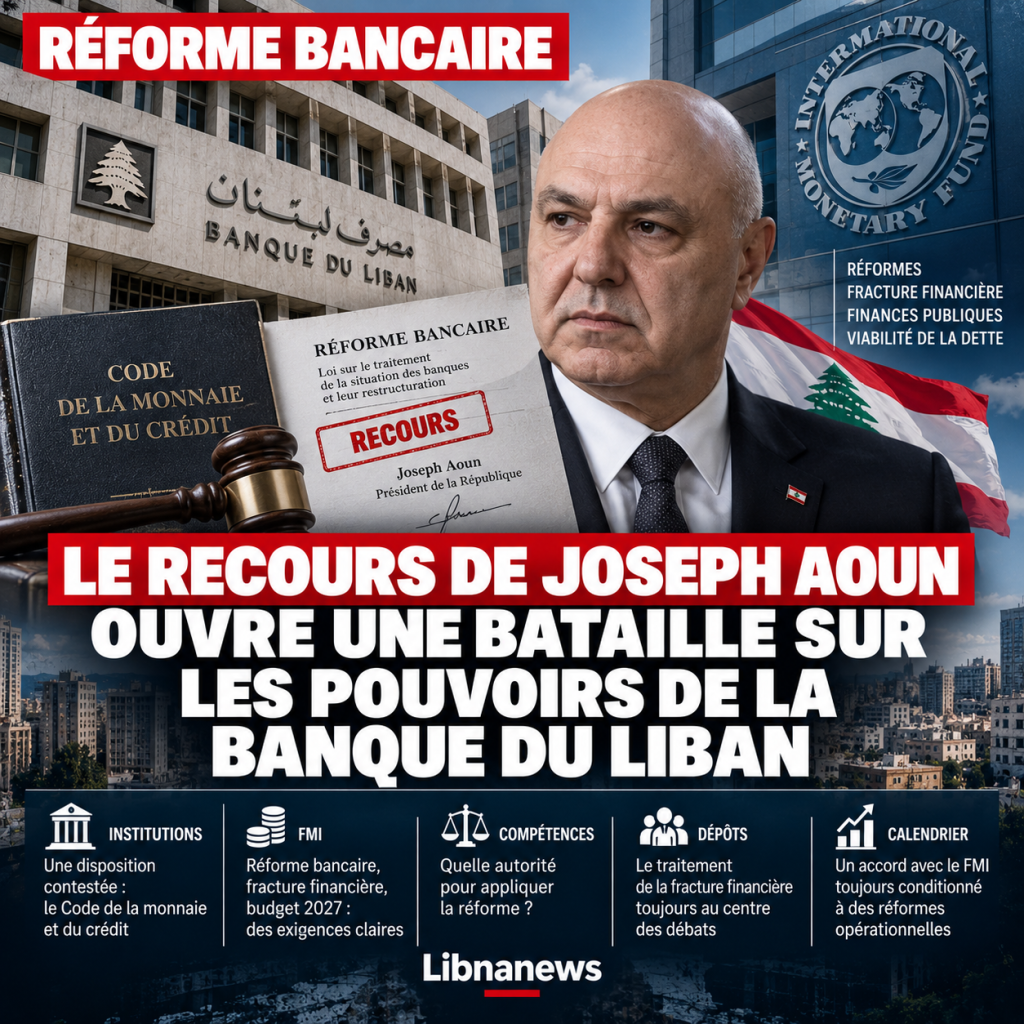
The road to a new agreement with the International Monetary Fund has just come up against a technical obstacle, but one that actually affects the very architecture of banking reform. President Joseph Aoun challenged a provision of the Bank Treatment and Restructuring Act. The appeal does not cover the whole text. It deals with a specific point concerning the reference to the Currency and Credit Code and, behind it, the powers of the Bank of Lebanon. At the same time, the International Monetary Fund recalls that Lebanon must bring banking reform into force, adopt legislation in accordance with international standards to address the financial divide and present a fiscal trajectory compatible with debt sustainability. Between these two requirements appears a central question: how can banks be reformed without creating new authorities that could encroach on the powers of the central bank?
The controversy arises as Karim Suaid leads the Bank of Lebanon and the institution must participate in several of the most sensitive projects of the post-crisis period. There is a need to restructure the banking sector, determine the treatment of losses, settle the fate of deposits and define how the State, the central bank, financial institutions and their shareholders will participate in the effort. The legal dispute is therefore not marginal. Depending on how it will be decided, it can determine who will have the authority to implement part of the reform.
A limited use of a provision, but with far wider consequences
Joseph Aoun’s appeal comes after the enactment of the Law on the Treatment and Restructuring of Banks. It does not call into question the entire device. The disputed point concerns the third provision of the text and the deletion of a reference to the provisions of the Currency and Credit Code. This clarification is important because part of the political controversy has presented the presidential initiative as a global challenge to banking reform.
In the facts reported by the sources of October 2, 2026, the President chose a targeted challenge. The issue is the need to maintain the Currency and Credit Code as a reference for monetary and banking action. The question then becomes that of the hierarchy between the new mechanisms created by the reform and the powers already entrusted to the Bank of Lebanon by existing law. Banking restructuring may require new procedures. However, it cannot function sustainably if several authorities simultaneously claim the capacity to take incompatible decisions.
The debate, therefore, does not focus solely on the deletion of a text. It affects the institutional chain of command. If a new body has powers that may compete with those of the Bank of Lebanon, it must be determined which of the two frameworks prevails. If, on the contrary, the new mechanisms remain subject to the existing powers of the central bank, the reform must specify this sufficiently to avoid future conflicts.
Article 70 of the Currency and Credit Code at the heart of the controversy
The most detailed arguments in favour of the appeal are presented exclusively byAd Diyar October 2, 2026. According to information published by the daily newspaper, the Presidency relies in particular on Article 70 of the Currency and Credit Code. Among the tasks of the Bank of Lebanon is the preservation of currency, economic stability, the soundness of the banking system and the development of the money and financial market. The reasoning is therefore to consider that a reform specifically concerned with banks cannot be organised outside this architecture without risking creating parallel competences.
According to the exclusive information provided by Ad Diyar, the formula referring to the Currency and Credit Code appeared in earlier versions of the text. It would have been agreed during the preparatory process before being deleted during the parliamentary phase. Political sources cited by the newspaper question several MPs in this removal and also suggest that the head of government would have supported this direction. This latter statement is not corroborated by an official statement in the corpus and must therefore remain attributed to the sources of the daily.
The same publication states that the purpose of the presidential appeal is to protect the independence of the Bank of Lebanon, the unity of decision within the institution and the hierarchy of competences. This reading is the heart of Joseph Aoun’s favourable argument. However, it does not in itself lead to the conclusion that the contested provision would have effectively undermined the independence of the central bank. This is precisely a matter of the legal review of the appeal.
A parliamentary amendment at the centre of suspicion
The course of the text adds a political dimension to the controversy. According toAd Diyar, the reference to the Currency and Credit Code would have been maintained during discussions between the main stakeholders. The version worked by the Finance and Budget Committee would also have retained this articulation before it was forwarded to the plenary. The newspaper states that the abolition took place later, in a parliamentary session marked by debates on the amnesty law, the withdrawal of certain blocks and the absence of a part of the deputies.
This chronology is important because it feeds into the question whether the version finally adopted really corresponds to the technical compromise built during the negotiations. The daily reports that several parliamentary blocs have succeeded, in this context, in removing the formula and having the new wording adopted. This description remains information specific to Ad Diyar. It must be distinguished from the indisputable institutional facts: Parliament adopted the text, the President promulgated it, and then exercised its right of appeal over a provision.
The debate now focuses on the consequences of this abolition. For advocates of the remedy, it could allow the creation of mechanisms with excessive autonomy over the Bank of Lebanon. For his critics, presidential intervention is likely to slow down a reform expected for several years. The two arguments address different concerns: legal coherence on one side, the speed of restructuring on the other.
IMF recalls that banking reform is only part of the project
The International Monetary Fund has intervened in this context with a message that reduces the possibility of summarising negotiations with one law. His spokesman Julie Kozack said on 2 October that the road to a new agreement requires several elements. In particular, it cited the entry into force of the bank processing scheme and the adoption of appropriate legislation to address the financial divide in accordance with international standards.
The Fund also calls for the preparation of a budget for 2027 and a medium-term financial framework compatible with debt sustainability. This precision is essential. Even if the dispute over bank restructuring were resolved quickly, Lebanon would not automatically have an agreement with the Fund. Several projects must progress simultaneously. Banking reform is an important condition, but it is not the only condition.
This position also provides a better understanding of the difficulty of the calendar. Lebanon must reorganize its banks while deciding how to deal with accumulated losses. At the same time, it must stabilize public finances and define a credible path for debt. Each of these cases involves a division of costs between the State, the Bank of Lebanon, banks, their shareholders and depositors. It is precisely this distribution that feeds much of the political resistance since the beginning of the crisis.
Would the Fund have asked to reduce the powers of the Bank of Lebanon?
The controversy also led to a battle over the interpretation of the position of the International Monetary Fund. Some arguments put forward in the debate suggested that deleting the reference to the Currency and Credit Code would meet the Fund’s requirements. Exclusive information published byAd Diyardispute this version. According to the newspaper, the various stages of preparation of the text had been carried out in coordination with the relevant actors and the Fund, while the reference to the Currency and Credit Code had been designed to protect the independence of the Bank of Lebanon and prevent the proliferation of decision-making centres.
The corpus does not, however, contain any official statement from the Fund that specifically resolves this editorial dispute. It would therefore be incorrect to state that the international institution supports Joseph Aoun’s position or, conversely, that it requires the contested deletion. What the Fund publicly states is more general: Lebanon must have an operational banking restructuring framework in line with international standards and credible legislation to address the financial divide.
This distinction is decisive. The Lebanese debate should not turn the Fund into a fictional arbitrator for an internal institutional controversy. The Lebanese authorities must first produce a legally coherent mechanism. It should then be compatible with the criteria for an international agreement.
Karim Souaid placed at the centre of a yard that goes beyond monetary policy
The competence issue is of particular importance with Karim Suaid at the head of the Bank of Lebanon. The institution must no longer only lead monetary policy and contribute to financial stability. It must participate in the resolution of a banking crisis in which its own balance sheet and past relations with banks play a major role. This creates a delicate institutional situation: the Bank of Lebanon is simultaneously an essential regulator of the system and an actor directly involved in the treatment of accumulated losses.
The presidential appeal can therefore be read as an attempt to preserve the unity of decision within the central bank. But this protection cannot mean lack of control. Bank restructuring requires clear rules, precise assessments of the situation of each institution and a transparent division of responsibilities. Preserving the competence of the Bank of Lebanon and strengthening supervisory mechanisms are not necessarily two contradictory objectives.
The real challenge is to avoid two excesses. The first would be to create parallel authorities capable of making contradictory monetary or banking decisions. The second would be to concentrate so many powers in one institution that accountability mechanisms become insufficient. The law must strike a balance between efficiency, independence and control.
The financial divide remains the decisive issue
While the debate focuses on bank restructuring, another text remains essential: the one on the financial divide. Finance Minister Yassine Jaber continued discussions on this issue with the representative of the French President for Economic Affairs, Jacques de Lajugie. Trade focused on banking restructuring, fracture treatment, public finances, debt and negotiations with the International Monetary Fund.
Yassine Jaber indicated that discussions with the Fund were continuing and that there was a rapprochement on several fundamental issues. However, work must continue on the outstanding issues before proceeding to the next stage. For his part, the Chairman of the Finance and Budget Committee, Ibrahim Kanaan, also referred to the project on the financial divide, which is currently being discussed between the Ministry of Finance, the Bank of Lebanon and the Fund.
This law will probably be even more sensitive than the one on restructuring. Restructuring a bank involves determining whether it is viable, how it needs to be recapitalized and how to deal with institutions that cannot continue to operate. Dealing with the financial divide means answering a much more explosive question: who will bear the losses?
Depositors remain at the heart of the battle
The economic pages of the corpus show how politically flammable this issue remains. Several analyses argue for the principle of full return of deposits and reject the idea of holding applicants liable for a crisis they have not created. Others stress the responsibility of the State, the Bank of Lebanon and financial institutions. These texts are subject to economic analysis and opinion. However, they show the level of resistance that any law on the financial divide will face.
Deposits cannot be separated from restructuring. A bank cannot return to normal business if its balance sheet remains loaded with losses that cannot be absorbed. But a reform that would erase applicants’ claims without a credible clearing mechanism would further destroy confidence. The government must therefore produce a formula that is both financially feasible, legally defensible and politically acceptable.
It is here that the debate on the competences of the Bank of Lebanon makes sense. The authority which will assess the banks, determine their needs and apply the restructuring mechanisms will have considerable power over the final allocation of losses. The definition of this authority is therefore not merely an administrative question.
A reform timetable now under pressure
Joseph Aoun’s appeal does not necessarily mean stopping the whole process. Discussions with the Fund continue. The Department of Finance is continuing its work. The financial gap project is still in preparation. Budget 2027 also advanced to the Council of Ministers. But the presidential challenge introduces additional uncertainty into an already busy timetable.
The main risk is that of a domino effect. If legal clarification takes time, the full entry into force of the banking framework may be delayed. If bank restructuring slows down, the discussion of the financial divide becomes more difficult. If these two files remain blocked, the agreement with the Fund moves away. This agreement is itself seen as an important element in restoring confidence and facilitating Lebanon’s access to external financing.
However, the urgency cannot serve as an argument to maintain institutional ambiguity. A banking reform to organise the sector for several years must clearly define the responsibilities of each actor. Correcting an inconsistency before application can be less costly than managing a permanent conflict of skills. The whole question is whether the appeal actually concerns such inconsistency or whether it causes a avoidable delay. It is now up to the legal process to determine this.
Behind an deleted sentence, the future Lebanese banking system
The battle over the presidential remedy finally reveals a much broader question than a provision. Lebanon must rebuild a banking system whose credibility has been deeply undermined. This requires viable banks, a central bank capable of carrying out its tasks, effective supervision and a credible solution for losses and deposits. None of these elements can function in isolation.
Exclusive informationAd Diyar of 2 October 2026present Joseph Aoun’s initiative as a defence of the independence of the Bank of Lebanon and claim that the reference to the Currency and Credit Code had been maintained during much of the negotiations before being removed from Parliament. This version will have to face the institutional process and arguments of the advocates of the adopted drafting. At the same time, the International Monetary Fund maintains a broader demand: reforms must become operational and the treatment of the financial divide must meet international standards.
The emerging choice therefore does not necessarily oppose the reform and independence of the central bank. The real challenge is to build a reform that guarantees both. If Lebanon fails to clarify this architecture, the problem will not only be a further delay in negotiations with the Fund. It will be that of a banking system restructured on disputed competences from the very beginning.





Comments