

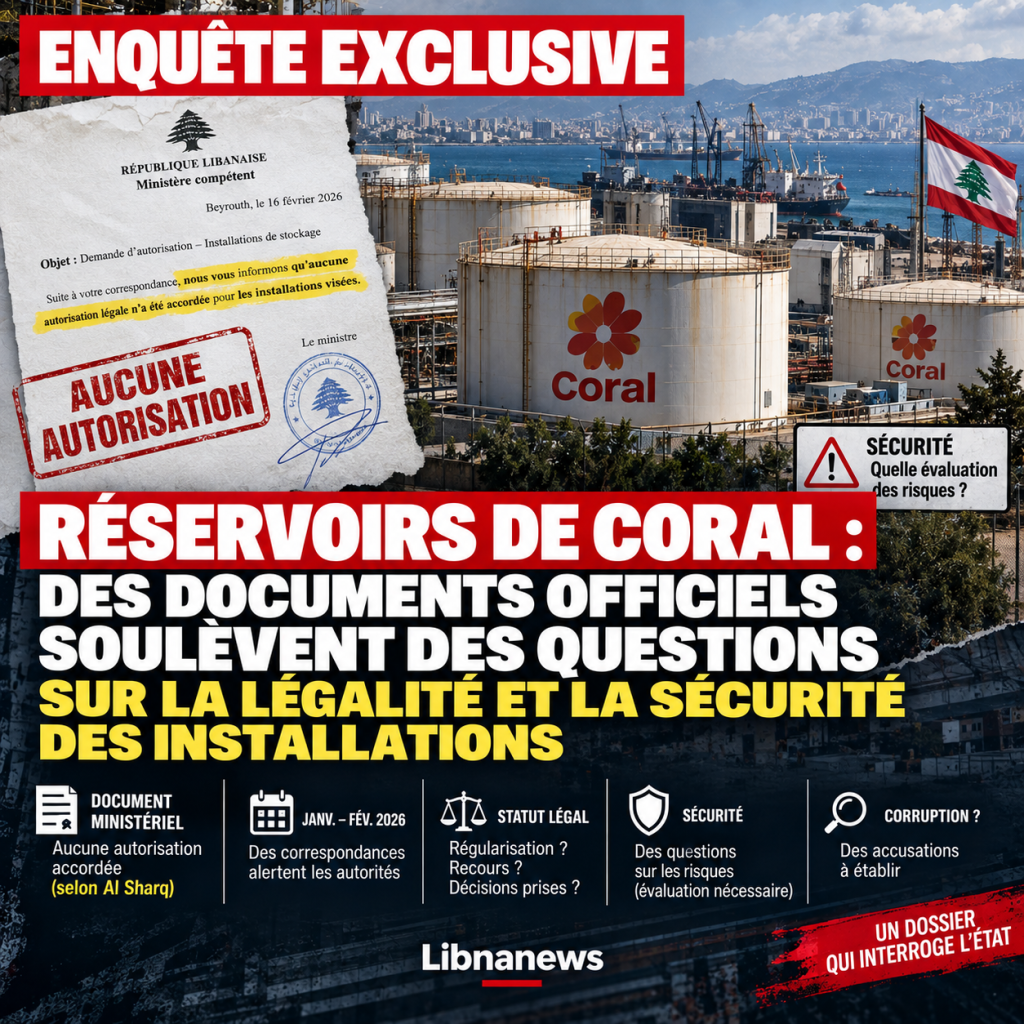
The file of the tanks allocated to Coral takes on a dimension that goes beyond a simple conflict between a company and a newspaper. In its October 2, 2026 edition,Al Sharqpublishes the first part of a survey on these facilities and claims to have administrative correspondence directly involving their legal situation. The central part of the publication is an official reply from the competent ministry indicating, according to the document reproduced and quoted by the daily newspaper, that no legal authorization would have been granted for the installations concerned. This revelation is specific to Al Sharq in the corpus consulted and must therefore be attributed to him. However, it does not constitute a definitive judgment on Coral or an expert opinion establishing the existence of an immediate danger.
However, the stakes are considerable. If the documents are authentic and still applicable, it is no longer just a question of determining whether all the administrative formalities have been properly completed. It is necessary to understand how storage facilities could have been built or developed when a department would have found that there was no authorization required. It is also necessary to determine which administrations have been informed, what measures they have taken and what the exact status of the reservoirs is today. Finally, a separate question concerns their safety. On this last point, the published material does not allow to repeat as a fact the spectacular comparison with « Chernobern » used by the newspaper. Only full technical expertise could objectively measure risk.
A departmental document puts the issue of authorizations at the centre of the file
According to the survey published byAl Sharq 2 October 2026the department concerned would have made it clear that no legal authorization had been granted to Coral for the facilities concerned. The newspaper relies on administrative correspondence and reproduces documents to support this claim. This piece changes the nature of the case. An accusation emanating only from a media can be contested in the journalistic field. A response from an administration requires, if properly interpreted, a review of the legal status of the project and the decisions taken by the competent services.
The chronology presented by Al Sharq reinforces this question. The daily newspaper includes documents dated 19 January, 16 February and 24 February 2026. The case would therefore have been brought to the attention of various authorities several months before the publication of the file in October. It then becomes necessary to determine what happened between these administrative exchanges and the situation described by the newspaper eight months later. Any adjustment could have taken place in the meantime. Appeals could also have been filed. Conversely, the facilities could have remained in the disputed situation described at the beginning of the year. The documents available in the corpus do not make it possible to decide between these scenarios.
This limit must remain at the centre of any reading of the file. A letter establishing the absence of a permit on a specific date alone is not sufficient to determine the legal situation several months later. In order to establish that of 2 October, it would be necessary to know all the administrative procedures carried out since February. The first part of the investigation does not provide all these elements. It therefore opens up a serious question without yet bringing all the pieces to close it.
A charge of illegal work that must be precisely defined
Al Sharq does not just question the existence of a permit. His investigation states that operations around the reservoirs would be illegal and that this situation would have been brought to the attention of the authorities. Again, this is a statement specific to the newspaper and its interpretation of administrative documents. No final judicial judgment reproduced in the corpus qualifies Coral’s officials as guilty of an offence. It would therefore be incorrect to turn the wording of daily life into an acquired conviction.
The distinction between absence of authorisation, administrative irregularity and criminal offence is fundamental. A company may challenge the jurisdiction of an administration, invoke another licensing regime, initiate an appeal or argue that the work concerned does not require the said permit. There is nothing in the available corpus to determine whether Coral makes any of these arguments. Conversely, if the competent ministry did consider that an authorisation was necessary and that it had not been issued, the administration must explain how it had enforced that position.
It is precisely at this level that the case becomes a state issue. A regulation has real scope only if the authorities have the means to enforce it. If a department finds an irregularity and an activity continues despite this finding, the reasons for this situation must be identified. They may be legal, administrative or judicial. They can also come from a conflict of competence. In the absence of additional parts, no hypothesis should be presented as certain.
Behind Coral, the question of the chain of administrative responsibilities
The inquiry implicitly raises another question: how many authorities can intervene in an energy storage project and which has the ultimate power to authorise or stop it? This issue is essential because the Lebanese administrative functioning often divides the competences among several agencies. An authorization under a ministry may coexist with municipal, environmental, technical or security obligations. The absence of a particular document therefore does not automatically permit the reconstruction of the whole procedure.
The corpus provided does not contain Coral’s complete administrative record. It would therefore be impossible to establish seriously a definitive list of the permits which the company was required to obtain and which were missing. On the other hand, Al Sharq’s correspondence justifies a request for transparency. The authorities may specify which permits were required, which were requested, which were granted or refused and which inspections were actually carried out. Such a publication would make it possible to remove the case face-to-face between media accusations and possible private challenges.
Such transparency would also protect administrations. If all procedures have finally been followed, the documents can demonstrate this. If certain steps remain incomplete, the authorities may explain the measures taken. On the contrary, silence maintains suspicion and gives more weight to the questions raised by the published correspondence.
Industrial risk cannot be established by press release
The first page of Al Sharq presents the investigation under an extremely alarming formula, comparing the reservoirs with « Chernobern in Lebanon ». Such a comparison has an obvious editorial force, but it cannot be repeated as a technical conclusion. The corpus does not contain any scientific studies establishing a risk comparable to a nuclear disaster or demonstrating the imminence of a major industrial accident. The formula therefore falls under the editorial choice of the newspaper.
This does not mean that questions about security are secondary. On the contrary, the existence of doubt about authorisations makes technical clarification essential. However, it must be based on measurable criteria: the nature of the substances stored, the capacity of the reservoirs, the distances with housing and infrastructure, containment systems, detection systems, means of fire control, access to rescue, hazard studies and evacuation procedures. These data are needed to move from journalistic alert to a real risk assessment.
An installation may present an administrative irregularity without constituting an immediate threat. It may also have authorisations while presenting technical deficiencies. The two questions must therefore never be confused. In Coral’s case, the available file makes it possible to seriously ask the legal question. It is not yet possible to quantify the danger scientifically.
Months between the first correspondence and the publication of the survey
Chronology is probably the most sensitive aspect of the file. The documents referred to date back to early 2026, while the first part of the survey was published on 2 October. If the authorities had already identified a problem in January or February, what decisions were taken in the following months. The existence of such an interval proves no negligence, as administrative and judicial proceedings can take time. But it requires an explanation.
Several scenarios remain possible. The work could be suspended and resumed after additional authorizations were obtained. Regularization proceedings were initiated. Coral was able to challenge the department’s interpretation. Other jurisdictions may have considered that the authorizations held were sufficient. Finally, the situation reported at the beginning of the year may never have been resolved. None of these scenarios can be arbitrarily chosen with the only available elements.
This uncertainty gives particular importance to the follow-up announced by Al Sharq. The daily presents its file as a first part. It is therefore possible that other documents will complete the chronology. Until these elements are available, it is necessary to stick to what is established by the publication: administrative correspondence exists and the newspaper states that they show the absence of a required authorization at the time they were issued.
Coral’s version still missing from the available file
An investigation of this gravity also requires an accurate understanding of the company’s position. However, the source files of October 2 do not provide a detailed response from Coral to each of the accusations made in the first part published by Al Sharq. This absence prevents a complete adversarial debate. It must never be interpreted as a confession.
Several specific questions should be able to receive a documentary answer. Does Coral have permissions that the newspaper did not reproduce? Has an application for regularization been filed? Does the company contest the jurisdiction of the responding department? Are the tanks operational, under construction or unused? Have they been subjected to technical inspections? Is there a safety study or impact assessment? Were administrative decisions challenged before a court?
The answers to these questions would determine whether the case is based on a total absence of authorization or on a more complex legal dispute regarding the nature of the permits required. Until this version is documented, there must be a clear separation between what Al Sharq claims, what the ministerial document submitted by the newspaper says and what remains to be established.
Charges of corruption require a different level of proof
The author of the survey also places his work under the sign of the fight against corruption. This dimension must be handled with even greater caution. The possible existence of work without authorization is not sufficient to prove corruption. Such a qualification implies additional elements: undue intervention by a person responsible, advantage granted in exchange for a consideration, falsification, abuse of power or other conduct that can be qualified as a court.
There is no evidence to conclude at this stage that such an offence has been established. The newspaper can legitimately ask why a situation which it considers to be irregular would have continued. He may publish the documents in his possession and hold the authorities accountable. But only a competent investigation can determine whether criminal liability exists.
This distinction also protects the strength of the file. The more serious the charges, the more it is necessary to separate what is documented from what is still suspected. The Ministerial Document on Authorization is a concrete lead. Corruption, for its part, remains a hypothesis that would require specific evidence.
The case becomes a prevention test for the state
The main teaching of the dossier is not ultimately the spectacular comparison chosen by Al Sharq. It is in the State’s capacity to respond before a possible incident turns an administrative controversy into a crisis. If the facilities are compliant and safe, independent verification can demonstrate this. If there are shortcomings, they can be corrected before they produce consequences.
A full technical inspection would thus make it possible to distinguish between legality and safety. At the same time, administrations could publish the chronology of authorizations and decisions taken since January 2026. Coral could provide his own documents and position. If there were criminal irregularities, the case could then be brought before the judicial authorities.
The central point revealed exclusively byAl Sharq 2 October 2026therefore, according to the administrative documents submitted by the newspaper, the competent ministry would have indicated that the legal authorization required for the facilities concerned had not been granted. Everything else must now be established. The current status of the tanks, possible adjustments, their actual level of security and administrative responsibilities remain open questions. It is their clarification, more than the alarming formulas, that will determine the true scope of the Coral case.





Comments