

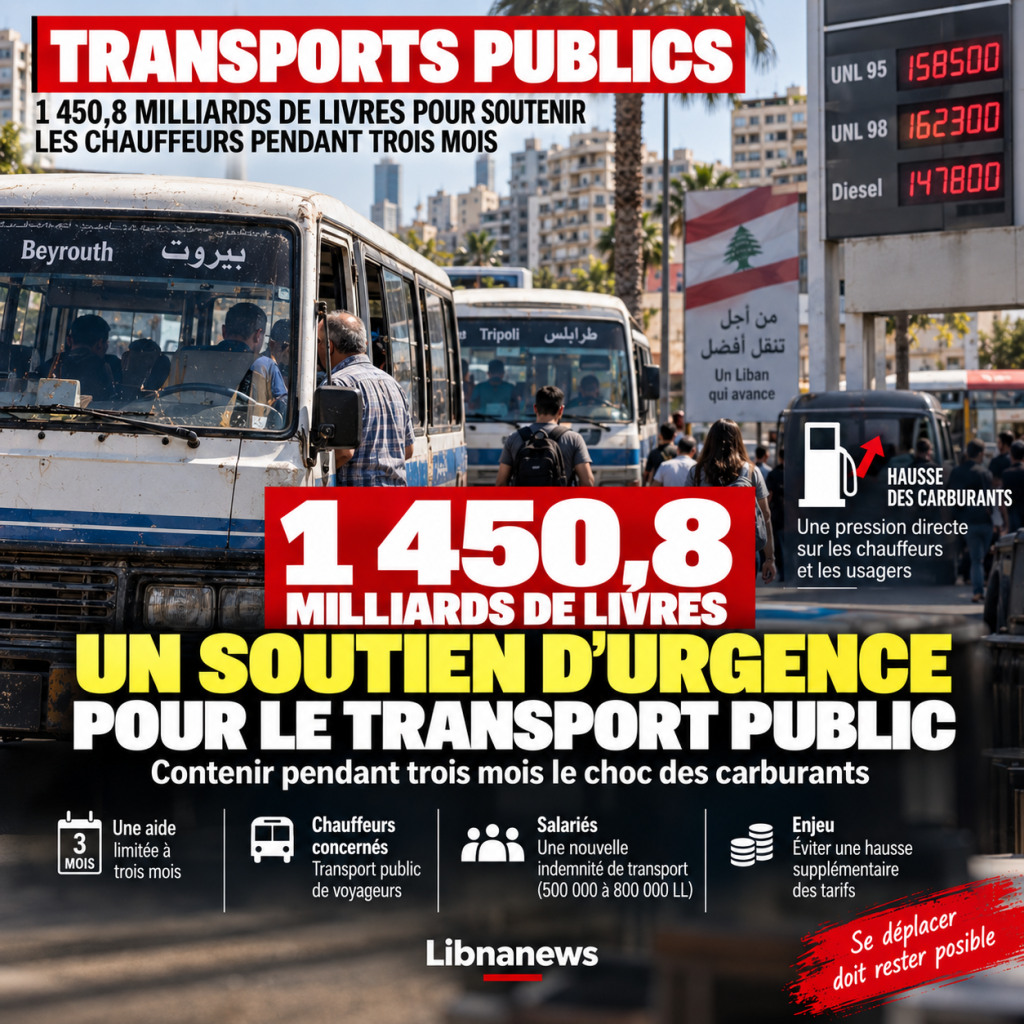
Nawaf Salam’s government has decided to mobilizelebanese pounds 1,450.8 billionto support public passenger transport drivers for three months. The measure, adopted by the Council of Ministers on 1 October 2026, responds directly to the increase in fuel costs. It takes the form of an additional appropriation to the Finance Act 2026 and aims to limit the immediate consequences of higher energy prices on a sector whose costs directly affect the daily movement of the population.
The decision is above all an emergency measure. Its duration is explicitly limited to three months. It does not reform the organisation of public transport or the structure of fuel prices. It seeks to prevent an energy shock from causing another sharp increase in transport costs. At the same time, the Government amended the daily travel allowance for employees. The two decisions show the same concern: the price of energy has become heavy enough to force the State to intervene with both transport professionals and employees who have to visit their workplace on a daily basis.
Over $1,450 billion in emergency funding
The Council of Ministers approved the opening of an additional appropriation of1,450 billion and 800 million lebanese poundsin the 2026 budget. This amount is specifically intended to support public passenger transport drivers for three months. The justification given is the rise in fuel prices, which has become a direct burden on the daily operation of vehicles.
The temporary nature of the measure is essential. The State does not introduce, in the available elements, a new permanent system of public transport financing. Instead, it purchases a three-month period during which the sector must be able to absorb the increase in its expenses more easily. This distinction allows us to understand both the usefulness and the limit of the device. Temporary assistance can prevent an immediate crisis. It cannot guarantee the stability of the sector if prices remain high after its expiry.
Sources dated October 2, 2026 do not specify the exact formula by which $1,450.8 billion will be distributed among recipients. They also do not give the definitive number of drivers concerned, the individual amount of aid or the exact frequency of payments. It would therefore be incorrect to calculate an average allowance per driver from data that are not available. The total amount and the three-month period shall be determined. Detailed distribution arrangements are not in the corpus.
This lack of precision will be one of the first points to be monitored. A large envelope has a real economic effect only if its payment mechanism is fast, identifiable and sufficiently transparent to ensure that the aid actually reaches the professionals concerned.
Fuel now accounts for a central part of the cost of transport
The decision comes at a time when the structure of fuel prices is itself at the centre of a debate. Sector representatives report that a gas plate arrives in Lebanon at a cost of about$23, including shipping and insurance. To this sum are added more than$6in the case of imports from other Member States, the amount of tax paid by the State, including taxes and value added tax, shall be taken into account before taking into account transport from importing companies to service stations.
This structure explains why any increase in fuel is rapidly spreading in the economy. For a professional driver, gasoline or diesel is not an occasional expense. This is a daily production cost. The more a vehicle runs, the more the variation in the price per litre directly affects the profitability of the business.
The professional then has few options. It can absorb part of the increase and reduce its income. It can increase its fares and transfer the cost to passengers. It can also reduce its activity if certain races become insufficiently profitable. Each of these responses has economic and social consequences.
It is precisely this mechanism that the government seeks to slow down for three months. By supporting the drivers, he tries to prevent all the shock from being immediately transferred to the passengers. However, the sources do not specify whether the aid will be accompanied by a tariff commitment. It would therefore be premature to state that it alone guarantees their stability.
The government is refusing to solve the problem with a general reduction in taxes
The fuel debate is not just about helping drivers. Another option is to reduce the levies applied to the final price. The subject was publicly raised, particularly in the context of a£300,000on gasoline. Distributor representatives questioned the government’s ability to remove this burden.
The difficulty is budgetary. A general reduction in taxes benefits all fuel consumers, but simultaneously reduces government revenues. Targeted aid also costs public money, but it can theoretically focus on the categories that the government considers to be the most exposed.
The choice of the 1 450.8 billion credit shows that the executive favours, at least immediately, targeted compensation for public transport rather than a general abolition of levies. This approach preserves some of the fuel revenues while using the budget to reduce the impact on a particular sector.
However, it produces an obvious paradox. The State collects revenues from fuel and then mobilizes part of its resources to compensate for the consequences of higher fuel prices. This logic can be defended as a temporary measure. It becomes more difficult to sustain if it continues indefinitely.
Driver support joins new employee transport allowance
The government did not deal in isolation with professionals. At the same meeting, it changed the value of the daily transport allowance payable to employees for their presence at their place of work. The new mechanism corresponds to the value of5 litres of petrol per daywith a minimum ofpound500,000and maximum£800,000.
The choice of indexing the allowance on a quantity of fuel is revealing. It makes it possible to change the amount with the official price of gasoline rather than to keep a fixed amount that quickly loses its value in times of increase. The calculation shall use the average official price of the petrol plate.
Both decisions thus respond to both sides of the same displacement. The driver is subject to an increase in the cost of providing the service. The employee is subject to an increase in the cost of using a means of transport and joining his employment. The State therefore intervenes simultaneously on supply and part of demand.
This architecture also shows the extent of the problem. When daily transport requires intervention on workers’ incomes and specific support for professionals, the increase in energy ceases to be a mere fluctuation in the market. It becomes a question of social policy.
Three months: a short deadline that already postpones the next question
The duration of aid is probably its most fragile point. Three months can allow for a period of sharp rise. They do not constitute a strategy if the conditions that caused intervention remain unchanged.
When the scheme expires, several scenarios will be possible. Prices may have fallen and reduced the need for new aid. They may remain high, forcing the government to choose between an extension, an increase in rates or a new formula. They can still increase and make the initial envelope insufficient.
The sources do not give any automatic rules for deciding what will happen after the three months. It is therefore not possible to say that support will be renewed. The government has given itself a limited period. The future will depend on price developments and budgetary choices.
This temporality can also be interpreted as a desire to avoid the immediate creation of a permanent grant. Lebanon is hardly emerging from a model in which several prices have been supported by mechanisms that have ultimately weighed heavily on public finances. A time-limited scheme allows a margin of re-evaluation to be maintained.
But it creates uncertainty for professionals. A driver must make daily decisions about his or her activity. An aid whose duration is known but which is not defined afterwards does not necessarily allow it to plan over several months.
The decisive question will be that of the beneficiaries
The overall amount naturally attracts attention, but the effectiveness of the scheme will depend on the identification of beneficiaries. Lebanese public transport is based on professionals whose situations may be different. In order for targeted aid to work, the State must have criteria to determine who can receive it.
Available sources do not detail these criteria. They only indicate that the credit is for public drivers carrying passengers. The administrative arrangements will therefore have to specify the conditions for eligibility and the procedures for payment.
This step is essential to avoid two opposing problems. An overly complicated mechanism can exclude professionals who really need help or delay payments until the three-month period is almost over. On the contrary, an inadequately controlled mechanism may pave the way for beneficiaries who do not meet the objective of the programme.
Speed must therefore be reconciled with verification. In an emergency measure, support provided several months after the shock loses much of its usefulness. But an envelope of over £1450 billion also requires control rules.
Aid indirectly protects users most dependent on public transport
The measure formally targets drivers. Its economic objective, however, is broader. People who use public transport daily often have fewer alternatives. They may not necessarily use a passenger car, bear all the expenses associated with a vehicle or pay for more expensive transport services.
A sharp increase in tariffs can therefore directly affect access to work, education and services. Transport becomes an incompressible expense for part of households. If its cost increases faster than income, some travel can be reduced or abandoned.
The new transport allowance attempts to address this problem for the employees concerned. But not all users necessarily benefit from this mechanism. Students, workers in special situations and other categories can continue to depend heavily on the rates charged.
Maintaining a functioning public transport sector therefore has a social function that goes beyond protecting drivers’ income. It is also a way of preserving minimum mobility in an economy where the cost of travel is heavy on households.
The scheme does not yet constitute a public transport policy
However, the 1 450.8 billion envelope must be placed within its limits. It does not create an integrated public network. It does not modernize vehicles. She doesn’t reorganize the lines. It does not address congestion or infrastructure problems. She’s treating a cost shock.
This distinction is important because a succession of temporary aids can eventually absorb significant resources without structurally improving the service. If the government wants to reduce the impact of fuel prices on a sustainable basis, it will also have to consider the efficiency of the transport system.
A more organized collective network can transport more people with more efficient use of resources. But such a transformation requires investments, planning and administrative capacity that go far beyond the measure adopted on 1 October.
There is no evidence that credit is already part of a comprehensive reform of this nature. It must be seen as a social and economic response to an immediate situation.
A major expenditure as the state seeks to restore its budgetary discipline
Support is also provided in a particular context for public finances. The Council of Ministers has just adopted draft budget 2027 and the Government is seeking to restore the budgetary order in its discussions with the international financial institutions.
Each exceptional expenditure must therefore be reconciled with the objective of controlling public finances. A £1450.8 billion envelope is not neutral, even when it responds to a social emergency. It is precisely for this reason that its duration, its targeting and its effectiveness will have to be assessed.
The government must demonstrate that it can protect the categories affected by the increases without returning to widespread and permanent mechanisms that cannot be funded. Driver support is thus a test of the new fiscal policy: to intervene quickly, but in a targeted and temporary way.
If aid has the desired effect for three months, the government will have a model for other ad hoc interventions. If prices remain high and the scheme is to be renewed indefinitely, its logic will have to be reviewed.
The real date will end three months
The decision of 1 October responds to an identifiable emergency. Fuel increases the cost of drivers and threatens to affect passengers. The government is therefore opening a loan of £1,450.8 billion and is also adjusting the employee transport allowance. Intervention is important in terms of its size and the number of trips it indirectly seeks to protect.
But it only moves the main three-month question. If the price of energy remains high, Lebanon will have to choose between several difficult options: maintaining compensation, reducing certain levies, accepting an increase in tariffs or further reorganizing public transport.
The stakes then go beyond the drivers. It concerns the ability of employees to return to work, that of households to absorb daily expenditure and that of the State to finance social protections without recreating permanent subsidies.
The£1,450.8 billionso above all, let us buy time. Their effectiveness will be measured by the stability of the sector over the three months covered, the speed of payments and the government’s ability to use this time to decide what will replace the scheme if the fuel crisis continues.





Comments