

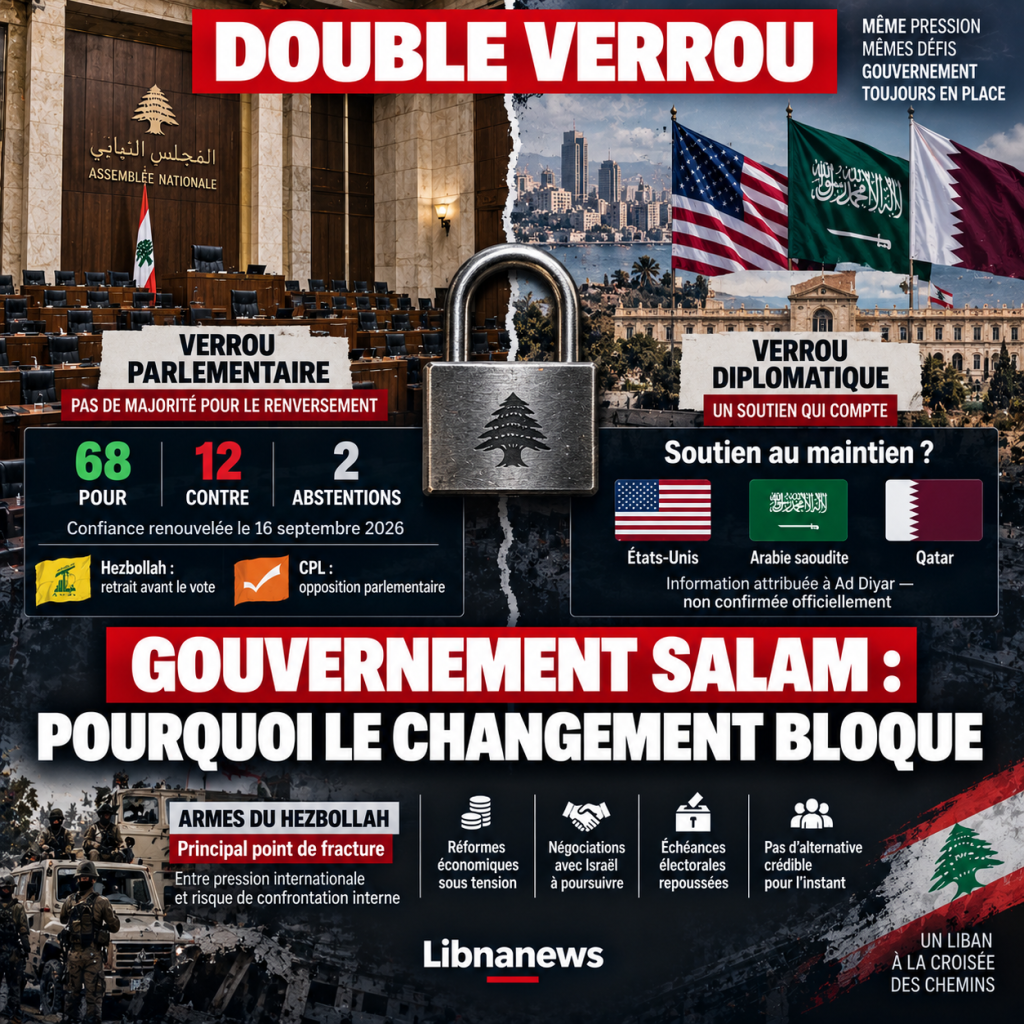
The government of Nawaf Salam remains under strong political pressure, but attempts to provoke its departure have so far produced no institutional change. Hezbollah is in frontal dispute with several decisions of the Council of Ministers, in particular those relating to the exclusivity of weapons in the hands of the State. The Free Patriotic Movement has, for its part, tried to translate its opposition into the parliamentary field. Yet the firm remains in place. According to proprietary information published by Ad Diyar on 2 October 2026, this resistance is not only explained by internal power relations. The government would also benefit from US, Saudi and Qatari support, which would make its replacement particularly difficult in the current circumstances.
This claim is based on political sources cited by Ad Diyar and has not been officially confirmed by Washington, Riyadh or Doha. It must therefore be seen as behind the scenes. However, it is of particular importance after the postponement of the parliamentary elections. A deadline that would normally have opened a new government cycle has disappeared from the immediate schedule. The question of the duration of the Salam cabinet therefore arises from a new perspective.
Two oppositions to the government, but two different strategies
The government’s challenge does not form a homogeneous bloc. Two forces have expressed particular opposition, but they neither follow the same method nor necessarily the same objectives.
The free Patriotic Current has chosen parliamentary ground. In the sequence of 15-16 September 2026 dedicated to the government, the cabinet obtained 68 votes in favour among the 81 MPs present. Twelve members of the Bloc of Lebanon voted against.
Hezbollah has adopted a different attitude. His parliamentary bloc, Faithful to the Resistance, withdrew and did not participate in the vote. The party remains represented in the government that it criticizes.
This situation creates an important political contradiction. Hezbollah rejects some of the fundamental decisions of the Council of Ministers, but an exit from the executive would make it lose its direct presence in the institution that adopts these decisions.
Ad Diyar believes that this data partly explains the party’s strategy. This interpretation belongs to the newspaper. Hezbollah has not formally presented its government participation in these terms.
However, the political outcome remains clear. The government was not overthrown in Parliament and the various oppositions failed to build a common majority around an alternative.
The weapons file at the heart of the rupture
The main source of confrontation remains the issue of Hezbollah’s weapons.
Since 2025, the government has taken several decisions to devote arms exclusivity to legal institutions. This orientation directly affects the military status of Hizbullah and its ability to maintain an autonomous armed arrangement.
The party rejects this logic under current conditions. In particular, it links the issue of its weapons with the Israeli presence, military operations in the South and the State’s ability to defend the territory.
Hezbollah’s secretary-general, Naim Kassem, has repeatedly taken a very critical position towards the government. The confrontation has reached a sufficiently high level to indicate the possibility of political mobilisation against the cabinet.
Yet it did not lead to its fall.
President Joseph Aoun, too, defends the principle of exclusive arms in the hands of the legal forces. But it combines this orientation with the refusal of an internal confrontation. The stated objective is therefore to gradually strengthen the authority of the State without causing a confrontation between the army and Hezbollah.
This constraint severely limits the options available.
A political decision may be adopted by the Council of Ministers. However, its implementation on the ground depends on a much more complex security and political environment.
External guarantees raised behind the scenes
It is in this context that the most sensitive information published by Ad Diyar comes into play.
According to the 2 October 2026 daily newspaper, the Salam government would benefit from significant international and Arab support. Guarantees were reportedly passed on to a senior Lebanese political official. They would indicate that Washington, Riyadh and Doha do not want the government to fall or reshuffle immediately.
The paper goes so far as to present the firm as a « red line » for these partners.
This formulation should not be understood as an official position of the three capitals. No statement reproduced in the corpus reproduces these terms. This is information attributed to political sources.
However, the accompanying reasoning is precise. According to these sources, no alternative would currently guarantee the continuation of the priority orientations of Lebanon ‘ s international partners.
These include the assertion of State authority, particularly over weapons and the decision on war and peace.
The stability of government would therefore have a function. It would avoid the opening of a new institutional crisis at a time when several major issues have to be dealt with simultaneously.
Why Washington should keep Salam
Lebanon is engaged in a complex security negotiation with Israel under American mediation. A new meeting is to be held in Tampa, Florida, in a military-technically dominant setting.
Beirut is seeking progress on Israeli withdrawal, cessation of operations and deployment of the army. Washington is also calling for measures concerning Hezbollah weapons.
In this context, the stability of the executive becomes a functional part of the process.
A resigned government or a long period of consultation to appoint a new Prime Minister would complicate negotiations. Foreign interlocutors would find it more difficult to secure sustainable political commitments.
The same reasoning applies to economic matters.
The Government is negotiating with the International Monetary Fund. It must lead banking restructuring, address the financial divide and put public finances on a more stable path.
The change of government team could slow down these processes.
Washington can therefore exert strong pressure on Nawaf Salam while wishing to maintain it. There is not necessarily a contradiction between the two attitudes.
Support does not mean satisfaction
The US discussions in Nawaf Salam also show that the possible political support it enjoys does not amount to an approval of its results.
The weapons file remains a point of friction.
The US officials are asking Lebanon for concrete measures. At the same time, Beirut hopes that Washington will obtain new steps of withdrawal from Israel.
This difference in the order of shares is one of the main current problems.
Lebanon believes that an additional Israeli withdrawal would strengthen the State and facilitate the deployment of the army. The American approach reported in several sources is, on the contrary, to demand Lebanese arms advances before calling for further withdrawals from Israel.
The Salam government is therefore caught between two pressures.
Outside, it must demonstrate its ability to implement its decisions.
Inside, it must avoid forced application causing confrontation.
Maintaining the government does not resolve this contradiction. It only prevents a government crisis from adding to it.
Nabih Berri, a key player in balance
The Speaker of the Chamber, Nabih Berri, occupies a central position in this architecture.
Ad Diyar attributes the failure of an attempt to bring the government down the street to the lack of Berri’s support for this option. Again, this is political information attributed to the newspaper.
The role of the Speaker of the House, however, goes beyond this sequence.
Berri remains one of the main institutional channels between Hezbollah and other power centres. It also has significant experience in managing compromises between actors who no longer speak directly.
A complete break between Hezbollah and the government would reduce these mediation spaces.
Maintaining the party within the executive and the Berri party at the centre of the parliamentary game therefore helps to maintain political channels despite the violence of disagreements.
This does not mean that a compromise on weapons exists. There is no evidence in the sources.
Rather, the system continues to operate despite the lack of agreement on the most sensitive issue.
Deferral of legislative changes the timetable
The potential duration of the Salam government was also modified by the postponement of the parliamentary elections.
The election was initially to open a new institutional cycle. After the elections, the government would have become resigned and further parliamentary consultations should have been held.
This scenario did not take place.
The House’s mandate was extended for two years for reasons related to the security environment. The government has therefore lost the deadline which would automatically have interrupted its normal exercise.
A question now arises: Can Nawaf Salam remain Prime Minister until 2028?
No automatic response can be given.
The government may fall before that date. The Prime Minister may resign. A new electoral deadline may be reached. A political crisis may also impose a new configuration.
But, in the absence of these events, the postponement of the election objectively extends the cabinet horizon.
Ad Diyar points out that Nawaf Salam could have remained a serious candidate for his own succession even if the elections had taken place.
The newspaper presents its nomination as having benefited from a favourable international environment after Joseph Aoun’s election to the presidency of the Republic in January 2025. This reading is that of the publication and its sources. It should not be confused with the constitutional procedure for appointing the Prime Minister, which requires mandatory parliamentary consultations.
Political stability that does not solve the social crisis
The Nawaf Salam problem, however, is not limited to parliamentary power relations.
The cost of living remains a major source of dissatisfaction. Energy prices affect households and businesses. Electricity and water also remain at the heart of criticism of public services.
The Council of Ministers tried to provide several answers at its meeting on 1 October.
The proposed budget for 2027 was adopted. The Government has also changed the calculation of the daily transportation allowance. This should be the value of five litres of gasoline per day of attendance, ranging from 500,000 to 800,000 pounds.
An additional appropriation of £1,450.8 billion was also approved to support public transport drivers for three months due to the rise in fuel prices.
Family allowances have also been modified.
These decisions show that the government is seeking to contain social pressure while continuing its financial program.
However, they do not constitute a structural response to the purchasing power crisis.
A cabinet can survive a parliamentary vote while gradually being weakened by the economic situation.
Criticism also focuses on the effectiveness of ministers
According to political information reported by Ad Diyar, the government’s external support would not mean that its functioning would be considered satisfactory in all areas.
There would be criticism of the effectiveness of some ministers, particularly in areas related to essential services.
This distinction is important.
The preference for institutional continuity may coexist with a strict assessment of executive performance.
An international partner may consider that a change of government would be more costly than maintaining the current team, without considering that this team is working perfectly.
This is probably one of the keys to the current situation.
The Salam government does not appear protected because all its problems would have been solved. It could be because the alternative seems even more uncertain.
Electoral debate remains the main institutional unknown
The postponement of legislation does not close the electoral file.
The Vice-President of the Chamber, Elias Bou Saab, called for a resumption of work on the electoral law. This debate can become decisive.
Several political forces, including Christian ones, attach great importance to the rules of representation. An amendment to the law or an agreement to hold elections before the extended deadline could change the government’s timetable.
Conversely, the absence of compromise would probably prolong the current situation.
The government is thus suspended from several clocks.
The first is safe and dependent on the South.
The second is diplomatic and concerns negotiations with Israel.
The third is financial and depends on reforms and discussions with the International Monetary Fund.
The fourth is political and concerns the weapons of Hezbollah.
Fifth is election.
Each can change the firm’s life span.
A lack of alternative more than an absence of opposition
The current strength of the government should therefore not be interpreted as the absence of adversaries.
Hezbollah opposes a central part of its policy. The free Patriotic Current denied him his confidence. Criticism affects his economic and social work. The issue of arms remains unresolved.
Yet no alternative coalition has so far emerged.
The parliamentary vote in September gives the most concrete indication. The government has retained a clear majority among the Members present.
The exclusive information from Ad Diyar adds a second dimension: major international actors would also prefer continuity.
These two factors are mutually reinforcing without being of the same nature.
The parliamentary majority allows the government to exist constitutionally. Possible external support gives it a more favourable diplomatic environment.
But neither guarantee its duration.
Nawaf Salam mainly has a political advantage: his opponents know what they are challenging, but they don’t seem to agree yet on what should replace his government.
In a Lebanon confronted simultaneously with the question of the South, Hezbollah weapons, reconstruction and the financial crisis, this lack of alternative could, for the time being, be the main guarantee of the firm’s survival.





Comments