

How far is an object whose signal takes a day to reach us? On 18 November 2026, at 1016 UTC, 1216 hours in Beirut, Voyager 1 reached an Earth light day, about 25.9 billion kilometres away. NASA confirmed the milestone the next day, when the probe radio signal reached the Earth antennas.
The Jet Propulsion Laboratory associated receiving the carrier wave with trajectory calculations. As of November 19, the teams had not received any scientific or technical data since 14. The signal thus confirmed the distance, without establishing that the probe measurements were again transmitted.
A light day is a distance
The word « day » may be misleading. He does not designate here the age of Voyager 1 or the length of his journey. A light day corresponds to the distance travelled by light in 24 hours. Radio waves used to communicate with the probe propagate at the same speed in the vacuum.
Comparison with our neighbourhood gives the scale of the problem. The light takes about 1.3 seconds to cross the average distance between Earth and the Moon, and eight minutes and twenty seconds between the Sun and the Earth. For Voyager 1, the order of magnitude becomes a day in one direction. NASA’s announcement is about distance to Earth, not the Sun.
Two days for a radio return
An order sent to a probe located on a light day takes about 24 hours to reach it. An answer must then travel the opposite route. The round-trip therefore represents about 48 hours of propagation, even before possible delays in processing and organizing communications.
This shift prevents instant piloting. Teams must prepare their orders, take into account the known condition of the aircraft and wait for information to determine their effect. A successful connection does not remove the distance: it only allows to continue to exchange despite it.
The milestone is not a physical barrier installed in space. It should therefore not be described as a shock, manoeuvre or change of environment which the vehicle would necessarily have detected at the moment announced. It is first of all a way to measure his position and the journey time of his communications.
A different record of entry into interstellar space
Voyager 1 has been in interstellar space since August 2012. It then left the heliosphere, the bubble of particles and magnetic fields produced by the Sun. This plasma boundary does not delimit all the gravitational grip of the Sun, which extends far further, towards the Oort cloud. The threshold of light day therefore does not mark a second entry into this environment, which it has been studying for more than a decade.
The journey of both Voyagers also explains their difference. Voyager 1 flew over Jupiter and then Saturn before continuing to interstellar space. Voyager 2 followed a different journey, passing also near Uranus and Neptune. NASA places its own passage on a light day in November 2035: this is still a forecast, not an appointment already made.
A scientific mission, without new photographs
The instrument table published by NASA indicates that the magnetometer and plasma wave measurement system are among Voyager 1’s active instruments, regardless of the interruption of transmission reported on 19 November. On the other hand, he reported the shutdown of the low-energy particle detector on 17 April 2026 and that of the cosmic ray system in February 2025, in order to save energy.
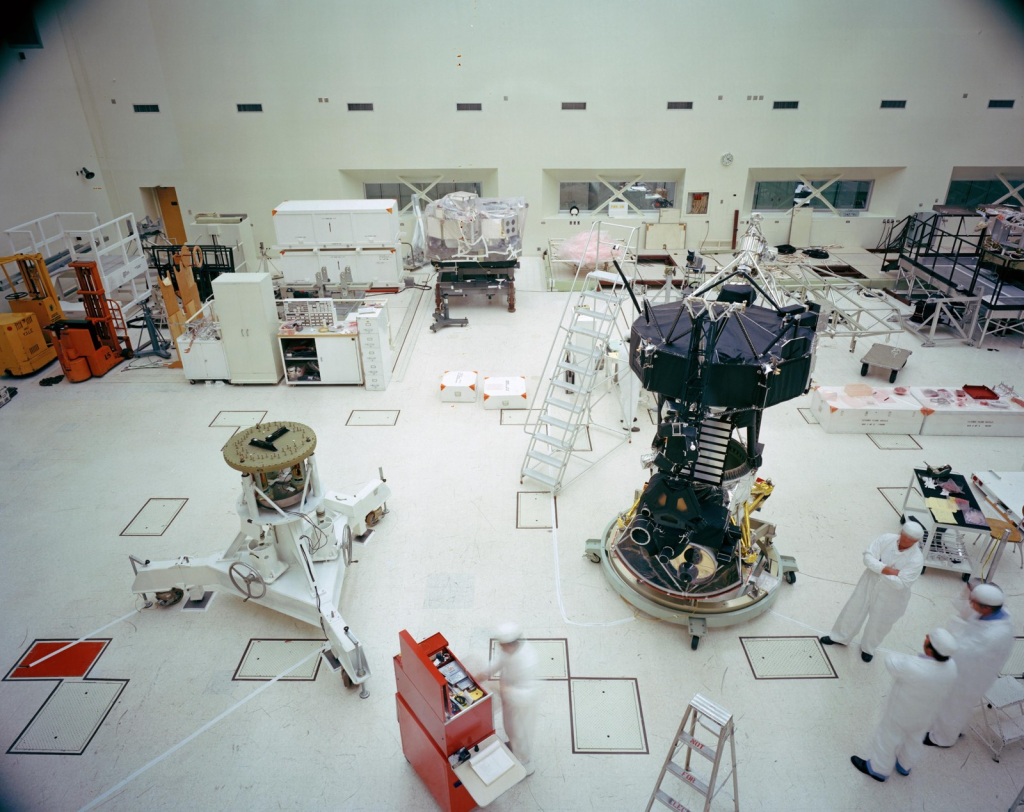
The cameras have been off since 14 February 1990. There is therefore no current photograph taken by Voyager 1 to show its environment as it passes this threshold. An image of the probe on the background of stars can be an artistic representation; A ground preparation photograph belongs to the mission archives. Neither is a view received today from this distance.
JPL teams listen to the probe every day and send it orders every week. With electric power decreasing by about four watts a year, they have already turned off several instruments. The magnetometer and plasma wave detector are among those they seek to keep in service.





Comments