

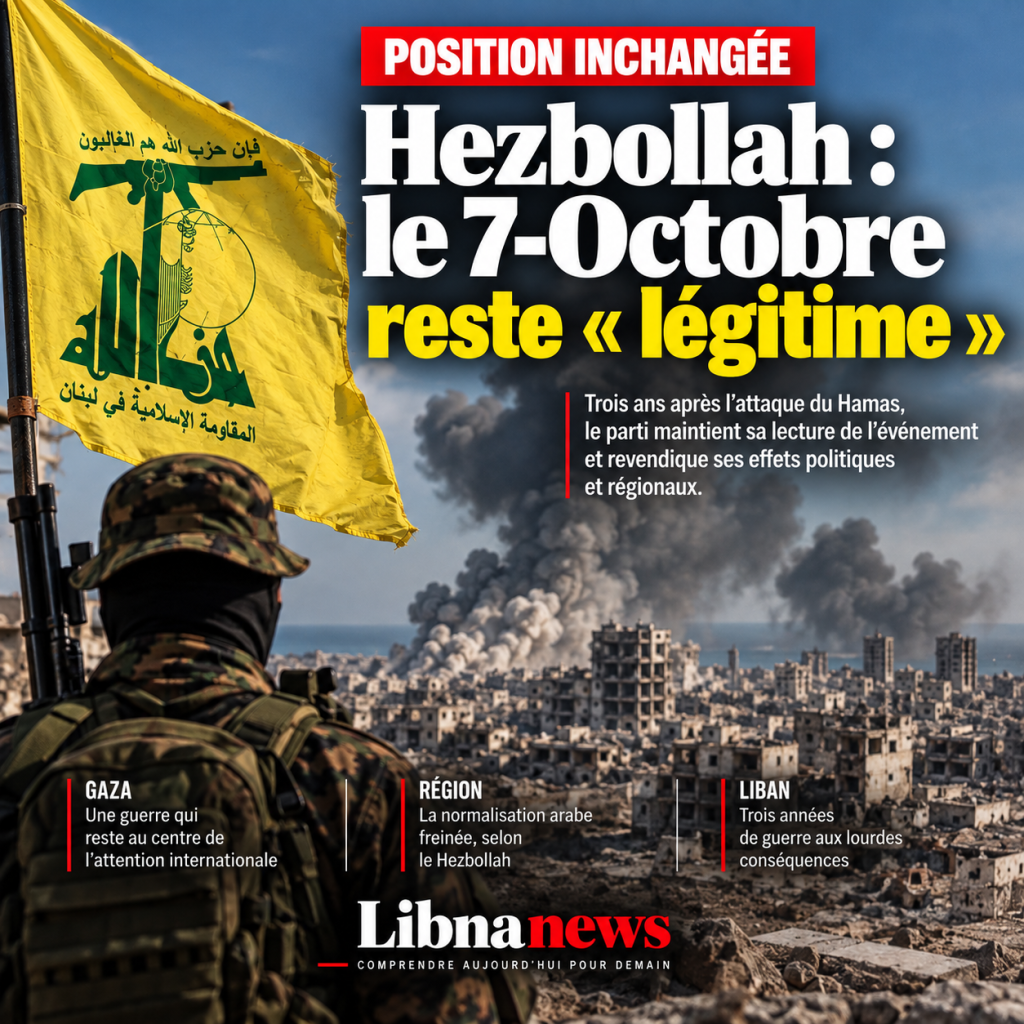
Three years after the Hamas attack of 7 October 2023, Hizbullah maintains its entire reading of the event. In a press release published Wednesday, October 7, 2026, the party described the operation as a « legitimate act of resistance » and claimed that it had placed the Palestinian cause at the centre of international attention. This declaration came after three years of profound upheaval in Lebanon and Hezbollah: the opening of the South Lebanon front on 8 October 2023, war with Israel, the death of Hassan Nasrallah and many leaders of the movement, the ceasefire of November 2024 and the rise of the internal debate on the party’s weapons.
Hezbollah defended Wednesday on the occasion of the third anniversary of the7-OctoberThe Hamas attack on Israel in 2023. The Lebanese movement describes the operation as » brave, qualitative, natural, justified » and a « legitimate act of resistance given the scale of injustice ». Three years after the beginning of a sequence that led Gaza, Lebanon and part of the region to a major confrontation, the party therefore makes no reservations about the initial operation and continues to defend its political scope.
This position takes on a particular dimension in Lebanon. By 8 October 2023, Hezbollah had opened a front from the South, which was described as military support for Gaza. Exchanges of fire with Israel continued for almost a year before a major escalation in autumn 2024. The conflict then directly affected large Lebanese regions, causing extensive destruction and mass displacement, while Hizbullah lost a significant part of its command. The movement’s secretary-general, Hassan Nasrallah, was killed on 27 September 2024 in an Israeli strike on the southern suburbs of Beirut.
Hezbollah defends 7 October’s political record
In its Wednesday communiqué, Hizbullah states that the consequences of October 7 cannot be assessed solely through the ratio of military forces or the magnitude of the destruction recorded over the past three years. The party believes that the operation has caused a global shock and placed the Palestinian question at the forefront, while, in his view, it might be marginalized by the ongoing diplomatic transformations in the Middle East. It thus asks to measure the event through its political, legal and regional effects rather than through Israeli military superiority alone.
In this way, the movement responds to criticisms about the considerable cost of the clashes that have taken place since October 2023. He rejects what he describes as the « wailings » around destruction and human and material loss, for which he assigns responsibility to Israel. This argument directly concerns the Lebanese debate: since the war, several political opponents of Hezbollah accuse him of having opened the front of 8 October without a decision by the State and thus exposed the country to a confrontation whose consequences continue to weigh on the South and other regions.
However, in its anniversary communiqué, Hizbullah does not return to its own decision to enter into confrontation from Lebanese territory. He focused his remarks on the legitimacy he attributed to the Palestinian operation and the effects it would have had on an international level. This continuity is politically significant three years later, while the issue of arms monopoly and the decision on war and peace has become one of the main institutional issues in Lebanon.
Three years that have profoundly changed Hezbollah
Between 7 October 2023 and Wednesday’s press release, Hezbollah experienced the most difficult military period in its recent history. After months of limited but daily confrontations at the border, Israel intensified its operations in September 2024. Several military leaders of the movement were killed before the 27 September strike against Hassan Nasrallah. Israel then launched ground operations in southern Lebanon, while its strikes extended to the Bekaa, the southern suburbs of Beirut and other areas.
The hostilities reached a turning point with the entry into force on 27 November 2024 of a cessation of hostilities agreement based, inter alia, on Security Council resolution 1701. The arrangements provided for the further deployment of the Lebanese army south of the Litani River and the withdrawal of Israeli forces from the Lebanese territories occupied during the operations. The question of the implementation of this agreement, the positions still occupied by Israel and the effective State authority in South Lebanon then continued to fuel tensions.
These developments have also displaced the internal political debate. The issue is no longer just the regional role of Hezbollah or its support for Gaza. It now focuses directly on the future of its arsenal and on the ability of the Lebanese State to exercise its military authority alone. The opponents of the movement consider that the experience opened on 8 October 2023 demonstrates the need to reserve to the constitutional institutions any decision concerning the war. Hezbollah continues to defend the principle of « resistance » against Israel.
Gaza and the international mobilizations highlighted
Hezbollah further states that 7 October has placed Palestine in the international debate for a long time. To support this reading, he cites demonstrations in several western capitals and protest movements that have emerged in universities since the beginning of the war in Gaza. According to the party, these mobilizations show that the events launched in October 2023 aroused international solidarity with the Palestinians and provoked a protest against the conduct of the Israeli war.
In its statement, the movement uses the term « genocide » to describe Israel’s operations in Gaza and specifically refers to women and children killed. He claims that three years of war did not allow Israel to settle the Gaza issue to its advantage or to determine its political future definitively. Hezbollah also argues that Israel has failed to eliminate neither Hamas nor other Palestinian factions and that it has failed to convert its military superiority into lasting stability.
This reading is one of the main arguments of the communiqué. For Hezbollah, the human and material cost of Gaza does not mean that the political objectives attributed to October 7 have disappeared. On the contrary, the party believes that the persistence of the Palestinian issue in international relations and the survival of the Palestinian armed movements prevent Israel from turning its military results into a definitive strategic victory.
Arab standardization remains at the heart of the argument
Hezbollah also attributes 7 October a direct effect on the plans for normalization between Israel and several Arab countries. Prior to the Hamas attack, the possibility of rapprochement between Israel and Saudi Arabia was an important part of regional diplomatic discussions. The party considered that this dynamic threatened to marginalize the Palestinian question and described the process initiated at the time as a « defatitist » path, conducted in accordance with Israel’s will and its international support.
According to this reading, the Hamas attack would have upset this trajectory by again imposing the Palestinian question in the calculations of the governments of the region. Hezbollah presents this effect as one of the lasting political results of October 7. It does not measure the operation only through the military situation in the Gaza Strip, but also through the transformations it has brought about in relations between Israel, the Arab States and the Western Powers.
A statement that resonates directly in Lebanon
In Lebanon, this defence of October 7 comes as the country continues to manage the consequences of the war on its southern border. The destruction in border villages, reconstruction needs, the deployment of the army, Israeli violations and the question of the still occupied territories remain linked to the post-war settlement. In addition to these issues, Hezbollah’s weapons have become one of the main points of confrontation between Lebanese political forces.
The Hezbollah communiqué does not develop these internal consequences, but it gives a special meaning to its message. Three years after deciding to open a support front in Gaza, the movement continues to regard the event that triggered this sequence as a legitimate act whose results must be evaluated in the long term. He thus refuses the argument that the losses suffered by Gaza, Hezbollah or Lebanon would be sufficient to politically invalidate Hamas’ initial choice.
This position comes at a time when the Lebanese debate is focused precisely on the lessons to be learned from these three years. For Hezbollah, October 7 prevented the elimination of the Palestinian question and thwarted regional normalization with Israel. For its opponents in Lebanon, the consequences of the war have instead reinforced the need to place weapons and military decisions under the exclusive authority of the State. Wednesday’s press release confirms that Hizbullah, despite the losses suffered since October 2023 and the transformations of the Lebanese scene, has not changed its fundamental reading of the event.





Comments