

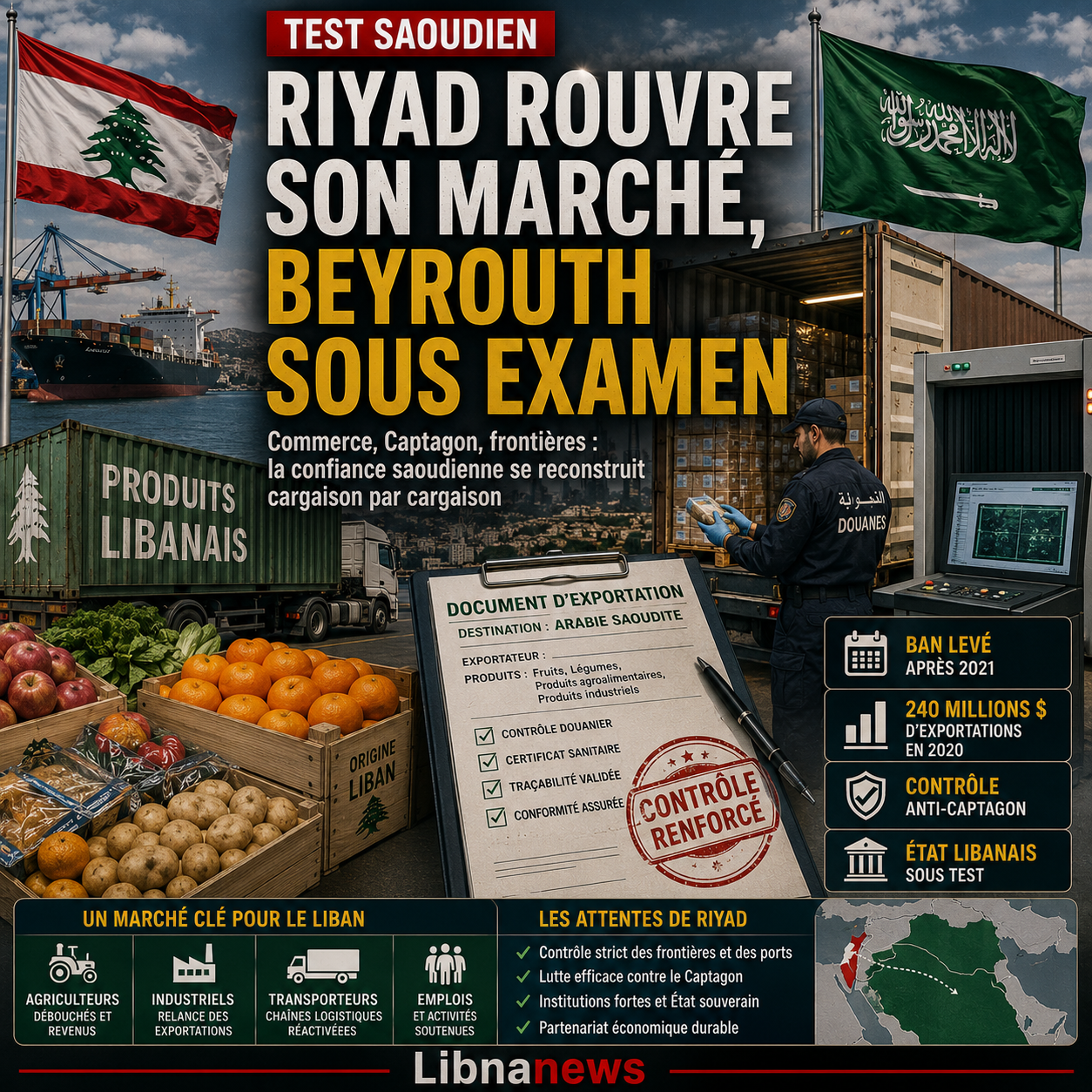
The relationship with Riyadh has become one of the most important levers for Lebanon’s Arab return. The resumption of Lebanese exports to Saudi Arabia, announced on 10 June, was hailed in Beirut as an economic signal. It is worth more than a commercial reopening. It marks a probationary period. Riyadh is testing the ability of the Lebanese State to control its borders, fight against the Captagon, restore its institutions and contain the actors who have long distanced the country from its Arab environment. In the post-United States-Iran regional agreement, this relationship with Riyadh can also affect reconstruction, the army and Lebanon’s position in the Middle East.
Saudi Arabia’s decision comes in a fragile moment. Lebanon is seeking a verifiable ceasefire in the South, an Israeli withdrawal, the return of internally displaced persons and aid to rebuild war-affected villages. It must also revive an economy strangled by the banking crisis, the fall of the currency, the lack of credit and the loss of confidence. In this context, Saudi return offers an opportunity, but above all a political leadership. He states that the Arab world has not completely closed the door. It also shows that this door will not reopen without conditions.
The relationship with Riyadh beyond trade
The resumption of exports to Saudi Arabia is the first concrete step in this new phase. Since 2021, Lebanese products had been subject to a Saudi ban on drug trafficking and a broader diplomatic crisis. The measurement had started with fruits and vegetables, after the discovery of Captagon pills hidden in a shipment of grenades. It was then extended to all Lebanese imports in a climate of political distrust. For farmers, industrialists and transporters, this closure had cut off one of the most important markets in the Gulf.
Before the crisis, Lebanese exports to Saudi Arabia amounted to approximately $240 million in 2020. This figure does not summarize the entire commercial relationship, but it gives the order of magnitude of the shock. Producers of fruit, vegetables, processed products, packaging, light industrial goods and logistics services had lost a solvent, regular and close destination. The local market could not absorb these volumes. Alternative markets often offered lower margins. The recovery can therefore help sectors that have gone through five years of crisis and a war that has directly affected several agricultural regions.
But Riyadh didn’t just reopen a market. The Saudi formulation emphasized the positive steps taken by the Lebanese State to rebuild its institutions. This choice of words gives the gesture a political dimension. Saudi Arabia not only tells importers that they can take over orders. She tells Lebanese leaders that a change in behaviour can produce results. The message targets Joseph Aoun, Nawaf Salam and the institutions responsible for restoring the credibility of the state. It also targets actors who have contributed to the breakdown of confidence, especially around the borders, trafficking and influence of Hezbollah.
Saudi conditions: security, drugs, stability
Saudi demands are in three words: security, anti-drugs, stability. Security means that Lebanon must no longer serve as a platform for threats against the Gulf States. This formula covers several realities. It concerns cargo, ports, airports, land borders, financial channels and political discourse. Riyadh wants a State capable of preventing its territory from being used by criminal networks, armed groups or actors aligned on regional agendas hostile to the kingdom.
The fight against Captagon remains the most immediate test. For several years, this synthetic drug has poisoned relations between Lebanon, Syria and the Gulf countries. Saudi authorities linked the 2021 ban to the discovery of millions of pills hidden in agricultural shipments. The networks involved use state loopholes, local complicity, cross-border roads and commercial documents. Beirut must therefore prove that the controls are not limited to a declaration of intent. Scanners, inspections, judicial investigations, lot traceability, sanctions against the companies involved and continued security cooperation with Riyadh are needed.
Political stability is the third condition. Saudi Arabia does not want to finance or support a state paralyzed by permanent blockages. It awaits institutions able to decide, pass laws, control administrations and speak with one voice on key issues. The return of Riyadh will therefore depend on the functioning of the institutional triangle formed by Joseph Aoun, Nawaf Salam and Nabih Berri. The president embodies the restoration of the state and the role of the army. The Prime Minister carries the reform agenda and diplomatic openness. The President of Parliament remains the necessary step towards the Shiite tandem and part of internal stability.
What Beirut can offer
Beirut cannot offer Riyadh an immediate transformation. The country remains fragile. Its institutions are emerging from long years of crisis. His army lacks resources. Its banks no longer perform their normal functions. Its territory remains exposed to Israeli strikes and regional tensions. But Lebanon can offer a verifiable trajectory. It is this trajectory that is now of interest to Arab capitals. They don’t ask for all the answers in one day. They want repeated evidence that the state is taking over.
The first evidence concerns the control of crossing points. Ports, airports and land borders must be treated as infrastructure of sovereignty. Lebanon should publish clear procedures for exporters, strengthen controls on sensitive cargoes and punish public or private officials who facilitate trafficking. This requirement is not only Saudi. It also conditions the exit from financial isolation, the confidence of insurers and the country’s credibility with donors. A State that does not control its goods will not be able to convince that it controls its commitments.
The second evidence concerns the army. Riyadh has already been asked to support the Lebanese military institution. Such support may return to the debate, particularly if the ceasefire in the South requires a strengthened deployment of the army and coordination with international forces. But Saudi Arabia will not finance a long-term law enforcement force condemned to cohabit with a parallel military decision. It can accept a gradual transition. It cannot accept that aid to the army becomes a cover for a status quo where the state pays the costs and other actors retain strategic choices.
The third evidence is political. Beirut must show that it can define a national interest distinct from regional agendas. This does not mean breaking up with a Lebanese component or provoking Hezbollah. This means that decisions on war, peace, borders, exports and Arab relations must go through institutions. Riyadh observes this ability. The Gulf countries too. Lebanon’s Arab return will not take place if each capital believes that Beirut cannot guarantee its own commitments.
Reconstruction as the next step
The relationship with Riyadh will become even more important when the reconstruction of the South is discussed. Destruction affects housing, roads, schools, hospitals, water systems, agriculture and small businesses. The Lebanese State cannot pay alone. The diaspora can help, but it will not replace structured funds. Western donors can contribute, but they will require reforms and rigorous transparency. The Arab countries, on the other hand, can play a decisive role if they believe that reconstruction serves the stability of the State and not the reconstruction of a war apparatus.
Riyadh could intervene in several ways. It can finance infrastructure projects, support the army, participate in an international conference, assist municipalities, support productive sectors or encourage the return of private investment in the Gulf. It can also encourage other Arab capitals to return. Qatar, the United Arab Emirates, Kuwait and other actors will observe the Saudi position. In the Lebanese case, Riyadh maintains a training capacity. His return does not automatically guarantee that of the Arab world, but his absence makes him much more difficult.
However, reconstruction will be conditioned. Donors will ask who controls the reconstructed areas, who allocates the markets, who checks the expenses and who prevents a new war from destroying the same infrastructure. This issue is sensitive to the South, where Hezbollah has a strong social and political presence. The state must prevent the reconstruction from being captured by partisan networks. It should also avoid marginalization of the affected populations, which would create lasting anger. The method should combine state presence, financial transparency, the role of municipalities and independent control of funds.
An Arab return through the real economy
The Arab return of Lebanon will not only be measured by official visits. It will measure contracts, tourists, investments, transfers, airlines, aid to the army and reconstruction projects. The relationship with Riyadh can open these doors, but it must produce concrete effects. A farmer in the Bekaa or the North must be able to export without fear of a smuggling incident closing the entire market. A hotelier must be able to plan a season with visitors from the Gulf. An industrialist needs to find customers. A corresponding bank must believe that Lebanese controls are serious. An investor must know that his capital will not be caught in a new political crisis.
This real economy is indispensable for stability. Since 2019, Lebanon has been living in a survival economy. Households depend on transfers, cash, informality and adaptability. Arab exports, tourism and investment can breathe again, but only if confidence returns. Trust is not decreed. It is built by the repetition of reliable acts. A controlled cargo. Border guarded. A law passed. A sanctioned scandal. Aid distributed without clientelism. An incident dealt with quickly. It is this accumulation that can transform a Saudi opening into a sustainable return.
Riyadh has also changed. The kingdom continues its own economic transformation, seeks useful partnerships, develops its industrial, tourist, logistical and technological priorities. It no longer sees Lebanon as a country to be supported by political solidarity. He also sees it as a risk, a potential partner or a space to stabilize. This approach is more demanding. It gives less room to cheques without conditions. It focuses on results, controls and measurable benefits. Beirut must adapt to this new grammar.
Hezbollah, the central variable of confidence
The role of Hezbollah remains the central variable. The Saudi-Lebanese relationship deteriorated largely because of the influence of the Shiite party, its alignment with Iran and suspicions of regional networks. Hezbollah rejects accusations of drug trafficking and presents its weapons as a response to the Israeli threat. But for Riyadh, the question goes beyond denial. It concerns the State’s ability to decide. As long as Hezbollah remains able to draw Lebanon into a regional confrontation, Arab capitals will hesitate to commit massive funds.
This does not mean that Riyadh demands a brutal breakup. Such a requirement would be unrealistic and risky. The kingdom can accept a gradual approach, if it goes in the direction of strengthening the state. The Israeli withdrawal, the deployment of the army, a verifiable ceasefire mechanism, border control and a national arms dialogue can form a sequence. But this sequence will have to produce visible steps. If it turns into a mere postponement, Saudi confidence will erode. Lebanon can no longer seek Arab support while leaving strategic issues in permanent ambiguity.
The relationship with Riyadh will therefore also depend on how Beirut manages the internal debate. Joseph Aoun and Nawaf Salam must avoid a confrontation that would break the country. They must also avoid immobility that would discourage partners. Nabih Berri can act as a bridge with the Shiite tandem, but he will have to contribute to decisions, not only to delays. The Lebanese army can embody the solution, provided that it receives clear resources and a clear political framework. It is this articulation that will tell whether Lebanon can return to its Arab environment without causing an internal crisis.
A Close Window Before Great Promises
The risk would be to overinterpret the Saudi gesture. The resumption of exports does not mean that Riyadh has decided to finance the entire reconstruction. It does not mean that Gulf tourists will return immediately. It does not mean that the banking crisis is resolved. It does not mean that the weapons file is closed. It means that Saudi Arabia agrees to reopen a first door because it sees a political possibility. This nuance is essential. The Arab return from Lebanon begins with a test, not with a general promise.
To pass this test, Beirut will have to maintain constant communication with Riyadh. The relevant ministries must monitor exports, exchange security information, deal promptly with incidents and avoid conflicting statements. The government must also involve producers and industrialists, as they will be the first affected by any Saudi hardening. The Lebanese private sector has an interest in supporting strict controls. Isolated fraud can cost a whole industry a lot. Credibility becomes a collective good.
The link with Riyadh can finally help Lebanon to escape psychological isolation. For years, the country has experienced the distrust of Arab partners as a political and economic sanction. The recovery of exports gives an opposite signal: different institutional behaviour can be recognised. This message can strengthen those responsible for defending the state, reform and the return to Arab relations. It can also force their opponents to deal with a reality: the Lebanese economy cannot be sustained from the Gulf.
The next few weeks will tell if this signal is transformed into dynamic. The first consignments exported, customs controls, security trade, discussions on the army, the conditions for possible reconstruction and the reaction of other Gulf countries will be the real indicators. The relationship with Riyadh will not replace the regional agreement, the ceasefire in the South or financial reforms. However, it can give them Arab depth. For Lebanon, the challenge is to prove that the reopening of a market can become the beginning of a political return, not a parenthesis closed in the first incident.




