






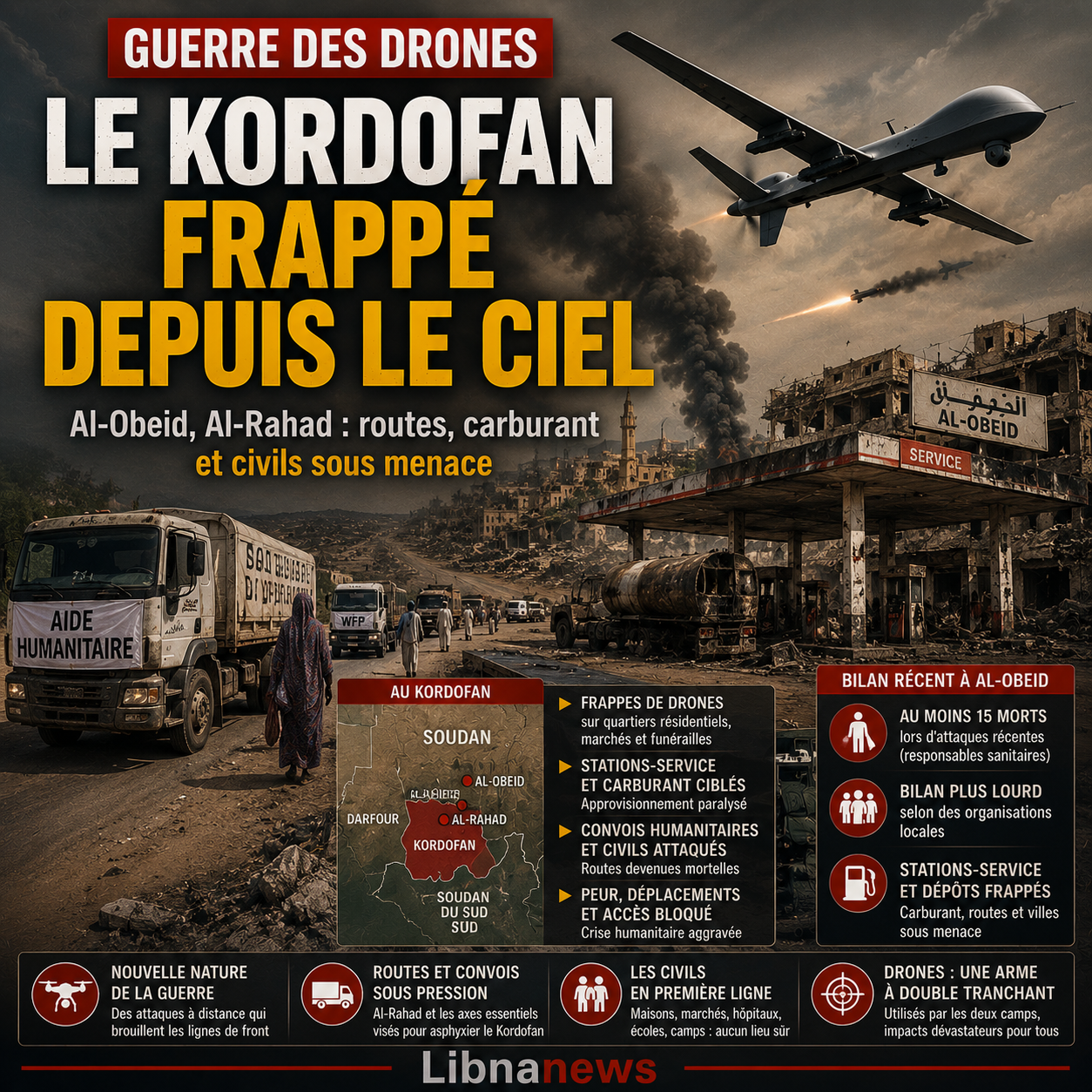
Kordofan is no longer just a front of columns, garrisons and roads cut off. He became one of the main drone war labs in Sudan. The attacks on Al-Obeid, the capital of Northern Kordofan, and the Al-Rahad axis show a rapid transformation of the conflict. The strikes are no longer directed solely at military positions. They reach gas stations, convoys, fuel depots, markets, funerals, residential neighbourhoods and help trucks. This blurs the front lines, increases the risk to civilians and makes humanitarian access even more uncertain.
For several weeks, Al-Obeid has been living under the repeated threat of drones. Health officials reported at least 15 deaths in recent attacks, while local organizations reported a heavier impact. The strikes affected areas close to military positions, but also civilian sites. At the same time, local reports have reported attacks on several gas stations and fuel tanks. Further south-east, around Al-Rahad and on roads between Al-Obeid and other cities, food and humanitarian convoys have already been targeted. The military message is clear: control of Kordofan now passes through the sky, by gasoline, by roads and by fear.
Al-Obeid, city strategic lock and air target
Al-Obeid occupies a decisive place in the Sudanese war. The city links the centre of the country to Darfur and Kordofan. It serves as a military, logistical, commercial and humanitarian point. Holding it, bypassing it or suffocating it amounts to weighing on several theatres at once. For the Sudanese army, Al-Obeid remains a key position in a disputed area. For the Rapid Support Forces, which control vast areas in Darfur and part of Kordofan, pressure on this city makes it possible to threaten opposing lines without necessarily engaging in a conventional urban battle.
Drones offer precisely this advantage. They allow to strike remotely, test defenses, disrupt logistics and keep a city under stress. An attack on a gas station can paralyse ambulances, generators, civilian transportation and military movements. A strike on a neighbourhood close to a base can target an armed position, but produce an immediate civilian shock. An explosion near a funeral gathering can create a more lasting fear than the destruction of a building. In Al-Obeid, the air war therefore affects both infrastructure and nerves.
The Rapid Support Forces are accused by local officials and Sudanese organizations of being behind several of these attacks. They did not always claim the strikes. This lack of claim is part of the difficulty. In a conflict where both sides use drones, attribution must remain prudent as long as it is not confirmed by independent elements. But the operational logic observed in Kordofan corresponds to a paramilitary pressure strategy: hitting the army’s supplies, preventing the normal functioning of the cities held by the opponent and showing that the rear is no longer protected.
Al-Rahad, convoys and road war
Al-Rahad illustrates another dimension of this mutation. The city and its surroundings are on essential routes for civilian, military and humanitarian convoys. When drones hit trucks between Al-Rahad, Um Rawaba and other localities in Kordofan, they are not only trying to kill. They seek to slow down, discourage and increase the price of any movement. Drivers hesitate. Humanitarian organizations are reassessing their routes. Traders store or report. Displaced families are stuck between the lines. An officially open road can become unusable if seen as visible from the sky.
Attacks already reported on this axis have affected trucks carrying food and aid-related vehicles. They also hit civilian transport. The risk is great in a region where humanitarian needs are massive. Kordofan is home to displaced populations, isolated villages and areas where access to care and food remains intermittent. When a drone hits a food truck or fuel tank, it does not just destroy a cargo. It sometimes removes several days of supply for a city, camp or local market.
This road war is changing military calculations. In the past, cutting a road often involved an armed presence, a checkpoint, an ambush or a mine. Drones allow another form of cutting. They make the road uncertain without occupying it. They turn the move into a bet. This capacity is suitable for a war of vast spaces, where fixed lines are difficult to maintain. It strengthens actors capable of monitoring, hitting and communicating quickly. It penalizes civilians, who have no air defence, reliable information or safe alternatives.
Fuel as a central target of the new war
The choice of fuel stations and fuel depots is not a problem. In a war like the one in Sudan, fuel runs weapons, but also civilian life. It supplies tanks, fast vehicles, trucks, ambulances, generators, water pumps, bakeries and hospitals. To hit him is to hit the army and the population simultaneously. That’s what makes these attacks so destabilizing. Even when a military objective is invoked, the civilian consequences are immediate.
In Al-Obeid, local sources reported several gas stations destroyed or burned during a series of strikes. Such a sequence threatens the supply of the entire city. Prices can rise sharply. The queues lengthen. Health services reduce travel. Generators run less time. Families who want to flee hesitate, for lack of gas. Traders can no longer transport their goods. The strike then becomes a crisis multiplier. It turns a war of positions into an urban crisis.
The same logic applies to convoys. A burning fuel truck can trigger secondary explosions, kill passersby, block an axis and deprive several locations of energy. In cities already affected by inflation, shortages and war, the destruction of fuel has a political effect. It gives the public the feeling that no place is protected and that essential services can stop without notice. This fear can cause families to leave, even if the front line does not move.
Civilians struck in ordinary spaces
Recent attacks mainly show that drones strike ordinary spaces. In Al-Obeid, strikes hit residential areas, a funeral assembly area, a gas station and trucks. In other parts of Kordofan, markets, villages, civilian vehicles and internally displaced persons camps were reached. The air war does not therefore take place above an empty battlefield. It crosses the places of daily life: refuelling, burying a dead person, seeking water, transporting food, driving a sick person.
This fact complicates the application of international humanitarian law. A military position near a gas station or civilian neighbourhood does not automatically turn the entire area into a free target. Warring parties must distinguish combatants from civilians, take precautions and avoid disproportionate attacks. In practice, drones sometimes reduce the political cost of the strike. The operator is far away. The information may be incomplete. Target can move. The explosion produces deaths that each camp can attribute to the other, to the error or proximity of a military position. Technical distance becomes a distance of responsibility.
Civilians do not have that distance. They live with buzzing, explosions, rumors and smoke images. Schools close or reduce their activity. Markets are empty. Families avoid gatherings. Merchants reduce the journeys. Humanitarian organizations must arbitrate between the urgency of entering and the risk of losing their teams. The drone war is not limited to direct deaths. It creates a permanent threat that changes social routines.
A weapon on both sides, but asymmetric effects
It would be reducing to present drones as the tool of a single camp. The Sudanese army is also using them, particularly against areas controlled by the Rapid Support Forces in Darfur and elsewhere. Attacks attributed to the army targeted markets, hospitals or areas where combatants were present, with very heavy civilian assessments. The Sudan is therefore experiencing a generalization of the light air war, fuelled by external supply networks, accessible technologies and a low defence capacity of the people.
In Kordofan, however, the current dynamics seem to favour a logic of harassment against cities or military-held axes. The Rapid Support Forces have a clear interest in hitting Al-Obeid and the roads linking it to the rest of the country. They can thus avoid costly frontal battle while creating constant pressure. The army, for its part, must protect a city, maintain its lines, defend its deposits and reassure a population that it controls. This asymmetry makes drones particularly effective for those who attack flows rather than positions.
Air defence becomes a central issue. Shooting a drone involves radars, electronic means, adapted weapons and rapid coordination. In a war-fragmented country, these means are scarce, dispersed and often reserved for the most sensitive sites. Markets, roads, camps and gas stations remain vulnerable. Low cost drones force the opponent to spend a lot to intercept them, or to accept continuous wear and tear. This is one of the major changes in this war: the air threat no longer comes only from aircraft or helicopters. It comes from smaller, more numerous and more difficult to attribute devices.
Kordofan, center of a war without fixed lines
The Kordofan becomes a front without fixed lines. Military maps show areas of influence, held cities and disputed roads. But drones cross these boundaries. They allow to hit the rear, reach an infrastructure, target a convoy, and then leave the space unoccupied. This mobility prevents civilians from understanding where the dangerous area begins and ends. A city can be held by the army and remain vulnerable. A road can be officially opened and become deadly. A displaced camp can be far from a battle and be hit.
This instability has major humanitarian consequences. Sudan is already experiencing one of the worst global crises, with millions of internally displaced persons, extreme food insecurity and collapsed health systems in several regions. Kordofan occupies a pivotal position in aid delivery and population movements. When drones make the axes uncertain, they complicate the humanitarian response far beyond the affected area. An attack on a truck can delay several distributions. A hit on fuel can immobilize medical teams. An explosion near a market can lead to higher prices and sustained panic.
The political effects are also important. A population that feels abandoned or targeted may lose confidence in the authority that controls the city. Armed groups can exploit this anger. The stories of victimization circulate quickly. Each camp accuses the other of targeting civilians, manipulating balance sheets or hiding its positions in inhabited areas. The drones thus fuel a propaganda war in addition to the military war. They produce images, smoke, videos and press releases that each camp uses to reinforce its story.
Regionalization of war technologies
The rise of drones in Sudan also refers to a regional issue. The belligerents do not produce all the technologies they use alone. Weapons, parts, guidance systems, roving munitions, modified commercial drones and communications equipment run through complex networks. Several investigations and reports have called into question support outside the two camps, although the exact chains often remain opaque. This movement turns the Sudanese conflict into a ground for experimentation and technological diffusion.
The danger goes beyond Sudan. Drones can travel to the Sahel, the Red Sea, Libya, Chad or other unstable areas. Armed groups observe the methods used. States are seeking answers. Traffickers are adapting their roads. Technology first used against a gas station in Al-Obeid can tomorrow become a tool against a port, power station, airport or convoy in another region. Kordofan thus reveals a wider evolution of African and Middle Eastern wars: the low sky becomes a permanent space of confrontation.
Civilians are the first to be exposed to this broadcast. Warning systems are weak. Hospitals lack resources. Local authorities do not always have the capacity to prevent, evacuate or document. Humanitarian organizations are calling for better control of arms transfers, but international mechanisms remain limited. As long as the drones continue to reach the belligerents, calls for the protection of civilians will remain insufficient. The problem is not only the abuse of a weapon. He is also gaining access to this weapon in a conflict that is already out of control.
A mutation that prolongs the war
The drones do not replace the ground fighting in Sudan. They extend, expand and make them less predictable. In Kordofan, they allow to strike without moving forward, to besiege without encircling completely, to cut off a road without posting men, to terrorize a city without occupying it. This capacity changes the ratio to time. An army can resist in a city, but simmer under the strikes. A population can survive an offensive, but exhaust itself in the daily threat. A humanitarian organization can obtain a permit, but give up the route after an attack.
The answer will not only be military. It should include documentation of strikes, protection of humanitarian roads, pressure on arms suppliers, independent investigations, local alert mechanisms and stronger diplomacy on attacks against civilians. The belligerents must be held responsible for indiscriminate strikes. External actors must be identified when they feed targeting capabilities. Humanitarian organizations must obtain guarantees of passage that do not depend solely on fragile promises.
Al-Obeid and Al-Rahad show what becomes of the Sudanese war when the drone is trivialized. The front line does not disappear, but it ceases to explain the danger alone. Fuel, convoys, markets, roads and ceremonies become targets or places at risk. The war no longer advances only by columns. It arrives by the noise of an aircraft, the explosion of a tank, the smoke over a neighborhood and the road that no one dares to take.