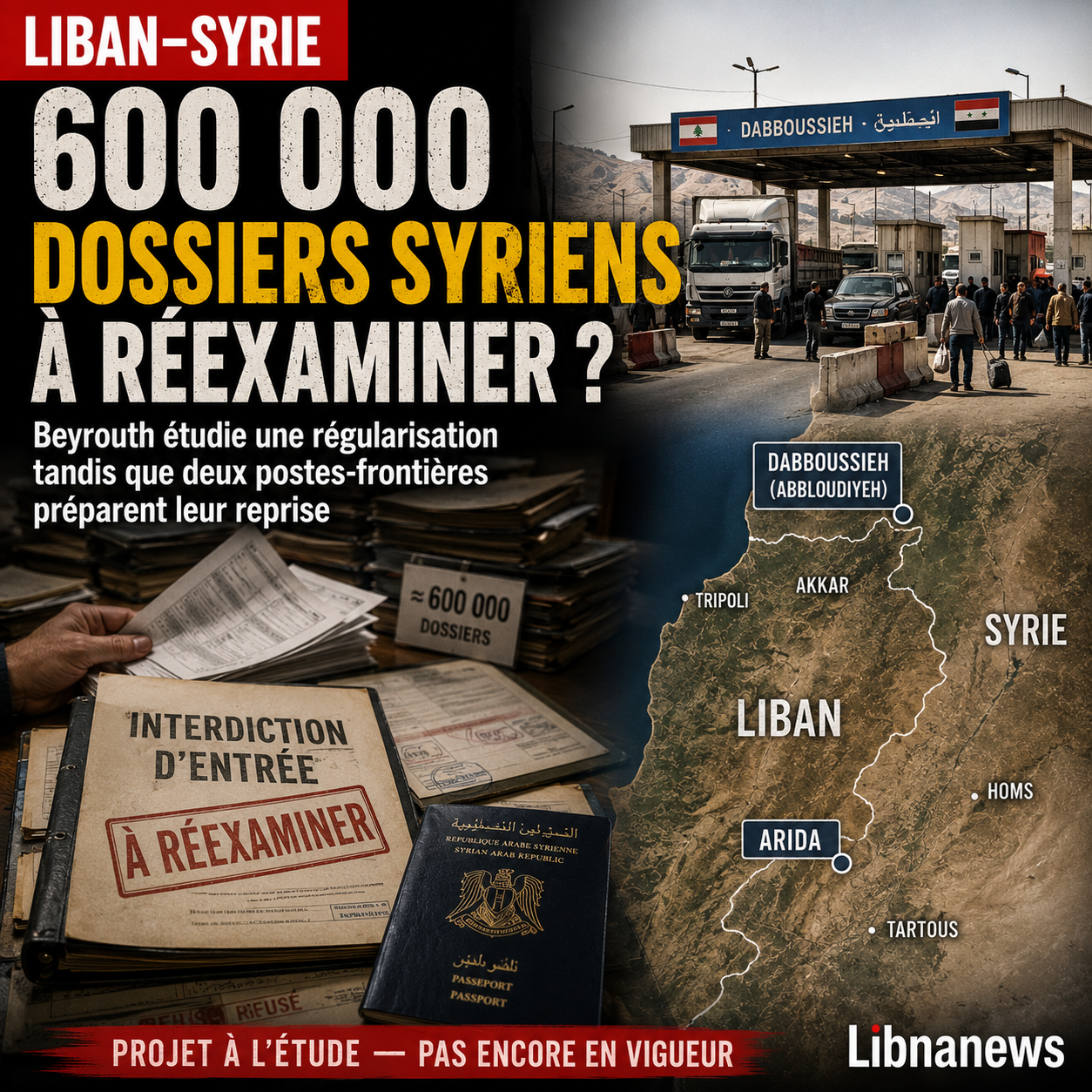
The Lebanese General Security would envisage a large-scale regularization of Syrians. It would cover persons with a ban on entry for residence-related offences. According to MFM, the number of cases concerned would reach about 600,000. This radio from the Lebanese media group El Murr broadcast the news on 30 July. The same source announces a reactivation in September 2026 of the border posts in Dabbousseh and d-Arida. These measures could ease displacement and support the administrative rapprochement between Beirut and Damascus. However, they do not have the same level of confirmation. The work and schedule of Dabbousseeh have been officially announced in Syria. The rehabilitation of Arida is also attested, but its complete return to traffic in September remains to be specified. As for the figure of 600,000 persons, it does not yet appear in any public communiqué of the General Security. The information should therefore be treated as a project under review, not as a decision already in force.
Regularization of Syrians: an announcement to be confirmed
The scope of the possible measure will first depend on its implementing text. MFM speaks of Syrians « prohibited entry » as a result of violations of the rules of residence. This formula can cover several administrative realities. It may target people leaving Lebanon after an irregular stay. It may also involve an over-authorisation or an arrest after a clandestine entry. It does not mean that 600,000 Syrians today live in Lebanon and are waiting for a residence permit. Instead, the figure would refer to a stock of files recorded in border control bases over the years. It may also include old sanctions, duplicates or files whose legal effects have expired. In the absence of an official circular, the form retained remains unknown. General Security could prepare for general abolition, an individual review or a reduction in the duration of prohibitions. This distinction will determine the actual number of beneficiaries and their rights to pass through.
A regularisation would not automatically create an absolute right of entry. Even after an administrative penalty has been lifted, every traveller would remain subject to the rules in force. The officers could verify his identity, the validity of his documents, the reason for the displacement and the existence of a judicial or security report. A decision could also exclude files related to convictions or false documents. Other offences unrelated to the stay could remain blockages. The project must therefore define its scope with precision. Above all, he would have to say whether the measure applied retroactively to all prohibitions. The text could limit it to overstays or to certain family and professional categories. For the time being, no filing date, window and appeal procedures have been made public. The figure announced by MFM remains an order of magnitude in the media. It does not yet measure how many people could actually cross the border after a possible update of their status.
Accumulated administrative litigation
Lebanese law already distinguishes several types of sanctions. The rules published by the General Security provide for a three-year entry ban in a first case. This period applies to an Arab or foreign national expelled after an infringement of the conditions of residence. The duration may be up to 10 years in case of recidivism. A separate regime concerns Syrians intercepted after an illegal entry. The penalty announced is one year for a first offence. It increases to five years for the second and ten years for the third. These categories show the complexity of an operation involving hundreds of thousands of files. It is not enough to delete a single list. Each sheet may contain a date, reason, duration and possible court decisions. A credible revision therefore requires legal sorting, computer updating and identical instructions at all border posts. It must also prevent a folder deleted in a system from being blocked in another base used by the security services.
The accumulation also results from fifteen years of massive displacement between the two countries. Families crossed the border to seek refuge, work, care or join relatives. Some entered legally before losing their status due to lack of renewal. Others have taken irregular routes, especially when procedures have become more stringent. Temporary returns and round trips added new administrative traces. The suspension, since 2015, of the registration of new Syrian refugees by the United Nations agency has further complicated the reading of the figures. Humanitarian registers, government estimates and transit records do not measure the same populations. Therefore, they cannot be added without caution. In this context, the 600,000 files could designate a cumulative volume. This figure cannot be assimilated to a population census and remains to be verified. Only the publication of a breakdown by reason, year and status would make it possible to verify its scope.
Previous departure without a fine
The General Security has just completed another operation for Syrians in an irregular situation. On 29 June, it had extended departure facilities for the last time. The scheme concerned Syrians and Palestinian refugees from Syria until 30 July 2026. The persons concerned could leave Lebanon by land crossing points without paying the fines related to the stay. They were not granted a ban on entry except in the presence of a judicial obstacle. The system covered both regular and irregular entries, regardless of the duration of the exceedance. By the end of the deadline, the administration had announced a return to strict application of the rules against foreigners without legal status. MFM information therefore comes at the exact moment when this exceptional window closes. Both approaches are not necessarily contradictory. The first encouraged a departure without sanction. The second could deal with the bans already registered before this period and clean up a file that has become difficult to manage.
Another mechanism remains open until 30 September 2026 for certain categories of Syrian workers. It allows, subject to conditions, to regularize a stay linked to employment and to request suitable authorisations. Syrians registered as refugees may also engage in paid employment. In order to regularize it, they must choose between their humanitarian dossier and a professional residence route. Those who have received a departure order after regular entry may, in some cases, submit an exceptional request for review. This framework should not be confused with the lifting of the entry bans mentioned by MFM. It mainly concerns persons present in Lebanon and their right to stay. The project reported would target nationals who are often in Syria or a third country and who can no longer legally return. However, the two construction sites meet on one point. Beirut seeks to replace old and informal situations with verifiable statutes. It wants to control work, stay and traffic better.
What a 600,000 caseload measure would change
For families separated by the border, lifting a ban could allow for visits, civil procedures or medical support. For professionals, it could facilitate one-time travel related to trade, transportation and services. However, the effects would remain linked to the admission conditions. A citizen released from an old sanction may still have to submit several supporting documents. Reservations, addresses, business invitations or proof of resources may be required depending on the category selected. The Lebanese authorities could also maintain a prior authorisation regime for certain profiles. The impact will therefore not only be measured by the number of names removed from a list. It will depend on the simplicity of the new procedures, their cost and their uniform application. An ambiguous circular would create new refusals and fuel the use of intermediaries. Conversely, public criteria would provide passengers with visibility before departure. They would also reduce the pressure on officials responsible for deciding at the border crossing.
The measure could also improve data quality. A base containing expired sanctions or duplicated identities slows down controls. It also weakens the distinction between administrative and security offences. Cleaning up the files would allow the audits to focus on those cases that remain active. However, it would require coordination between the General Security, the judiciary and the Syrian authorities. Differences in spelling between documents, use of multiple ID numbers and loss of papers often complicate correspondence. Administrations will also have to treat people born or become adults during their exile. They will have to examine families whose members are admitted and other prohibited. A notification mechanism will be essential. Without a written response, the persons concerned will not know whether their sanction has been lifted before coming to the border. The announcement of 600,000 files will not be enough. The success of the project will depend on the ability to produce reliable and searchable individual decisions.
Dabbousieh, northern axis expected in September
The border pillar is based on more advanced elements. The Syrian authorities announced on 12 July that the rehabilitation of the Dabbousieh post was nearing completion. A commercial and passenger opening is planned for early September 2026. The passage faces Abboudiyeh, in the Lebanese Akkar. It links northern Lebanon to the Talkalakh region and Homs. Its role therefore goes beyond local travel. The axis offers a road between the port of Tripoli, the center of Syria and land routes to other Arab markets. The bridge over the Great South River, damaged during Israeli strikes, was rebuilt. Customs facilities and access routes are still under construction. The first phase should allow for a functional resumption. A more complete extension must then bring the site to the standards of an international crossing. According to the Syrian-side calendar, this phase is expected to last about 18 months.
The re-opening of Dabbousieh must reduce the dependence on the Masnaa–Jdeidet Yabous axis. The latter remains the main passage for goods between Beirut, Damascus and the Syrian interior. A breakdown, security incident or traffic jam quickly produces truck lines and delays for travellers. The return of a second trade corridor to the north would distribute the controls and bring the Tripoli carriers closer to their destination. It could also reduce the detours imposed on the inhabitants of Akkar and Homs. However, these gains will depend on schedules, scanning capabilities, number of agents and harmonization of customs formalities. A post declared open but limited to a few categories only partially reduces traffic. The authorities must specify the categories allowed on the first day: heavy goods vehicles, private vehicles, coaches or pedestrians. They will also have to publish rules for agricultural products and regional transit.
Arida, a more progressive recovery
The situation in Arida is more nuanced. This coastal post links northern Lebanon to the Syrian region of Tartous. He had resumed some of his activities in June 2025, following an interruption caused by damage to the border bridge. New degradations then limited its functioning. Since March 2026, operational information has shown a pedestrian-only crossing. Schedules are reduced and meaning restrictions have been reported according to the periods. The Syrian authorities confirmed in July the continuation of the reconstruction of the bridge and the rehabilitation of infrastructure. They also received a Lebanese Government delegation. Trade focused on access, truck transit and common management of crossing points. MFM is now advancing a reactivation in September. This schedule remains credible in terms of the work, but it has not yet been detailed in a joint technical announcement. It is therefore necessary to distinguish the complete recovery of vehicles from a simple extension of pedestrian capacities.
A sustainable return of Arida would have a direct effect on the coastal band. The crossing serves exchanges between Tripoli, the localities of Akkar, Tartous and the municipalities close to the border. It offers an alternative to the inhabitants who must now come back to Abboudiyeh, Qaa or Masnaa according to their destination. For goods, its usefulness will depend on the strength of the new bridge, the control areas and the authorization of heavy goods vehicles. For travellers, the issue is the continuity of schedules and the ability to absorb peak periods. The announced reactivation should also be coordinated with Dabbousieh. Opening two axes at the same time can lighten the network, but requires additional staff on both sides. Computer procedures will have to recognize the same documents and apply the same decisions. This consistency will be crucial if General Security simultaneously changes the status of hundreds of thousands of Syrians who are banned from entry.
Pressure already visible on open passages
The reported figures for Joussieh–Qaa illustrate the volume of movements. The Syrian authorities recorded approximately 522,000 passenger crossings during the first six months of 2026. They reported 331,000 entries into Syria and 191 000 exits. They also count 127 000 voluntary returns on this axis. These data confirm a strong demand for the position. However, they must be read as border movements, not as an automatic count of separate persons. The same traveller can cross several times. A passage to Syria does not always correspond to a definitive installation, nor does an exit mean a new exile. Trade, family visits and administrative procedures generate regular returns. The distinction is important when assessing the effect of Dabbousieh and of Arida. Their reactivation would first distribute flows of passage. It alone would not allow for the number of sustainable returns.
The same caution is required for national data. The Syrian authorities announced several hundred thousand returns from Lebanon after the end of 2024. They had a significant share in the first five months of 2026. International organizations use a different methodology based on known records, declarations and observed movements. Lebanon maintains higher population estimates than active humanitarian registrations. This difference is partly due to the cessation of the registration of new refugees in 2015. It is also due to people never registered and departures that do not appear immediately in all files. The announced regularization will not solve these differences alone. However, it could shed light on a specific category. These are nationals who have left the territory, remain subject to an administrative ban and wish to apply for a new right of entry.
Reconciliation through procedures
For several months, Beirut and Damascus have been increasing technical exchanges on the border. A meeting on 8 July brought together Syrian border and customs officials. The Lebanese delegation was led by the Minister of Public Works and Transport. Discussions focused on infrastructure, obstacles to truck transit, passenger traffic and the creation of technical monitoring. The return to service of Dabbousieh and of Arida is part of this logic. It reflects a concrete rapprochement, based on roads, bridges and formalities, rather than a general political declaration. Any treatment of entry bans would add a human and administrative component. It could resolve a dispute that affects many families and businesses. But it would also require both States to exchange reliable data and verify identities. They should define responsibilities when a file contains an error or an unexecuted judicial decision.
The improvement of bilateral relations does not depend on a single case. The two countries still have to deal with several cases. These include smuggling, informal passages, the return of refugees, the status of workers, regional transit and security cooperation. The needs are not always the same. Lebanon seeks to control stays, reduce irregular work and organize returns. Syria wants to restore its commercial links, facilitate the return of its nationals and restore its administration at the crossing points. The reopening of posts can serve these common objectives. It may also reveal discrepancies in the documents required or in the categories allowed. The wording that regularization would « strengthen relationships » therefore describes a possible effect, not an acquired result. The test will be performed daily: waiting times, reasoned refusals, processing of goods and the ability of services to resolve disputes quickly.
Points to be decided by the circular
The first element is the exact definition of beneficiaries. The General Security shall indicate the grounds covered by the scheme. These may include overstays, deportation orders, illegal entry or expired sanctions. It shall specify the fate of repeat offenders and persons subject to judicial proceedings. The second point concerns the method. An automatic lifting from a given date would be quick, but could involve files that require control. An on-demand review would offer more guarantees, at the price of time and a significant administrative burden. An intermediate solution could erase the oldest purely administrative sanctions and then reserve complex cases for a commission. There is still no evidence that one of these models has been selected. The future text will also have to say whether decisions will be free and questionable. He will have to explain how a Syrian citizen will be able to verify his status before travelling.
The border calendar calls for equally concrete details. For Dabboussieh, the target of early September is now public, but the final inspection date and authorized traffic categories are still expected. For Arida, the work is confirmed, while the September deadline is still based on MFM’s information. A joint announcement will have to set schedules, capabilities and rules for vehicles. The combination of the two cases will be decisive. A massive revision of the entry bans, without strengthening the windows, could increase the queues at the same time as the new passages resume. On the other hand, two functional positions would provide the space to progressively apply new rules. The next milestones are therefore identifiable: a General Security Circular, the receipt of border works and a common operational schedule. Until such time as these documents are published, the 600,000 files remain a reported information and September is yet to be partially confirmed.