





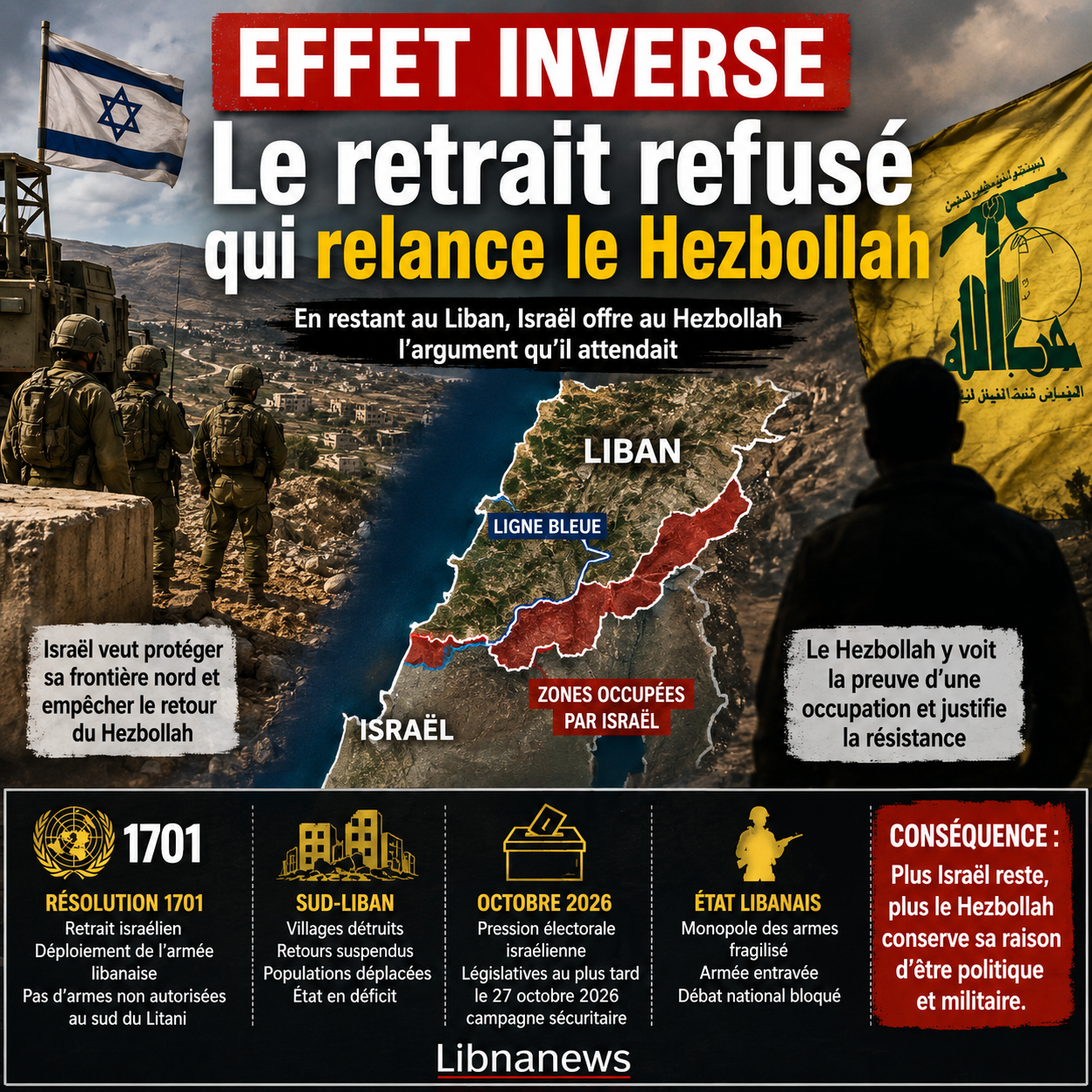
The Israeli refusal to withdraw from Lebanon, confirmed at a time when a new diplomatic sequence is seeking to freeze the regional fronts, may produce the opposite effect of that displayed by Israel. By maintaining troops and a security zone in southern Lebanon, the Hebrew state wants to prevent Hezbollah from rebuilding its military capabilities. But this presence also gives the Shiite movement a central argument: that of a still necessary resistance to foreign occupation. In a Lebanon exhausted by war, massive displacement and the collapse of public services, this argument weighs heavily. It complicates the government’s task, weakens the Lebanese army and makes it more difficult for credible discussions on the state’s arms monopoly.
Hezbollah finds territorial argument
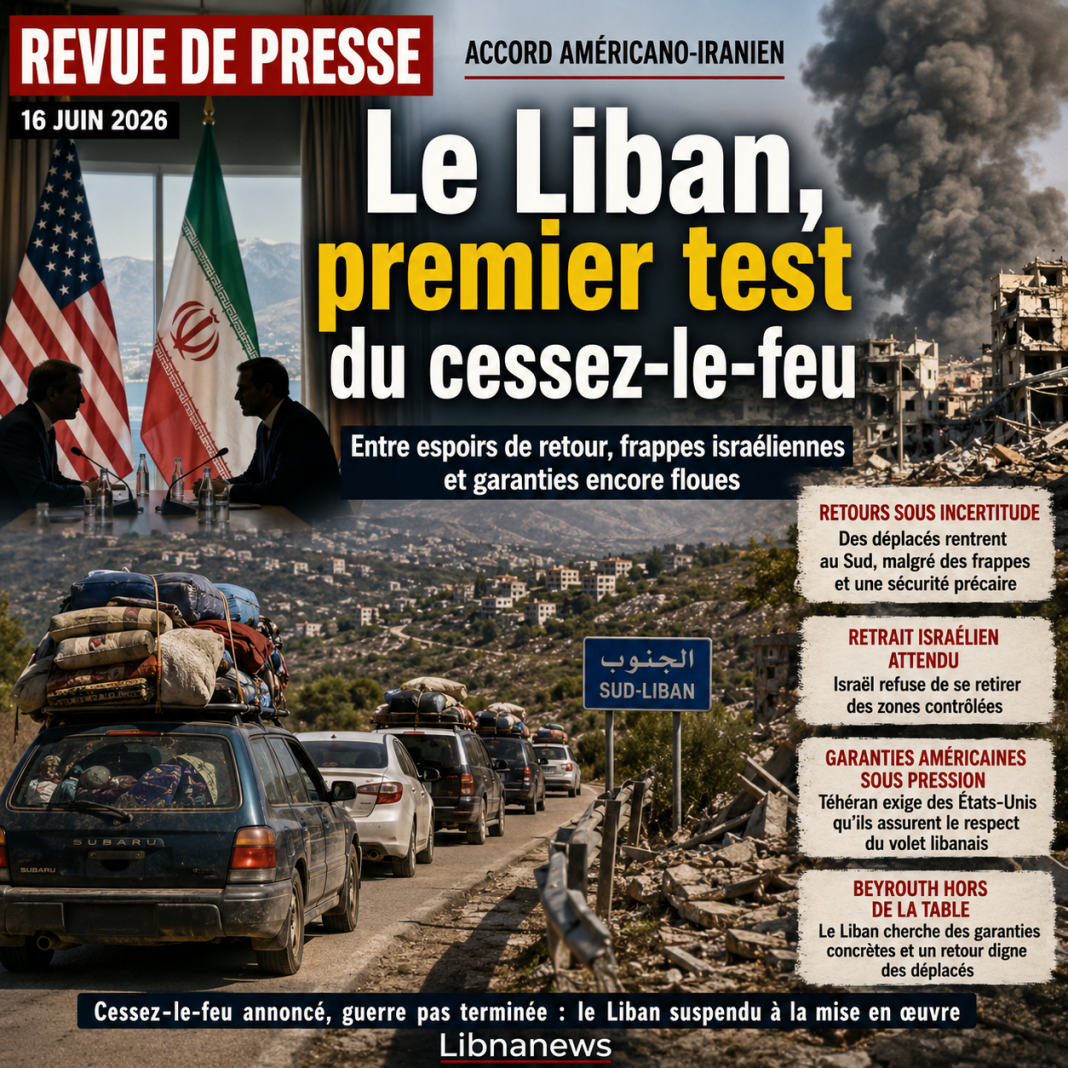
The Israeli decision is taking place in a context where fighting has diminished, but not disappeared. The ceasefire linked to the Washington-Theran agreement was to open a phase of de-escalation. However, sporadic strikes and shooting continued. The Lebanese authorities called on the internally displaced not to return too quickly to certain southern localities. Villages remain dangerous, mined, destroyed or under military surveillance. In these circumstances, refusal to withdraw is not only a tactical choice. It changes the Lebanese political balance. It offers Hezbollah a well-known scene: that of an occupied territory, of a powerless state and of an uncertain border population.
Israel presents its continued presence in Lebanon as a defensive measure. His Government claimed that it wanted to prevent Hezbollah from returning to the border and threatening the north of the country. This logic is part of a doctrine of security depth. It is based on the idea that a complete withdrawal would create a vacuum operated by an armed organization that maintains regional fighters, networks and relays. For Israeli opinion, marked by attacks, evacuations from the north and fear of a new front, this argument is of immediate significance. No Israeli government wants to appear as one that would have made possible a new offensive against border localities.
But a sustainable military presence produces a political cost. The more Israel remains in Lebanon, the more Hezbollah can present its arsenal as a response to a concrete situation. The Lebanese debate then goes beyond the legitimacy of a militia in a sovereign State. He moves to a more sensitive question: what to do with a foreign army that refuses to leave? This question divides less than that of Hezbollah’s weapons. It allows the party to bypass criticism of its internal role, its regional weight and its involvement in past wars. It also allows him to speak on behalf of a national cause, and not just a denominational camp.
This mechanism is not new. Since the 1980s, Hezbollah has built its legitimacy on the fight against Israeli occupation. The Israeli withdrawal of 2000 had limited this argument, without removing it. Records of Shabaa farms, Kfarchouba hills and Ghajar village maintained a grey area. Each border violation, each overflight, each strike then fed the discourse that the Lebanese State could not protect its territory alone. The current Israeli maintenance reactivates this matrix. He does not create Hezbollah, but he reinforces his founding narrative at the very moment when this story suffered a severe wear and tear in a part of Lebanese society.
A closed political window in Lebanon
This wear was real. The war has cost Shia areas, southern Lebanon, the Bekaa and the southern suburbs of Beirut dearly. Families have lost their homes, jobs or loved ones. Already fragile economic sectors have been further destroyed. The issue of Hezbollah’s weapons has regained a place in the public debate, including among Lebanese who have so far refused to make it a priority. The Beirut government has also sought to place the Lebanese army at the centre of the security arrangements. In this sequence, a complete Israeli withdrawal could have deprived Hezbollah of a major argument and opened a more direct debate on state authority.
Israeli refusal blurs this dynamic. It pushes Hezbollah’s opponents into an uncomfortable position. They can criticize the party, but they must also denounce the Israeli presence. If they insist only on disarmament, they give the impression of minimizing Lebanese sovereignty. If they focus on occupation, they join part of Hezbollah’s vocabulary. This constraint reduces the political space of the sovereignist camp. It also weakens those who want to negotiate a rise in the Lebanese army in the South. A State cannot ask a militia to give up the land if a foreign army still occupies part of the same land.
Resolution 1701 remains the frame of reference. It provides for a cessation of hostilities, the deployment of the Lebanese army to the south and the absence of unauthorized armed forces between the Blue Line and the Litani. It also implies the withdrawal of Israeli forces. This dual movement is the heart of the compromise. Hezbollah must lose its military freedom in the area. Israel must renounce any land presence in Lebanon. If one of the two obligations disappears, the other becomes politically fragile. That’s exactly what’s happening today. By refusing to withdraw, Israel weakens the international argument that requires Hezbollah to accept the state’s security monopoly.
The Lebanese government is therefore facing an almost impossible equation. He must reassure Western and Arab partners, who demand a real limitation of Hezbollah’s arsenal. It must also avoid internal confrontation that could rekindle political violence. Finally, it must protect a population in the South that first demands security, return to villages and reconstruction. In this context, any initiative on Hezbollah’s weapons becomes dependent on Israeli withdrawal. The Lebanese authorities may draw up plans, strengthen dams or cooperate with the Finul. But their margin remains low if the inhabitants see Israeli soldiers on their territory.
The South as a social and political lever
The Israeli position also risks strengthening Hezbollah’s internal discipline. When an armed movement is under strong military pressure, it must justify the losses and maintain the cohesion of its base. Even a limited occupation facilitates this work. It transforms a costly record into a story of patience and resistance. It helps the party leadership to ask for time, report accounts and present internal criticism as premature. Displaced families can challenge conflict management. They may require compensation. But until the withdrawal takes place, Hezbollah can respond that the priority remains the liberation of the territory.
This effect does not mean that the party comes out free of war. His managers were targeted. Its infrastructure has been hit. His command capabilities have been under significant pressure. His image of an invulnerable actor has been damaged. Part of the Lebanese blamed him for dragging the country into a conflict linked to regional calculations. Others refuse that the decision on war and peace remain outside the institutions. These criticisms remain strong. But they lose effectiveness when the Israeli presence gives Hezbollah a tangible argument. The movement no longer needs to convince everyone. It is enough to make disarmament politically impossible in the short term.
The population of the South is at the centre of this mechanism. For her, the question is not theoretical. It is measured in cut roads, destroyed houses, closed schools, inaccessible agricultural land and suspended returns. An Israeli security zone extends internal exile. It delays compensation and blocks the revival of the local economy. It also creates increased dependence on Hezbollah’s assistance networks, which can intervene quickly in neighbourhoods and villages where the state lacks resources. The longer the crisis lasts, the more necessary these networks can be. The party then turns a national weakness into a social lever.
The same logic applies to the Lebanese army. It is the only institution capable of gradually replacing armed groups in the South. But she needs clear conditions. It must be able to deploy without appearing as an auxiliary force of Israel. It must also avoid confrontation with a part of the local population. A coordinated Israeli withdrawal, coupled with a strengthened mandate from the Finul and serious financial support, could give the army a new credibility. Conversely, a prolonged Israeli presence exposes him to double criticism. Israel will find it insufficient. Hezbollah will accuse it of covering an occupation that it cannot prevent.
Israeli security facing its own paradox
The Finul is in an equally delicate position. Its mandate is based on the support of the Lebanese army and the observation of the cessation of hostilities. But peacekeepers alone cannot impose a security order that armed actors refuse. They can document, patrol, coordinate and alert. They cannot replace a political decision. If Israel maintains positions and if Hezbollah retains a capacity for clandestine action, the international force may be reduced to a witness role. This limit then feeds Israeli critics against its inefficiency and Lebanese critics against its inability to stop violations.
Refusal to withdraw also entails a regional risk. The Lebanese case has now become part of a broader negotiation between the United States, Iran and several mediators. Tehran seeks to portray the cessation of fighting as a victory of its axis. Israel wants to show that it does not let its opponents set the terms of the ceasefire. Hezbollah is observing these power relations. If he can say that diplomacy does not free the territory, he preserves his military role. If he can say that Washington does not force Israel, he reinforces his speech against Western guarantees. Each ambiguity in the agreement then becomes a political resource.
Israeli elections increase margin of withdrawal
The Israeli sequence is not only on military ground. It is also part of a close electoral calendar. The next legislative period is to take place by 27 October 2026, unless the Knesset sets an anticipated timetable. The dissolution of Parliament has already taken place, as a result of the tensions in the coalition and the explosive issue of conscription of the ultra-Orthodox. Election scenarios between September and October are circulating in Israeli political life. In this context, Lebanon is becoming an electoral marker. Any concession on withdrawal may be presented by Benjamin Netanyahu’s rivals as a safety abandonment.
This electoral constraint weighs on Israeli choice. The Prime Minister must speak to an opinion calling for the safe return of northerners. It must also contain a hard line which refuses to see a regional agreement limiting the action of the army. Its competitors can attack it on two opposing fronts: it accuses it of having chained Israel to wars of wear and tear, or of not having achieved a sufficiently decisive victory against Iran, Hezbollah and their allies. In a national security campaign, retention in Lebanon becomes political assurance. It makes it possible to display firmness, even if this firmness nourishes the story of Hezbollah.
This paradox is central. A measure designed to reassure the Israeli electorate can strengthen the enemy it claims to contain. The more Netanyahu or its ministers promise to stay in safe areas, the more Hezbollah can tell the Lebanese that withdrawal will not come through diplomacy alone. The more security-speaking Israeli parties compete, the more they reduce the place of an international compromise that would give the Lebanese army a real role. The Israeli election therefore turns South Lebanon into an internal argument. It makes any withdrawal before the vote more costly and makes it more difficult for any progressive mechanism after the vote.
For Israel, the calculation can therefore turn. A buffer zone can reduce some immediate risks. It can move away from firing teams, control axes and destroy infrastructure. But it does not solve the substantive question: who guarantees the border for a long time? If the answer remains the Israeli army itself, Hezbollah retains its raison d’être. If the answer becomes the Lebanese army, with international supervision, the party gradually loses its monopoly of resistance. The Israeli choice therefore does not concern only a few military positions. It defines the adversary type that Israel wants to face tomorrow: an organization isolated in the Lebanese game, or a movement relegitimized by a foreign presence.
Lebanon’s recent history shows that amputated sovereignty feeds parallel actors. When the state does not control its borders, other forces claim to do so. When it does not protect the inhabitants, other networks occupy the land. When diplomacy fails to obtain a withdrawal, weapons find a justification. Hezbollah knows this political grammar. He used it for decades. His Lebanese opponents know that too. This is why Israeli maintenance is not just a military crisis. It recomposes the terms of the national debate and makes any unnegotiated disarmament attempt more risky.
The real test will focus on the sequence that opens. If Israel accepts a verifiable timetable for withdrawal, the Government of Lebanon may, in turn, demand an effective deployment of the army, the closure of unauthorized facilities and enhanced monitoring south of the Litani River. If Israel refuses any deadline, Hezbollah will have a simple and powerful argument: no weapon can be discussed while the territory remains occupied. This formula will not convince all Lebanese. But it will be enough to block compromises. It will place its opponents on the defensive and slow international pressure.
An Israeli withdrawal alone would not guarantee the disarmament of Hezbollah. The party maintains its own basis, ideology, alliances and interests. He won’t hand over his arsenal for a single concession. But a complete withdrawal would reduce the political cost of challenging his weapons. It would make it possible to hold accountable for the destruction, the military decisions and Iran’s place in Lebanese security. It would open a clearer political battle. By remaining in Lebanon, Israel maintains an ambiguity that Hizbullah knows how to feed itself.
In border villages, the next step will be less in the press releases than on the return roads. Families will seek information on which houses still hold, which land remains accessible and which military posts dominate the surrounding hills. The Lebanese government will have to prove that it can protect these returns. The army will have to show that it can deploy without causing a new confrontation. Diplomacy will have to turn a fragile truce into a concrete calendar. In Israel, the electoral campaign will also tell whether security in the north is through prolonged occupation or a verifiable arrangement. As long as this chain is incomplete, Hezbollah can say that its role is not over.