






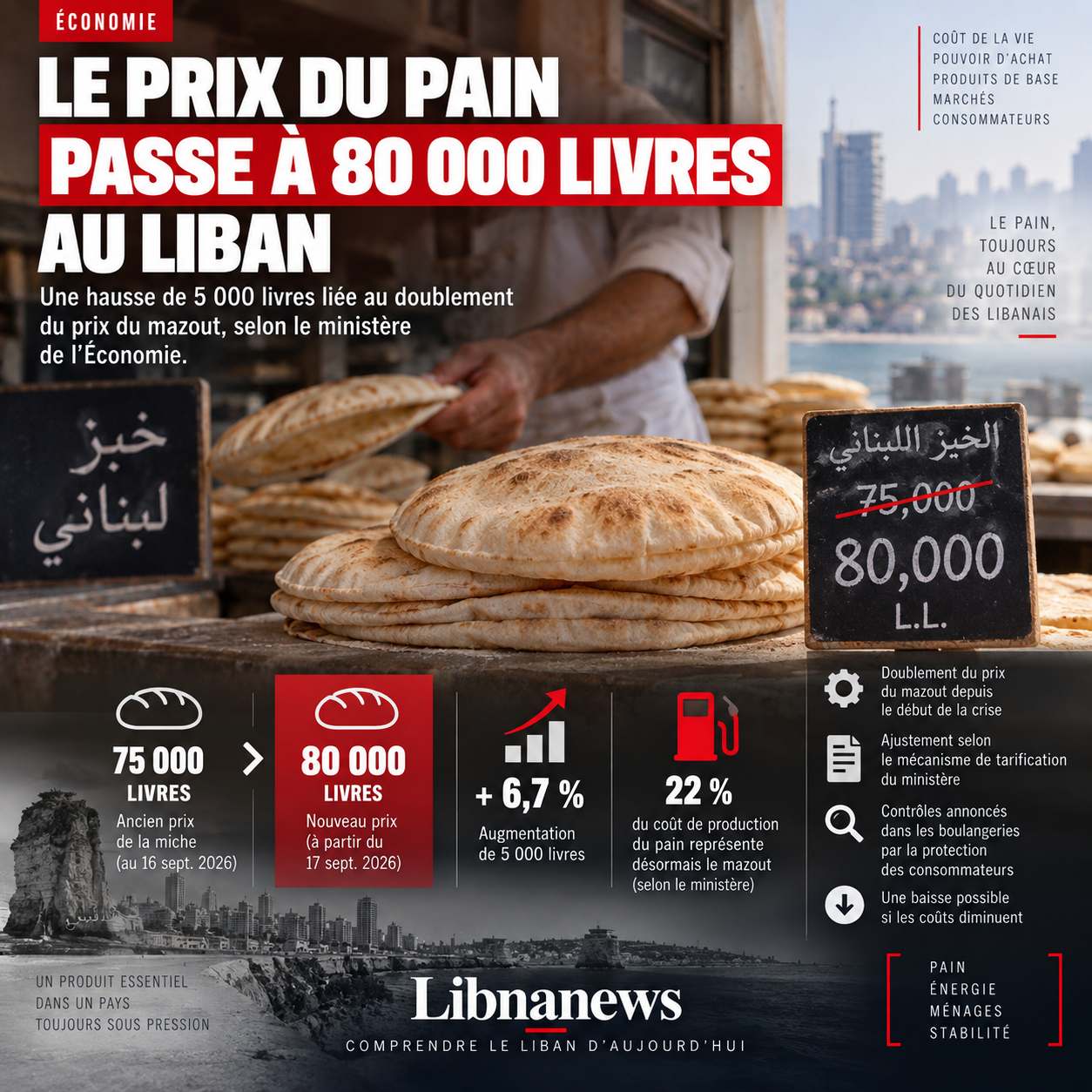
The price of bread increased by 5,000 Lebanese pounds from 17 September 2026. The Ministry of Economy and Commerce has set the price of medium-sized white Lebanese bread miche at £80,000, compared with £75,000 previously. This 6.7% increase comes after the doubling of fuel oil prices since the beginning of the crisis mentioned by the ministry. Fuel now accounts for about 22 per cent of the cost of producing bread.
The decision affects a daily consumer product and takes place in a context where bakeries bear an increase in their operating costs. The department states that it has applied the pricing mechanism used for several years. It periodically re-evaluates the official price on the basis of the actual cost of the various components necessary for the manufacture and distribution of bread.
The price of bread increased by 6.7%
The change announced relates specifically to the medium-sized white Lebanese loaf of bread sold in the bakeries’ shops. Its price rose from £75,000 to £80,000, an additional £5,000. Compared to the previous tariff, the increase was about 6.7%.
The Department presents this revision as an adjustment to maintain the continuity of production and the availability of bread in the market. However, it recognizes that any increase in the price of this product adds an expense to household budgets, already facing difficult living conditions.
The measure therefore does not, according to the official explanation, result from an arbitrary change in the tariff. It follows from the formula used by the administration to monitor the evolution of costs. The final price must therefore reflect changes in the main expenses borne by bakeries.
This logic is particularly important for Lebanese white bread, the price of which remains framed. Unlike a product whose tariff is freely fixed by each seller, the product concerned is subject to an official price. Bakeries and outlets must therefore comply with the amounts set out in the current tariff.
Oil accounts for 22% of the cost of production
The department’s focus is on fuel oil. Its price has doubled since the beginning of the crisis mentioned in the press release. This fuel represents about 22% of the cost of producing bread. The increase in the cost of the ovens is therefore directly related to the costs of operating the ovens and, more broadly, to the expenses of the bakeries.
The effect is not limited to fuel. The department also reported an increase in other production costs, without detailing their respective trends in its announcement. These cumulative increases increased the cost of producing a miche and maintaining the facilities in operation.
However, the 22% share of fuel oil is used to measure the weight of energy in the decision. For bakeries, a significant change in this expenditure quickly affects the cost of operating. According to the Department, the new price of £80,000 is intended to absorb part of this increase while avoiding disruption of supply.
The challenge posted by the authorities is to keep the bread available in the bakeries. The Department considers that the old tariff no longer reflected the current level of expenses. It therefore considers that a limited adjustment had become necessary to enable producers to continue their business under current cost conditions.
Pricing to evolve with costs
The department insists on another point: the pricing mechanism must operate in both directions. An increase in charges may lead to an increase in the official price, but a fall in costs must also lead to a downward revision.
The administration thus undertakes to review the tariff if production costs decrease. It states that it will reduce the price when conditions permit, in accordance with the mechanism already applied before. The retention of the 80,000 pounds is therefore not presented as definitive, but as the result of the current cost structure.
This precision places the evolution of fuel oil at the centre of the next revisions. If its price declines significantly enough, its weight in the calculation could help to lower the price of the miche. Conversely, any further increase in the main production components could put additional pressure on pricing.
The mechanism thus aims to link the price paid by the consumer to the expenditure actually incurred by the sector. However, the department did not announce a specific schedule for the next review. This will depend on the evolution of the parameters taken into account in the official formula.
Controls announced in bakeries
The increase in prices is accompanied by a monitoring mechanism. The Consumer Protection Directorate is continuing its market and bakery inspections to verify compliance with the official tariff. These operations must also enable the detection and punishment of possible infringements.
For consumers, the reference amount is now 80,000 pounds for medium-sized white miche purchased directly from bakeries. Compliance with the official price thus becomes one of the main monitoring points after the new pricing takes effect.
Control is of particular importance when changing prices. A formal change may create differences between the posted rates, the old grids still visible and the amounts actually claimed. Inspections must limit these differences and ensure uniform application of the decision.
The Consumer Protection Directorate is responsible for monitoring this implementation. The Ministry explicitly links these controls to two objectives: to preserve market organization and to protect consumer rights. The administration wants to prevent the official increase of £5,000 from being used as a justification for increases not provided for in the tariff.
An immediate extra cost for households
For a unit purchase, the difference seems limited to £5,000. But the effect becomes more visible for households that buy bread frequently. Ten pieces now represent an additional expenditure of £50,000 over the previous price. Twenty bucks are an extra 100,000 pounds.
This increase occurs on an essential product, which explains the particular sensitivity of any tariff change. The Ministry itself highlights the additional weight imposed on citizens. However, it justifies the decision by the need to maintain production and avoid supply difficulties due to pricing which has become insufficient to meet costs.
The new grid is therefore a trade-off between two immediate constraints: to contain the expense borne by consumers and to cover enough the expenses of bakeries to preserve the manufacture of bread. At this stage, the ministry favours an increase of £5,000 and maintains the principle of a future correction if costs decrease.
The evolution of fuel oil will now be one of the indicators to follow. With an estimated 22% of the cost of production, any significant change in its price may alter the balance of pricing. The next checks will have to check that the 80,000 pound switch is applied in accordance with the official price and without unjustified increases.