





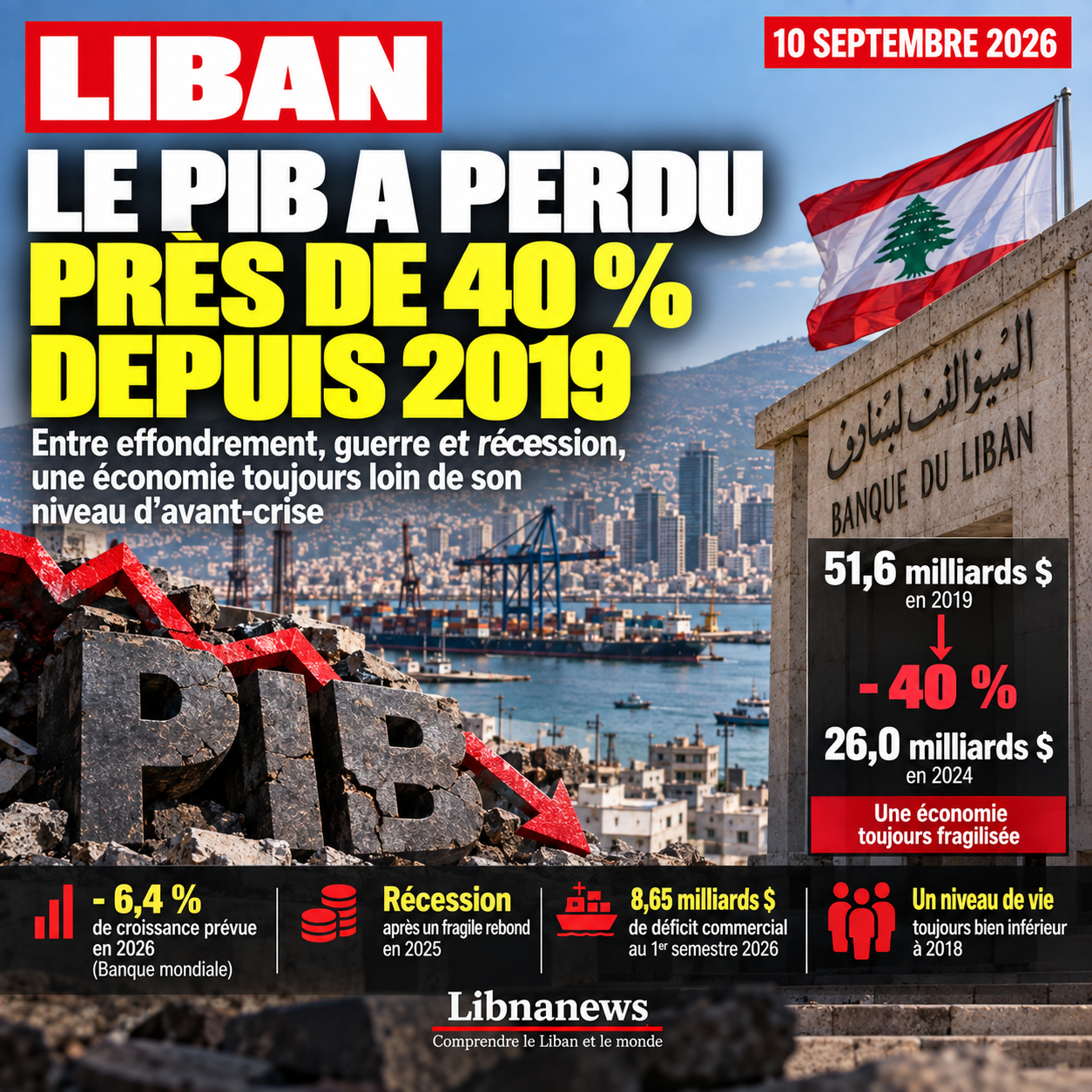
Seven years after the beginning of the financial crisis, the Lebanese economy remains far from its pre-crisis level. Nominal GDP, expressed at current prices and converted into dollars, rose from $51.6 billion in 2019 to $20.1 billion in 2023, before rising to nearly $26 billion in 2024. But this nominal upturn does not mean that the country produces more: real GDP in volume fell by 7.1% in 2024. After an estimated rebound of 4.2 per cent in 2025, the World Bank forecasts a further real contraction of 6.4 per cent in 2026 as a result of the conflict. The distinction between nominal and real GDP is therefore essential to understand an economy where devaluation, inflation and dollarization can raise the dollar value without restoring lost output.
Nominal GDP and real GDP: two measures, two questions
Nominal GDP measures the value of all final goods and services produced in one year at the same year’s prices. It answers a question of monetary size: how much is the economy worth at current prices? In Lebanon, this measure has been particularly volatile since 2019, as prices have exploded into pounds and the exchange rate used to convert this production into dollars has changed dramatically. A rise in nominal GDP may therefore be due to higher prices, a change in monetary conversion or a real increase in output — often a combination of the three.
On the contrary, real GDP seeks to isolate the quantity actually produced. Statisticians keep prices constant so that the increase in the price of a meal, a medical consultation or a service is not counted as an increase in output. If a restaurant serves exactly 100 meals a year and then 100 meals a year, but the average price doubles, its nominal activity doubles while its actual activity remains unchanged. At the country level, the principle is the same.
This distinction explains the paradox of 2024. Lebanon’s nominal GDP rose from about $20.1 billion in 2023 to $26.0 billion in 2024, or almost 29 per cent increase in current dollars. Yet the World Bank estimates that real GDP has declined by 7.1 per cent. Lebanon therefore did not produce 29 per cent additional goods and services. The increase in nominal value largely reflects the effects of price, dollarization and conversion, while the volume of economic activity continued to decline.
From $51.6 billion to an amputated economy
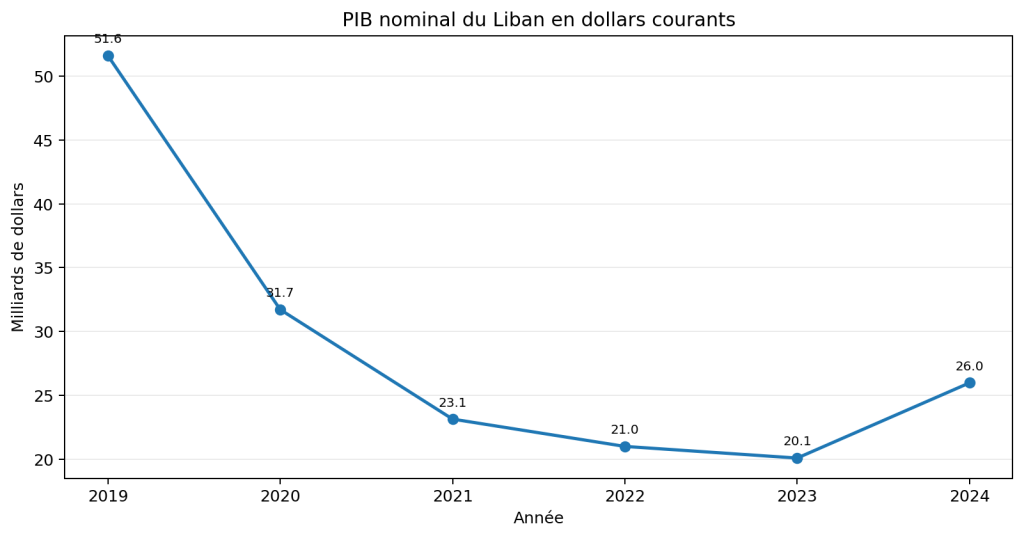
Nominal GDP in current dollars. Source: World Bank, WDI.
In 2019, Lebanon’s nominal GDP was $51.6 billion. It fell to 31.7 billion in 2020, then 23.1 billion in 2021, 21.0 billion in 2022 and 20.1 billion in 2023. Between 2019 and 2023, the current value in dollars decreased by approximately $31.5 billion, or 61%. This dramatic fall reflects both the collapse of activity and the collapse of currency. It should therefore not be equated with a real contraction of 61 %.
To measure production loss, the actual series is more relevant. Real GDP had already fallen by 6.9% in 2019, 21.4% in 2020 and 7.0% in 2021. The contractions of 0.6% in 2022, 0.8% in 2023 and 7.1% in 2024 prolonged depression. By re-establishing an index based on World Bank growth rates, with 2018 equal to 100, the level of production fell around 62 in 2024. In other words, the economy then produced nearly 38% less than in 2018.
The 2025 rebound only partially corrected this loss. The latest World Bank estimate places real growth at 4.2 per cent, bringing the index to around 65. The 6.4% contraction expected in 2026 would bring it back to 61. At this level, the Lebanese economy would remain around 39% below its 2018 level. This calculation is a reconstructed index based on annual changes, not a new official estimate of GDP.
Why nominal GDP can rise during a recession
The Lebanese case particularly illustrates the limits of GDP in current dollars. After the collapse of the pound, an increasing share of private prices and revenues was directly denominated in dollars. The stabilization of the exchange rate around a new level then made statistical conversions less erratic. As a result, the nominal value of many services was raised in dollar terms without regaining its pre-crisis level.
Inflation produces the same effect. Suppose that an economy produces only ten units of a good sold $10: its nominal GDP is $100. The following year, it produced only nine, but the price rose to $15. Nominal GDP rose to $135, an increase of 35%, while real output fell by 10%. It is precisely to avoid confusing prices and quantities that economists use real GDP to measure growth.
This distinction does not render nominal GDP useless. It remains essential to compare certain financial aggregates with the weight of the economy: debt, tax revenues, bank deposits or public expenditure are often related to nominal GDP. It also gives an indication of the monetary size of the market. But to answer the question « Does Lebanon produce more than before? », real GDP must prevail.
A depression that begins with financial collapse
The trajectory since 2019 does not correspond to an ordinary recession. The banking system ceased to return deposits normally, credit collapsed and the pound lost most of its value. The Covid-19 and the explosion of the port of Beirut on 4 August 2020 hit an economy already in crisis. The year 2020 remains the most violent shock, with a real contraction of 21.4%.
Gradual stabilization from 2022 did not replenish the growth engines. The economy has adapted through dollarization, cash, diaspora transfers and tourism. This has enabled trade and services to function, but it has not replaced a banking system capable of turning savings into credit for investment. Companies finance their projects more from own funds, which mechanically limits the size and number of possible investments.
The weakness of investment is one of the most serious consequences of the crisis. Without normal bank credit, without significant public investment and with high political and security uncertainty, the country is less quickly renewing its equipment and infrastructure. The loss of GDP is therefore not only a temporary decline in demand, but also reflects a deterioration in productive capacity.
2025: a real rebound, but very insufficient
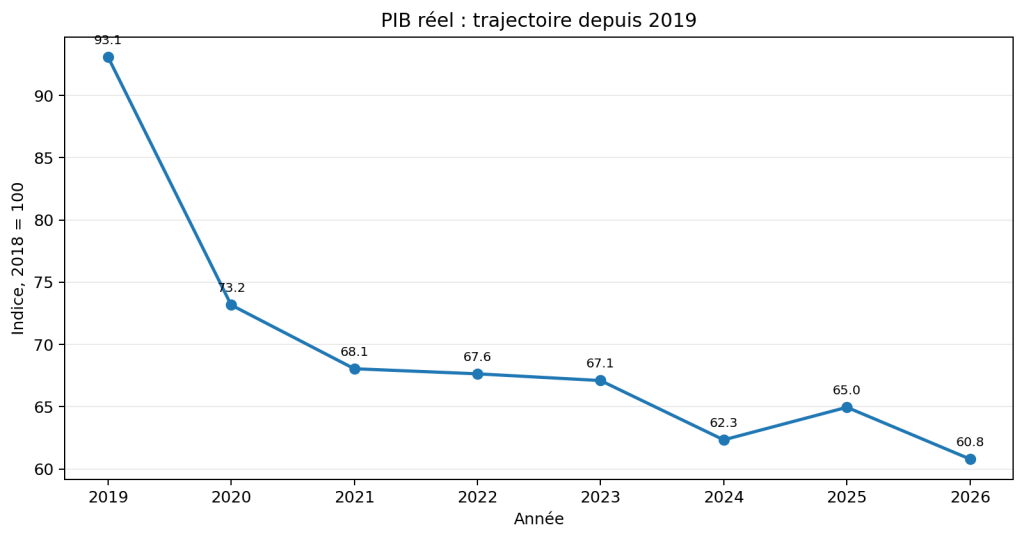
Rebuilt real GDP index, base 2018 = 100. 2025: estimate; 2026: forecast.
The year 2025 was the first net improvement since the beginning of the crisis. The World Bank revised its latest estimate of real growth to 4.2 per cent in its summer 2026 report. The rebound was based on higher consumption, tourism, investment and an improvement in several activity indicators. He confirmed that such a compressed economy could rebound quickly as security and political conditions improved.
But a 4.2% growth after a cumulative loss close to 40% is not a return to the starting point. The percentages are not symmetrical: an economy that falls from 100 to 60 loses 40 per cent, but then has to increase by 66.7 per cent to 100. Lebanon faces this unfavourable arithmetic. Even several years of growth at 4% or 5% would not be enough to quickly clear the losses accumulated since 2019.
2026: War stops GDP reconstruction again
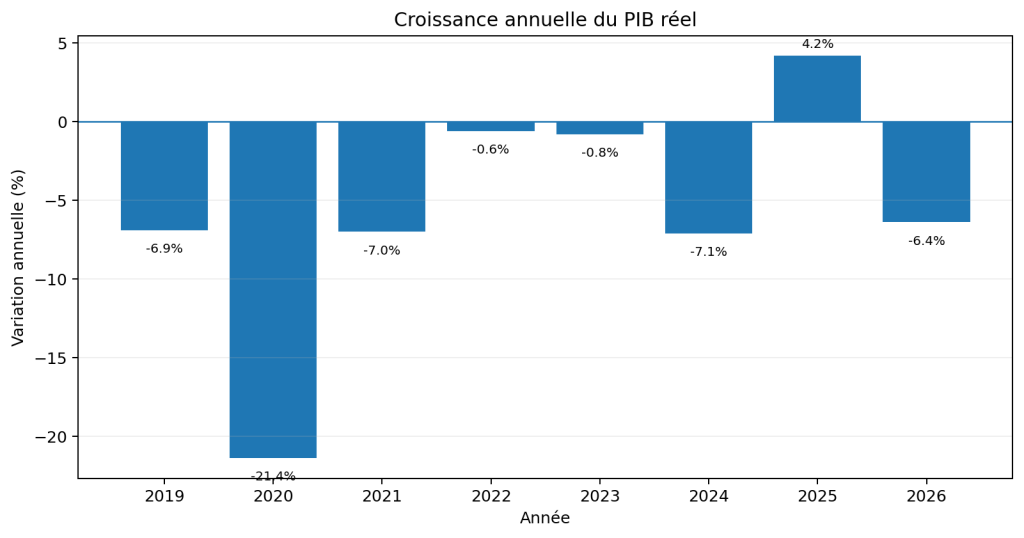
Annual real growth. 2025: revised estimate; 2026: forecast.
The new escalation of March 2026 interrupted this movement. The World Bank now forecasts a real contraction of 6.4 per cent in 2026. It estimates that the conflict reduces about 10.4 growth points from a war-free scenario, mainly through declining tourism revenues and private consumption. The destruction of housing and infrastructure, population displacement and logistical disruptions also affect the capital stock and therefore the potential for future growth.
The shock comes when inflation is expected to average 17.5% by 2026. This combination again illustrates the difference between nominal and real: prices can continue to rise as the quantity of goods and services produced declines. For households, this is the most unfavourable pattern: less economic activity and a higher cost of living.
Per capita GDP confirms loss of wealth
The nominal GDP per capita supplements the table. According to the World Bank, it reached approximately $8,906 in 2019, before falling to $5,561 in 2020, $4,045 in 2021, $3,654 in 2022 and $3,478 in 2023. It was about $4,473 in 2024. This increase does not mean, again, that the real standard of living has risen in the same proportions: inflation, the exchange rate and the very uneven distribution of income significantly alter what this amount actually allows to buy.
Moreover, GDP per capita is not an average wage. It divides national production by the population and does not say anything on its own about how this wealth is distributed. Two countries with the same per capita GDP may have very different levels of poverty and inequality. In Lebanon, the indicator is mainly used to show the extent of the reduction in the available economic base per resident since the crisis.
Restoring the pre-crisis level will require more than just a tourist rebound
The central question, therefore, is not only to return to positive growth. Lebanon must rebuild the mechanisms that allow this growth to continue: banking restructuring, settling the issue of deposits, returning credit, financing reconstruction, infrastructure, electricity and a credible fiscal framework. Tourism and diaspora transfers bring currency and support consumption, but they alone cannot replace productive investment.
The trajectory of GDP since 2019 shows two superimposed crises. The first is nominal and monetary: the collapse of the pound, inflation and a sharp reduction in the value of the economy converted into dollars. The second is real: closure of businesses, decline in investment, destruction of capital and a sustained decline in the quantity of goods and services produced. The rise in nominal GDP since 2023 should not mask the second.
Future estimates will refine the cost of the 2026 conflict. To measure a real exit from the crisis, however, the decisive indicator will remain real GDP: as long as price-adjusted output does not progress sustainably for several years, an increase in nominal GDP in dollars can give a normalization image without meaning that the Lebanese economy has recovered the wealth lost since 2019.
The illusion of standardization
The rise in nominal GDP, exchange rate stability and dollarization now give a sense of normalisation which must be distinguished from a genuine economic recovery. Shops work, restaurants can be full, some private wages are paid back in dollars and prices have become more predictable than at the height of the crisis. These signs are real. They show that the economy has adapted to the monetary collapse. They do not mean that it has recovered production, investment and wealth lost since 2019.
An economy can stabilize after a sharp contraction. This is precisely what happened in Lebanon. Households reduced or changed their consumption, businesses adjusted their costs and part of the activity moved to cash and the fresh dollar. The stability of the exchange rate around a new level does not re-establish blocked deposits, lost real wages or missing businesses. It mainly prevents the depreciation-inflation mechanism from producing the same shocks as between 2019 and 2023.
This difference explains why visible activity can give a more favourable image than national accounts. Consumer and service sectors can rebound rapidly with diaspora and tourism dollars. They often require less long-term financing than a factory, a real estate project or an infrastructure. Thus, a lively shopping street alone is not an indicator of the reconstruction of productive capacity.
Missing bank restructuring holds growth
The main structural obstacle remains the banking system. Since 2019, the old deposits have remained largely fixed and the accumulated losses between the State, the Bank of Lebanon and commercial banks have not yet been distributed as part of a completed restructuring. Banks continue to provide services, but they no longer provide the necessary scale of their central economic function: to collect savings and turn them into credit for households and businesses.
The effect on potential GDP is direct. An SME wishing to buy a machine, expand a workshop or finance a large stock must rely heavily on its own funds, an investor or external financing. A profitable but insufficiently capitalised company can therefore abandon a project that a normal banking system would have financed. Repeated on a scale of thousands of firms, these decisions reduce investment, productivity gains, job creation and ultimately production.
The same mechanism affects households. Real estate credit, financing of equipment and part of consumer credit remain well below their pre-crisis level. Demand is more dependent on current income and available dollars. This situation favours those who already have liquidity and penalizes new investors. As long as the issue of bank losses and deposits is not resolved in a credible manner, it remains difficult to restore confidence and bring savings back into the banking system on a sustainable basis.
Cash economy favours services, less heavy investment
The model that emerged since the crisis mechanically favours activities capable of operating with immediate payments and relatively limited capital requirements. Restoration, trade, personal services and tourism can quickly benefit from the dollars brought by the diaspora. They support employment and activity, but they do not replace the investments needed for a more productive economy.
Industry, modernised agriculture, housing and infrastructure require financing in the medium to long term. An industrial enterprise must buy machinery, finance buildings and immobilize working capital. A farmer who wants to increase his productivity must invest in irrigation, storage and equipment. Without credit, these investments must be financed almost entirely at the outset, which greatly reduces the number of actors able to undertake them.
This constraint helps explain why Lebanon can experience periods of dynamic consumption without regaining strong real GDP growth. Cash allows the economy to function; It replaces much less the mechanism of accumulation of capital which allows for a lasting increase in production.
Electricity, Infrastructure, State and Human Capital: Other Blockages
The financial system is not the only obstacle. The cost of electricity remains high for companies combining public grids, generators and solar investments. Transport infrastructure and several public services have suffered long years of underinvestment. These costs reduce project profitability and reduce Lebanon’s competitiveness in the face of economies where energy, logistics and financing are more predictable.
At the same time, the State has a limited margin to compensate for weak private investment. The needs relate simultaneously to public sector salaries and pensions, infrastructure, health, education, security and reconstruction. Public investment therefore remains constrained while it should restore part of the physical capital destroyed or degraded since 2019.
Emigration adds a less visible loss. Doctors, engineers, teachers, executives and young graduates who left since the beginning of the crisis sometimes send transfers that support consumption and foreign exchange reserves. But their departure simultaneously reduces the available human capital. The diaspora thus helps the economy to hold while reflecting a brain drain that can reduce its growth potential.
Why a few years of rebound won’t be enough
The 4.2% growth estimated in 2025 showed the rebound capacity of a highly compressed economy. It does not mean that the crisis was over. The percentages are asymmetric: an economy that falls from 100 to 60 loses 40%, but then needs to grow by 66.7% to recover 100. From a real level close to 61 after the contraction expected in 2026, several years of strong growth would be needed to return to the pre-crisis level.
The problem is therefore twofold. Lebanon must return to growth, but also change its composition. A recovery driven mainly by consumption, tourism and transfers remains vulnerable to security crises and seasonal variations. Sustainable growth requires more productive investment, exports, credit, infrastructure and productivity gains.
It is in this sense that the rise in nominal GDP should be interpreted with caution. It shows a monetary appreciation of activity and an adaptation to dollarization. It does not demonstrate that the economy has repaired its financing mechanisms or regained its productive capacity. The real test remains real GDP, but also the country’s ability to transform savings into investment and maintain growth for several years.
Summary table
| Year | Nominal GDP ($ billion) | Real growth | Real Index (2018=100) |
| 2019 | 51.6 | -6.9 % | 93.1 |
| 2020 | 31.7 | -21.4% | 73. 2 |
| 2021 | 23.1 | -7.0 % | 68.1 |
| 2022 | 21.0 | -0.6 % | 67.6 |
| 2023 | 20.1 | -0.8 % | 67.1 |
| 2024 | 26.0 | -7.1 % | 62. 3 |
| 2025 | n/a. | +4.2 % | 65.0 |
| 2026 | n/a. | -6.4 % | 60.8 |
Note: WDI nominal GDP is available until 2024. Growth 2025 is the revised estimate published in August 2026; 2026 is a forecast.
References and links
World Bank, World Development Indicators — Lebanon nominal GDP and real growth, 2019-2024 data: https://databank.worldbank.org/reports.aspx?country=LBN&source=2
World Bank, Lebanon Economic Monitor, summer 2026 — A Conflict-Torn Economy: https://www.worldbank.org/en/news/press-release/2026/08/21/renewed-conflict-derails-lebanon-s-fragile-economic-recovery
World Bank, full report Lebanon Economic Monitor, summer 2026: https://documents.worldbank.org/en/publication/documents-reports/documentdetail/099613508202629849
World Bank, selected data on Lebanon — real growth and GDP per capita: https://thedocs.worldbank.org/en/doc/7210a1bcbdc24a6d73c62228ee1e3e70-0500042021/related/data-lbn.pdf