






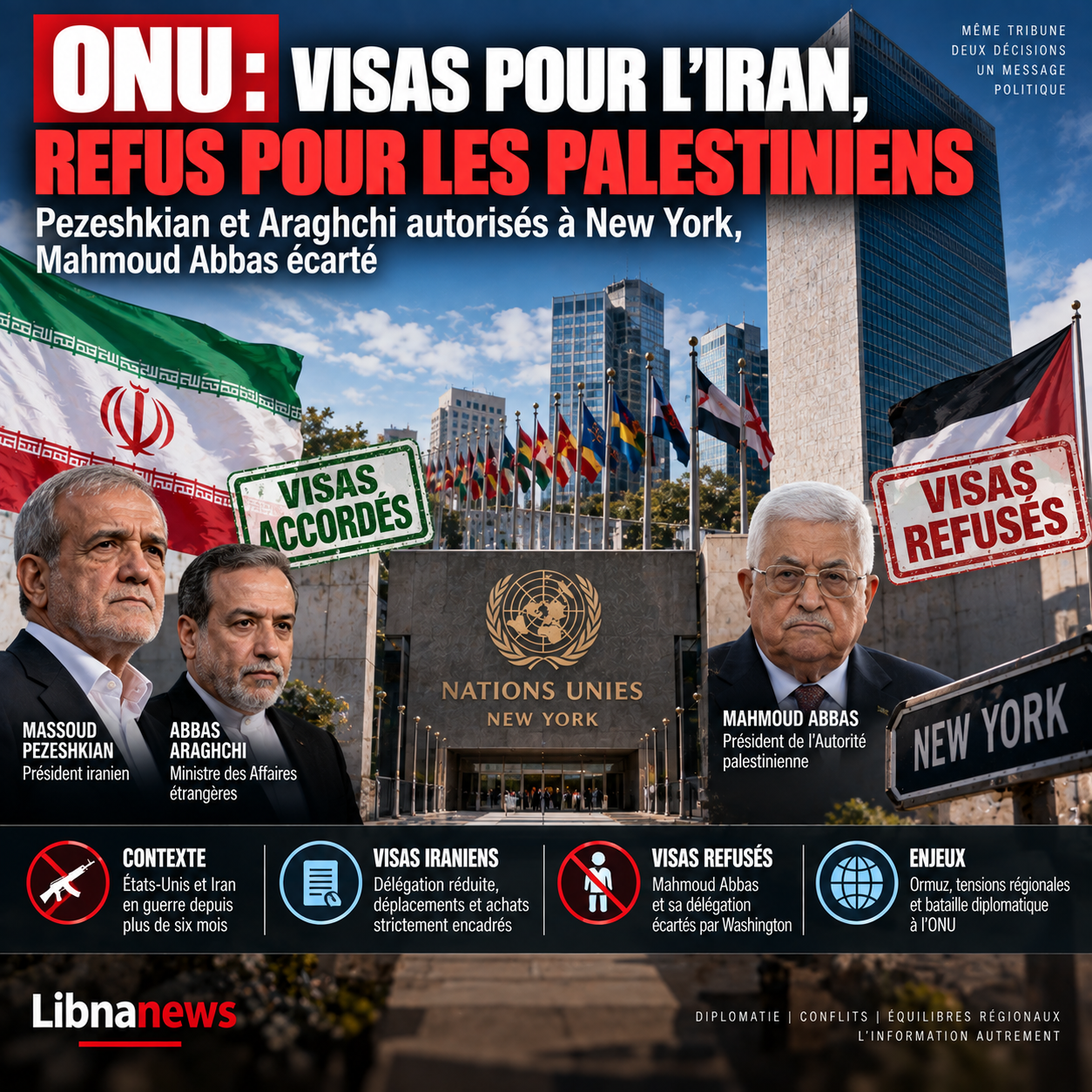
Donald Trump’s administration has authorized Iranian President Massoud Pezeshkian, Foreign Minister Abbas Araghchi and a small delegation to New York for the UN General Assembly. The decision comes when the United States and Iran have been at war for more than six months. It contrasts, above all, with the one taken by Washington the previous day: Palestinian President Mahmoud Abbas and his delegation were denied visas to participate in the same diplomatic meeting.
Washington opens UN to Iranian leaders
On Thursday, 17 September, the U.S. State Department announced that it had approved the visas of the Iranian « main delegation » and the staff required for its participation in the high-level week of the General Assembly.
This delegation includes Massoud Pezeshkian and Abbas Araghchi. However, it will be smaller than that sent by Tehran the previous year.
The decision is particularly notable because of the state of relations between Washington and Tehran. Both countries have been engaged for more than six months in a conflict that has still not been resolved diplomatically.
There is currently no agreement on two key issues. The first concerns the Strait of Ormuz and the conditions for a return to normal maritime traffic. The second concerns a possible resumption of negotiations on the Iranian nuclear programme.
The presence of Pezeshkian and Araghchi in New York therefore does not mean that Washington is relaxing its policy towards the Islamic Republic.
US sanctions remain in force. The US authorities also continue to regard Iran as a State supporting terrorism. Washington has also launched in recent weeks a new campaign to cut off what it presents as essential financial circuits for Tehran.
Iranian Visas: obligations related to UN headquarters
To justify the authorization granted to Iranian officials, the State Department invoked US obligations as host country of the United Nations headquarters.
The United States has particular flexibility with regard to foreign delegations visiting the headquarters of the international organization in New York. This situation does not prevent them from imposing certain restrictions.
Washington announced that Iranian officials would remain subject to travel restrictions during their stay. They will also be subject to restrictions on the purchase of luxury and other goods.
Previous Iranian delegations had already been subject to strict rules. Their travel to New York was highly restricted around the United Nations headquarters, the Iranian mission and the authorized locations.
Iranian officials had also been prevented from making certain purchases, particularly in American wholesale brands accessible by membership.
This year, Washington adds another limitation: the delegation authorized to enter the United States will be smaller than that of 2025.
Mahmoud Abbas deprived of a visa for the same General Assembly
The contrast is all the more marked since the announcement concerning Iran comes only one day after an opposing decision concerning the Palestinians.
The Trump administration refused the visas requested by Palestinian Authority President Mahmoud Abbas and members of his delegation to participate in the General Assembly.
Washington thus allows the highest officials of a country with which the United States is directly at war to travel to New York, while refusing to join the Palestinian political delegation led by Mahmoud Abbas.
The State Department, however, provides separate foundations for both decisions.
In the Iranian case, Washington highlighted its host country obligations and authorized a small delegation, under heavy constraints.
With regard to the Palestinians, the United States administration blamed the Palestinian Authority, inter alia, for its actions before international courts and its policy of payment of allowances for Palestinians detained by Israel.
The United States also accuses the Palestinian Authority of seeking to « internationalize » the Israeli-Palestinian conflict, including through its appeals to the International Court of Justice and the International Criminal Court.
The Trump administration believes that these steps are incompatible with the commitments it expects from the Palestinian leadership in the context of a negotiated settlement with Israel.
Two different statutes at the United Nations
Differences in treatment also occur within a particular legal and diplomatic framework.
The United States does not recognize the Palestinian Authority as the government of a fully-fledged Member State of the United Nations. Palestine has non-member observer status with the United Nations.
Iran, on the other hand, has been a Member State of the United Nations since 1945. His delegation therefore represented a full member of the United States-based organization.
This status does not remove all American restrictions. Washington has already restricted the travel of foreign officials and may, under certain circumstances, refuse visas or discourage certain applications.
But the current situation produces an unusual diplomatic image: Massoud Pezeshkian will be able to access the General Assembly while Mahmoud Abbas will not be able to physically return to it at the head of his delegation.
However, Palestinian representation at the United Nations is not abolished. Palestinian diplomats already accredited may continue to participate in the work of the organization.
Palestinian Authority denounces punitive measure
The Palestinian Authority condemned the US refusal and challenged Washington’s arguments.
It affirms its commitment to a negotiated political solution while defending its right to use international institutions to gain wider recognition of the Palestinian State and to challenge certain Israeli policies.
His Department of Foreign Affairs believed that the restrictions imposed on its officials did not promote peace or the fight against violence.
The Palestinian leadership also argues that these measures weaken actors in favour of a two-State political solution. At the same time, it accuses Israel of compromising this prospect through colonization, occupation and annexation projects.
Washington presents a different reading. The Trump administration has long criticized the Palestinian Authority for some of its policies and considers its international judicial actions against Israel as an obstacle to the diplomatic process it favours.
The dispute therefore goes beyond issuing visas alone. It affects the international status of Palestine, its diplomatic and judicial strategy and the conditions imposed by the United States on its relations with the Palestinian Authority.
Iranian delegation allowed despite war
However, the Iranian situation remains exceptional in its military context.
The United States and Iran are directly engaged in conflict, while tensions extend to the major maritime routes in the Middle East.
The Strait of Ormuz remains at the centre of the confrontation. The disruptions of shipping in this strategic area have contributed to tensions in global energy markets.
In the Red Sea, attacks by the Yemeni Houthis, supported by Iran, against Saudi infrastructure and commercial shipping also exacerbate the risks. Simultaneous difficulties on these two shipping routes contributed to the rise in world oil prices.
Despite this confrontation, Washington chose to allow Pezeshkian and Araghchi to defend Iran’s position directly before the United Nations.
However, no meetings with US officials were announced. Visa issuance is therefore not, at this stage, an indication of a resumption of bilateral dialogue.
Pezeshkian and Araghchi under heavy restrictions in New York
The high-level week of the General Assembly will nevertheless offer Iranian diplomacy a rare opportunity for international contacts in the same place.
Massoud Pezeshkian may present Tehran’s position before the Member States. Abbas Araghchi, for his part, will be able to increase meetings with his counterparts on the margins of official meetings.
These meetings can allow direct or indirect exchanges on the conflict, the Strait of Ormuz and Iranian nuclear power. However, there is no indication that they will lead to formal negotiations with Washington.
The American restrictions will also recall the special nature of this Iranian presence. Visas give Iranian leaders access to the work of the United Nations, but not a general freedom of movement in the United States.
The Trump administration thus maintains two decisions parallel to a few days before the opening of the New York rendezvous: a small Iranian delegation will be able to enter the United States despite the war, under strict restrictions, while Mahmoud Abbas and his Palestinian delegation will remain without visas.