





The army now directly targeted in the arm of the South
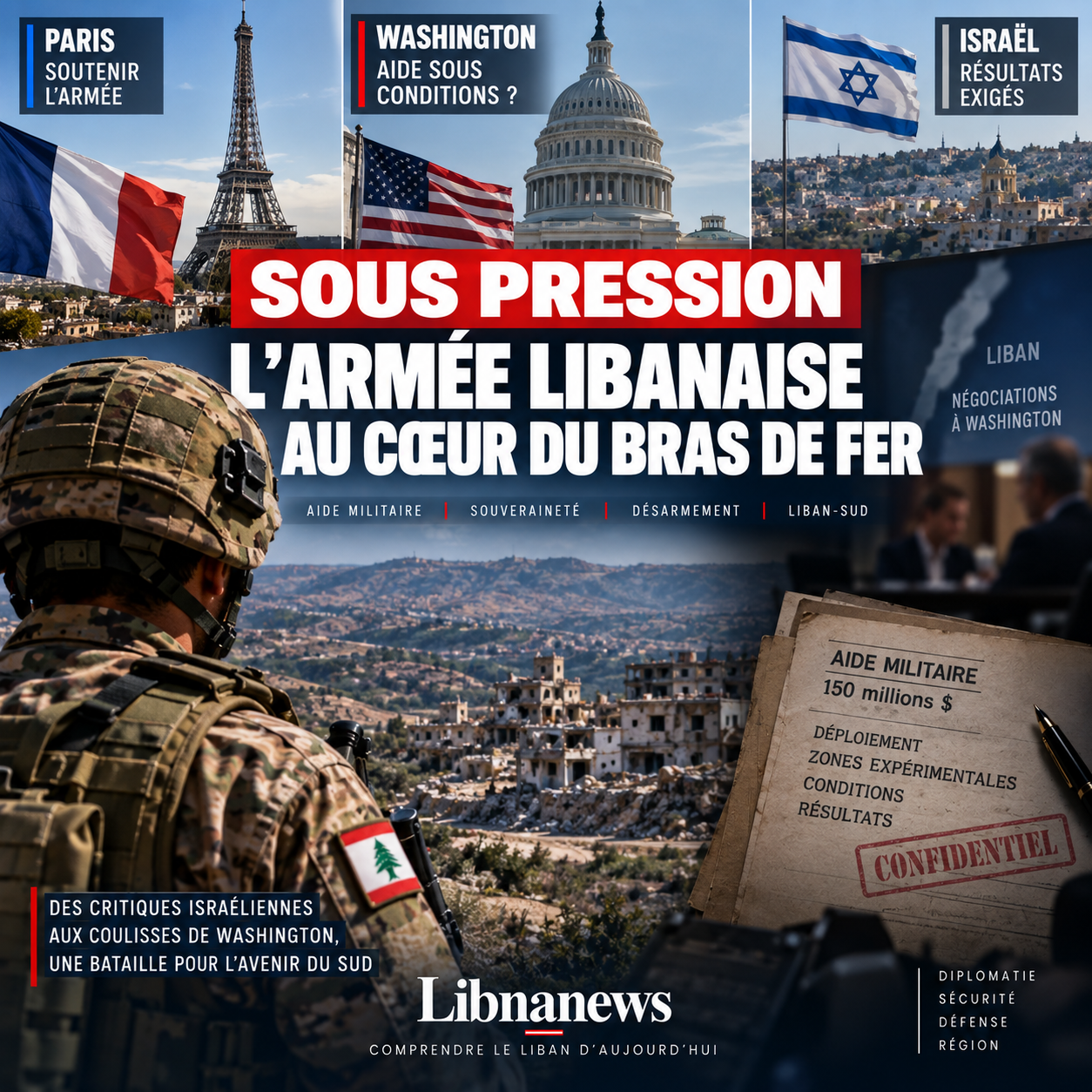
The debate on the disarmament of Hezbollah is shifting part of the pressure to another institution: the Lebanese army. Israel ‘ s statements to the Security Council have increased as Beirut seeks, on the contrary, to make it a central part of the security arrangements in South Lebanon. This confrontation occurs at a particularly sensitive moment. Paris brings together Lebanon’s partners to prepare lasting support for the military institution. Washington continues to mediate between Lebanon and Israel. In the field, the so-called experimental areas must be used to test an increased deployment of the army. Yet there is a growing divergence of opinion about his action.
Al Akhbar of 17 September 2026 reports that Israeli Chief of Staff Eyal Zamir believes that the Lebanese army does not appear willing or capable of disarming Hezbollah. This declaration comes as negotiations between Beirut and Israel remain blocked on the order of action to be taken. Lebanon calls for a halt to Israeli operations and withdrawal before taking further steps. Israel links its own movements to progress on the issue of arms and the effective authority of the State.
Ad Diyar of 17 September 2026 describes a broader campaign. According to sources cited by the daily newspaper, Israeli intelligence reports transmitted to Washington reportedly accused the Lebanese army of conduct deemed insufficiently cooperative. The newspaper goes further by referring to renewed pressure in the US capital against the army command.
This last information is the most sensitive. It outlines the possible existence of a battle far beyond Israeli public statements. The real issue would then be whether the criticisms against the army are beginning to find relays within the American apparatus and whether they can influence the promised military aid in Lebanon.
Paris prepares support while Israel challenges results
The calendar places the army in a paradoxical situation. As Israel criticizes its action, France is organizing an international meeting to define its needs.
Nahar of 17 September 2026 publishes an interview with the Chief of Staff of the French Armed Forces Fabien Mandon. It presents the Lebanese army as an institution essential to the stability of the country. He says he has deep respect for his military and emphasizes their role in national unity. The Paris meeting is intended to identify the means needed to carry out larger missions, particularly with a view to the end of the Final.
But international support is no longer a matter of equipment. Fabien Mandon himself places state sovereignty and exclusive use of force at the centre of the debate. France therefore considers that the strengthening of the army must accompany the process of concentration of arms in the hands of the State.
The difference with Israeli critics lies mainly in method and timing.
Paris defends a progressive approach. According to the comments of Fabien Mandon published by Nahar on 17 September 2026, the question of sovereignty and the use of force requires a complex process based on the construction of trust. The French official warns against a multiplication of conditions that would make any progress impossible.
This formulation contrasts with Israeli pressure. Israel is calling for results on Hezbollah to justify further action on the ground. France believes that the institution responsible for producing these results should be strengthened at the same time.
The army thus finds itself between two reasonings. The first is to give it the means before demanding more. The second considers that its behaviour must first demonstrate its willingness to act before aid and concessions can follow.
Zawtar, first confrontational terrain
Differences already appear in experimental areas.
Ad Diyar of 17 September 2026 reports that the case of Zawtar al-Gharbiyah provoked Israeli objections after the deployment of the army and the return of the inhabitants. According to daily reports, Israel estimated that Hezbollah was returning indirectly to the locality. Criticism reportedly included the activity of the Islamic Health Association and the presence of some residents considered close to the party.
The episode reveals a major problem for the army. If its mission is to prevent the presence of weapons and combatants, it can conduct control operations, search for deposits and secure the territory. If the requirement extends to the disappearance of any Hezbollah-related social organization or the return of citizens sympathetic to it, the nature of the mission changes.
The army would then be invited to intervene in a much larger political and social space.
Ad Diyar describes this development as one of the reasons for the new Israeli campaign. The newspaper believes that the aim would be to place the army in difficult conditions and then to present its action as insufficient.
The problem goes beyond Zawtar. If the same criteria are applied to the next experimental areas, each population return may give rise to a further challenge. The deployment of the army would no longer be sufficient to trigger the Israeli withdrawal. A positive assessment of the local political and social environment should also be obtained.
This issue will be crucial for the continuation of negotiations.
Israeli suspicion extends to the very role of the army
Ad Diyar of 17 September 2026 describes a more radical Israeli reading. According to the newspaper, the criticisms against the army would no longer focus solely on its effectiveness. They would gradually call into question its place in the future southern apparatus.
The daily links this campaign to discussions about a possible security zone and information about further Israeli redeployments. It considers that the objective would weaken the possibility of effective Lebanese control over the territories concerned.
This reading takes on a particular dimension with the announced end of the mission of the Finul. If the international presence decreases and the Lebanese army is simultaneously considered incapable of ensuring the security conditions required by Israel, the issue of land control will remain open.
Now Joseph Aoun defends exactly the opposite scenario. In his statements reported by Ad Diyar, Al Quds and Nahar on 17 September 2026, the president presented the army as the main instrument for the return of the state. The Israeli withdrawal must be followed by the deployment of the Lebanese military. Foreign support must be used to build that capacity. Any future international force must help the army rather than take its place.
The dispute is therefore now about the security model itself.
For Beirut, the solution lies in a stronger army and a progressive Israeli withdrawal. For Israel, the ability of this army to neutralize Hezbollah’s military presence determines the credibility of this model.
The question of command comes behind the American scenes
It is on this ground that the most explosive information published by Ad Diyar appears.
The newspaper of 17 September 2026 cites diplomatic sources referring to a renewed pressure in Washington against the army commander, who was presented by his critics as insufficiently cooperative with Israeli demands.
The newspaper does not give the identity of the American officials who would support such an approach. Nor does he mention a formal decision by Donald Trump’s administration against the Lebanese command. The information thus describes a pressure behind the scenes, not an American policy announced.
However, its importance lies in the context.
The United States is one of the main partners of the Lebanese Armed Forces. They also play a central role in negotiations with Israel. An Israeli campaign aimed at the military institution can therefore have far greater effects if it moves from Tel Aviv to Washington.
The question of financial support is already a confrontational one.
Al Jumhouriyat of 17 September 2026 reports that Washington links aid to the army to concrete advances in the arms monopoly. The newspaper mentions, among other things, a $150 million envelope that has not yet been released. According to the information published, US officials considered that the main obstacle to military action was not only lack of equipment, but also political decision-making.
France seeks to defend a different approach. Paris wants to advance support and measures on the ground simultaneously. The idea is to give the army the necessary capabilities while asking it to make progress in the implementation of state decisions.
Behind the Paris meeting thus appears a much deeper debate on the relationship between means and results.
« Not capable » or « not allowed »: the heart of disagreement
Criticisms of the army are based on two accusations that must be distinguished.
The first concerns his ability. Does it have the manpower, intelligence, equipment, surveillance and financing needed to control the South and borders in a sustainable manner?
The second concerns his will or mandate. Does the army receive the political instructions to go to the end of certain operations, especially when they can provoke confrontation with Hezbollah?
These two questions produce very different answers.
If the problem is material, the solution lies in international aid. The meeting in Paris then made sense. If the problem is political, the additional equipment will not suffice. The government will have to specify the tasks entrusted to the army and the limits of their execution.
Joseph Aoun tries to reconcile these dimensions. He claims that the decision to concentrate weapons in the hands of the State is taken. At the same time, it excludes a bloody confrontation inside the country. He wants to solve the file through dialogue.
This position means that the army will not necessarily be asked to impose immediately by force the whole process. It will have to move forward within a political framework defined by the authorities.
It is precisely this progressivity that seems to fuel some of the Israeli critics.
An institution between sovereignty and risk of internal confrontation
The Lebanese dilemma is particularly heavy. A confrontation between the army and Hezbollah would have difficult internal consequences to predict. But the lack of progress on the weapons issue can maintain Israeli pressure and slow down withdrawal.
Joseph Aoun thus presents the strengthening of the state as an alternative to confrontation. The aim is to gradually increase the capacity of institutions until they can fully fulfil their responsibilities.
This strategy takes time. Israel, on the contrary, calls for prompt guarantees.
The question of experimental zones then becomes central. They can be used to demonstrate that the army is capable of assuming new responsibilities without causing internal conflict. But if Israel considers that the presence of social organizations or Hezbollah supporters is enough to invalidate the experience, the demonstration becomes almost impossible.
The debate on the criteria for success thus joins the debate on the command of the army.
A military institution may be given the task of controlling arms. It cannot solve a political problem rooted in Lebanese society alone. To ask her to do so is to transfer to her a responsibility that is primarily the responsibility of the political authorities.
Washington becomes the arbiter of a battle that goes beyond military aid
The American position will be decisive.
The United States has several levers. They can maintain or change their support for the army. They can put pressure on Israel in the negotiations. They may also affect the pace of the experimental areas and the definition of the conditions necessary for withdrawal.
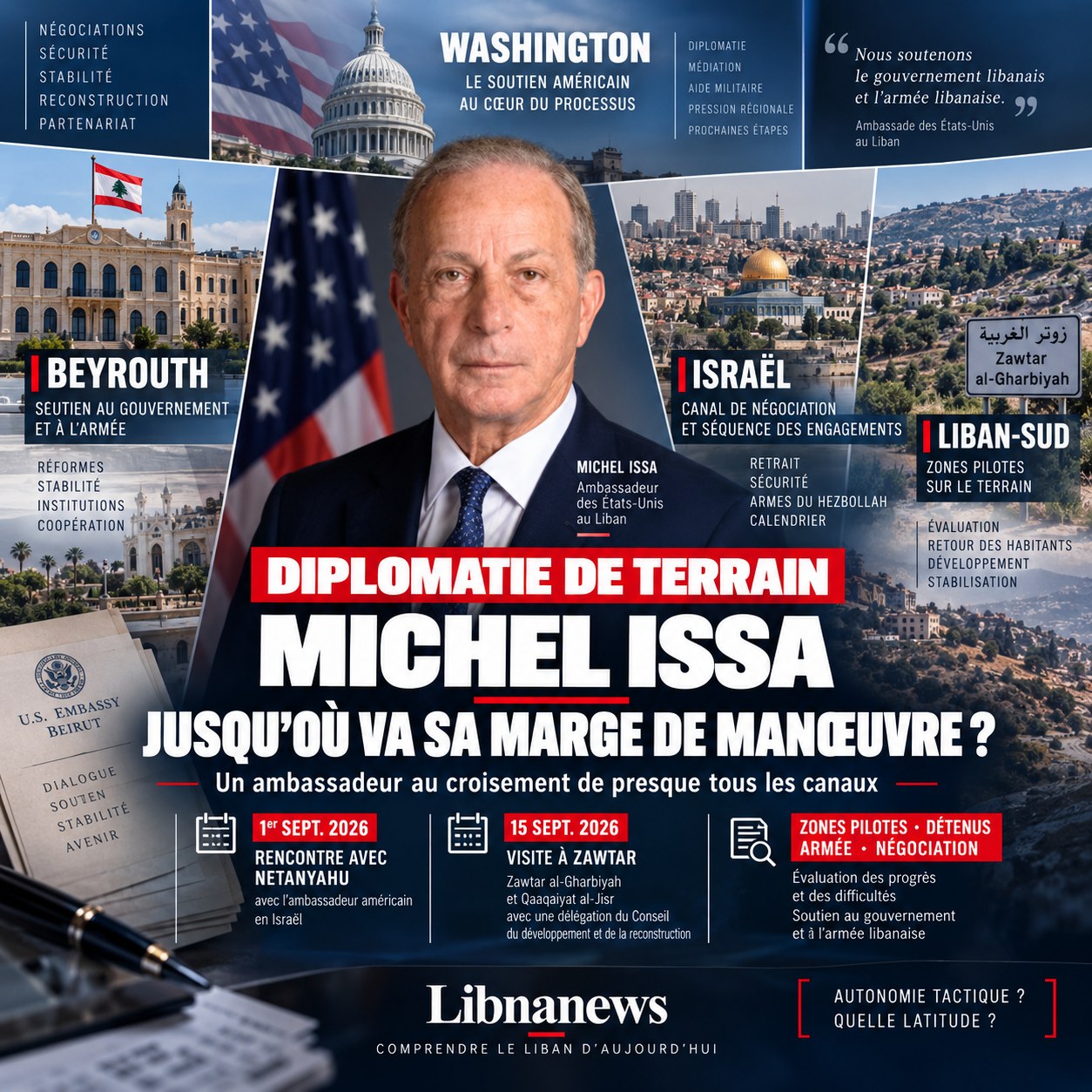
Ad Diyar of 17 September 2026 presents Ambassador Michel Issa as particularly active in this matter. His visit to Zawtar al-Gharbiyah illustrates this involvement. He directly observed the terrain while Washington received parallel Israeli assessments of the army’s action.
The American administration is therefore faced with two accounts.
The first presents the army as the institution indispensable for any lasting stabilization of Lebanon. This is the position publicly defended by Joseph Aoun and strongly supported by Paris.
The second stresses his alleged inability to prevent the return of Hezbollah and the need to condition aid for greater results.
The fate of American support will depend in part on the arbitration between these two readings.
The battle over the army announces that of the South Lebanon of tomorrow
The issue ultimately exceeds the person of the army commander or the amount of a military envelope.
If the Lebanese institution is seen as a credible partner, it can become the pillar of the security architecture that will gradually succeed the current situation. The Israeli withdrawal, the post-Final and the return of the inhabitants will then be able to organize around its deployment.
If its credibility is permanently challenged in Washington, the scenario changes. Israel could invoke its shortcomings to delay certain withdrawals or call for other security mechanisms. The conditions attached to foreign aid could also become more stringent.
The current campaign is therefore a battle over defining the future role of the army.
Paris wants to strengthen it to allow it to assume more. Joseph Aoun made it the guarantee of the return of the state. Israel calls for much faster results on Hezbollah. And, according to information published by Ad Diyar on September 17, 2026, this protest has now reached the backstage of Washington until it aimed at his command.
The next step will be to measure the real scale of this offensive. The level of support decided after Paris, the American attitude towards military aid and the treatment of the next experimental zones will show whether Israeli critics remain an instrument of pressure in the negotiations or whether they are beginning to change Washington’s policy towards the Lebanese army.